Our readers keep the lights on and my smoothie glass nicely filled. As an Amazon Associate, I earn from qualifying purchases.
Whether you are a journalist piecing together an interview, a musician capturing a live improvisation, or a filmmaker recording dialogue on a noisy set, the single most common frustration with portable audio recorders is losing a perfect take to distortion or a background hiss that ruins the track. Every digital audio recorder promises clarity, but the real difference lies in how the hardware handles dynamic range, noise floor, and preamp quality before the file ever touches your editing software.
I’m Mohammad Maruf — the founder and writer behind WellFizz. This guide comes from comparing seven top-tier models side-by-side, assessing their bit depth capabilities, microphone configurations, and build quality to separate the serious field recorders from the mediocre ones.
After hours of research comparing signal-to-noise ratios, input options, and real-world recording scenarios, I have compiled a definitive guide to finding the best digital audio recorder that matches your specific workflow and budget.
How To Choose The Best Digital Audio Recorder
Choosing the right recorder means balancing the kind of audio you capture, the environments you work in, and how much post-production work you want to avoid. The wrong choice can mean spending hours editing out hiss or losing a take to clipping.
Choose 32-Bit Float if You Hate Setting Gain
The biggest shift in portable recording is 32-bit float technology. It captures audio across a massive dynamic range, so you never have to set levels before an unpredictable sound source. If you record ambient sound, live music, or dialogue where volume can spike suddenly, this feature alone is worth prioritizing. Standard 16-bit or 24-bit recorders require careful gain staging to avoid clipping.
Match Inputs to Your Microphones
If you plan to use lavalier microphones, shotgun mics, or any professional XLR equipment, you need a recorder with XLR/TRS combo inputs and 48V phantom power. For basic dictation or recording lectures with the built-in mics, a recorder with a 3.5mm microphone input is perfectly adequate. The more inputs you have, the more versatile your recorder becomes, but also the larger and more expensive it gets.
Prioritize Preamp Quality and Noise Floor
The preamps inside the recorder determine the noise floor, which is the background hiss you hear in quiet passages. Recorders with ultra-low-noise preamps, like those from Zoom’s F series, produce cleaner audio when recording quiet sources like nature sounds or whispered dialogue. Always look for specifications that list the EIN (Equivalent Input Noise), with lower numbers being better.
Quick Comparison
On smaller screens, swipe sideways to see the full table.
| Model | Category | Best For | Key Spec | Amazon |
|---|---|---|---|---|
| Zoom F3 | Premium | Professional field recording with XLR mics | 32-bit float, dual XLR, -127dBu EIN | Amazon |
| Zoom H4 Essential | Premium | Musicians and podcasters with 4-track recording | 32-bit float, 19.4mm X/Y mics, 4 tracks | Amazon |
| Roland R-07 | Premium | Ultra-portable hi-res recording with Bluetooth | 96kHz/24-bit, Bluetooth, aptX playback | Amazon |
| OM System LS-P5 | Mid-Range | Lectures and interviews with 3-mic array | 96kHz/24-bit, 3 directional mics, Bluetooth | Amazon |
| TASCAM DR-05XP | Mid-Range | Entry-level field recording and audio interface | 32-bit float, USB-C interface, 125dB SPL | Amazon |
| Olympus WS-883 | Mid-Range | Simple dictation and lecture capture | Linear PCM, 8GB internal, 2080hrs recording | Amazon |
| Yorlu AI Recorder | Entry-Level | AI transcription and meeting summaries | 64GB storage, 30hr battery, 90 languages | Amazon |
In‑Depth Reviews
1. Zoom F3 Professional Field Recorder

The Zoom F3 is built for professionals who cannot risk a ruined take. Its ultra-low-noise preamps with an EIN of -127dBu deliver studio-quality audio even in uncontrolled environments. The 32-bit float recording means you never have to touch the gain knob, capturing everything from a whisper to a shout in a single file without clipping.
Two locking XLR/TRS combo inputs with 48V phantom power make it perfect for using shotgun or lavalier microphones on a film set. The recorder is compact enough to mount on a camera rig but rugged enough for outdoor field recording. Battery life exceeds six hours on two AA batteries, and you can power it via USB-C for longer sessions.
The menu system is simple and intuitive, with a clear display showing battery and card status. It lacks a 3.5mm mic input, so you are committed to XLR-only workflows, but for serious location recording, this is the purest tool available. It supports microSD cards up to 512GB for extended recording times.
Why it’s great
- Industry-leading preamps with -127dBu noise floor
- 32-bit float recording eliminates gain setting
- Dual locking XLR inputs with phantom power
- Compact and durable build for field use
Good to know
- No built-in microphones
- No 3.5mm input for consumer mics
2. Zoom H4 Essential Handheld Recorder

The Zoom H4 Essential upgrades the classic H4n formula with 32-bit float recording and the largest microphone capsule on any handheld recorder at 19.4mm. The built-in X/Y stereo mics capture a wide, rich stereo image perfect for music recording, podcasting, and ambient sound.
Two XLR/TRS combo inputs join the stereo mics for up to four tracks of simultaneous 192kHz WAV recording, making this a serious tool for musicians who want to record a live band or multi-mic podcast setup. Dedicated gain knobs give you tactile control, though with 32-bit float, you rarely need them for clipping protection.
The interface is straightforward, with a clear LCD and accessible menu buttons. It weighs only 243 grams and runs for about 20 hours on two AA batteries. The only trade-off is size—it is bulkier than pocket-sized recorders, but the expanded connectivity and sound quality justify it.
Why it’s great
- 19.4mm X/Y mics for detailed stereo capture
- 4-track simultaneous recording at 192kHz
- Two XLR inputs with phantom power
- 32-bit float prevents clipping
Good to know
- Larger than pocket-sized recorders
- Onboard mics are prone to wind noise
3. Roland R-07 High-Resolution Handheld Audio Recorder

The Roland R-07 is one of the most portable hi-res recorders on the market, smaller than an iPhone 6S, yet it records 96kHz/24-bit WAV and MP3 files with excellent clarity. Integrated stereo microphones deliver clean audio for interviews, ambient sound, and meetings without the bulk of larger field recorders.
Bluetooth connectivity sets it apart, allowing low-latency wireless monitoring and remote control via the Roland app. One-touch scene templates instantly configure the recorder for voice, music, or meeting scenarios, making it exceptionally beginner-friendly while keeping depth for advanced users.
It runs 30 hours on two AA batteries for playback and 16 hours for continuous recording. The built-in speaker is handy for quick checks without headphones. Some users report that USB bus power introduces noise, so battery operation is recommended for critical takes. The microSD slot accepts up to 32GB cards.
Why it’s great
- Ultra-portable pocket-sized design
- Bluetooth control and low-latency monitoring
- One-touch scene templates for instant setup
- Long battery life with 16 hours of recording
Good to know
- USB bus power can introduce noise
- No XLR inputs for professional mics
4. OM System Olympus LS-P5 PCM Recorder

The OM System LS-P5 packs three directional microphones—a left, right, and center array—into a body the size of a pack of gum. The tresmic system allows you to zoom in on a sound source, ideal for lecture capture where you need to isolate a speaker from room noise.
It records up to 96kHz/24-bit in WAV and FLAC formats, and includes Bluetooth for remote control and live audio streaming to your phone via the OM System app. The USB composite mode lets you use it as a high-quality microphone for a computer, making it dual-purpose for streaming or podcasting.
Battery life is around 24 hours of continuous recording on the included NiMH rechargeable batteries. It also supports AAA batteries as a backup. The built-in 16GB storage is ample for long sessions, and a microSD slot expands capacity. Some users note that Bluetooth only supports lower quality audio, so critical listening should be done via the headphone jack.
Why it’s great
- Three adjustable mics for directional recording
- Bluetooth remote control and live listen
- USB composite mode for streaming
- Ultra-compact and discreet design
Good to know
- Bluetooth audio quality is limited
- Micro-USB instead of USB-C
5. TASCAM DR-05XP 32-Bit Float Handheld Recorder

The TASCAM DR-05XP brings 32-bit float recording to a budget-friendly price point, making it the most affordable entry into clip-free recording. It records up to 96kHz/24-bit and supports MP3, giving you flexibility for different projects. The omnidirectional condenser microphones handle loud sources up to 125dB SPL without distortion.
It doubles as a 2-in/2-out USB-C audio interface, allowing direct recording to a computer or smartphone. This dual functionality makes it a great choice for podcasters or content creators who need a portable field recorder that also works as a desktop mic.
Battery life is around 17.5 hours on two AA alkaline batteries. The build feels solid, though some users report that the internal speaker is weak and the stereo separation on built-in mics is not as wide as dedicated stereo recorder. It supports microSD cards up to 512GB for massive storage without worries.
Why it’s great
- 32-bit float recording at an accessible price
- USB-C audio interface for computer recording
- Handles loud sources up to 125dB SPL
- Intuitive one-button recording operation
Good to know
- Built-in mics have average stereo separation
- Line input sensitivity requires careful preamp settings
6. Olympus WS-883 Digital Voice Recorder

The Olympus WS-883 is a straightforward voice recorder for dictation, lectures, and meetings, where ease of use matters more than advanced features. It records in Linear PCM and MP3 formats, with 8GB of internal memory plus a microSD slot for expansion, giving up to 2080 hours of recording time.
Its true stereo microphones with a low-cut filter help reduce background rumble, making speech clearer. The USB-A connector folds out directly from the body for easy file transfer without needing a cable. It runs on two AAA batteries with a 68-hour battery life, making it ideal for long conference days.
The interface is simple with a one-switch and two-button operation, perfect for users who do not want to dig through menus. Audio quality is good for voice but not designed for music or complex ambience. Some users report that auto power-off cannot be disabled, which may cut off longer silent moments if voice activation is not used.
Why it’s great
- Exceptional battery life at 68 hours
- Direct USB-A connector for easy file transfer
- Low-cut filter reduces background rumble
- Simple operation for quick recording
Good to know
- Auto power-off cannot be disabled
- Not suitable for music or ambient recording
7. Yorlu AI Digital Voice Recorder
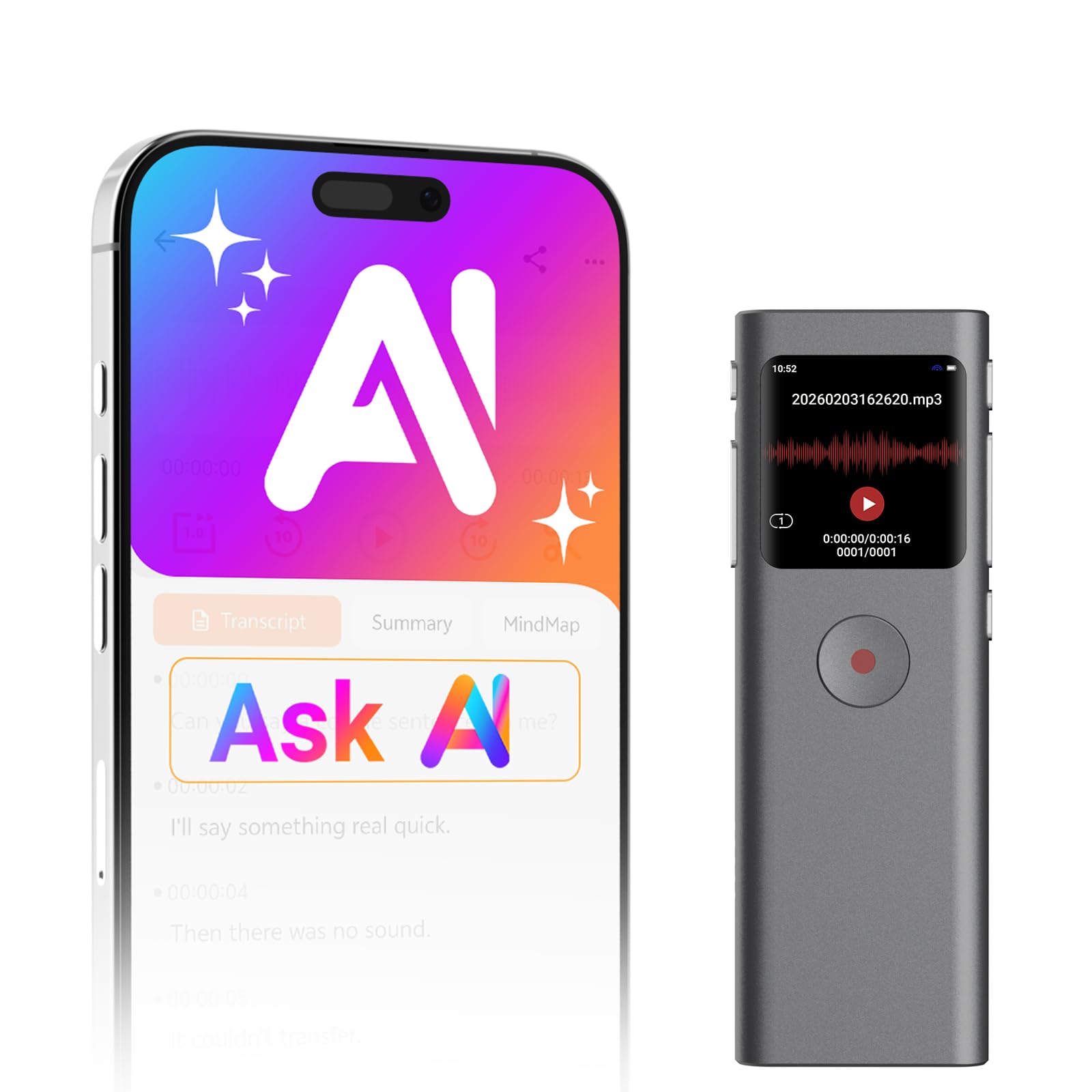
The Yorlu AI recorder is designed for users who want more than just audio capture—it transcribes and summarizes recordings in 90+ languages using advanced AI. A single button press starts recording, and the companion app handles transcription, mind map generation, and key point extraction automatically.
Dual high-sensitivity microphones with 360-degree pickup ensure clear voice capture in meetings and lectures. Voice-activated mode pauses recording during silence to save storage and editing time. It stores up to 4700 hours of audio on 64GB internal memory, and the battery lasts 30 continuous hours on a single charge.
File transfer happens via Bluetooth to the Boean app, or over USB-C. Password protection secures your recordings, and cloud storage is available through the app. The free monthly transcription allowance of 200 minutes is generous for light users, but heavy users may need a subscription for more minutes.
Why it’s great
- AI transcription and summarization in 90+ languages
- Massive 64GB storage holds thousands of hours
- 30-hour battery life
- Voice-activated recording saves storage
Good to know
- Transcription requires subscription beyond 200 free minutes
- AI features depend on app availability
FAQ
Can I use a 32-bit float recorder with any microphone?
What is the difference between PCM and MP3 recording on a digital audio recorder?
Why does my recorder pick up handling noise when I hold it?
Final Thoughts: The Verdict
For most users, the best digital audio recorder winner is the Zoom F3 because it combines professional-grade preamps, 32-bit float recording, and dual XLR inputs in a compact, durable body that fits any serious field recording workflow. If you want built-in microphones and multitrack recording for music and podcasting, grab the Zoom H4 Essential. And for the most portable high-resolution recorder with Bluetooth control and scene presets for on-the-go use, nothing beats the Roland R-07.

Mo Maruf
I created WellFizz to bridge the gap between vague wellness advice and actionable solutions. My mission is simple: to decode the research and give you practical tools you can actually use.
Beyond the data, I am a passionate traveler. I believe that stepping away from the screen to explore new environments is essential for mental clarity and physical vitality.