If you are tired of dragging extension cords around the job site or fighting with a tangled cable every time you need to make a simple cut, a cordless circular saw is the tool that finally cuts that hassle loose. You get the same straight, clean cuts in lumber and plywood, but with the freedom to work anywhere — on a roof, in a muddy yard, or deep inside a framing project — without hunting for an outlet.
I’m Mohammad Maruf — the co-founder and writer behind WellFizz. This guide is built by comparing the manufacturers’ published specifications and the patterns across verified customer reviews, so you get each pick’s real strengths and trade-offs instead of marketing spin.
Whether you need to frame a deck, rip down plywood for a shed, or make quick trim cuts on a weekend project, the best cordless circular saw for you balances cutting power, runtime, weight, and your existing battery platform so you never get stuck mid-project.
How To Choose The Best Cordless Circular Saw
Picking the right saw comes down to a handful of decisions that directly affect what you can cut, how long you can work, and how comfortable the saw feels in your hands. Here are the three most important factors to consider.
Blade Size and Cutting Depth
The blade size determines the maximum depth you can cut in a single pass. A 7-1/4-inch blade cuts up to about 2-1/2 inches deep at 90 degrees — enough to slice through a 2×4 in one go. Smaller 6-1/2-inch saws are lighter and more compact, but they max out around 2 inches of cut depth, which means you may need to flip thicker stock for a second pass. A 4-1/2-inch mini saw is for light trim work, PVC, and thin plywood, not framing.
Brushless vs. Brushed Motor
A brushless motor uses electronic controls instead of physical carbon brushes to transfer power, which means less friction, less heat, and more of the battery’s energy turning into cutting force. You get more cuts per charge — typically 30 to 50 percent more — and the motor itself lasts longer because there are no brushes to wear out. Almost every saw on this list is brushless, which is the standard for serious work.
Battery Platform and Voltage
If you already own power tools from a brand like Milwaukee, Makita, or DeWalt, staying within that battery family saves you a lot of money because you can buy the saw as a bare tool without a battery. Voltage matters: an 18V or 20V saw is sufficient for most DIY and professional work, while 36V (Makita’s dual-battery system) and 60V (DeWalt FlexVolt) deliver more torque for dense hardwoods and repeated cuts in thick lumber without bogging down.
Quick Comparison
On smaller screens, swipe sideways to see the full table.
| Model | Category | Best For | Key Spec | Amazon |
|---|---|---|---|---|
| Metabo HPT C1807DAQ4 | Premium / Best Overall | Maximum cuts per charge at a fair price | 200 cuts per charge in 2×4 | Amazon |
| CRAFTSMAN CMCS551B | Mid-range | Powerful cuts on a tight budget | 56° bevel capacity | Amazon |
| WORKPRO 20V Mini | Budget / Compact | Light-duty portability in a complete kit | 4.5-inch blade, 4.36 lbs | Amazon |
| ONEAND HP (Ryobi) PSBCS01B | Value | DIY-friendly weight and price | 5.5 lbs, 6.5-inch blade | Amazon |
| SKIL CR5440B-10 | Premium | High RPM and included battery kit | 5,300 RPM, 4.0Ah battery | Amazon |
| Milwaukee 2732-20 | Premium | Pro-grade build with magnesium shoe | 15 Amp motor, 7.25-inch blade | Amazon |
| Makita XSH06PT | High-End | Beastly 36V dual-battery power | 6,000 RPM, 610 cuts per charge | Amazon |
| DEWALT DCS577X1 | Top-Tier | Worm-drive style power for pros | 60V battery, 2-7/16-inch cut depth | Amazon |
In‑Depth Reviews
1. Metabo HPT 18V MultiVolt 7-1/4 Inch Cordless Circular Saw (C1807DAQ4)

8.9 pounds with 200 cuts per charge on pressure-treated 2x4s — the best cut-per-charge number in its price range — makes the Metabo HPT the top pick for serious DIYers and pros who want a full day of framing without swapping batteries constantly.
A brushless motor gives 40% higher torque than the brand claims for leading cordless saws, yet the tool body is 8% lighter than many competitors at 8.9 pounds. The soft start (the blade ramps up gently instead of jerking) and electric brake (the blade stops fast when you let go of the trigger) give you precise control and improved safety. Buyers report that “up to 200 2×4 cuts per charge” means you complete tasks without worrying about battery life.
The only real trade-off is that this is the tool body only — you need a Metabo HPT 18V or 36V MultiVolt battery, which are sold separately. If you already own Metabo HPT gear, this is a no-brainer; if you are starting fresh, the battery purchase pushes the total cost up, but you get a lifetime warranty on the tool. Verdict: the smartest all-around choice for anyone who values runtime as much as raw power.
Why it’s great
- Up to 200 cuts per charge in 2×4 lumber
- 40% higher torque than leading competitors
- Lighter than most full-size cordless saws at 8.9 lbs
- Electric brake and soft start for safety
Good to know
- Tool only — battery and charger sold separately
- Best performance with a 6Ah+ battery
- Safety trigger lock may annoy some users
2. CRAFTSMAN V20 RP Cordless Circular Saw, 7-1/4 inch, Bare Tool Only (CMCS551B)
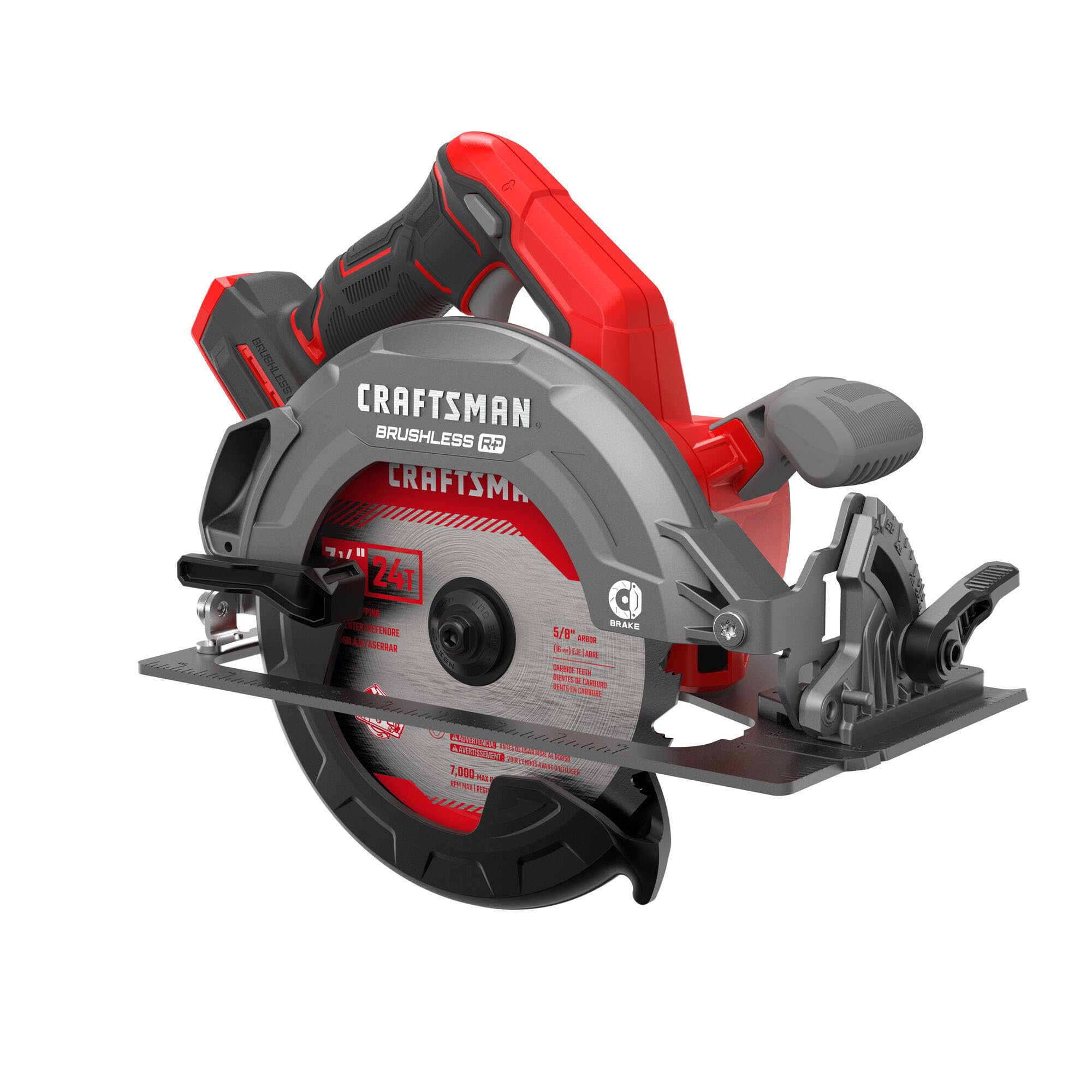
Against the top-pick Metabo HPT, the CRAFTSMAN V20 RP wins on bevel capacity: 56 degrees versus Metabo’s 55 degrees, giving you one extra degree for steep-pitch trim or tight rafters. It loses on runtime, however; owners mention it “eats batteries” and can drain a high-capacity pack in about 10 minutes of heavy use.
Where this saw shines is raw cutting force for the price. Customers note “huge torque, cuts straight and clean through 1” lumber.” The brushless motor delivers 75% more power than the brand claims compared to brushed alternatives, and the upper metal guard and rigid aluminum shoe make the saw feel durable and precise. The built-in LED illuminates the cut line clearly, and the 56-degree bevel includes positive stops at 22.5 and 45 degrees for quick adjustments.
Choose this over the Metabo HPT if you already own CRAFTSMAN V20 batteries and need a saw for short but powerful bursts of cutting — like building a deck over a weekend where you can swap packs between cuts — and your priority is torque per dollar.
Where it shines
- 56-degree bevel capacity — best in this price range
- 75% more power than brushed motors
- LED light for improved cut-line visibility
- Rigid metal guards for durability
Worth noting
- Battery drains fast under heavy cutting
- Bare tool — batteries sold separately
- Weighs 9.3 lbs, on the heavier side for its class
3. WORKPRO 20V Cordless Mini Circular Saw, 4-1/2″ Compact Kit

Picture this: you are on an RV roof cutting a new vent hole, or trimming PVC pipe in a tight crawl space where a full-size 7-1/4-inch saw simply will not fit. That is the exact scenario the WORKPRO mini saw is built for — a 4-1/2-inch blade in a 4.36-pound body that fits in one hand and tucks into a provided storage bag.
Despite its small size, it spins at 4,500 RPM and comes as a complete kit: a 4.0Ah battery, a fast charger that refills in about 2 hours, three blades (for wood, plastic, and tile), a laser guide, a parallel guide, and a dust extraction tube. Reviewers point out “long battery life (several hours of daily use for days before slowing).” The max cutting depth is 1-11/16 inches at 90 degrees and 1-1/8 inches at 45 degrees — enough for 1x lumber, plywood, and trim, but not for a single-pass 2×4 cut.
The standout feature here is the included blade variety: a 24-tooth alloy blade for wood, a 60-tooth blade for cleaner cuts, and a diamond blade for tile make this the most versatile compact kit on the list. You pay for a complete system, not just a tool body, so you can start cutting immediately.
What stands out
- Complete kit with battery, charger, and 3 blades
- Extremely lightweight at 4.36 lbs for easy one-hand use
- Laser and parallel guides for accuracy
- Great for tight spaces and light-duty cuts
The trade-offs
- Not powerful enough for 2x4s or thick lumber
- Depth gauge accuracy reported as off
- Laser guide may drain battery if left on
4. ONEAND HP 18V BRUSHLESS Cordless Compact 6-1/2 in. Circular Saw (Ryobi PSBCS01B)

The single number that matters most in this category is weight, and this Ryobi HP saw scores at just 5.5 pounds — the lightest 6-1/2-inch cordless saw on the list, 0.9 pounds lighter than the WORKPRO mini and 3.8 pounds lighter than the CRAFTSMAN. For a DIYer who makes occasional cuts and wants something that does not fatigue the arm after a few minutes, that weight difference matters more than max RPM.
The catch is power: buyers confirm it is “underpowered for 2x12s/2x6s” and suffers from “poor battery life per cut.” The 50-degree bevel is useful, and the brushless motor is a clear upgrade over Ryobi’s older brushed saws — one reviewer says it “cuts better than brushed Ryobi” and even matches a DeWalt 14.4V in cut depth at 2.25 inches. Still, for dense hardwoods or repeated cuts in treated lumber, you will feel the saw struggle.
This saw is the right choice if you are already on the Ryobi ONE+ battery platform (the most popular battery system in North America for DIY users) and want a brushless upgrade for light framing, sheet goods, and trim work without buying into a new battery system. Price-to-performance, it makes sense only if you already own Ryobi batteries.
The upsides
- Extremely lightweight at 5.5 lbs for easy handling
- Fits the Ryobi ONE+ battery platform
- Brushless motor is more efficient than older brushed models
- 50-degree bevel capacity for angled cuts
Keep in mind
- Underpowered for thick lumber (2x12s)
- Battery life is short under heavy load
- Best used with a 4Ah or larger battery
5. SKIL PWR CORE 20 Brushless 20V 7-1/4″ 5300 RPM, Circular Saw Kit (CR5440B-10)

You get a blade that spins at 5,300 RPM — 800 RPM faster than the WORKPRO mini and 700 RPM faster than the Ryobi, making it the highest-spinning 7-1/4-inch saw in the mid-range. For slicing through treated lumber and dense plywood, that extra blade speed means smoother cuts with less effort.
You also get a 2-5/8-inch depth of cut (the brand says it cuts 3 times deeper than typical 7-1/4-inch saws in one pass), an electric brake that stops the blade quickly, and cast aluminum guards and shoe for durability. This kit includes a 4.0Ah battery and a quick charger, so you can start cutting right out of the box. Shoppers say it is “lightweight, well-balanced, powerful” and that the battery lasts long enough for most diy projects.
The downside is that the kit weighs 11.98 pounds — heavier than most other mid-range options. If you need the fastest blade speed for clean cuts in dense materials and do not mind the extra weight, the SKIL is a strong value-for-money pick that punches above its price class on RPM alone. It is perfect for the budget buyer who prioritizes raw cutting speed and included battery kit over a lighter tool.
Why we’d pick it
- 5,300 RPM is one of the highest speeds in its class
- 2-5/8-inch depth cuts 3 times deeper in one pass
- Kit includes 4.0Ah battery and fast charger
- Electric brake for safety
A few caveats
- Heavier than expected at 11.98 lbs with battery
- Professional users may need a second battery
- Cast aluminum guards can dent on job sites
6. Milwaukee 2732-20 M18 Fuel 18 Volt Lithium-Ion 15 Amp 7-1/4 Inch Cordless Circular Saw (Tool Only)
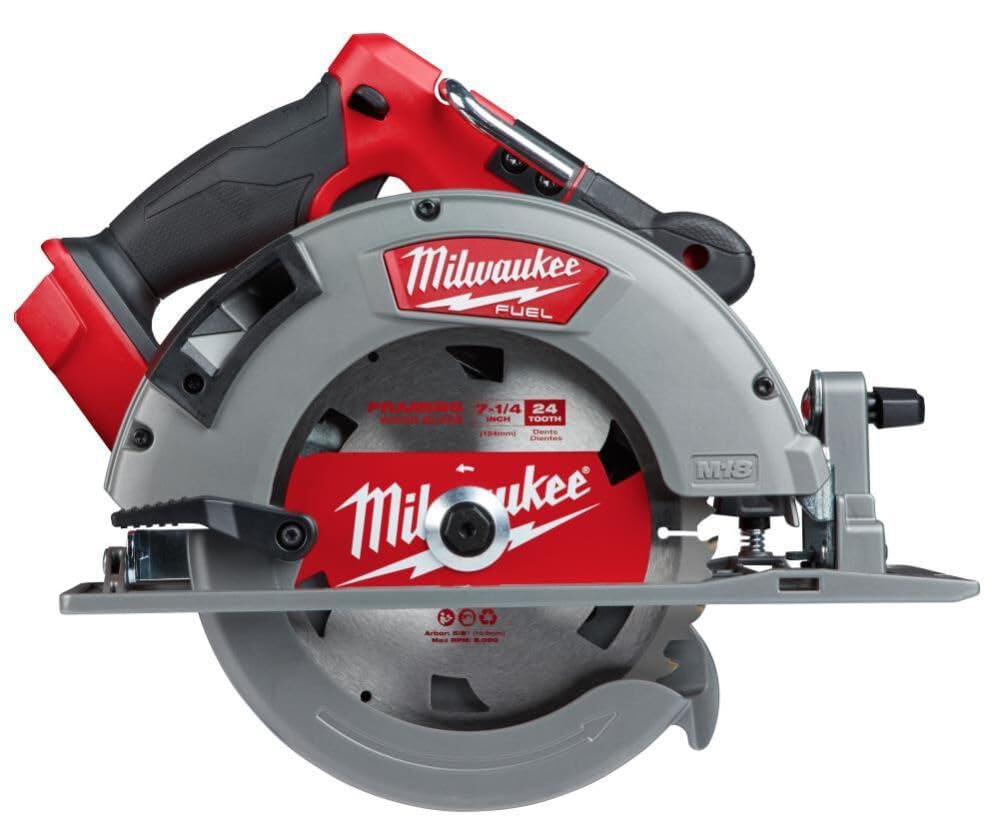
The Milwaukee Fuel saw is for the pro who needs a saw that survives a drop off a ladder and still cuts true the next day. The magnesium shoe and guards are lighter and more durable than aluminum or plastic, and the integrated rafter hook lets you hang the saw between cuts without hunting for a flat spot to set it down.
You get a 15-amp motor (rated power equivalent to a corded saw), an electric brake, an LED worklight, and a dust port with a vacuum adapter to keep the cut line clean. Buyers report it is “powerful and quiet” and that the “flexibility a battery-powered tool gives” makes it a favorite for contractors. At 10 pounds (160 ounces), it is lighter than the SKIL kit and feels better balanced for overhead work.
The honest limit is that this is a bare tool — no battery or charger included — and it uses Milwaukee’s M18 Fuel platform, which is among the most expensive battery systems. If you already own M18 batteries, this is the best-built cordless saw Milwaukee makes; if you are starting fresh, the battery cost is significant.
Strong points
- Magnesium shoe and guards for maximum durability
- 15-amp motor delivers corded-like power
- Integrated rafter hook and dust port
- Electric brake and LED light for precision
Before you buy
- Tool only — requires M18 Fuel battery
- Battery platform is more expensive than many brands
- Blade length listed as 4 inches (actual 7-1/4-inch blade)
7. Makita XSH06PT 18V X2 LXT Lithium-Ion (36V) Brushless Cordless 7-1/4” Circular Saw Kit (5.0Ah)

The Makita XSH06PT is the most expensive kit on the list but delivers numbers that justify the investment: 6,000 RPM (the highest blade speed here) and up to 610 crosscuts in 2×4 lumber per charge using two 5.0Ah batteries. That is more than triple the Metabo HPT’s 200 cuts, making this the undisputed runtime king.
You get Makita’s electronically controlled brushless motor with automatic speed change technology (the saw adjusts torque and speed mid-cut for the best performance through varying wood densities), a 3-year limited warranty, and a kit that includes two 5.0Ah batteries and a dual-port charger. Reviewers call it “the most powerful cordless circular saw I’ve ever used” and say it “makes my 120V saw look weak.”
The price-to-performance line is simple: the Makita costs more upfront, but if you need to cut hundreds of boards in a single day without recharging, this pays for itself in productivity. Choose this saw if your work is high-volume framing or demo where downtime costs you money.
What we like
- 6,000 RPM — fastest blade speed on the list
- Up to 610 cuts in 2×4 per charge
- 36V dual-battery system for maximum torque
- 3-year warranty on tool, battery, and charger
The downsides
- Heavier than single-battery saws at 21.2 lbs with both batteries
- Dual-battery design requires more upfront investment
- Soft-sided bag instead of a hard case
8. DEWALT FLEXVOLT 60V MAX Circular Saw Kit, 7-1/4-Inch, Worm Style (DCS577X1)
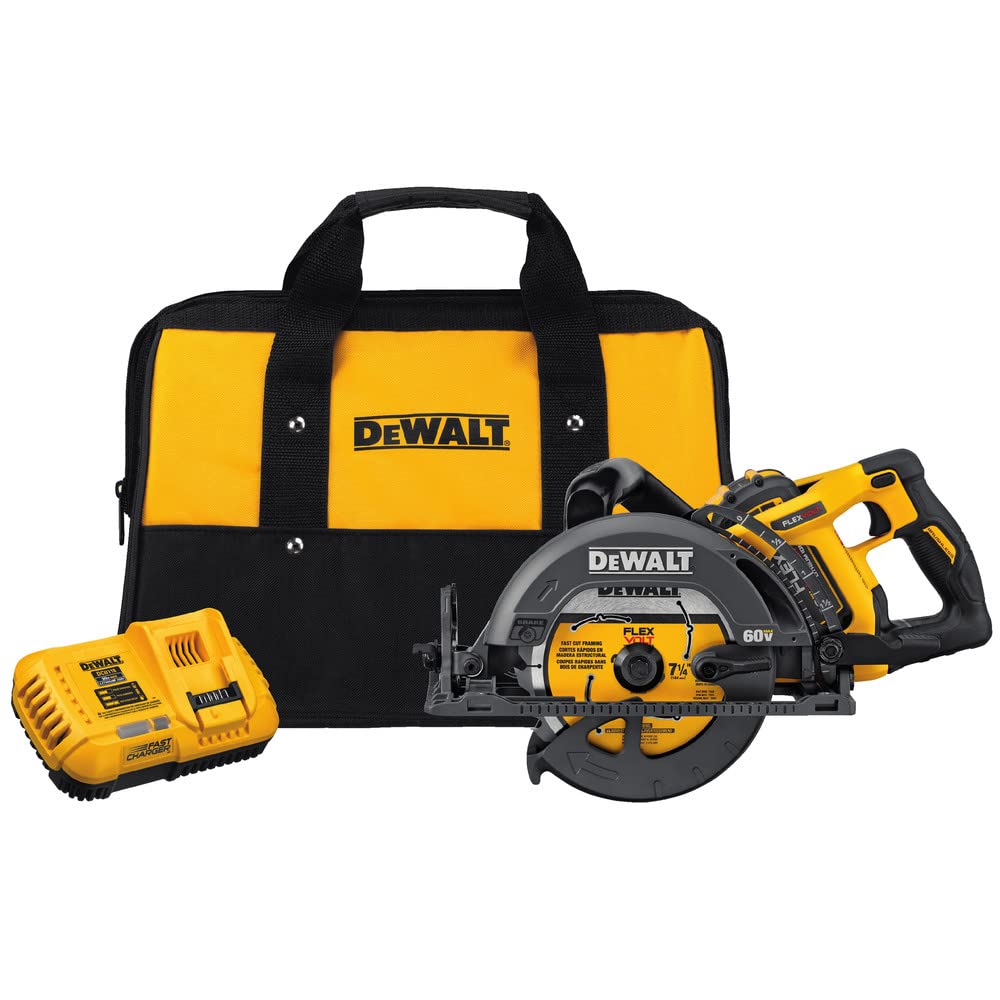
The 60V FLEXVOLT battery is the single spec that makes this the top pick for pro framers who grew up on worm-drive saws and want cordless convenience with a familiar body style. The DEWALT DCS577X1 competes directly with the Makita on power but takes a different approach: a worm-drive style design (the blade sits on the left side of the motor, with a rear handle for a clear line of sight along the cut).
You get a 60V FLEXVOLT battery (works with both 20V and 60V DeWalt tools), a 2-7/16-inch depth of cut at 90 degrees, a 53-degree bevel with stops at 45 and 22.5 degrees, a high-grade magnesium shoe, an electric brake, and a dust blower that clears sawdust from your cut line. Reviewers report “all-day use for a large deck” on a single charge and call it the “best cordless saw ever” for its combination of power and runtime. The saw weighs 10.9 pounds with the battery — heavy, but in line with pro demand for durability.
Compared to the Makita, the DEWALT has a higher voltage battery (60V vs 36V) but a slower RPM (unspecified, but lower than the Makita’s 6,000 RPM). Choose the DEWALT if you already own DeWalt tools and want a worm-drive feel that handles 4x4s and deck boards all day without bogging down. The DEWALT is the go-to for contractors who need extreme durability and a left-blade view, while the Makita wins on pure speed and cut count.
Why it’s great
- Worm-drive style provides excellent cut-line visibility
- 60V FLEXVOLT battery works with 20V and 60V tools
- All-day battery life for heavy framing projects
- Magnesium shoe and electric brake
Good to know
- Very heavy — 10.9 lbs with battery
- Left-side blade may blow chips toward the user
- Not rain-resistant; one reviewer noted water damage
Understanding the Specs
Blade Size and Cutting Depth
Blade size is measured in inches across the blade diameter. A 7-1/4-inch blade cuts up to about 2-1/2 inches deep at 90 degrees — enough to slice through a standard 2×4 in one pass without flipping the board. Smaller 6-1/2-inch saws cut about 2 inches deep, which is fine for plywood and 2x material but may require a second pass on thicker stock. Mini 4-1/2-inch saws cut around 1-11/16 inches deep and are intended for trim, PVC, and sheet goods, not framing. Always match the blade size to the thickest material you plan to cut.
Brushless Motor and RPM
A brushless motor uses electronic controls instead of carbon brushes to transfer power to the motor, which cuts down on friction and heat. The result is more cutting torque per watt of battery power and a motor that lasts longer because there are fewer wearing parts. RPM (revolutions per minute) tells you how fast the blade spins — higher RPM generally means smoother cuts in dense wood. Most cordless circular saws spin between 4,500 and 6,000 RPM. A saw spinning at 5,300 RPM (like the SKIL) will slice through hardwoods more cleanly than one at 4,500 RPM.
Bevel and Cutting Angle
Bevel capacity measures how far the saw’s base plate can tilt for angled cuts. Standard saws tilt to 45 degrees on one side; better saws reach 50 to 56 degrees for steeper cuts like roof rafters or crown molding. Positive stops are preset detents that lock the saw at common angles (22.5, 45, and 56 degrees) so you don’t have to guess or measure every time. If you plan to cut roof pitches or trim angles, a saw with 50+ degrees of bevel and positive stops saves time and improves accuracy.
Battery Type and Cuts Per Charge
Battery voltage determines how much power the saw can draw. Most cordless saws use 18V or 20V packs (essentially the same voltage, just different marketing). Higher-voltage systems like Makita’s 36V dual-battery or DeWalt’s 60V FlexVolt provide more torque but add weight. Cuts per charge is a real-world benchmark: a saw rated for 200 cuts in 2×4 lumber will get you through a full day of light framing, while 600+ cuts (Makita) means heavy production work without stopping. Always check the Ah (amp-hour) rating of the battery — a 4.0Ah pack holds roughly twice the energy of a 2.0Ah pack.
FAQ
Can a 6-1/2-inch cordless circular saw cut a 2×4 in one pass?
What is the difference between 18V and 20V cordless saws?
How important is an electric brake on a cordless circular saw?
Final Thoughts: The Verdict
Across the board, the best cordless circular saw winner is the Metabo HPT C1807DAQ4 because it delivers the highest cut-per-charge ratio at a mid-range price, with a 55-degree bevel, soft start, and an electric brake — all in a tool that is lighter and more balanced than most competitors. If you want maximum torque and do not mind swapping batteries often for a lower price, grab the CRAFTSMAN CMCS551B. And for high-volume production cutting where runtime is everything, the standout is the Makita XSH06PT with its 6,000 RPM and 610 cuts per charge.

Mo Maruf
I created WellFizz to bridge the gap between vague wellness advice and actionable solutions. My mission is simple: to decode the research and give you practical tools you can actually use.
Beyond the data, I am a passionate traveler. I believe that stepping away from the screen to explore new environments is essential for mental clarity and physical vitality.