Choosing a genuine Chinese tea means facing a maze of options — white jasmine, green dragon well, dark oolong — and you want one that tastes authentic and fits your daily routine, not a bag of dust that turns bitter after thirty seconds.
I’m Mohammad Maruf — the co-founder and writer behind WellFizz. This guide is built by comparing the manufacturers’ published specifications and the patterns across verified customer reviews, so you get each pick’s real strengths and trade-offs instead of marketing spin.
Whether you are new to Chinese tea or a seasoned drinker, these five selections cover white, green, oolong, and black varieties at different price tiers. Here is the best chinese tea to start your journey with confidence.
How To Choose The Best Chinese Tea
Chinese tea comes in four main families — white, green, oolong, and black — and each has a different level of oxidation (exposure to air during processing) that changes the flavor, aroma, and caffeine content. Your choice depends on what you want out of a cup: a gentle floral sip, a vegetal green brew, a complex layered oolong, or a bold malty morning drink.
Oxidation level and flavor profile
White tea is the least processed and has the lowest caffeine, about 15-20 milligrams per cup, with a light, delicate flavor. Green tea is slightly oxidized, giving it a grassy, vegetal taste. Oolong sits between green and black, partially oxidized, which creates floral and earthy notes. Black tea is fully oxidized, producing a bold, strong brew.
Whole leaf versus tea bags
Loose-leaf teas use whole or large pieces of the leaf, which release flavor slowly and can often be re-steeped two or three times. Tea bags typically contain smaller, broken leaves or dust that brew fast but lose nuanced flavor and turn bitter if steeped too long. If you want depth and multiple cups, go loose leaf; for convenience and quick brewing, a quality tea bag is fine.
Origin and freshness
Genuine Chinese teas are named after their growing region — Anxi for Tie Guan Yin oolong, Fujian for white tea, Zhejiang for Long Jing green tea. Look for a resealable pouch or bag to keep the leaves fresh. Buyers report that freshness fades over time, so check roast dates and buy from sellers with good turnover.
Quick Comparison
On smaller screens, swipe sideways to see the full table.
| Model | Category | Best For | Key Spec | Amazon |
|---|---|---|---|---|
| Prince of Peace Oolong | Tea Bags | Daily oolong on a budget, kombucha making | 300 bags total, 13.6 oz | Amazon |
| Numi Chinese Breakfast | Loose Leaf | Bold black tea, coffee alternative | 16 oz, brews 200 cups | Amazon |
| Tealyra Long Jing | Loose Leaf | Classic green tea, delicate daily drink | 8 oz, whole flat leaves | Amazon |
| Oriarm Tie Guan Yin | Loose Leaf | Oolong lovers, multiple infusions | 8.82 oz, resealable bag | Amazon |
| Republic of Tea Jasmine White | Tea Bags | Low-caffeine, floral, celiac-safe | 50 bags, 5.76 oz | Amazon |
In‑Depth Reviews
1. Prince of Peace Organic Oolong Tea – 100 Tea Bags (Pack of 3)
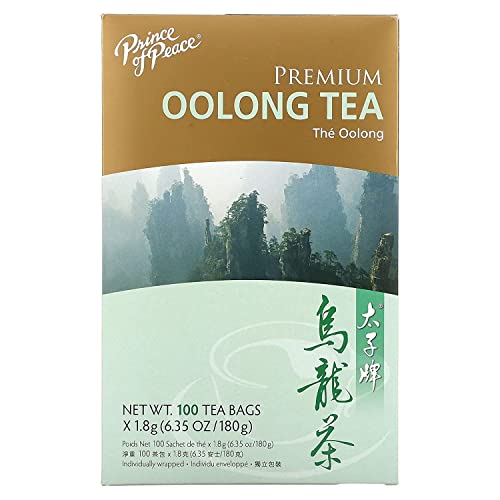
300 tea bags in three boxes — enough for 100 days of daily drinking without rationing — makes this the top pick for anyone who drinks oolong daily and wants organic, bagged convenience. This is organic oolong grown in certified Chinese plantations, with a mild, earthy, and woody flavor that buyers describe as “perfect for hot tea or kombucha brewing.”
At 13.6 ounces total, this pack holds 2.4 times more tea by weight than the Republic of Tea’s 50-bag jasmine white box. Owners mention using 7 bags per half-gallon jar for kombucha, and note that the strings are easy to remove — no bag failures. The flavor is mild enough for evening drinking, and one reviewer says it helps maintain weight loss and sleep quality.
The only real limit is that this is bagged tea, not loose leaf, so you cannot control the leaf-to-water ratio or re-steep the leaves for a second cup. But for an organic, good-tasting daily oolong that also supports a company with humanitarian efforts in China, this is the safest bet on the list.
Why it’s great
- Organic certified, hand-picked oolong
- 300 bags — enough for 100 days of daily drinking
- Mild, earthy flavor works hot or iced
- Company uses profits for humanitarian work
Good to know
- Bagged format, not loose leaf — no second steep
- Mild flavor may be too subtle for strong-tea drinkers
2. Numi Organic Chinese Breakfast Loose Leaf Tea, 16 Ounce Pouch
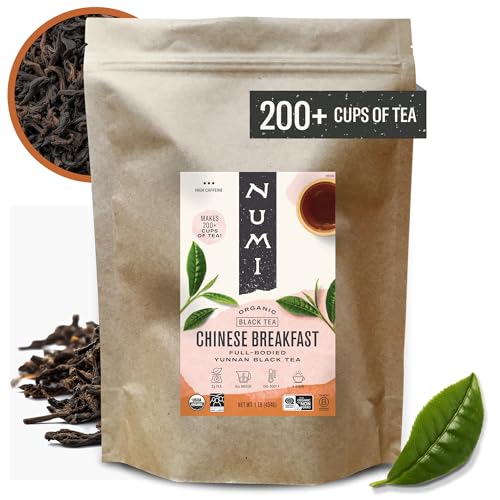
If you want a bold black tea that can stand up to milk or replace coffee, this Yunnan-style loose leaf leads on sheer strength — it holds 2 times more tea by weight than Tealyra’s 8-ounce Long Jing pouch. The leaves include golden tips (the youngest buds), which give a malty, full-bodied brew with floral honey notes rather than harshness.
Customers note that this tea brews up strong without turning bitter, especially if you use water just under boiling. One reviewer notes it has “quite a few tips” and works as a “good coffee replacement without harshness.” The resealable 16-ounce pouch keeps the leaves fresh for daily use, and at roughly 200 cups per bag, this Numi pouch stretches further than most loose-leaf options on the list.
The catch is that this is a premium product — you pay more upfront for the larger quantity and organic certification. Choose this over the Prince of Peace if you prefer loose leaf for multiple infusions and want a black tea that wakes you up without the coffee crash.
Where it shines
- Organic full-leaf Yunnan black tea with golden tips
- Brews 200 cups from one 16-ounce pouch
- Malty, bold flavor without bitterness
- Resealable bag preserves freshness
Worth noting
- Larger pouch dimensions (11.54 x 7.91 x 3.07 inches) need pantry space
- Premium price compared to entry-level teas
3. Tealyra – Premium Dragon Well (Long Jing) Green Tea, 8-Ounce

You want a classic Chinese green tea that tastes smooth, not grassy or bitter — Dragon Well (Long Jing) is the most famous green tea in China for exactly that reason. Tealyra’s version uses whole flat leaves that expand beautifully when brewed, producing a golden-green cup with a light vegetal flavor and a soft, sweet finish.
Reviewers point out that the leaves are large with no powdery dust, and that the tea remains drinkable even after three steeps. One reviewer calls it the “smoothest green tea” and says it is easy to clean because the leaves go directly into the cup. The product dimensions are 6 x 4 x 1 inches — a compact pouch that stores easily.
The standout feature here is the leaf quality: full, flat leaves that show the traditional hand-processing of Dragon Well, which is rare at this price tier for an 8-ounce bag.
What stands out
- Whole flat leaves — no dust or broken bits
- Smooth, sweet, non-bitter green tea
- Good for 2-3 infusions per batch
- Compact 8-ounce pouch
The trade-offs
- Some batches may vary in flavor (smoky vs. vegetal)
- Needs careful water temperature (175°F) to avoid bitterness
4. Oriarm Anxi Tie Guan Yin Oolong Tea, 250g (8.82 oz)
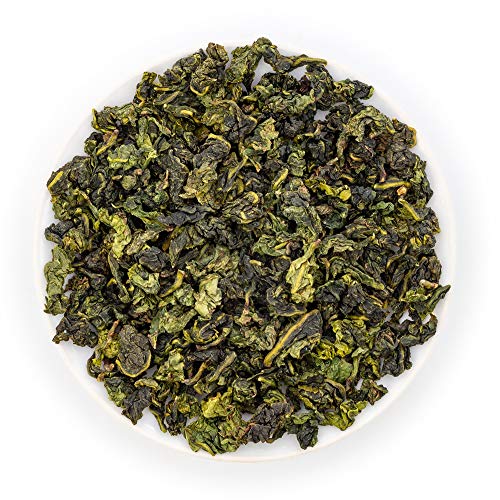
The single number that matters most for oolong lovers is how many steeps you get from one batch — and this Tie Guan Yin delivers excellent flavor across multiple infusions, with buyer reports calling it “pleasant earthy taste” and “amazing taste and smell.” At 8.82 ounces in a slim 4.6 x 4.6 x 2.2 inch package, it is the second-lightest loose leaf here, but its green-style oxidation keeps the leaves tender and aromatic.
The downside you accept is batch inconsistency. One long-time buyer notes that the quality has deteriorated over years, with the most recent batch having a “strong, unpleasant aftertaste” and reduced aroma. Another reviewer, however, calls it “on par with high-quality original” and plans to reorder. Natural batch variation is common in small-batch teas, but it is a real gamble here.
Price-to-value reads strongly positive if you catch a fresh batch. For the price, you get a genuine Anxi Tie Guan Yin — a name-brand oolong from Fujian — in a resealable zipper bag that preserves freshness. If you want a daily oolong that can be re-steeped, this beats the Prince of Peace bags on leaf quality but risks inconsistency.
The upsides
- Genuine Anxi Tie Guan Yin from Fujian
- Lightly oxidized for a floral, refreshing taste
- Resealable bag keeps leaves fresh
- Holds up to 3+ infusions per batch
Keep in mind
- Batch quality can vary — some recent orders had weak aroma
- Requires careful steeping (under 185°F) for best flavor
5. The Republic of Tea – Asian Jasmine 100% White Tea Bags, 50 Count

At 50 bags for the price of a box, what you actually get is a low-caffeine white tea (about 15-20 mg per cup, compared to 40-50 mg in black tea) that is naturally delicate and floral. This is 100% white tea from Fujian Province, blended with natural jasmine flavor — no artificial additives. Shoppers say that the “1st cup strongest but never bitter,” and that the jasmine scent lingers pleasantly through a second steep if you reuse the bag.
What you give up is strength and volume. At 5.76 ounces total, this is 2.4 times lighter than the Prince of Peace 300-bag pack, and some buyers report the flavor is “somewhat weak” even after leaving the bag in the cup. It is also only 50 bags — compared to 300 from Prince of Peace, you go through this box faster if you drink multiple cups daily.
This is perfect for the budget buyer who wants a gentle, floral, celiac-safe tea with low caffeine — ideal for evening sipping or for anyone prone to kidney stones who needs to limit black tea. The mildness is the feature, not the flaw.
Why we’d pick it
- Low caffeine (15-20 mg per cup)
- Gluten-free certified — safe for celiacs
- Fragrant jasmine, never bitter
- Real 100% white tea from Fujian
A few caveats
- Flavor is light — not for those wanting a bold cup
- Only 50 bags compared to larger bulk options
Understanding the Specs
Oxidation Level
This is the biggest difference between white, green, oolong, and black tea. Oxidation (exposure to air) changes the color and flavor. White tea is barely oxidized — it stays pale and delicate. Green tea is lightly heated to stop oxidation, keeping a fresh, grassy taste. Oolong is partially oxidized, which creates floral and earthy layers. Black tea is fully oxidized, giving it a dark color and bold, malty flavor. Knowing your preferred oxidation level is the fastest way to narrow down choices.
Leaf Format: Bags vs. Loose Leaf
Tea bags use broken leaves or dust that brew fast but lose nuance and turn bitter if over-steeped. Loose-leaf tea uses whole leaves that expand during steeping, releasing flavor slowly and allowing 2-3 infusions per batch. If you value convenience and quick cleanup, go with bags. If you want depth and multiple cups, choose loose leaf. The trade-off is prep time: loose leaf needs an infuser or teapot.
FAQ
What is the caffeine content difference between white, green, oolong, and black Chinese tea?
How many times can I re-steep Chinese loose-leaf tea?
What water temperature should I use for Chinese green tea to avoid bitterness?
Final Thoughts: The Verdict
For the majority of shoppers, the best chinese tea winner is the Prince of Peace Organic Oolong because it combines organic quality, mild and drinkable flavor, and an impressive 300-bag count that lasts for months. If you want a bold black tea that can replace coffee, grab the Numi Chinese Breakfast loose leaf. And for a classic, smooth green tea experience that stays non-bitter, the Tealyra Dragon Well is your best daily drink.

Mo Maruf
I created WellFizz to bridge the gap between vague wellness advice and actionable solutions. My mission is simple: to decode the research and give you practical tools you can actually use.
Beyond the data, I am a passionate traveler. I believe that stepping away from the screen to explore new environments is essential for mental clarity and physical vitality.