You know the frustration of freehand sharpening: one wrong tilt and your bevel (the angled cutting face of the blade) goes uneven, so the tool tears wood fibers instead of slicing cleanly. A chisel sharpening jig solves that by locking your blade at a precise, repeatable angle against the stone, giving you a consistent, razor-sharp edge every stroke. This guide breaks down six top options right now, from budget-friendly kits to professional-grade tools for daily workshop use.
I’m Mohammad Maruf — the co-founder and writer behind WellFizz. This guide is built by comparing the manufacturers’ published specifications and the patterns across verified customer reviews, so you get each pick’s real strengths and trade-offs instead of marketing spin.
Tuning up old chisels or maintaining plane irons (blades for hand planes) — the right chisel sharpening jig is the difference between fighting a dull tool and enjoying a clean, effortless cut every time you reach for the bench.
How To Choose The Best Chisel Sharpening Jig
Not all jigs work the same. Focus on three things that decide if the jig fits your tools and sharpening style.
Blade width range (what it will actually hold)
Every jig has a minimum and maximum blade width it can clamp. Check your smallest chisel and your widest plane iron against that spec. Many jigs claim a range up to 2.8 inches, but one buyer of the Precision Jig noted it “fails on 1/4 inch chisels” because the clamping blocks are not cut square for narrow blades. If you sharpen small chisels, look for a lower limit around 1/8 inch (3 mm) like the KAKURI offers.
Adjustability (how you set the bevel angle)
A fixed-angle jig forces you to guess the blade projection (how far the blade sticks out) to set the bevel, which is harder to repeat. Jigs with a dedicated angle fixture and a separate angle gauge — like the Precision and GOINGMAKE — let you dial in specific angles (15, 20, 25, 30, 35, 40, 45 degrees) by locking a positioning block. This gives every chisel the exact same bevel each time, with no measuring.
Roller design (stability during the stroke)
Wide rollers stop the jig from tipping side-to-side as you roll it across the stone, which matters most for plane irons. Double-roller designs (two short rollers on each side) add contact points but can pick up diamond grit and jam, as one GOINGMAKE buyer reported. Single-roller designs, like the Sharp Pebble, roll directly on the stone surface and are not affected by stone thickness, but they give less lateral stability for very wide blades.
Quick Comparison
On smaller screens, swipe sideways to see the full table.
| Model | Category | Best For | Key Spec | Amazon |
|---|---|---|---|---|
| ISQTLMF Precision Jig | Best Overall | Beginner & intermediate woodworkers who want a complete kit | 10°–45° adjustable angle fixture | Amazon |
| AUXTUR Honing Guide | Great Value | Woodworkers who want an easy, all-in-one set | 400/1000 grit stone included | Amazon |
| GOINGMAKE Kit | Top Performer | Users who need a wide blade range up to 3 inches | 5/32″ to 3″ blade range | Amazon |
| Sharp Pebble Honing Guide | Premium Pick | Woodworkers who prioritize all-metal durability | Stainless steel & bronze bearing | Amazon |
| Gohelper Sharpening Kit | Best Value | Buyers who want a premium-feel kit without the top-tier price | 0.1″ to 2.8″ blade range | Amazon |
| KAKURI Honing Guide | Specialty Pick | Japanese plane & chisel owners who want professional-grade quality | Steel body, Japanese ash wood handles | Amazon |
In‑Depth Reviews
1. ISQTLMF Precision Chisel Sharpening Jig
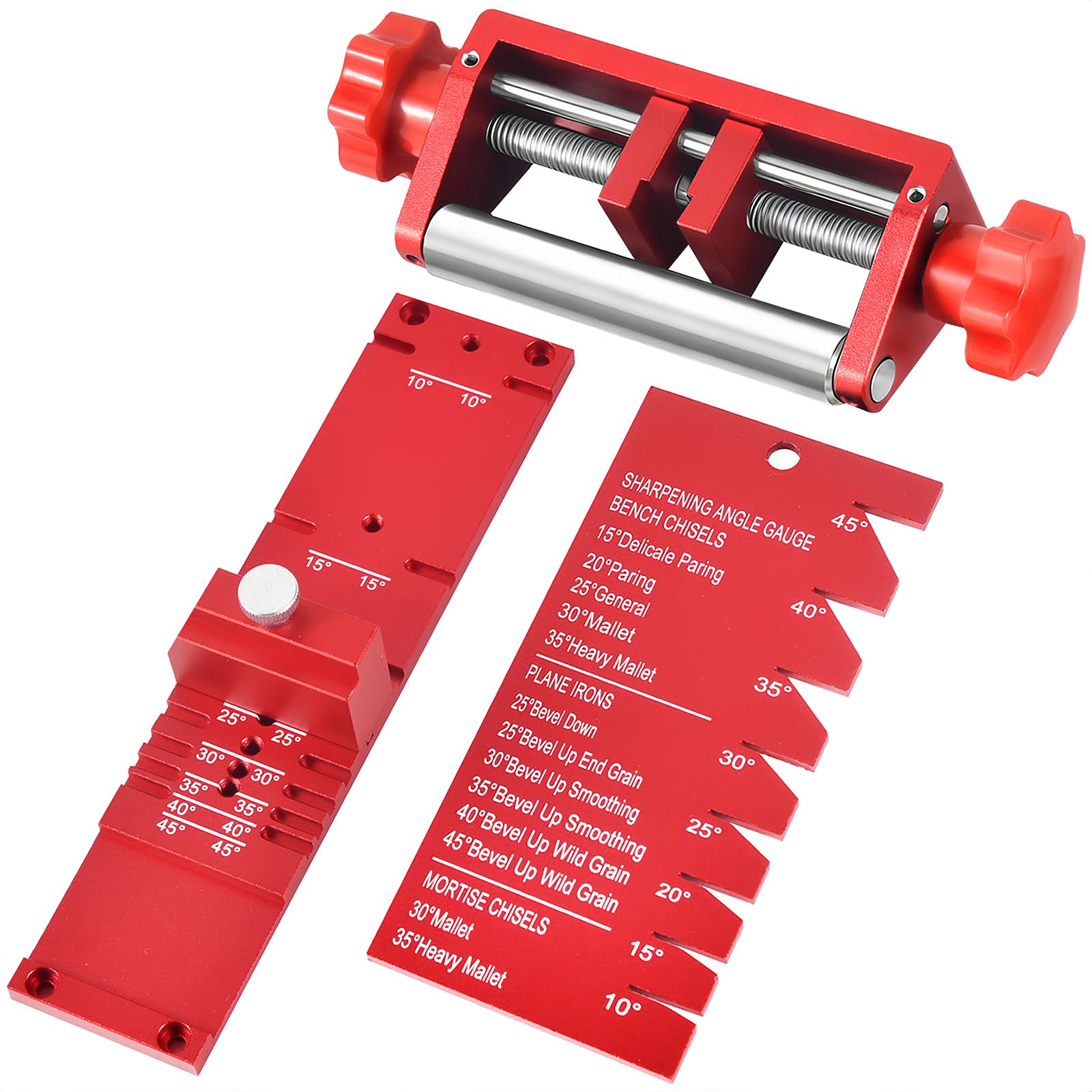
The adjustable angle fixture covers 10 to 45 degrees with a clear angle gauge — so you never have to guess your bevel angle again. Buyers report it is “easy to use and for a beginner I recommend to pick this up,” which makes it the most accessible entry point in this lineup for beginners.
The wide roller spans your sharpening stone’s full width, stopping the jig from tipping during the stroke. The included dual-grit stone (400 for reshaping, 1000 for honing) gives you everything to start sharpening immediately. At 5 inches long and just 1.2 inches high, the aluminum-body jig fits easily into a toolbox drawer without taking up much space.
The honest catch is the plastic knobs — one reviewer noted they may need upgrading if they break, and the clamping blocks can rock on the frame if not assembled perfectly, making it harder to get a perfectly square edge on narrow chisels. For most home users, though, this jig offers the best balance of precision and value.
Why it’s great
- Adjustable 10°–45° angle fixture with gauge for repeatable bevels
- Wide roller provides stability and prevents tipping
- Includes 400/1000 grit diamond stone and non-slip base
- Fits blades from 0.1″ to 2.8″ wide
Good to know
- Plastic knobs feel less durable than metal
- Clamping blocks may rock on frame, making square alignment tricky
2. AUXTUR Chisel Sharpening Jig with Honing Guide Tool
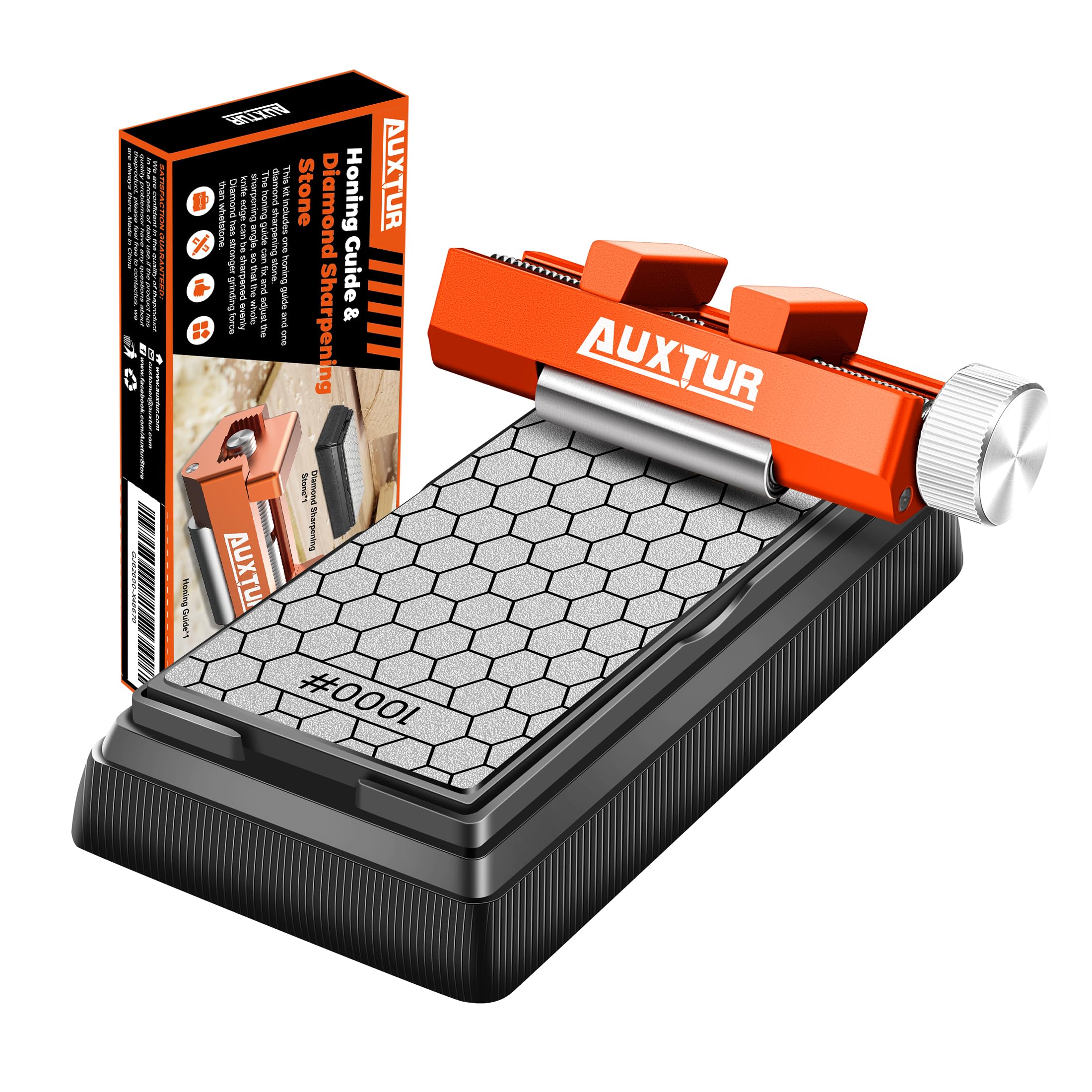
It falls short on max blade width compared to the ISQTLMF — it accepts blades only up to 2.55 inches versus the ISQTLMF’s 2.8-inch range — so it cannot handle the widest plane irons.
What it does well is deliver a complete set that includes a sharpening stone with 400 and 1000 grit surfaces, so you can repair chip-outs and hone a fine edge without buying extra stones. One buyer mentioned, “I have sharpened 3 different width chisels and the blade to my hand planer,” and described the improvement in edge uniformity as “huge.” The extended roller keeps the blade stable regardless of width, which helps when switching between tools.
Pick this jig over the ISQTLMF if you want a slightly lighter, simpler setup and do not own chisels or plane irons wider than 2.55 inches. It is a solid mid-range option that gets your tools dangerously sharp without overcomplicating the process.
Where it shines
- Includes 400/1000 grit sharpening stone for repair and honing
- Lightweight 1.1 lb design is easy to maneuver
- Extended roller keeps blade stable at any width
- Angle gauge and fixture simplify setup
Worth noting
- Max blade width is 2.55″ — not suitable for large plane irons
- Some owners mention initial tinkering needed to dial in bevel angle
3. GOINGMAKE Honing Guide System

If you sharpen a mix of chisels and plane irons, including wide joinery planes 3 inches across, this jig’s 5/32-inch-to-3-inch blade range is the broadest in this lineup — 18% more capacity than the AUXTUR’s 2.55-inch limit. That extra reach lets you sharpen everything from narrow dovetail chisels to a full-width No. 7 plane iron with a single jig.
The double-roller design (two short brass rollers plus two long rollers) delivers exceptional stability on the stone, and the included angle fixture gives you seven preset positions (15, 20, 25, 30, 35, 40, and 45 degrees plus their mirror angles) so you can dial in the exact bevel you need. A buyer noted it is a “solid accurate honing guide with easy setup” and that it “clamps irons well, rolls smoothly on stones.” The all-metal construction — aluminum alloy, brass, and stainless steel — means this jig will outlast many plastic-composite options on the market.
The one detail to watch: the roller can jam with diamond grit; one reviewer suggested adding Teflon washers to prevent flat spots over time. Across the board, the wide capacity and solid build make this the jig to beat for a mixed workshop — a 5/32-to-3-inch range that no other jig in this guide can match.
What stands out
- Blade range from 5/32″ to 3″ covers chisels and wide plane irons
- Double-roller design for stable, square sharpening
- Angle fixture with 7 preset angles for repeatable bevels
- Full metal construction: aluminum, brass, stainless steel
The trade-offs
- Roller can pick up diamond grit and jam over time
- Angle gauge is reportedly off by ~0.5 degrees
4. Sharp Pebble Honing Guide

The single number that matters most in this category is weight: at just 0.7 pounds, it is the lightest jig in this lineup, yet it feels substantially denser than aluminum jigs because the stainless steel construction eliminates any flex when you clamp down on a wide plane iron. One reviewer with 40 years of woodworking experience said “this thing is great” and that it “locks on with no wobble or play.”
The catch is the single-roller design. It rolls directly on the stone surface, so it works with any stone thickness — unlike some double-roller jigs that can bottom out or jam on thick diamond plates. But without a second roller for lateral stability, it is best suited for chisels and plane irons up to about 2 inches wide; beyond that, you may feel the jig wanting to tip during the stroke. The included instruction manual and e-book provide blade projection measurements for every angle, so you can dial in a 25-degree bevel on a chisel or a 30-degree bevel on a plane iron with precision.
Customers note it is extremely well-built with smooth threads, a brass knob with knurling, and a sealed bearing that rolls smoothly. If you value tool-like heft and corrosion resistance over a wide blade range, this premium jig delivers on its price.
The upsides
- Solid stainless steel body with bronze bearing — no flex, no wobble
- Single-roller design works on diamond plates of any thickness
- Includes detailed instruction manual and e-book with angle charts
- Compact 4.7″ length fits easily into a drawer or tool roll
Keep in mind
- Single roller offers less lateral stability for very wide blades
- Cannot easily clamp chisels with tapered side bevels
5. Gohelper Chisel Sharpening Jig Set
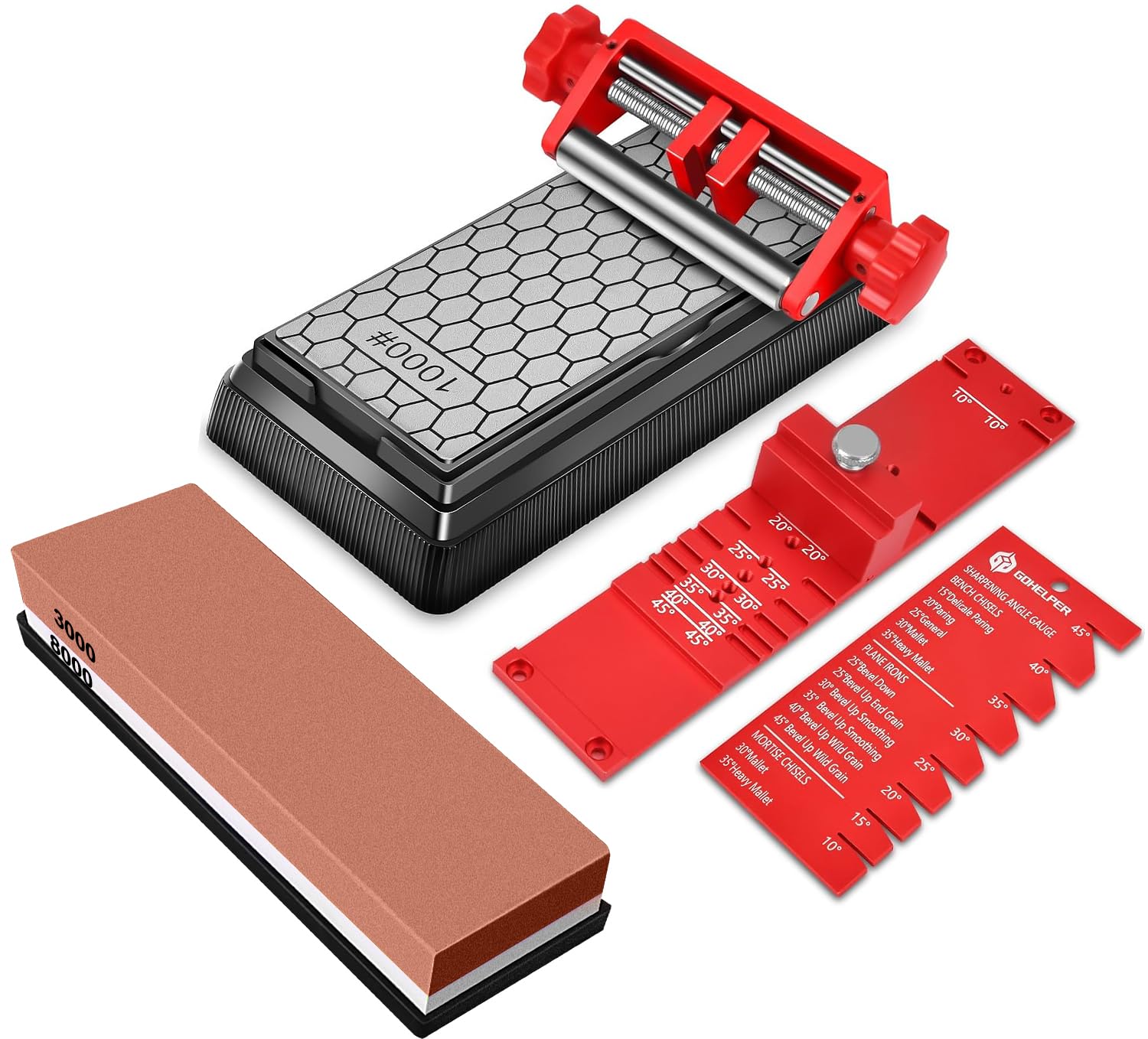
For the money, this kit gives you the most comprehensive stone system in the lineup — four grits (400, 1000, 3000, and 8000) instead of the two-stone setup most competitors offer. That means you can take a chisel from chip repair all the way to a mirror-polished edge without buying additional stones. The jig itself accepts blades from 0.1 to 2.8 inches and includes the same angle fixture and gauge found on the ISQTLMF top pick — essentially the same core hardware with more stone options.
What you give up is the confidence that comes from a well-known brand or a narrower, higher-quality stone selection. Some buyers reported the included stones are functional but not as fast-cutting as premium diamond plates, and the jig’s aluminum frame, while sturdy at 2 pounds, has plastic knobs that feel less durable than the all-metal alternatives. One reviewer called it a “simple tool that works well” and noted it handles tapered blades better than some expensive competitors.
This kit suits the budget-conscious woodworker who wants to try jig sharpening without committing to a premium stone system. If you decide to upgrade later, the jig itself works fine with any water stone or diamond plate you buy down the road — making it the perfect budget buyer who wants maximum versatility for the lowest upfront cost.
Why we’d pick it
- Four grit stones (400–8000) handle repair through final polish
- Wide roller uses full stone width for even wear
- Angle fixture with gauge for repeatable bevels from 10° to 45°
- Thick aluminum frame feels solid and handles tapered blades well
A few caveats
- Plastic knobs may not last as long as metal hardware
- Included stones are decent but not premium-grade diamond plates
6. KAKURI Honing Guide Sharpening Jig

This jig is perfect for the woodworker who owns Japanese planes (kanna) and chisels and wants a guide designed around those tools’ geometry. At 16 ounces with a heavy-duty steel body and handles made from Japanese ash wood, it feels more like a precision machine tool than a plastic accessory. The angled wooden handles let you grip the jig comfortably without reaching near the blade edge — a real safety upgrade over clamp-style jigs.
The feature that serves this buyer best is the 42-to-70-millimeter blade width range for hand planes, which covers standard Japanese kanna exactly. For chisels, the range is 3 to 42 millimeters (1/8 inch to 1-5/8 inches), so it fits the narrower Japanese chisel sizes perfectly. A buyer noted it is “excellent for plane irons due to roller shape, grip, and corner beveling leverage.” The single-roller design and steel body give it excellent wear resistance — this is a tool that will last a lifetime if maintained.
For anyone serious about Japanese woodworking, however, this is the essential tool. The honest limit: it is not ideal for small chisels under 1/2-inch wide, because the grip point and lack of a 90-degree reference make it hard to square up a narrow blade.
Strong points
- Heavy-duty steel body with ergonomic Japanese ash wood handles
- Perfectly sized for Japanese kanna (plane) blades from 42 to 70 mm
- Safe, comfortable grip keeps fingers away from the blade edge
- Handcrafted in Japan by professional tool makers
Before you buy
- Not ideal for chisels narrower than 1/2 inch
- Requires a full-size whetstone — a small pocket stone won’t work
Understanding the Specs
Blade Width Range
This is the minimum and maximum width of chisel or plane iron the jig can securely clamp. If your narrowest chisel is 1/4 inch (6 mm) and the jig’s lower limit is 3/8 inch (10 mm), you cannot sharpen that chisel with it. The GOINGMAKE jig leads here, accepting blades from 5/32 inch (4 mm) up to 3 inches (76 mm).
Angle Fixture vs. Projection Method
An angle fixture — like the one on the ISQTLMF or GOINGMAKE — uses a positioning block to set the blade’s projection (the distance the blade sticks out of the jig) for a specific angle. This is faster and more repeatable than the projection-only method used by the Sharp Pebble, where you measure blade protrusion against a chart. If you sharpen multiple chisels in one session, the fixture saves time.
Roller Design: Single vs. Double
Double-roller jigs (GOINGMAKE, ISQTLMF, AUXTUR, Gohelper) use two rollers on each side for stability — they resist tipping and keep the blade square on the stone. Single-roller jigs (Sharp Pebble, KAKURI) roll directly on the stone and are unaffected by stone thickness, but they offer less lateral stability for very wide blades. Choose based on whether you sharpen mostly plane irons (double roller) or mostly chisels (single roller works fine).
Included Stones vs. Buy-Your-Own
Some kits include a sharpening stone (ISQTLMF, AUXTUR, Gohelper) while others sell the jig alone (Sharp Pebble, KAKURI, GOINGMAKE). If you already own water stones or diamond plates, you do not need the extra stone. If you are starting from scratch, a kit with a stone saves you the hassle of buying one separately, but the included stone is rarely as high-quality as a dedicated aftermarket stone.
FAQ
Can I use a chisel sharpening jig with a belt sander or grinder?
What is the difference between a honing guide and a sharpening jig?
Why does my jig produce an uneven bevel on one side of the blade?
Can I sharpen a knife with a chisel sharpening jig?
Do I need an angle gauge, or can I just eyeball it?
Final Thoughts: The Verdict
For most users, the chisel sharpening jig winner is the ISQTLMF Precision Jig because it combines an adjustable angle fixture, a wide roller, and an included stone at a price that works for beginners and experienced woodworkers alike. If you want the widest blade range for a mixed shop of chisels and plane irons, grab the GOINGMAKE Honing Guide System. And for Japanese tool owners who value craftsmanship and ergonomics, the KAKURI Honing Guide is a lifetime tool that feels as good as it performs.

Mo Maruf
I created WellFizz to bridge the gap between vague wellness advice and actionable solutions. My mission is simple: to decode the research and give you practical tools you can actually use.
Beyond the data, I am a passionate traveler. I believe that stepping away from the screen to explore new environments is essential for mental clarity and physical vitality.