Our readers keep the lights on and my smoothie glass nicely filled. As an Amazon Associate, I earn from qualifying purchases.
A good trail sleep is the difference between a summit and a bail-out. The wrong backpacking sleeping bag means shivering through a 40°F night or hauling a tent full of dead weight. This guide drills into the real-world warmth, packed volume, and material trade-offs that determine whether your bag earns its spot in your pack or costs you miles.
I’m Mohammad Maruf — the founder and writer behind WellFizz. I’ve spent years dissecting outdoor gear specs, comparing fill powers against customer durability reports, and analyzing how insulation types behave in wet versus dry alpine conditions.
After reviewing nine top-selling designs, the backpacking sleeping bag landscape breaks cleanly into lightweight down models for gram-counters and reliable synthetic options for damp-weather trips. This guide matches each to your specific trail conditions and budget.
How To Choose The Best Backpacking Sleeping Bag
Every ounce matters when your bag rides on your back all day. The challenge is balancing warmth-to-weight ratio, insulation type, and packed size without overspending on features you won’t use in your specific terrain.
Decoding Temperature Ratings
Ignore the marketing number. Look for ISO or EN-rated limit temps — that’s the temperature at which a standard adult can sleep curled up without shivering. A 20°F bag often has a comfort rating near 32°F for cold sleepers. If you sleep cold, aim for a bag rated 10-15°F lower than your expected low.
Down vs Synthetic Fill
Down (measured in fill power, or FP) delivers the best warmth-per-ounce and compresses smallest. Anything above 650FP is good for backpacking. Synthetic fill is heavier and bulkier but retains insulation when wet — critical for damp climates or creek-side camping. For dry western trails, down wins. For coastal or humid trips, synthetic is the safer call.
Shape and Fit
A tapered mummy shape minimizes dead air space, making it the most thermally efficient design for its weight. Semi-rectangular bags offer more movement room but require more insulation to stay warm, adding bulk. Your height and shoulder width determine which size (Short, Regular, Long) actually seals heat in without being restrictive.
Quick Comparison
On smaller screens, swipe sideways to see the full table.
| Model | Category | Best For | Key Spec | Amazon |
|---|---|---|---|---|
| Therm-a-Rest Hyperion 32F | Premium Down | Ultralight gram-counters | 18 oz, 900FP down | Amazon |
| Sea to Summit Spark | Premium Down | Warm-weather ultralight trips | 14.56 oz, 850+FP down | Amazon |
| Rab Men’s Ascent 10°F | Premium Down | Cold-weather alpine backpacking | 650FP, 24 oz fill weight | Amazon |
| Kelty Cosmic 20 Down | Mid-Range Down | First down bag for 3-season hikers | 550FP, 2 lbs 6 oz | Amazon |
| Kelty Cosmic Synthetic 20 | Mid-Range Synthetic | Cold, damp conditions | 2 lbs 13 oz, 30.5 oz fill | Amazon |
| Naturehike CW295 | Budget Down | Entry-level backpacking, warm sleepers | 1.3 lbs, 650FP down | Amazon |
| QEZER Down Bag | Budget Down | Essentials-focused budget bag | 1.61 lbs, 600FP down | Amazon |
| ZOOOBELIVES Alplive T400 | Budget Down | Couples sharing a double bag | 1.7 lbs, 650FP down | Amazon |
| Teton LEEF | Budget Synthetic | Wet-weather trips on a budget | 3.5 lbs, synthetic fill | Amazon |
In‑Depth Reviews
1. Therm-a-Rest Hyperion 32F
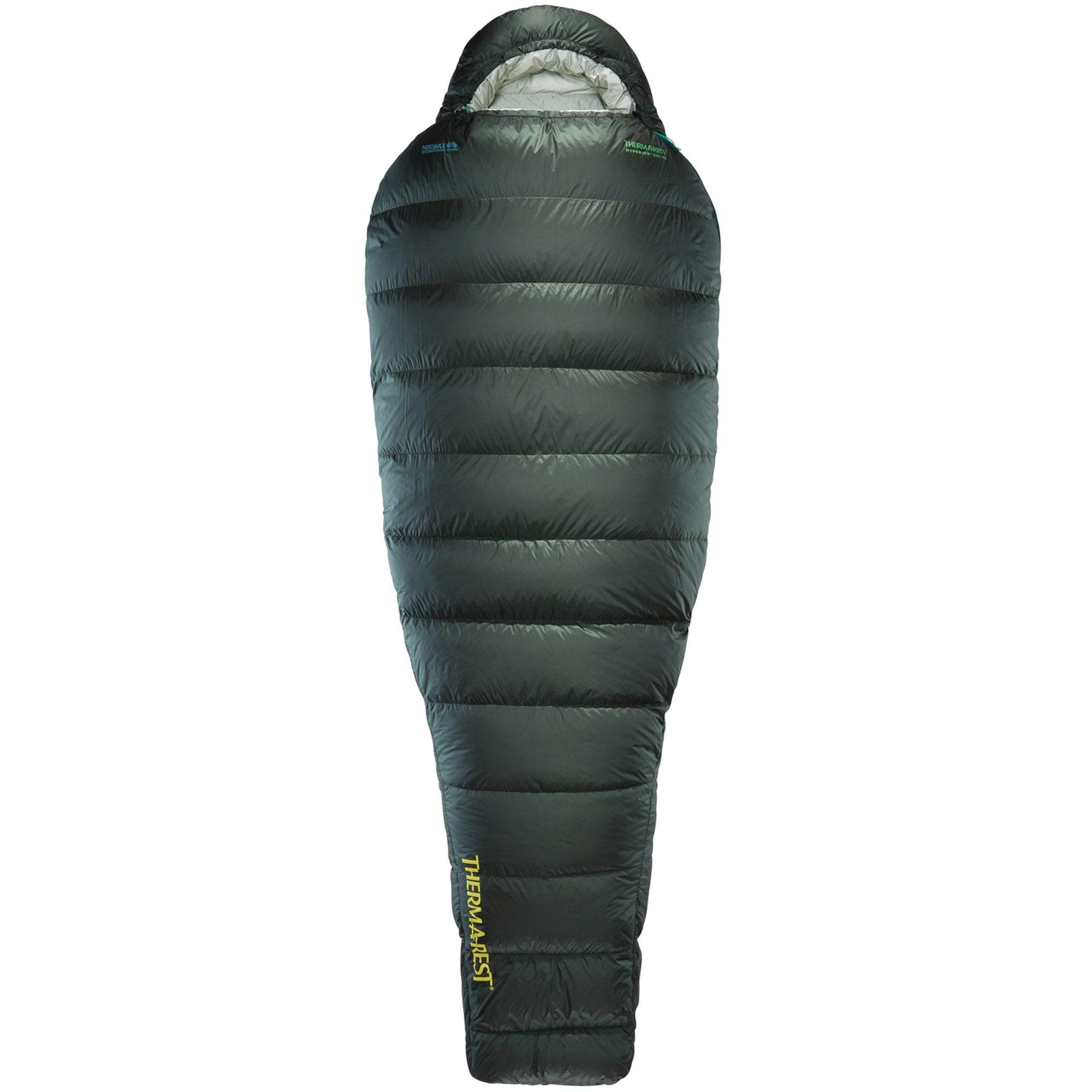
The Hyperion redefines what a summer backpacking bag can weigh. At just 18 ounces with 900-fill Nikwax Hydrophobic Down, it delivers a warmth-to-weight ratio that ultralight enthusiasts will find hard to beat. The box baffle construction prevents cold spots more effectively than cheaper sewn-through designs, and the 10D nylon ripstop shell resists snags reasonably well for its feathery weight.
Real-world feedback confirms its 32°F rating is accurate for warm sleepers, but several users report feeling cold below 40°F when paired with low-R-value pads. The ergonomic mummy cut is efficient but snug — not ideal for broad shoulders or restless side-sleepers. SynergyLink Connectors let you attach the bag to a compatible Therm-a-Rest pad, which helps manage the slippery 10D liner fabric on uneven tent floors.
The compressed size (5.5 x 6 inches) easily fits inside a frameless pack, and the included compression sack works well. For anyone trimming every gram on a summer thru-hike, the Hyperion is a category-defining option. Just pair it with a warm-rated sleeping pad and an insulated layer if you hit shoulder-season temps.
Why it’s great
- Remarkably light 18-ounce total weight saves ounces over any comparable down bag
- 900FP hydrophobic down maintains loft longer than untreated fill in damp conditions
- Box baffle design eliminates heat-stealing cold spots for consistent warmth
Good to know
- Slippery 10D liner requires pad attachment loops or a fitted pad to prevent sliding
- Snug mummy cut restricts arm movement; not comfortable for broad-shouldered sleepers
- Comfort rating is optimistic; most users need base layers below 40°F
2. Sea to Summit Spark Ultralight
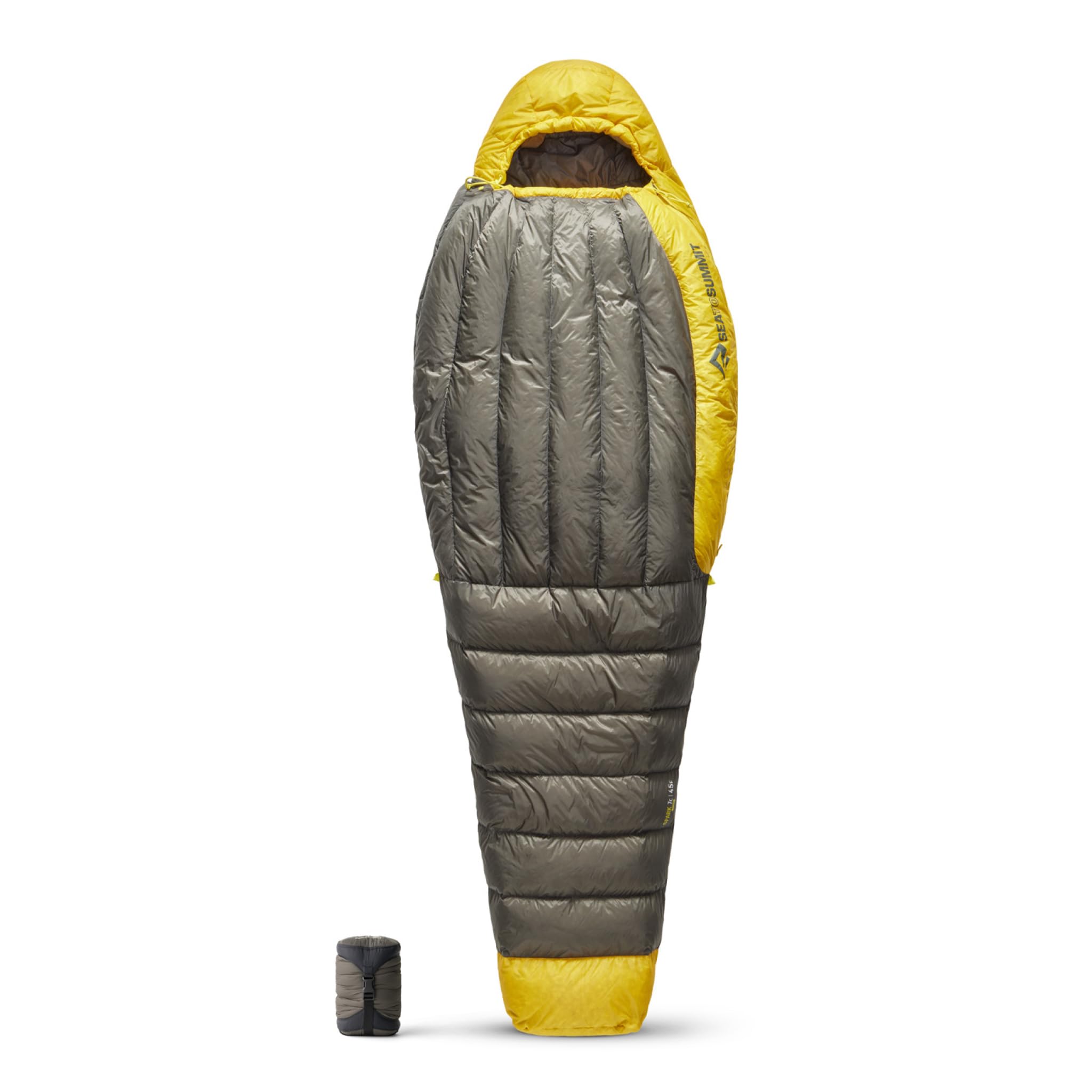
The Spark takes ultralight warmth to the edge of possibility. Weighing just 14.56 ounces with 850+ fill power down, it compresses smaller than a football and disappears into the corner of a frameless pack. The 10D shell uses a PFC-free DWR finish for light moisture resistance, and the YKK #5 zipper operates smoothly despite the minimalist weight budget.
Customer reports consistently praise its surprising warmth for a 45°F-rated bag — several users stayed comfortable down to 40°F with a good base layer. But this is strictly a warm-weather tool. Below 40°F, the sewn-through baffles create thermal bridges that steal heat, and the lack of a draft collar or hood baffle means any shoulder-season use requires a sleep liner and insulated clothing.
The contoured mummy shape offers enough room to shift positions without excess airspace, and the Regular size accommodates sleepers up to 6 feet easily. If your backpacking season runs June through August and you weigh every gram, the Spark delivers unmatched lightness. For colder spring or fall trips, look to the warmer Rab or Kelty down models.
Why it’s great
- Extremely packable; compressed size fits inside a standard hydration sleeve
- Premium 850+FP down with non-PFC Hydrophobic treatment retains loft in light moisture
- Smooth YKK #5 zipper resist snags even in the dark
Good to know
- Sewn-through baffle construction limits warmth below 45°F; add a liner for cooler nights
- Thin 10D shell requires careful use to avoid punctures from tent poles or rocks
- No draft collar or hood baffle reduces heat retention around the neck
3. Rab Men’s Ascent Down 10°F
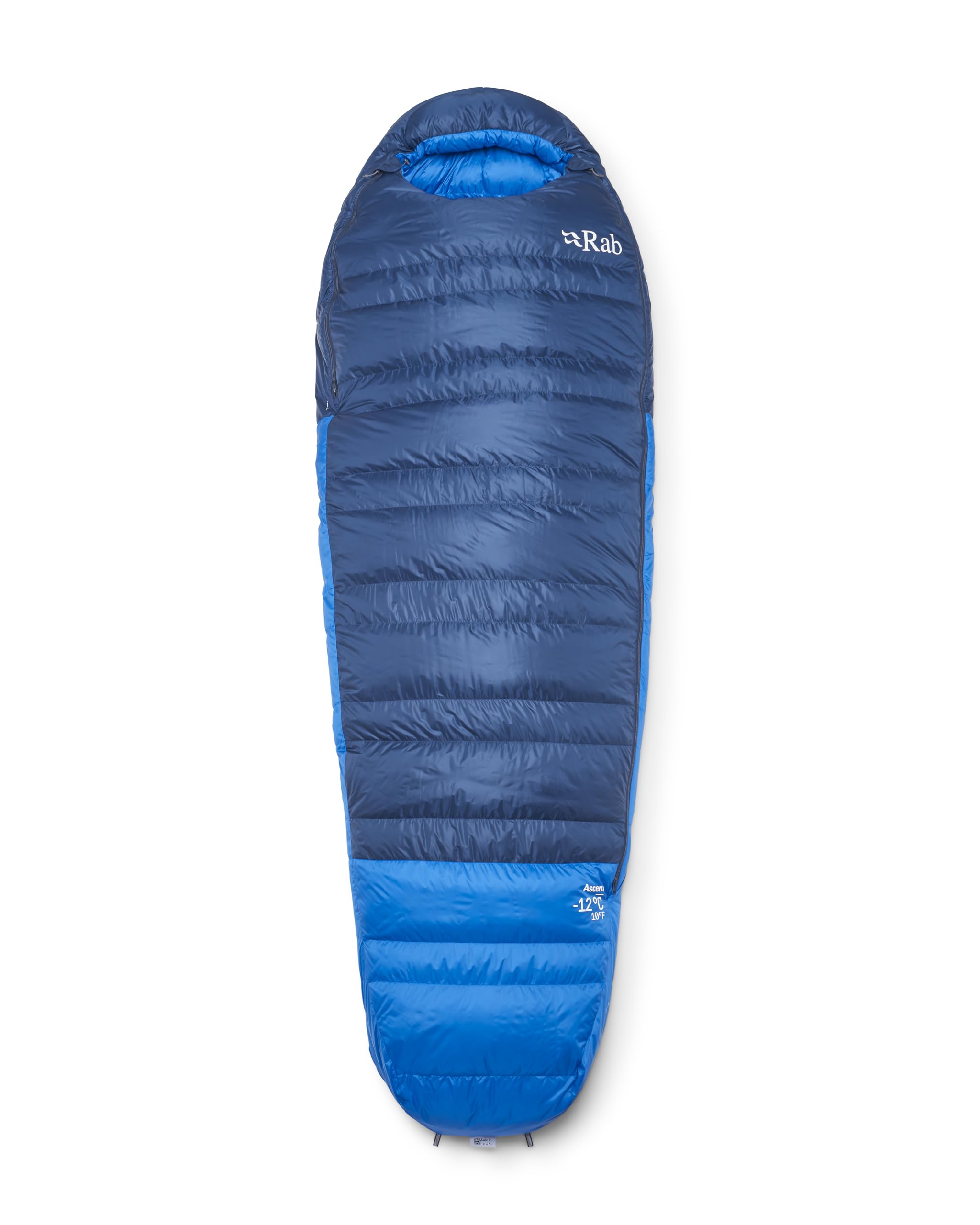
The Rab Ascent sits at the intersection of serious cold-weather performance and backpackable weight. With a 10°F limit rating, 650FP European duck down, and a 20D Pertex Quantum shell, it shrugs off wind and light condensation better than typical ultralight fabrics. The L.O.F.T baffling system prevents down migration, and the 3D collar combined with an anatomic hood seals warmth effectively around the neck and face.
At 48 ounces for the regular size, the Ascent is heavier than summer-focused bags but remains reasonable for three-season alpine carries where temperatures drop below freezing. The ¾-length zipper reduces weight and heat loss, though some users find entry and exit slightly restrictive compared to full-length zippers. The Pertex Quantum shell has proven durable against brush and tent poles, outlasting thinner 10D alternatives.
One verified reviewer noted that the bag performed well in damp Welsh conditions without significant loft loss after multiple nights. The hydrophobic Grangers treatment on the down adds real moisture resistance, though synthetic fill would still be more reliable in sustained rain. For mountaineering, shoulder-season backpacking, or high-altitude trips where nights hit 20°F, the Ascent is a premium choice.
Why it’s great
- 10°F limit rating with 24 oz of 650FP down handles genuine freezing conditions
- 20D Pertex Quantum shell resists wind and moisture better than thinner ultralight fabrics
- L.O.F.T baffling prevents down from shifting and creating cold spots
Good to know
- 48-ounce weight is heavy for summer ultralight trips; best for cooler shoulder seasons
- Snug shoulder girth may not accommodate broad-chested sleepers comfortably
- ¾-length zipper makes venting feet harder on warmer nights
4. Kelty Cosmic 20 Down

The Cosmic 20 Down is Kelty’s most popular down bag for good reason: it offers genuine 20°F performance with 550FP down at a weight that won’t break your back. The recycled nylon and polyester shell with PFAS-free DWR offers a sustainable twist without sacrificing feel or durability. The dual-direction zippers make venting easy, and the down-filled draft collar effectively seals warmth around the neck.
Users report comfort down to the upper 20s°F when paired with a good pad and base layer. The mummy cut is standard-kosher — snug but not suffocating — though the shoulder girth can feel tight for muscular sleepers over 190 pounds. The Long version adds 6 inches of length for 6′ 6″ sleepers. The 13 x 7-inch stuffed size fits easily in a 50-liter pack without dominating the compartment.
Where the Cosmic truly shines is value. It delivers 90% of the warmth-to-weight performance of premium down bags at roughly half the price. The RDS-certified down ensures ethical sourcing, and Kelty’s limited lifetime warranty backs the build. For a first down bag purchase or a reliable 3-season workhorse, the Cosmic 20 Down is the smart money play.
Why it’s great
- Impressive warmth-to-price ratio; competes with bags costing twice as much
- Recycled shell and liner materials with PFAS-free DWR reduce environmental impact
- RDS-certified down with traceability ensures ethical sourcing
Good to know
- 550FP down is less compressible than 650FP+ fills; packed size is decent but not premium
- Snug shoulder area limits comfort for broad-shouldered or larger-framed sleepers
- Not ultralight; 2 lbs 6 oz is solid for the price but heavier than premium competitors
5. Kelty Cosmic Synthetic 20

The Cosmic Synthetic is the damp-weather counterpart to the Cosmic Down. Using Kelty’s Cirroloft synthetic insulation, it provides reliable warmth even when soaked — a critical advantage for kayak campers, coastal hikers, or anyone who can’t guarantee dry conditions. The 380T nylon taffeta shell feels smooth and durable, and the integrated compression stuff sack packs the bag down to roughly the size of a small watermelon.
At 2 pounds 13 ounces for the Regular size, the synthetic fill is noticeably heavier than comparable down models, but the trade-off is peace of mind in wet environments. Users report comfort into the low 30s°F without extra layers, and the 20°F rating feels honest. The footbox vent zipper is a welcome feature for temperature regulation, letting you cool your feet without unzipping the main zipper.
The stash pocket on the exterior is handy for a phone or headlamp. The regular size fits sleepers up to 6 feet comfortably, though users with size 13 feet mentioned the footbox is snug for toe wiggle. For backpackers who prioritize worry-free insulation over absolute minimum weight, the Cosmic Synthetic 20 is a proven, affordable choice that won’t let you down when the weather turns.
Why it’s great
- Cirroloft synthetic insulation retains warmth even when wet, unlike down
- Integrated compression straps and stuff sack make packing straightforward
- Footbox vent zipper adds valuable temperature control on milder nights
Good to know
- Heavier than down alternatives; 2 lbs 13 oz adds up on long carries
- Packed size is larger than down bags of the same temperature rating
- Snug footbox for larger feet; not ideal for users above size 12
6. Naturehike CW295 / CWM400

Naturehike’s CW295 series punches far above its price bracket. With 650FP RDS-certified duck down and a 20D 400T nylon shell, this bag weighs just 1.3 pounds and packs to the size of a Nalgene bottle. The individual down channel design prevents fill migration, while the YKK two-way zipper operates smoothly. Recommended comfort temperature is 42.8–51.8°F, with an extreme rating of 32°F.
Customer reports confirm the CW295 is genuinely warm near freezing — a surprising feat for a bag at this weight and price. The semi-rectangular shape offers more room than a strict mummy, which side sleepers appreciate. Several users noted this is the best budget down bag they’ve owned, citing its balance of packability and warmth. The drawstring design has a known weak point, so avoid over-tensioning the cord.
The main shortcoming is sizing: the CW295 short (74.8″ length) is too small for anyone over 5’9″, and even the CWM400 (78.7″) is snug for 6-footers. The 20D shell feels delicate but held up during typical 3-season use. For taller or broader backpackers, this bag may be too restrictive; for average-sized summer hikers, it’s an exceptional value down bag that rivals brands costing three times as much.
Why it’s great
- Outstanding warmth-to-weight ratio for the price; 650FP down at 1.3 lbs is rare at this cost
- RDS-certified down with 20D nylon shell offers premium build quality on a budget
- Individual down channels prevent cold spots by stopping fill migration
Good to know
- Drawstring closure has weak stitching that can fail; avoid tensioning the cord fully
- Short sizes only; 6-foot-plus sleepers will find the bag too restrictive
- 20D shell is thinner than mid-range options; requires careful site selection
7. QEZER Down Sleeping Bag
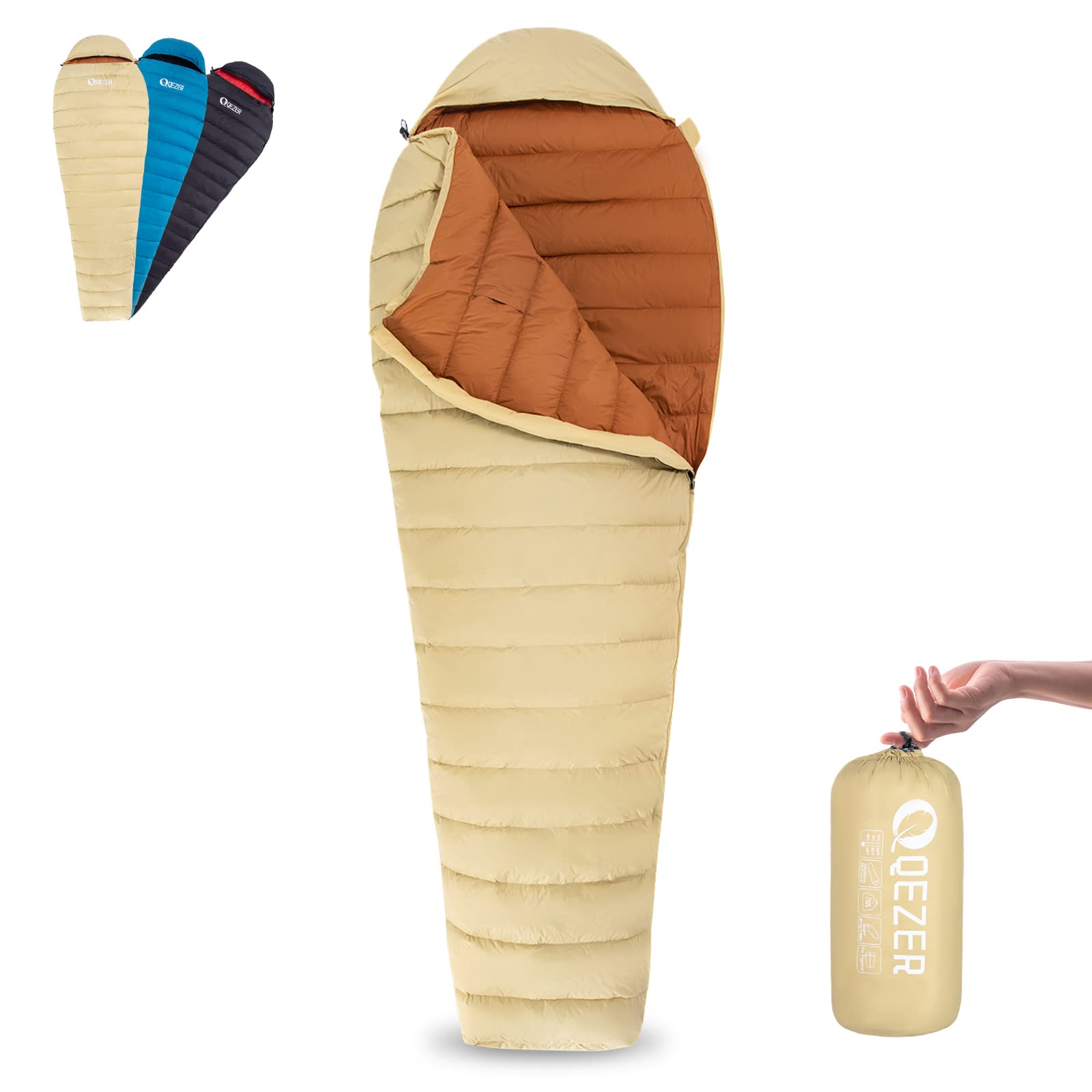
The QEZER Down Bag offers a spacious alternative to cramped mummy designs. Filled with 14.11 ounces of 600FP duck down, it measures 84.65″ x 32.28″ — notably wider than typical budget bags. The trapezoidal bottom provides extra foot room, and the left-right zippers allow two bags to join into a double. The comfort temperature range of 45–61°F limits it to summer use, but within that window it performs well.
Users consistently praise its weight (1.61 lbs) and packability (10.63″ x 5.91″ compressed). Several reported sleeping warm in 40°F conditions with base layers, though the 600FP down and sewn-through construction lose steam below that threshold. The 400T nylon fabric resists down leakage effectively, and the zipper operation has been described as smooth across multiple reviews.
The bag’s generous width is a double-edged sword — it allows more movement but creates more dead air to heat. For cold sleepers, the extra space means you’ll need a liner or extra layer at the bottom of its comfort range. For warm sleepers or summer-only campers who value space over thermal efficiency, the QEZER is a lightweight, roomy, and affordable choice that avoids the claustrophobia of typical mummy cuts.
Why it’s great
- Roomy 32.28″ width provides extra space without significant weight penalty
- Lightweight at 1.61 lbs with good packability for summer trips
- Two-way zippers allow bags to join into a double sleeping bag
Good to know
- 600FP down is less lofty than higher-fill alternatives; warmth ceiling is lower
- Sewn-through baffle construction creates cold spots below 45°F
- Generous width requires more body heat to warm up; cold sleepers may feel chilly
8. ZOOOBELIVES Alplive T400

The Alplive T400 is designed for flexibility. With 650FP duck down and a 20D nylon shell with DWR finish, this envelope-style bag can serve as a sleeping bag, unzip fully into a large quilt, or zip together with a second T400 to create a double bag for two people. The dual two-way YKK zippers allow footbox venting and side openings. Comfort rating is 32–50°F, making it a warm-weather or summer bag.
User reports highlight the spacious envelope shape as a key selling point for those who feel confined by mummy bags. Several couples noted that zipping two bags together works well, though the lack of a draft collar at the mating point can let cold air in. The fabric texture has been described as “plasticky” by some users, and the absence of a zipper baffle can create a draft along the zipper track on windy nights.
At 1.7 pounds, the Alplive T400 is light enough for backpacking, though its packed volume (11″ x 6.7″) is larger than comparably rated mummy bags due to the rectangular cut. The down has a known odor issue out of the bag — multiple reviewers reported a poultry smell that required washing to resolve. Once aired out, it performs as advertised. For couples who want a convertible, shareable sleeping system, the Alplive T400 is a creative solution.
Why it’s great
- Envelope shape unzips fully into a quilt or zips with a second bag for couple use
- 650FP down with DWR finish offers decent moisture resistance for the price
- Dual two-way YKK zippers allow versatile venting and footbox access
Good to know
- No zipper baffle creates a draft along the zipper track in breezy conditions
- Some units have a strong poultry odor that requires washing to eliminate
- Rectangular shape packs larger than mummy bags of comparable warmth
9. TETON Sports LEEF
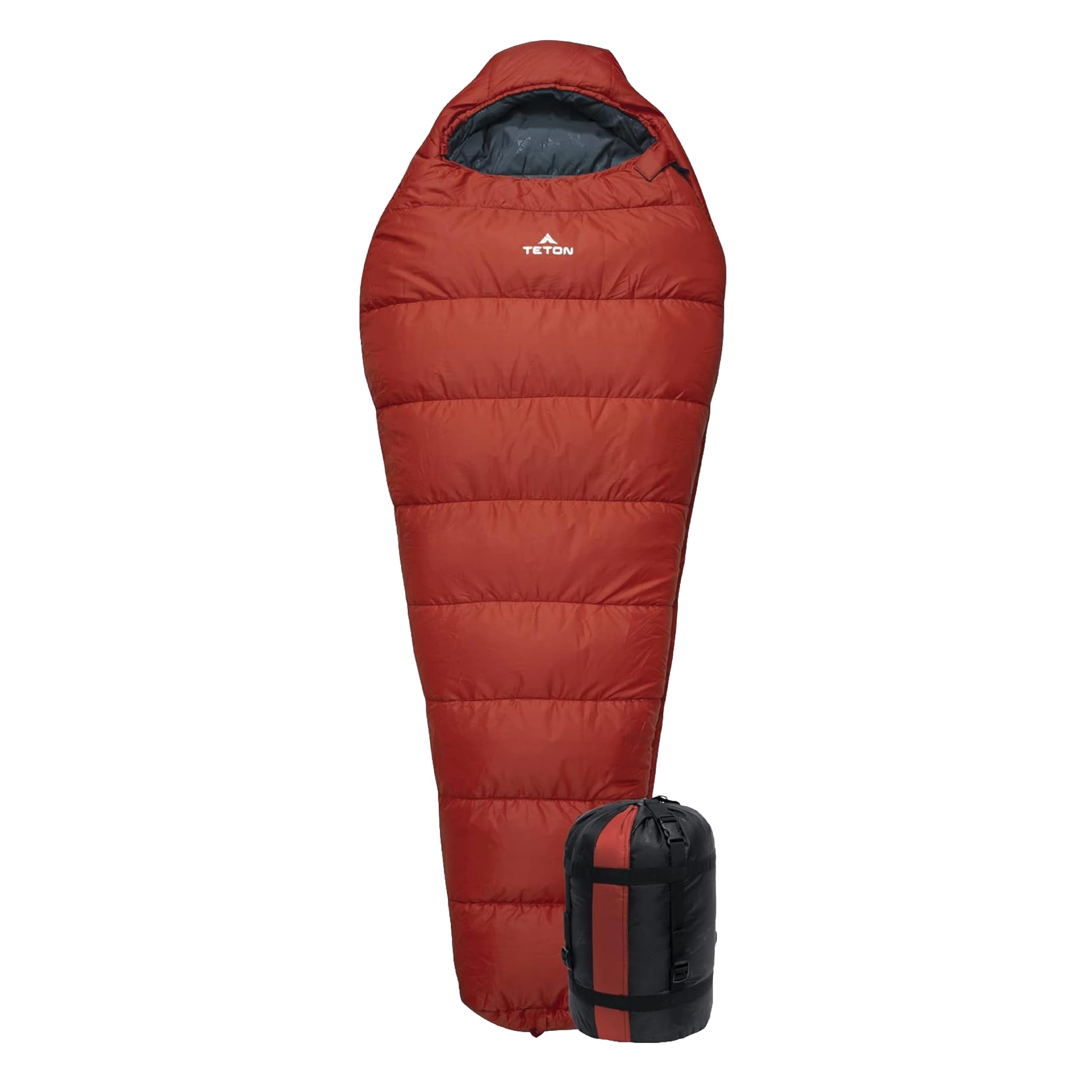
The TETON Sports LEEF is the synthetic-fill workhorse that earned its reputation through durability, not ultralight specs. Using micro-fiber insulation with a polyester ripstop shell, this bag delivers reliable warmth in the 20/30°F range without the moisture anxiety of down. Several long-term owners reported 60–70 nights of use without significant lumpiness or insulation degradation — a testament to the build quality.
At 3.5 pounds, the LEEF is notably heavier than down alternatives, and its packed volume is correspondingly larger. But for car camping, canoe trips, or backpacking in persistently damp environments, the weight penalty is offset by total peace of mind. The roomier mummy design offers more shoulder and foot room than classic mummy shapes, and users up to 6’5″ reported a comfortable fit with room for size 14 boots.
The included compression sack is functional but requires effort to squeeze the synthetic fill down to a manageable size. The zipper mechanism with Velcro lock stays secure during the night. The LEEF is not the right choice for gram-counting thru-hikers, but for wet-weather scouts, canoe campers, or budget-conscious backpackers who value indestructible warmth over pack weight, it remains a top contender after years of positive owner feedback.
Why it’s great
- Proven durability; owners report 60+ nights without insulation degradation
- Roomier mummy design accommodates larger frames, tall sleepers, and size 14 feet
- Synthetic fill provides reliable insulation even when damp — no down panic
Good to know
- Heavy at 3.5 lbs; significantly heavier than any down bag in this guide
- Packed volume is large even in the compression sack; takes up major pack space
- Not machine washable; spot cleaning required to maintain insulation performance
FAQ
Will a 20°F sleeping bag keep me warm in 20°F weather?
How do I know if down or synthetic insulation is better for my hiking area?
Can I use a 32°F bag in winter with extra layers?
How do I maintain down loft over multiple seasons?
What sleeping pad R-value do I need to match a 20°F bag?
Final Thoughts: The Verdict
For most users, the backpacking sleeping bag winner is the Therm-a-Rest Hyperion 32F because it sets the ultralight standard with 900FP down and an 18-ounce total weight that disappears into any pack. If you want a reliable cold-weather bag with proven moisture resistance, grab the Rab Men’s Ascent 10°F. And for the best balance of warmth, weight, and price on a 3-season budget, nothing beats the Kelty Cosmic 20 Down.

Mo Maruf
I created WellFizz to bridge the gap between vague wellness advice and actionable solutions. My mission is simple: to decode the research and give you practical tools you can actually use.
Beyond the data, I am a passionate traveler. I believe that stepping away from the screen to explore new environments is essential for mental clarity and physical vitality.