Our readers keep the lights on and my smoothie glass nicely filled. As an Amazon Associate, I earn from qualifying purchases.
Your one-year-old wants to see the world, but your lower back is starting to protest every time you lift them out of the crib. The narrow carriers designed for floppy newborns no longer fit a wiggly toddler who arches, leans, and demands to be carried facing out. At this stage, the wrong carrier causes hip strain for your child and shoulder fatigue for you—two problems that compound as your toddler approaches the 30-pound mark.
I’m Mohammad Maruf — the founder and writer behind WellFizz. I’ve analyzed the weight distribution systems, hip-health ergonomics, and fabric engineering of dozens of toddler carriers to separate the supportive designs from the ones that leave you hunched over after 20 minutes.
Whether you’re upgrading from a newborn wrap or buying your first structured carrier for a child who has outgrown the infant stage, this guide breaks down the seven best options to help you find the right baby carrier for 1 year old that keeps both of you comfortable on every outing.
How To Choose The Best Baby Carrier For 1 Year Old
By twelve months, your baby has gained significant head control, trunk strength, and curiosity—but their hip sockets are still developing. The carrier that worked at four months may now feel restrictive or painful. These four criteria will steer you toward a model that fits a growing toddler without sacrificing your own comfort.
Seat Width and Panel Height Adjustment
A one-year-old’s thighs need support from knee pit to knee pit in the natural “M” position. Fixed-width carriers meant for newborns tend to be too narrow, forcing the legs into a straight hang that stresses the hip joints. Look for a carrier whose seat width adjusts outward as your child grows—ideally from around 5 inches at the smallest setting to 8 inches or more when expanded. The back panel height matters equally: a panel that ends below your toddler’s shoulder blades offers no neck support during nap time, while one that covers the ears restricts their view and airflow.
Weight Distribution System for the Wearer
A 25-pound toddler produces roughly 40 pounds of force on your lower spine when carried asymmetrically on one hip. Structured carriers counter this with a padded lumbar support pad that sits on your hip bones rather than your soft waist, a sternum strap that pulls the shoulder straps inward to prevent them from sliding off, and thick, foam-filled shoulder straps that spread the load across your deltoids and trapezius. Carriers that rely on thin nylon webbing or unpadded straps will cause noticeable discomfort within 30 minutes once your child exceeds 20 pounds.
Breathability and Temperature Regulation
One-year-olds generate significant body heat, and the shared surface area between your torso and theirs creates a microclimate that can reach uncomfortable temperatures even in moderate weather. Mesh paneling on the front of the carrier allows air to circulate between your chest and your baby’s back, reducing sweat buildup. Carriers made from 100% cotton or cotton-linen blends breathe better than polyester-heavy fabrics but may retain moisture. For warm climates or indoor use, prioritize carriers with a mesh torso panel over solid fabric.
Carry Position Versatility
Your 1-year-old’s mood changes hourly. A carrier that supports both front-facing-in (for naps or crowded spaces) and front-facing-out (for sightseeing) gives you options without switching gear. Back carry becomes feasible around 12 to 15 months when your child can sit independently and hold their trunk upright—look for a carrier that allows you to reach the back position without needing a second person to help buckle. Hip carry, offered by some seat-style carriers, provides a quick middle-ground position for short stints around the house.
Quick Comparison
On smaller screens, swipe sideways to see the full table.
| Model | Category | Best For | Key Spec | Amazon |
|---|---|---|---|---|
| Ergobaby Omni Classic | Structured Soft | Long walks and all-day wear | Bucket seat, 7-45 lbs | Amazon |
| Baby Tula Explore | Adjustable Panel | Plus-size parents and tall toddlers | Padded lumbar, 7-45 lbs | Amazon |
| Mabē Monarch | Cotton Blend | Style-conscious everyday carry | Cotton/linen, 7-35 lbs | Amazon |
| Momcozy Hip Seat | Hip Seat 2-in-1 | Quick errands and hip carry | Rotating seat, up to 44 lbs | Amazon |
| BabyBjörn Mini | Compact Jersey | Newborn stage up to 12 months | 3D jersey, 7-25 lbs | Amazon |
| Grownsy Houndstooth | Lightweight | Budget-friendly first carrier | 3-point support, 7-44 lbs | Amazon |
| Boba Air | Ultra-Light | Travel and diaper bag storage | Packs to pouch, 15-45 lbs | Amazon |
In‑Depth Reviews
1. Ergobaby Omni Classic
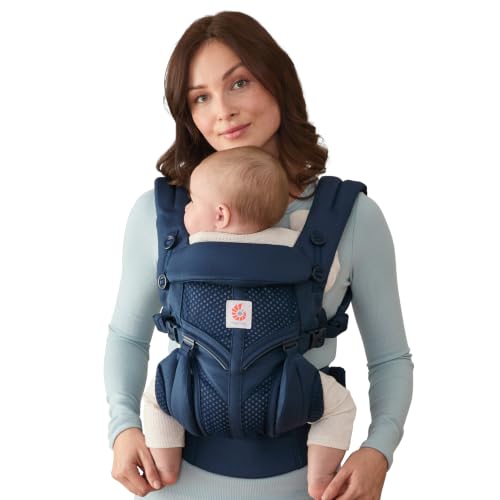
The Omni Classic remains the benchmark for toddler-carrying precisely because its patented bucket seat doesn’t collapse under a 30-pound child. Unlike carriers that rely on a flat flap of fabric, the Ergobaby’s seat forms a deep, rounded pocket that keeps your toddler’s hips in the natural M-position without requiring them to actively straddle. The adjustable back panel slides up as your child grows, providing enough coverage for a napping head without blocking their peripheral vision when awake.
From the wearer’s perspective, the lumbar pad is thick enough to notice immediately: it shifts the weight off your lower spine and onto your pelvis, which changes the experience of a 40-minute grocery trip from painful to sustainable. The cross-back or H-back strap configuration lets you choose between a racerback feel for mobility or a traditional backpack setup for stability, and the sternum strap prevents the shoulder straps from migrating toward your neck.
The breathable mesh version circulates air noticeably better than cotton-only carriers, though the mesh fabric picks up lint and pet hair readily. Four carry positions—inward, outward, back, and hip—cover every phase from newborn to 48 months, but the back carry does require some practice to buckle solo. Overall, this is the safest all-around choice for a 1-year-old who will likely reach the 40-pound range before outgrowing it.
Why it’s great
- Industry-leading bucket seat maintains hip-healthy M-position at any weight
- Lumbar pad and wide waist belt prevent lower back fatigue during long carries
- Four carrying positions cover inward, outward, back, and hip without extra accessories
Good to know
- The rear buckle is difficult to clip alone when using back-carry mode
- Mesh panel requires frequent wiping to stay clean in dusty environments
2. Baby Tula Explore

The Baby Tula Explore distinguishes itself with a two-stage panel adjustment that genuinely works without an infant insert—lower the panel for a 7-pound newborn, raise it for a 35-pound toddler, and the seat width widens automatically as you go. For a 1-year-old, this means you can dial in a fit that matches their exact torso length, which is crucial when your child is on the shorter or taller side of the growth curve. The 3D mesh torso panel is soft against the skin and highly breathable, making this carrier a strong candidate for summer walks or warm indoor use.
The padding on both the shoulder straps and the lumbar support is generous without being bulky—about 1.5 inches of closed-cell foam that does not compress after hours of wear. The waistband fits from XS to 4X, a range that accommodates different caregiver body types without requiring an extension buckle. The hood stores neatly in a zippered pouch and snaps on to provide sun coverage or nap support without detaching the baby.
One limitation: the outward-facing position is comfortable for the baby but the panel height cannot be lowered while in that mode, so taller toddlers may find their view partially blocked by the top edge. The buckles are high-quality plastic with a reassuring click, and the cotton exterior feels substantial without being stiff. If your 1-year-old is a contact napper, the padded neck support pillow lets them rest their head sideways without craning their neck.
Why it’s great
- Two-stage panel adjustment changes both height and width for precise ergonomic fit
- Padded lumbar and shoulder straps distribute toddler weight without pressure points
- Inclusive sizing accommodates XS to 4X waist ranges without an extension
Good to know
- Outward-facing mode limits panel height adjustment for taller toddlers
- Heavier construction compared to ultra-light travel carriers
3. Mabē Monarch
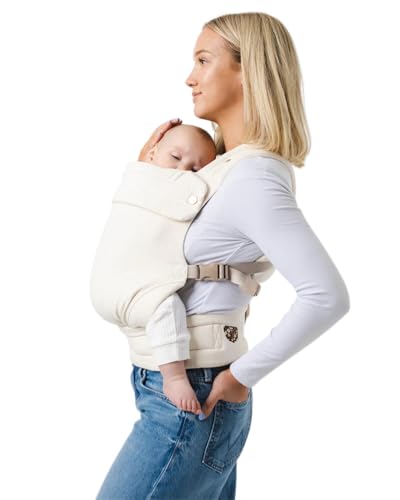
The Mabē Monarch is built for the parent who refuses to compromise on aesthetics but still demands ergonomic integrity. The 90% cotton, 10% linen fabric blend feels substantially softer than standard cotton twill carriers, and it develops a slight lived-in give after a few wears that conforms to the baby’s body rather than fighting it. The deep seat design promotes the M-position with a firm, curved bucket that does not flatten out when the carrier is tightened, and the seat width accommodates toddlers up to 35 pounds without forcing their thighs into an unnatural spread.
What surprised me during analysis was how well the shoulder straps distribute weight despite lacking the thick foam pads seen on the Ergobaby or Tula carriers. The straps are wider than average—around 4 inches at the shoulder—and the X-shaped back design keeps them anchored so they don’t slide down toward your elbows. The linen content in the fabric wicks moisture noticeably better than pure cotton, which helps during the inevitable sweaty summer outings.
The trade-off: the weight capacity tops out at 35 pounds, lower than the 45-pound limit of the competition, so a 90th-percentile 3-year-old may outgrow it before age 2. The carrier is machine washable on cold gentle cycle, but the linen blend wrinkles easily and looks more casual after washing. It supports three carry positions (inward, outward, back) and does not include an infant insert—the seat is designed to work from 3 months without extra padding. For a sleek, breathable carrier that feels like clothing rather than gear, this is the standout choice.
Why it’s great
- Cotton-linen blend offers superior breathability and a soft, non-bulky feel
- Deep, firm bucket seat maintains M-position without collapsing under weight
- Wide shoulder straps and X-back design prevent strap slippage on narrow shoulders
Good to know
- 35-pound maximum weight limit may not last through the toddler years
- Linen fabric wrinkles and shows wear after repeated machine washing
4. Momcozy Baby Carrier with Hip Seat

The Momcozy Hip Seat carrier solves a problem unique to the toddler phase: the need to shift positions constantly without taking the entire carrier off. The 360-degree rotating hip seat clicks into six positions, so you can spin your 1-year-old from facing your chest to facing sideways on your hip to facing outward without unbuckling a single strap. For a parent who holds their toddler on one hip while cooking or tidying up, this removes the friction of re-buckling every time the baby’s mood changes.
The seat itself is a 10mm thick cushion that sits on your waist like a shelf, and it unzips from the upper harness to function as a standalone Tushbaby-style hip seat for quick carries. The X-structure upper harness straps cross in the back and buckle at the front, making it possible to put on the carrier one-handed while holding a wiggly baby. The waist belt adjusts with Velcro rather than buckles, which allows micro-adjustments but wears out faster than nylon webbing—users report the Velcro still holds after months of daily use, but it is the component most likely to fail long-term.
The carrier supports up to 44 pounds, and the seat width is generous enough for a 25-pound toddler’s thighs. The main caveat: the hip seat adds bulk to the waist area, so bending down to pick up a dropped toy requires a slight squat rather than a forward fold. The zipper that connects the seat to the harness can loosen if the side snaps pop open, a quirk noted by several users. For parents who prioritize quick position changes over minimalist design, this is a uniquely practical option.
Why it’s great
- 360-degree rotating hip seat enables position changes without removing the carrier
- Detachable seat doubles as a standalone hip seat for quick household carries
- X-structure harness and Velcro waist allow fast one-handed donning
Good to know
- Side snaps can pop loose under heavy use, loosening the seat connection
- Velcro waist belt may lose grip over time compared to buckle-style belts
5. Boba Air

The Boba Air is a travel-first carrier designed for parents who want a backup option they can keep in a diaper bag or clip to a purse. At 0.9 pounds, it weighs less than most baby carriers’ shoulder straps alone, and it folds into its own hood pocket to produce a package roughly the size of a rolled-up rain jacket. For a 1-year-old on a complicated travel day—airport, taxi, museum, stroller, back to airport—having this third arm option stashed in a side pocket changes the calculus of whether to bring a carrier at all.
The trade-off for the negligible weight is a reduction in padding throughout. The shoulder straps are thin foam wrapped in quick-dry nylon, and the waist belt is essentially a nylon webbing strap with a small cushioned section. For a toddler in the 15-20 pound range, this is perfectly comfortable for airport dashes and short sightseeing stops. At 30 pounds, the webbing begins to dig into the shoulders, and the lack of lumbar support becomes noticeable within an hour. The carrier supports both front and back carry positions, though back carry is less comfortable due to the minimal padding on the shoulder straps.
The nylon fabric dries in minutes after exposure to rain or a splash pad, and it resists salt stains from sweat better than cotton carriers. The hood unclips to provide sun coverage and nursing privacy, and the leg openings are edged with a soft mesh that does not chafe. The Boba Air is certified hip-healthy by the International Hip Dysplasia Institute, so the seat shape remains safe even though the overall feel is minimalist. If your primary need is a carrier that disappears into a bag when not in use, this is the best execution available.
Why it’s great
- Weighs under a pound and folds into its own hood pocket for compact storage
- Quick-drying nylon fabric resists stains and moisture during outdoor use
- Certified hip-healthy seat shape despite minimalist construction
Good to know
- Thin shoulder straps become uncomfortable for long carries with toddlers over 25 pounds
- No lumbar pad or structured waist belt for lower back support
6. Grownsy Baby Carrier

The Grownsy carrier packs features usually found on carriers priced considerably higher: a foldable head and neck support that flips down for newborns and pops up for sleeping toddlers, an EVA foam waist pad that resists flattening, and a three-point support system that includes widened shoulder straps with internal padding. For a 1-year-old in the 20-30 pound range, the carrier holds its structure well—the seat does not sag, and the X-shaped back support distributes weight evenly across the upper back.
The fabric is a brushed cotton-polyester blend that feels soft against the skin and machine washes without pilling. Hidden pockets on the bottom panel are large enough for a phone and keys, a detail usually reserved for mid-range carriers. The carrier adjusts for babies from 7 to 44 pounds and includes both inward and outward-facing positions, though the outward mode limits the baby’s leg position slightly compared to more expensive carriers with wider seat bases.
Build quality is solid for the price point, but there are compromises: the waist strap buckle uses a smaller plastic clip than premium carriers, and some users report the strap twists inside the buckle if not threaded carefully. The EVA waist pad is supportive but has a stiffer feel than memory foam options, so breaking it in takes a few wears. For a first-time buyer on a tight budget who wants a carrier that works from infancy through toddlerhood without obvious ergonomic flaws, this is a surprisingly capable entry-level option.
Why it’s great
- Foldable head support transitions from newborn to toddler without detaching
- EVA foam waist pad and padded shoulder straps prevent pressure points on the wearer
- Hidden zippered pockets add storage typically missing at this price level
Good to know
- Waist strap buckle is smaller than premium models and may twist during buckling
- Outward-facing position has a slightly narrower seat base for leg support
7. BabyBjörn Baby Carrier Mini
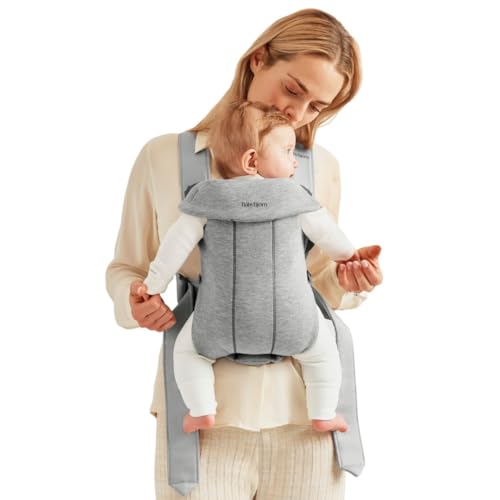
The BabyBjörn Mini is a lightweight, soft-structured carrier designed specifically for newborns and infants up to approximately 12 months of age. Its 3D jersey fabric is exceptionally soft and flexible, providing a cozy, womb-like environment for a small baby. The adjustable seat and head support grow with your child, and the carrier is remarkably easy to put on and take off, with simple buckles and no complicated straps to thread.
For a 1-year-old, however, this carrier hits its limits quickly. The weight capacity stops at 25 pounds, which many toddlers reach before their first birthday, and the fixed seat width does not expand to accommodate the wider hip-to-knee spread required for a walking toddler. The carrier offers only two front-carrying positions (inward-facing and outward-facing), meaning it lacks the back-carry option that becomes the most comfortable position for heavier toddlers.
The jersey fabric, while wonderfully soft for a newborn, does not provide the structured support that a 20+ pound child needs—the carrier tends to sag slightly under the weight, pulling on the parent’s shoulders. It is machine washable and packs small, making it a great backup or a primary carrier for the first six months. But for a dedicated carrier for a one-year-old, the Mini is outclassed by every other option on this list in terms of weight capacity, ergonomic adjustment, and long-term comfort. It earns a spot here as a recognition of its quality within its intended range, with the clear note that your 1-year-old has likely already outgrown it.
Why it’s great
- Ultra-soft 3D jersey fabric is gentle on newborn skin and machine washable
- Exceptionally easy to put on and adjust with simple, intuitive buckles
- Compact and lightweight for easy packing in a diaper bag
Good to know
- 25-pound weight limit is often reached before the first birthday
- Fixed seat width does not adjust for a toddler’s wider hip-to-knee spread
- Lacks back-carry option, which is the most ergonomic position for a heavier toddler
FAQ
Is outward-facing carry safe for a 1-year-old’s hips?
How do I clean a structured toddler carrier without damaging the foam?
Can I use a carrier for a 1-year-old if I had a C-section?
Final Thoughts: The Verdict
For most parents, the baby carrier for 1 year old winner is the Ergobaby Omni Classic because its bucket seat and lumbar support handle the growing weight of a toddler without compromising on ergonomic safety. If you want a carrier that adjusts seamlessly between caregivers of different sizes, grab the Baby Tula Explore. And for a stylish, breathable option that feels like an extension of your wardrobe, nothing beats the Mabē Monarch.

Mo Maruf
I created WellFizz to bridge the gap between vague wellness advice and actionable solutions. My mission is simple: to decode the research and give you practical tools you can actually use.
Beyond the data, I am a passionate traveler. I believe that stepping away from the screen to explore new environments is essential for mental clarity and physical vitality.