Our readers keep the lights on and my smoothie glass nicely filled. As an Amazon Associate, I earn from qualifying purchases.
The biggest mistake under 300 is chasing megapixels instead of optical zoom. A marketing-hyped 48-megapixel sensor attached to a cheap digital zoom lens will produce soft, disappointing images every time. The real battle is between true optical reach and the convenience of a point-and-shoot that doesn’t require a second mortgage.
I’m Mohammad Maruf — the founder and writer behind WellFizz. I’ve spent hundreds of hours analyzing sensor specs, zoom mechanics, and real-world image quality comparisons to separate the few worthwhile cameras from the overhyped toys on the market.
This guide cuts through the noise to find the only digital camera under 300 that actually delivers usable zoom, respectable low-light performance, and reliable build quality without demanding a premium for a brand name.
How To Choose The Best Digital Camera Under 300
Shopping for a sub-300 camera forces a critical trade-off: optical zoom reach versus sensor quality. Within this budget, no camera excels at both. The best strategy is to decide which matters more for your use case — capturing distant wildlife on hikes or producing clean portraits in mixed lighting. Understanding a few core specs will prevent you from overpaying for inflated numbers that never materialize in real image quality.
Optical Zoom Versus Digital Zoom: The Non-Negotiable Difference
Optical zoom physically moves glass elements to magnify the scene, preserving full resolution at every focal length. Digital zoom simply crops and enlarges the center pixels, producing grainy, pixelated results that look like a bad phone crop. Any camera advertising only “digital zoom” should be crossed off the list immediately. Within the under 300 range, expect optical zoom between 8x and 50x — the higher the number, the larger the lens barrel and heavier the body.
Sensor Size and Low-Light Reality
The tiny 1/2.3-inch sensors common in sub-300 cameras are the biggest limiter in dim conditions. Even a 20-megapixel count on this small sensor cannot compete with older 12-megapixel sensors in a larger 1-inch format for light capture. In practice, most cameras in this bracket produce usable photos only up to ISO 800. If you shoot primarily indoors or at dusk, prioritize optical image stabilization (OIS) over higher megapixel claims — OIS buys you two extra stops of usable handheld shutter speed.
Battery System: AA Convenience Versus Proprietary Lithium
AA-battery cameras like certain Kodak and Minolta bridge models offer a hidden advantage: you can buy alkalines anywhere in the world when the pack dies mid-trip. Proprietary lithium-ion batteries pack more energy per gram and charge faster via USB, but a dead proprietary battery means finding a wall outlet for two hours. For travel photographers who shoot hundreds of frames daily, the ability to swap in fresh AAs in under 30 seconds can save a day of missed shots.
Quick Comparison
On smaller screens, swipe sideways to see the full table.
| Model | Category | Best For | Key Spec | Amazon |
|---|---|---|---|---|
| Canon PowerShot SX530 HS (Renewed) | Renewed Premium | Telephoto & Wildlife | 50x Optical Zoom (24-1200mm) | Amazon |
| Canon PowerShot SX400 (Renewed) | Renewed Mid-Range | Long Zoom & Compact | 30x Optical Zoom (24-720mm) | Amazon |
| Minolta MN40Z | Bridge Camera | All-Purpose Zoom | 40x Optical Zoom / WiFi | Amazon |
| Kodak PIXPRO AZ255 | Bridge Camera | Budget Telephoto | 25x Optical Zoom / AA Batteries | Amazon |
| Minolta MND23-BL | Point & Shoot | Casual Everyday Use | 48MP Still / Rear Selfie Lens | Amazon |
| NBDDIGITAL True 5K | Travel Compact | Lightweight Vlogging | 4K Video / 180° Flip Screen | Amazon |
| FlyFrost 8K Camera | Entry Vlogger | Webcam & Basic Video | 8K Video / 3.2″ Touch Screen | Amazon |
In‑Depth Reviews
1. Canon PowerShot SX530 HS 16MP CMOS (Renewed)

The SX530 HS delivers an astounding 50x optical zoom (24-1200mm equivalent) that reaches subjects invisible to the naked eye — a capability normally reserved for cameras three times its price. The 16-megapixel high-sensitivity CMOS sensor paired with the DIGIC 4+ processor handles daylight landscapes and stadium seating shots with genuine clarity, while built-in WiFi and NFC let you transfer full-resolution images to a phone wirelessly in seconds.
Renewed units typically show minor cosmetic wear but function identically to new stock. The 3-inch LCD with 461,000 dots provides adequate outdoor framing, though it washes out in direct sunlight. At 50x zoom, image stabilization works hard but cannot eliminate all shake at the telephoto end — a monopod or steady surface significantly improves keeper rates at maximum focal length.
Low-light performance caps out around ISO 800 with noticeable noise beyond, consistent with the 1/2.3-inch sensor size. The autofocus is contrast-detection based with 9 points, which feels dated but remains reliable in well-lit scenes. For anyone prioritizing extreme reach over pocketability, this is the strongest optical performer available within the budget.
Why it’s great
- 50x optical zoom unmatched at this price tier
- WiFi transfer enables quick social sharing
- Full HD 1080p video with dedicated movie button
Good to know
- Renewed unit — no manufacturer warranty
- Contrast-detect AF slower than phase-detect
- No USB charging; uses proprietary battery
2. Canon PowerShot SX400 16MP (Renewed)

The SX400 brings 30x optical zoom (24-720mm equivalent) into the sub-300 conversation with Canon’s proven DIGIC 4+ processing and a 16-megapixel CCD sensor. The wide-angle 24mm end captures expansive group shots and tight interiors, while the 720mm telephoto end reaches stage performers and distant wildlife with optical integrity that digital zoom cannot touch. A dedicated movie button enables instant 720p HD video recording, though it lacks the full 1080p of pricier models.
Renewed stock offers substantial savings while preserving the core optical performance. The body is slightly larger than pocket-friendly compacts but remains light enough for day trips. Autofocus uses contrast detection across 50 points, providing faster lock-on than the SX530 HS in good light, though both struggle in dim conditions. The 3-inch LCD screen is functional but lower resolution than modern standards — composing fine details at maximum zoom requires careful attention.
Battery life is the weakest link: the proprietary NB-11LH pack delivers roughly 200 shots per charge. Carrying a spare is mandatory for full-day outings. The lack of WiFi means transferring photos requires a USB cable or SD card reader — a trade-off for the lower price point. For pure optical zoom quality per dollar, this remains a standout choice among budget cameras.
Why it’s great
- 30x optical zoom in a compact body
- Proven Canon color science and processing
- Very strong value as renewed hardware
Good to know
- Limited to 720p video recording
- Below-average battery life for its class
- No WiFi or Bluetooth connectivity
3. Minolta MN40Z 20MP Digital Camera

The MN40Z bridges the gap between consumer point-and-shoots and serious bridge cameras, offering 40x optical zoom and a 20-megapixel sensor in a body that weighs under a pound. The zoom range (24-960mm equivalent) covers everything from wide landscapes to distant wildlife, and the optical image stabilization helps keep handheld shots sharp at the telephoto end. Built-in WiFi connects to the Minolta app for remote shutter control and instant image transfer to a paired smartphone.
Image quality is respectable in bright daylight, with accurate color reproduction and adequate detail for 8×10 prints. Video recording reaches 1080p Full HD at 30fps, producing smooth footage for casual family events. The 3-inch LCD display is bright enough for outdoor use, and the inclusion of face, smile, and blink detection adds a layer of convenience for group portraits. Autofocus uses contrast detection and can be slow in low contrast scenes, occasionally freezing the camera entirely during mode switches.
The AA battery power system is a double-edged sword: dead batteries can be replaced instantly anywhere in the world, but runtime is shorter than lithium-ion equivalents. Owners report approximately 300 shots on a set of fresh lithium AAs. The built-in flash is adequate for subjects within 15 feet but produces harsh shadows in darker rooms. For beginners wanting significant zoom without the complexity of interchangeable lenses, the MN40Z offers a practical entry point.
Why it’s great
- 40x optical zoom covers an enormous range
- WiFi app provides remote control and sharing
- AA batteries offer universal replacement convenience
Good to know
- Autofocus can freeze during mode changes
- AA batteries drain faster than lithium packs
- Included carrying case is low quality
4. Kodak PIXPRO AZ255 16MP Bridge Camera

The AZ255 offers 25x optical zoom (24-600mm equivalent) with a 16-megapixel CMOS sensor and optical image stabilization in a package that runs on standard AA batteries. The 24mm wide end is genuinely wide enough for landscape photography, while the 600mm telephoto captures wildlife and sports with real optical clarity — a significant step above what any phone can achieve. The OIS system effectively compensates for hand shake at intermediate zoom lengths, though full telephoto still benefits from bracing the camera on a stable surface.
Build quality is solid for the price bracket, with a textured grip and ergonomic contours that help steady the camera during long shooting sessions. The 3-inch LCD screen is adequate for framing and review, and the electronic viewfinder (though small) provides an alternative for bright outdoor days. Video recording hits 1080p Full HD at 30fps, which is standard for this category. The automatic modes work well for beginners, while the PASM dial gives more experienced users manual control over aperture and shutter speed.
AA battery performance is the defining trade-off: starter alkalines included in the box last only about 100 shots. Switching to lithium AAs or rechargeable NiMH cells pushes runtime to roughly 400 shots per set. The camera does not support USB charging, so carrying spare batteries is essential. The white color variant looks distinct but shows grime quickly. For budget-conscious families who want genuine optical zoom without premium pricing, the AZ255 delivers consistent results.
Why it’s great
- Genuine 25x optical zoom at an entry-level price
- OIS keeps handheld shots usable at full zoom
- AA batteries enable instant swaps anywhere
Good to know
- No SD card included despite claims otherwise
- Body is bulky — not pocketable
- USB-only transfer; no WiFi or Bluetooth
5. Minolta MND23-BL 48MP Digital Camera

The MND23-BL takes a different approach by prioritizing still resolution and selfie convenience over optical zoom. The 48-megapixel sensor (interpolated from a lower native count) produces files large enough for heavy cropping, but real-world sharpness is limited by the fixed 3.37mm f/2.2 lens — equivalent to roughly a standard wide-angle smartphone view. The standout feature is the rear selfie lens, which lets you frame self-portraits using the main lens without needing a separate front-facing camera.
4K video recording at 30fps is a welcome addition at this price, delivering smooth footage for social media content. Digital image stabilization helps reduce walking shake in videos, though the effect is modest compared to optical systems. Creative modes including 9 scene presets, color filters, slow motion, and time-lapse provide room for experimentation without manual exposure knowledge. The 2.8-inch LCD screen is smaller than the competition but adequate for quick composition.
The trade-offs are immediate: shutter lag is noticeable, particularly after half-pressing to focus. Battery life averages around 140 shots at highest quality settings with flash disabled — substantially less than bridge cameras. Low-light performance is poor, with noise visible even at ISO 400. For casual social photographers who prioritize selfie convenience and don’t need telephoto reach, this camera works, but it cannot compete with bridge cameras for general versatility.
Why it’s great
- Rear selfie lens uses the main sensor for higher quality
- 4K video at 30fps is above average for this tier
- Complete kit includes 32GB card and case
Good to know
- Noticeable shutter lag in auto mode
- Battery life is short at high resolution settings
- Heavy noise above ISO 400
6. NBDDIGITAL True 5K 64MP Camera
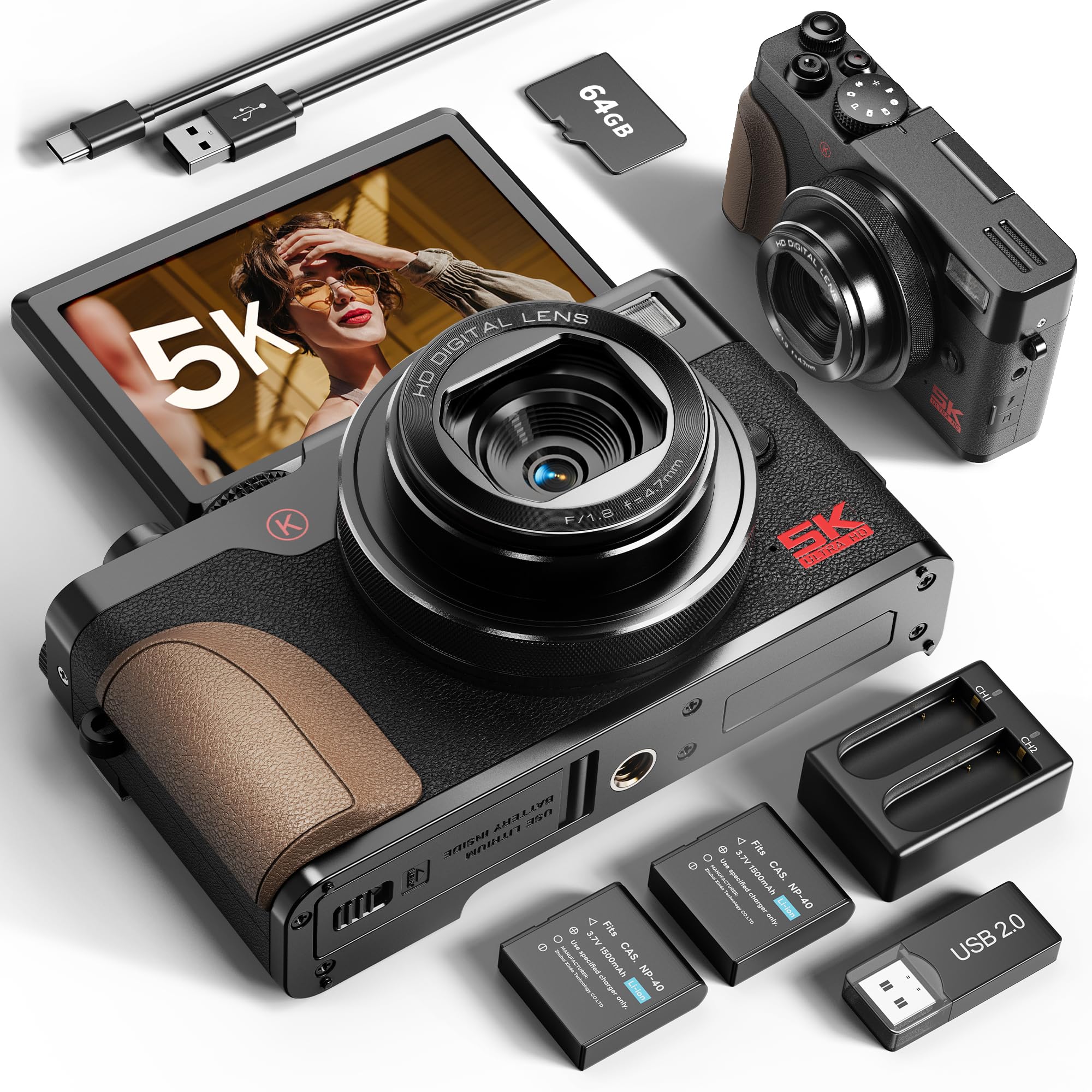
The NBDDIGITAL True 5K camera wraps a 64-megapixel sensor and 4K video recording in a sleek, ceramic-feel body that weighs only 121 grams. The patented silent scroll wheel replaces traditional zoom buttons, enabling quiet zoom adjustments during video recording — a thoughtful detail for vloggers who want to avoid click noise in their audio. The 180-degree flip screen faces forward for self-recording, though the camera lacks a dedicated front-facing lens, relying on the main sensor for selfies.
Image quality is best in bright conditions, where the 64MP sensor captures detail that crops well. Default 21MP output balances resolution and storage efficiency, a sensible choice for beginners who don’t want to manage massive file sizes. The 16x digital zoom is purely digital — no optical zoom here — so relying on it at maximum crop produces noticeably softer images. Anti-shake stabilization helps steady handheld video but cannot compensate for significant movement.
The built-in battery supports approximately 300 shots per charge and charges twice as fast as earlier models via USB-C. A 32GB microSD card is included, which holds roughly 15 minutes of 4K video. The menu system is straightforward, with 8 dedicated scene modes for sports, night, and portrait situations. For style-conscious beginners who prioritize 4K video and a compact form factor over optical zoom, this is a solid entry-level choice, but the lack of optical reach limits its versatility.
Why it’s great
- Ultra-light 121g body is easy to carry
- Silent scroll wheel eliminates recording noise
- Fast USB-C charging and file transfer
Good to know
- No optical zoom — 16x digital only
- No front-facing selfie screen
- Low-light image quality is noticeably weak
7. FlyFrost 8K Digital Camera
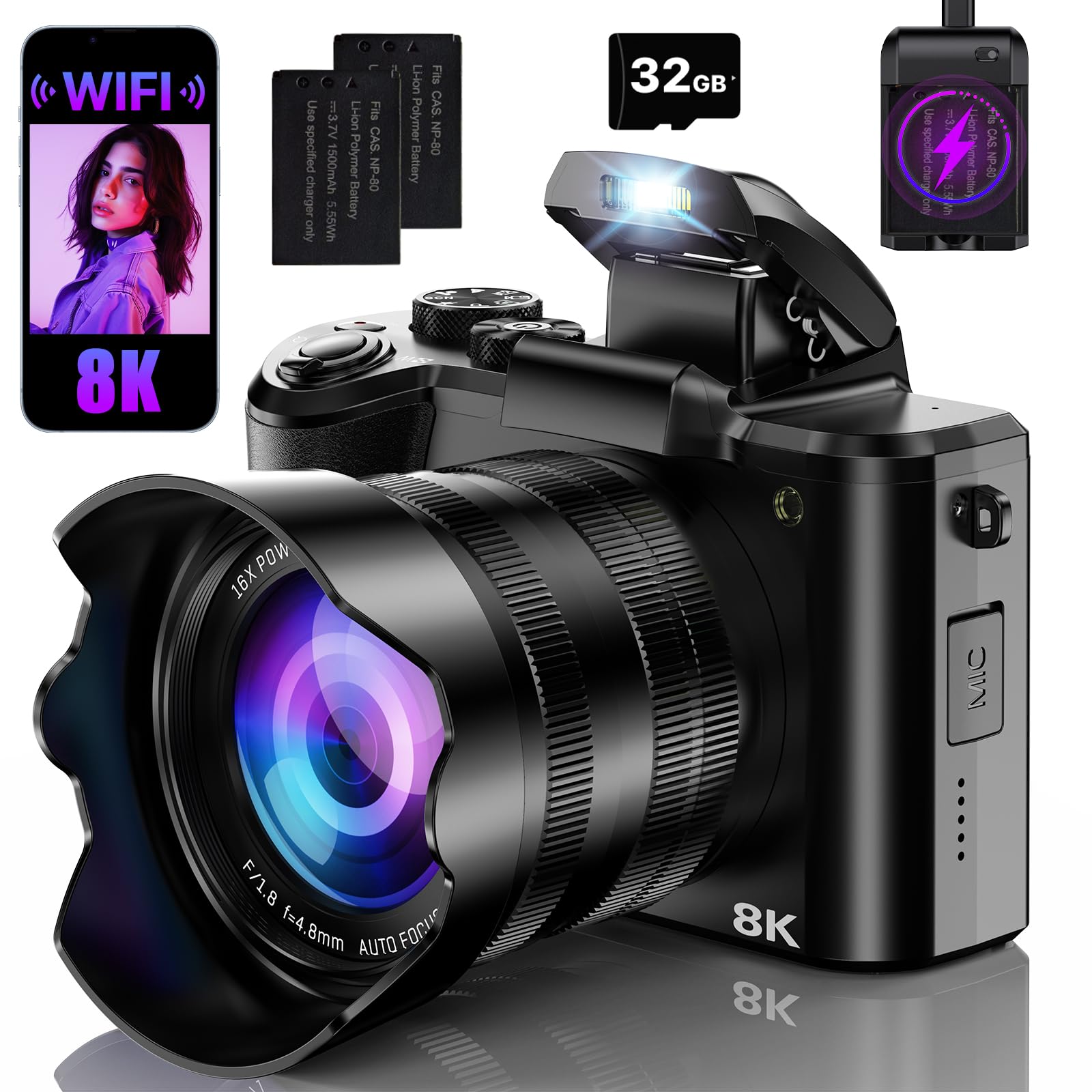
The FlyFrost 8K camera packs an 88-megapixel still resolution and 8K video recording into an aggressively affordable package that includes dual batteries and a charging stand. The 3.2-inch IPS touchscreen is larger than most in this tier, and the 16x digital zoom (again, digital only) lets you frame tighter shots when needed. Built-in WiFi connects to the iSmart DV2 app for instant photo transfers, and the 32GB SD card included provides immediate storage out of the box.
Video quality at 8K is more marketing claim than practical reality — the sensor’s small size produces soft detail, and 8K files are enormous without meaningful resolution advantage over 4K for most viewers. The more usable 4K mode delivers passable footage for social media, especially when the 6-axis stabilization is engaged. The dual-lens design with front and rear cameras enables easy selfie switching, though both lenses share the same modest sensor, limiting low-light performance equally.
Build quality reflects the price point: the body feels plasticky, and buttons lack the tactile feedback of higher-end cameras. The 360-degree rotary dial provides quick access to 8 shooting modes including slow motion and time-lapse, which are genuinely useful for creative content. Battery life is surprisingly good thanks to the included two packs, each lasting roughly 200 shots. For absolute beginners who want a complete kit and aren’t chasing professional-grade image quality, this camera provides the highest spec-sheet numbers for the lowest entry cost.
Why it’s great
- Dual batteries and charging stand included
- 3.2-inch touchscreen is above average for the price
- Built-in WiFi enables quick social sharing
Good to know
- 8K video is marketing — real detail is modest
- Build quality feels noticeably plasticky
- No optical zoom at any focal length
FAQ
Is a 48-megapixel camera under 300 actually better than a 16-megapixel one?
Can I use a sub-300 camera for professional photography?
Why do some sub-300 cameras use AA batteries instead of rechargeables?
How much optical zoom do I actually need for wildlife photography?
Can sub-300 cameras shoot decent 4K video?
Final Thoughts: The Verdict
For most users, the digital camera under 300 winner is the Canon PowerShot SX530 HS (Renewed) because its 50x optical zoom delivers telephoto reach that no other camera in this budget can match, making it the only option that genuinely outperforms a smartphone. If you want a lighter body with integrated WiFi and still-solid 30x zoom, grab the Canon PowerShot SX400 (Renewed). And for beginners who need the absolute lowest entry cost and prefer a complete kit with dual batteries and 8K marketing specs, nothing beats the FlyFrost 8K Camera.

Mo Maruf
I created WellFizz to bridge the gap between vague wellness advice and actionable solutions. My mission is simple: to decode the research and give you practical tools you can actually use.
Beyond the data, I am a passionate traveler. I believe that stepping away from the screen to explore new environments is essential for mental clarity and physical vitality.