Our readers keep the lights on and my smoothie glass nicely filled. As an Amazon Associate, I earn from qualifying purchases.
Floating chlorinators bob around like pool toys, skimmer pucks drop your pH and erode equipment, and daily liquid dosing turns pool ownership into a part-time job. An automatic chlorinator for inground pool plumbed directly into your return line solves all of this by delivering a steady, consistent dose of sanitizer week after week with zero daily effort.
I’m Mohammad Maruf — the founder and writer behind WellFizz. I’ve spent years analyzing the build quality, valve engineering, material thickness, and flow dynamics of off-line and in-line pool feeders so you know exactly which unit actually delivers reliable, corrosion-resistant performance.
The truth is that most chlorinators share a basic design — a canister, a control valve, and a supply tube — but the ones built with thicker ABS walls, robust control valves, and proper sealing gaskets separate a two-season unit from a decade-long investment, and that is exactly how we identify the best automatic chlorinator for inground pool.
How To Choose The Best Automatic Chlorinator For Inground Pool
An automatic chlorinator is a long-term piece of pool equipment that will see constant chemical exposure and seasonal weather extremes. Choosing the wrong one means leaks, clogged feed tubes, or a feeder that cracks within two seasons. Focus on these four factors to get a unit that last.
Off-line vs. In-line Installation
Off-line chlorinators connect to your existing plumbing via a 1/4-inch feeder hose and rely on a pressure differential to draw water through the canister. They are easier to retrofit because they do not require cutting your main return pipe. In-line units plumb directly into the return line with 2-inch or 1.5-inch PVC ports, delivering higher flow rates and more consistent chlorination but requiring more permanent plumbing work. Choose off-line if you want a straightforward DIY install; choose in-line if you are building a new equipment pad or replacing an existing in-line feeder.
Barrel Material and Wall Thickness
Chlorine gas and acidic bromine solutions degrade plastic over time. The best chlorinators use high-density ABS or polypropylene with visibly thick walls — thin, translucent barrels often crack within 18 months. Look for units that mention “thickened inner wall” or “heavy-duty ABS” in the spec sheet. A thicker barrel also resists warping from the heat of direct sunlight when installed outdoors.
Control Valve Quality
The dial or knob that regulates water flow through the canister is the most common failure point. Cheap valves use brittle plastic that snaps during hand-tightening, while premium valves use reinforced materials with smooth, 360-degree rotation. A quality control valve lets you dial in the exact feed rate — usually settings 1 through 6 or an infinite-turn knob — so you can match sanitizer output to your pool size and bather load without over-chlorinating.
Tablet Capacity and Pool Size Matching
Capacity is measured in the number of 3-inch trichlor tablets or bromine sticks the canister holds. A 9-pound unit (roughly 8 to 12 tablets) works well for pools up to 20,000 gallons and can run 2 to 4 weeks between refills. Larger 13-pound units handle 30,000-gallon pools and can stretch to 6 weeks. Overfilling a small-capacity feeder into a small pool causes runaway chlorine levels; underfilling a large unit into a big pool leaves you sanitizer-short. Match the capacity to your pool volume and pump run time.
Quick Comparison
On smaller screens, swipe sideways to see the full table.
| Model | Category | Best For | Key Spec | Amazon |
|---|---|---|---|---|
| Pentair Rainbow 300 R171016 | Premium Off-line | Reliable, brand-name auto-dosing | 3 lbs. capacity, NSF listed | Amazon |
| Hayward CL2002S | Premium In-line | High-flow in-ground systems | 2-inch ports, 90 GPM flow rate | Amazon |
| CMP Powerclean Tab Ultra VS | Premium In-line | Variable-speed pump compatibility | Clear glass lid, union connections | Amazon |
| Pentair Rainbow 300-29X R171070 | Heavy-Duty Off-line | Large pools & commercial use | 13 lbs. capacity, drain valve | Amazon |
| Tablet Feeder Rainbow 300-29X | Heavy-Duty Off-line | Commercial/commercial-light sanitizing | 6 lbs. capacity, 40-inch height | Amazon |
| Hayward CL100 | Mid-Range Off-line | Reliable, compact 3-inch tab feeder | 9 lbs. capacity, dial control valve | Amazon |
| Upgraded R171016 300 Chlorinator | Budget Off-line | Cost-effective upgrade with better valve | 72,000 gal capacity, widened base | Amazon |
| Upgraded 320 Pool Chlorinator | Mid-Range Off-line | Versatile in-line/off-line large capacity | 11 large tabs, 70,000 gal top feed | Amazon |
| Professional CL220 | Budget Off-line | Budget-friendly 9-pound feeder kit | 9 lbs. capacity, ABS body | Amazon |
In‑Depth Reviews
1. Pentair R171016 Rainbow 300 Automatic Pool and Spa Feeder

Pentair’s Rainbow 300 is the name-brand standard that pool pros reach for, and for good reason. The enclosed system requires no special venting, which means you can install it directly in your equipment area without worrying about chlorine gas buildup. The NSF listing is a meaningful validation that the materials resist corrosion and the design meets sanitation standards — a detail the generic no-name feeders simply do not carry.
The 300 holds enough tablets to run an average 20,000-gallon inground pool for two to three weeks, depending on pump runtime and temperature. The adjustable flow dial lets you fine-tune output from a low maintenance dose up to a high-level shock, and users consistently report that settings 3 or 4 on the dial deliver steady 1-3 ppm levels without overshooting. The 3-pound canister is compact enough to fit on tight equipment pads.
The common complaints center on the plastic fittings — the ball valve and nipple connectors feel brittle and can snap if overtightened. Seasoned owners recommend hand-tightening only and using a backup wrench lightly. The lid requires a flat tool or a block of wood to twist open, which is slightly inconvenient, but the trade-off is a reliable seal that does not develop leaks over time.
Why it’s great
- NSF certified materials provide proven chemical resistance
- Consistent adjustable flow dial with predictable output settings
- Enclosed design eliminates dangerous gas venting requirements
Good to know
- Plastic ball valve can snap if tightened beyond hand-tight
- Lid requires a tool to open; no built-in grip ridges
- Installation instructions lack diagrams for first-timers
2. Hayward CL2002S In-line Automatic Chemical Feeder

For inground pools with high-flow pump systems — especially those with 2-inch PVC return plumbing — the CL2002S is a purpose-built in-line feeder that integrates directly into the pipe run. The 2-inch inlet and outlet ports handle flow rates from 50 to 90 gallons per minute, meaning it does not create a pressure bottleneck even with a variable-speed pump running at higher speeds for cleaning or spa jets.
The Easy-Lok threaded cover uses a finger-release catch safety mechanism that prevents accidental opening while the system is pressurized — a genuine safety feature for families. The dial control valve is robust and easy to read, and the unit accepts both large and small trichlor tablets or bromine sticks, giving you flexibility in sanitizer choice. Users who upgraded from off-line tube feeders note that the in-line design delivers more consistent sanitizer levels because flow does not depend on a differential pressure hose.
The primary drawback is that the CL2002S ships with 2-inch slip fittings only. If your existing plumbing is 1.5-inch PVC, you must buy separate reducing bushings. The lack of threaded connections means you will need PVC primer and cement to install, making it less DIY-friendly than the off-line units. A few users also note that the canister can be tricky to seal fully, requiring a firm press on the lid to ensure the O-ring seats evenly.
Why it’s great
- High 90 GPM flow capacity works with powerful pumps
- Pressurized safety catch prevents accidental lid opening
- Runs 30+ days on a single load for large pools
Good to know
- Requires glue-on PVC installation with 2-inch slip fittings
- 1.5-inch adapter not included with the purchase
- Lid O-ring can shift if not placed carefully during sealing
3. CMP Powerclean Tab Ultra VS Chlorinator

CMP engineered this chlorinator specifically for variable-speed pump (VSP) systems — a growing segment of the inground pool market. The “tab ultra VS” designation means it maintains effective chlorination even at the low flow rates (around 20 GPM) that VSPs use during their energy-saving cycles. The clear glass lid lets you see the tablet level at a glance without unscrewing anything — a simple but genuinely useful design detail.
The unit comes with union connections that thread directly into standard PVC fittings, making installation a straightforward hand-tighten job. The thick PVC body and wide internal diameter allow you to reach in and retrieve tablets if needed, which is not possible with narrower canisters. Users with VSPs report that this chlorinator solved the chronic under-chlorination problem they had with older Pentair models at low flow.
The flow-adjusting knob on the outer dial has a tendency to bind up after a full season of chemical exposure, and some units develop a stubborn knob that requires pliers to turn. The clear glass lid also fogs or films over after several months in direct sunlight, reducing its visibility advantage. A few users report that the binding issue appears within one year, requiring replacement of the knob assembly.
Why it’s great
- Designed specifically for low-flow variable-speed pump operation
- Clear glass lid allows quick visual tablet level check
- Thick PVC body with union connectors for easy install
Good to know
- Outer adjustment knob can bind and become hard to turn
- Glass lid may fog or film over after extended sun exposure
- Not every replacement part is widely available retail
4. Pentair Rainbow 300-29X Off-Line Feeder R171070

This is the largest off-line feeder Pentair makes, with a 13-pound tablet capacity that can keep a 40,000-gallon inground pool sanitized for well over a month between refills. The heavy-duty control valve is built with thicker internals than the standard Rainbow 300, and it includes a dedicated drain valve and vent plug — two features that simplify maintenance significantly. The drain valve lets you purge residual water before opening the lid, preventing the chemical bath splash that smaller units subject you to.
The height of the canister — nearly 40 inches — means it holds a full column of tablets without bridging (when tablets stick together and stop dissolving). The off-line design uses a 1/4-inch feeder hose, so it retrofits into any equipment pad without cutting return pipe. Commercial pool operators and owners of large residential pools alike choose this unit because it dramatically cuts the frequency of service visits.
Build quality inconsistency is the main complaint. Several buyers report receiving units with broken flow valves out of the box, and the PVC tubing that ships with the unit is not UV-stabilized — it becomes brittle and cracks within one season of direct sun exposure. The threaded connections have also been reported to fracture during installation if you apply normal wrench pressure, requiring re-plumbing within the first year. Inspect the unit immediately upon delivery and replace the tubing with UV-rated vinyl if your pad is sun-exposed.
Why it’s great
- Massive 13-pound capacity for large pools or commercial use
- Drain valve and vent plug make maintenance cleaner and safer
- Off-line design retrofits easily without cutting return plumbing
Good to know
- Incoming quality control is inconsistent; inspect all parts
- Included tubing is not UV-stabilized and will crack outdoors
- Threaded connections can break if over-tightened during install
5. Tablet Feeder Rainbow 300-29X (1 or 3 Tabs)
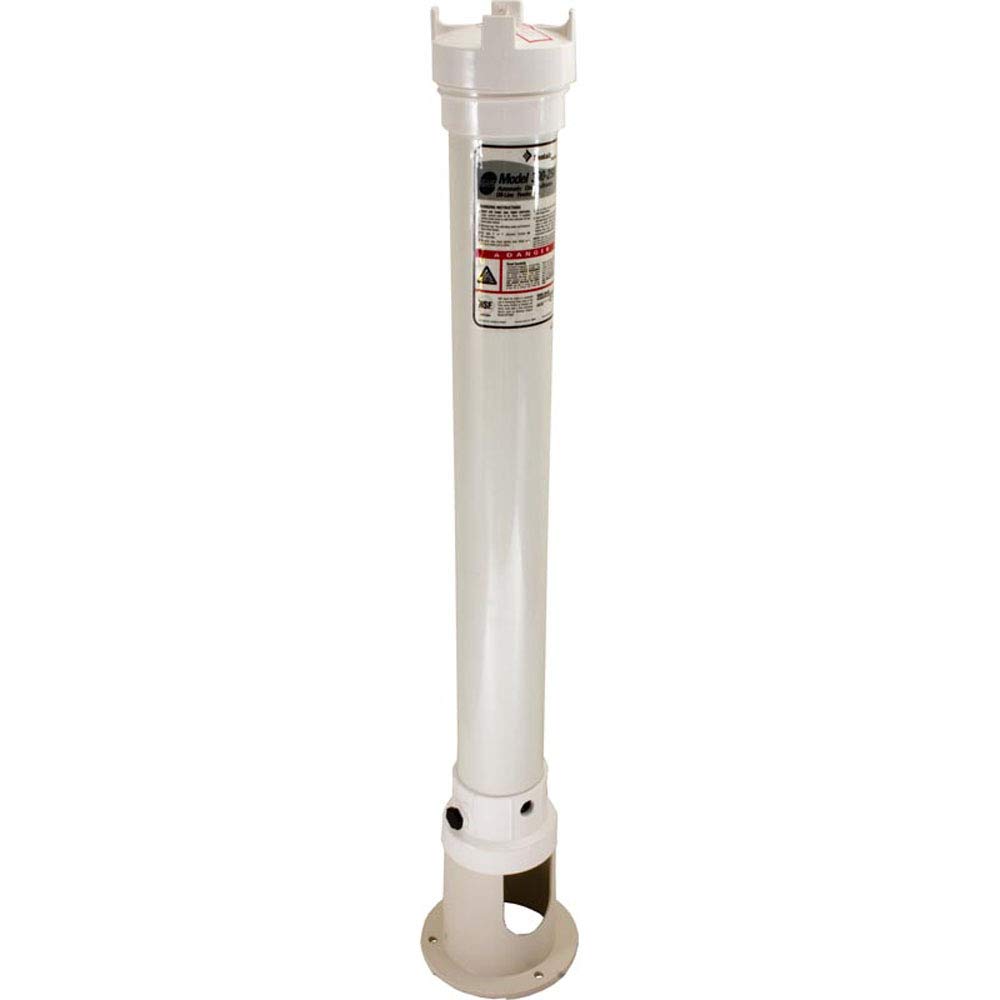
This is the same Pentair design as the R171070 but configured as a slightly smaller commercial-oriented feeder. It is often the go-to replacement unit for small commercial pools, apartment complexes, and HOA facilities because it delivers reliable autochlorination at a price well below dedicated commercial chemical controllers. The standard 300-29X platform uses the same robust valve and vent system as the larger model but with a reduced capacity.
Installation is identical to the other Pentair off-line feeders — 1/4-inch hose, differential pressure operation, and an external dial for rate control. The tall, narrow canister (just over 10 inches wide) fits into tight spaces between filter tanks and heaters. Users running 30,000-gallon commercial pools note that this unit must not be filled completely because it will over-chlorinate; partial loads provide steady maintenance dosing for lower bather-load facilities.
The exact same QC pitfalls apply as the larger R171070 — the tubing supplied is not UV-rated and will crack under sun exposure. Some units arrive with missing or damaged bottom plugs, and the thin plastic of the check valve assembly can break if the line freezes. For outdoor commercial installations, replacement of the hose with thick-wall vinyl tubing is strongly recommended from day one.
Why it’s great
- OEM Pentair quality with proven off-line feeder design
- Narrow footprint saves space on crowded equipment pads
- Capable of supporting small commercial pools effectively
Good to know
- Included tubing is not UV-stabilized; replace if exposed to sun
- May over-chlorinate if filled to capacity on smaller pools
- Some units arrive with missing or damaged bottom drain plugs
6. Hayward CL100 Automatic Chlorine Feeder
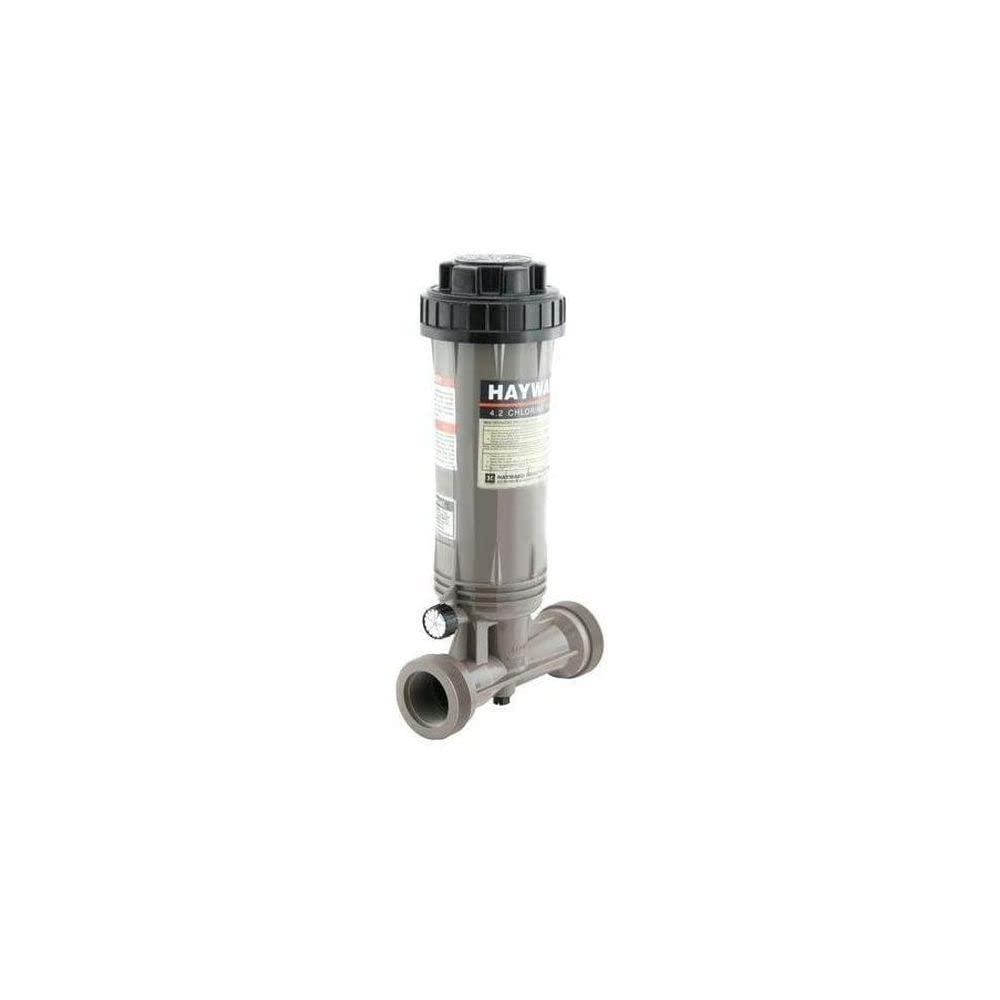
The Hayward CL100 is a mid-range workhorse that hits the sweet spot of price, capacity, and build quality for the average inground pool owner. It accepts standard 3-inch trichlor tablets, holds about 9 pounds of tablets, and uses the same Easy-Lok threaded cover system found on Hayward’s more expensive models. The dial control valve lets you adjust feed rate without tools, and the design is simple enough that first-time chlorinator buyers can install it in under an hour.
Users consistently report that a full load of tablets lasts two to three weeks for a 15,000- to 20,000-gallon pool, with the dial at a mid setting. The off-line installation is straightforward: drill a small hole in your return pipe, attach the included fittings and supply tube, and mount the canister on a flat surface. The plastic body is rigid and resists chemical clouding longer than the ultra-budget alternatives.
The major safety warning that emerges from user feedback is that the CL100 can release a dense cloud of toxic chlorine gas if opened without proper precautions — some buyers experienced symptoms requiring medical attention. Always turn off the pump, wait several minutes, and wear a respirator and sealed goggles before opening the lid. The black O-ring seal inside the cover can also dislodge easily if you tilt the lid during removal; check it before reseating.
Why it’s great
- Dependable mid-range off-line feeder from a trusted brand
- Easy-Lok cover with finger-release safety catch mechanism
- Adjustment dial provides clear, repeatable feed rate settings
Good to know
- Opening lid without pump-off delay releases dangerous gas
- O-ring seal can fall out during removal if tilted sharply
- Requires careful Teflon taping of PVC connections to prevent leaks
7. Upgraded R171016 Pool Chlorinator 300 (Miory)

This third-party upgrade of the Pentair R171016 design targets the original unit’s two weakest points: the control valve and the base stability. The manufacturer uses high-density materials for the valve assembly to resist the corrosion and blockage that occur when chlorine reaction byproducts accumulate in standard valves. The widened base increases the footprint and prevents the canister from tipping on uneven equipment pads.
The unit claims compatibility with up to 72,000 gallons, though in practice real-world users with smaller 16,000-gallon pools found that setting 4 over-chlorinated and had to dial down to settings 1 or 2. The full kit includes all necessary O-rings, Teflon tape, and hose clamps — nothing extra to buy. Users switching from salt systems praise the dramatic cost reduction, noting a seasonal chlorine expense of around versus replacing a salt cell annually.
The lid gasket uses a flat prototype design that improves sealing surface contact, but the O-ring still requires regular lubrication with silicone-based pool lube to prevent drying and cracking. The included hose is generic and may kink if routed too tightly around corners; upgrading to a reinforced hose is recommended for permanent installations.
Why it’s great
- Upgraded control valve with denser material resists corrosion
- Widened base provides better stability on uneven surfaces
- Significant cost savings compared to salt cell replacement
Good to know
- Over-chlorinates at higher dial settings in smaller pools
- O-ring needs periodic silicone lubrication to maintain seal
- Included hose can kink; replace with reinforced tubing for best run
8. Upgraded 320 Pool Chlorinator (Vikua)

The Vikua 320 chlorinator is designed to emulate the Pentair Rainbow 320 platform — a feeder that works in both off-line and in-line applications due to its closed-loop circulation design. It holds either 11 large 3-inch trichlor tablets or 98 small bromine tablets, giving you flexibility in sanitizer choice. The stated capacity range spans 6,500 to 27,000 gallons in bottom-feed orientation and 18,000 to 70,000 gallons in top-feed orientation, which covers nearly all residential inground pools.
The build features a thickened ABS inner wall that resists oxidation and impact better than the thin-walled budget units. The five-design approach includes a white thickened lid gasket, a top vent plug to release gas pressure, a bottom drain valve, and a 1/4-inch feed hose with a separate vent hose connection. The vent plug is especially important for units installed in hot climates where chlorine off-gassing can build dangerous pressure inside the canister.
The control valve on the Vikua is reported as inconsistent — one user reported a leak at the valve threads within weeks of installation, and replacement valves from the manufacturer do not always match the original thread sizing. The bottom drain valve can also be difficult to operate after a few months of disuse, as mineral deposits seize the threads. Regular cycling of the drain valve prevents this issue.
Why it’s great
- High tablet capacity handles up to 70,000 gallons top-feed
- Vent plug safely releases internal chlorine gas pressure
- Thickened ABS barrel resists chemical oxidation over time
Good to know
- Control valve threads may not match replacement parts
- Bottom drain valve can seize if not operated regularly
- Some units arrive with mismatched feeder-side fitting sizing
9. Professional CL220 Off-line Automatic Chlorinator
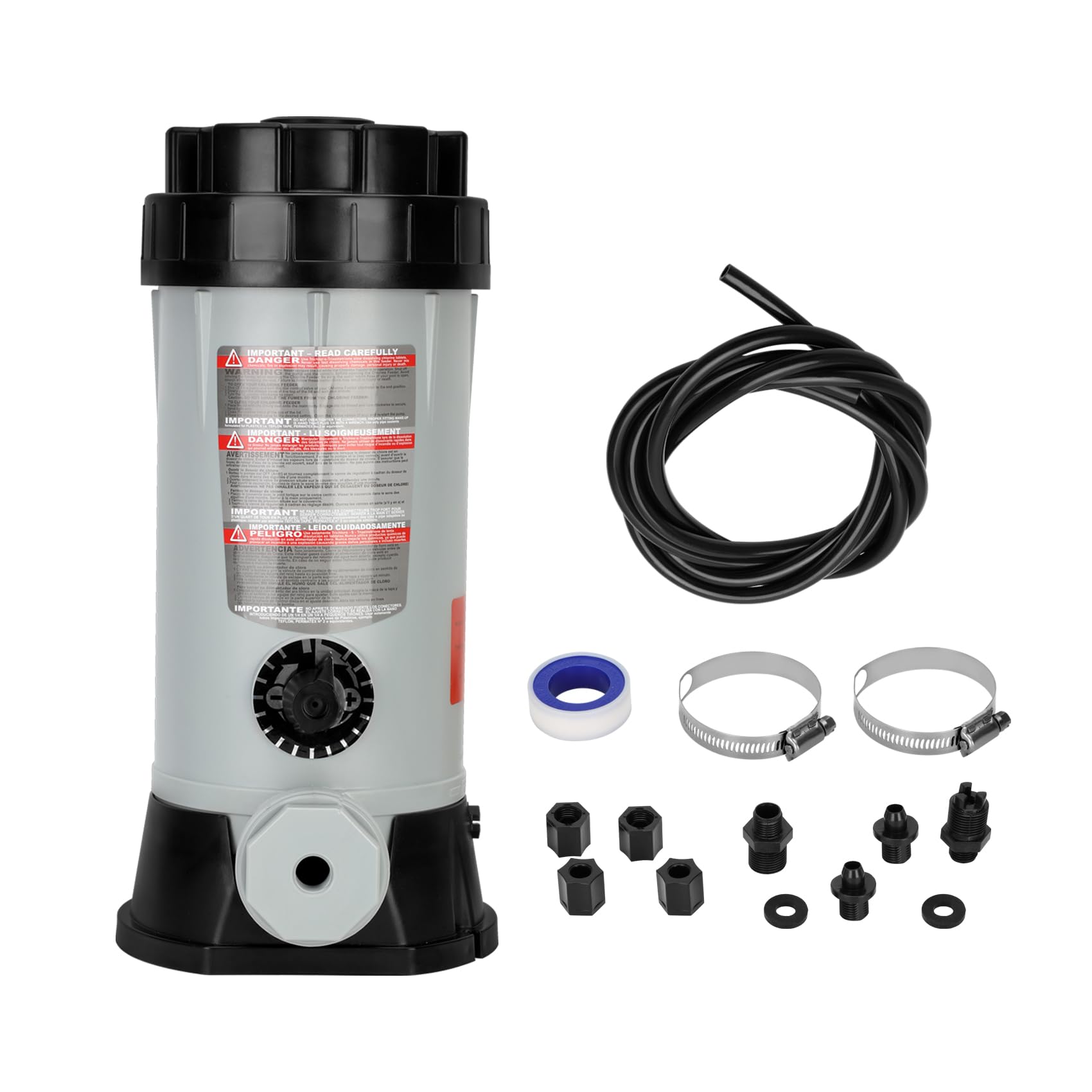
The CL220 from Yhaofu is a budget-tier off-line chlorinator that mimics the form factor of the Hayward CL220 at a price that undercuts the name brand. The kit includes everything needed for a basic off-line installation: the feeder body, supply hose, two clamps, washers, Teflon tape, and check valve control valves. The 9-pound tablet capacity is standard for the mid-range pool class and will run a typical 15,000- to 20,000-gallon pool for two weeks between refills.
The finger-release button on the Easy-Lok threaded cap is a direct copy of the Hayward system and works dependably. The 360-degree control knob on the bottom side of the canister regulates incoming water speed, though the knob’s plastic stem can feel flimsy compared to the premium units. Users report that the unit requires periodic cleaning of the internal feed tubes because dissolved tablet residue clogs the flow path, which is an expected maintenance item for any feeder using trichlor tablets that contain binders.
The ABS body is adequate for the price tier, but the wall thickness is visibly thinner than the Pentair and CMP units. A few users mention that after two seasons of continuous use, the body began showing hairline cracks near the threaded lid area. The hose clamps supplied are basic metal screw-type clamps that can rust if exposed to constant moisture; replacing them with stainless steel clamps is a cheap upgrade that extends the system life.
Why it’s great
- Complete all-in-one kit includes all installation accessories
- Finger-release lid catch adds safety during operation
- 9-pound capacity offers two-week runtime for medium pools
Good to know
- ABS body is thinner than premium models; prone to hairline cracks
- Feed tube requires periodic cleaning to prevent tablet clogging
- Metal hose clamps can rust in wet environments; upgrade to stainless
FAQ
How often should I lubricate the O-ring on my automatic chlorinator?
Why does my chlorinator over-chlorinate the pool even at the lowest setting?
Can I use bromine tablets in a chlorator designed for chlorine?
What size feeder hose do most off-line chlorinators use?
How do I winterize my automatic chlorinator in freezing climates?
Final Thoughts: The Verdict
For most inground pool owners, the best automatic chlorinator for inground pool winner is the Pentair R171016 Rainbow 300 because it combines NSF-certified materials, consistent dial control, and a proven off-line design that fits virtually any equipment pad without cutting pipe. If you need higher flow capacity for a larger pool or a VSP system, grab the Hayward CL2002S for its 2-inch in-line ports and 90 GPM rating. And for maximum runtime between refills on pools over 30,000 gallons, nothing beats the Pentair Rainbow 300-29X R171070 with its 13-pound tablet capacity and built-in drain valve for easy maintenance.

Mo Maruf
I created WellFizz to bridge the gap between vague wellness advice and actionable solutions. My mission is simple: to decode the research and give you practical tools you can actually use.
Beyond the data, I am a passionate traveler. I believe that stepping away from the screen to explore new environments is essential for mental clarity and physical vitality.