Our readers keep the lights on and my smoothie glass nicely filled. As an Amazon Associate, I earn from qualifying purchases.
If a room in your house is consistently freezing in winter and sweltering in summer—no matter how hard your HVAC system works—the problem might not be your furnace or AC unit. The issue is often poor airflow to that specific register, and a battery-powered or corded booster fan is the only fix that doesn’t require tearing into your ductwork or hiring an expensive contractor.
I’m Mohammad Maruf — the founder and writer behind WellFizz. I’ve analyzed dozens of register booster fan models across temperature sensing accuracy, CFM output, noise floor, and build materials to separate the units that actually balance a room from the ones that just make noise.
Whether your problem room sits above a garage, at the end of a long duct run, or on a second floor with no independent zone control, the best battery powered register booster fan offers a straightforward, energy-efficient solution to rebalance your home’s temperature without major renovation.
How To Choose The Best Battery Powered Register Booster Fan
A register booster fan is a small, powered vent insert that pulls additional air from your ductwork and pushes it into a specific room. Unlike whole-house solutions, it targets one register at a time and works with your existing HVAC cycles. Choosing the right one depends on three variables: size, airflow capacity, and how the fan decides to turn on and off.
Measure the Duct Opening, Not the Vent Cover
The single most common mistake buyers make is ordering based on the visible floor or wall vent dimensions. The listed size—for example, 4” x 10”—refers to the inside duct opening, not the decorative cover you see. Remove the existing vent and measure the raw hole with a tape. If the neck of the fan doesn’t fit inside that opening, the unit won’t mount flush, and you’ll have an ugly gap or a unit that won’t sit flat.
CFM vs. Speed Control
CFM (cubic feet per minute) tells you the maximum volume of air the fan can move. A 120 CFM fan can noticeably improve a small to medium bedroom, while a room with long, narrow ducts or two-story supply runs may need upwards of 200 CFM. But maximum CFM usually comes at the highest speed, which is also the noisiest. The best units offer 8 to 10 speed levels so you can dial in the right balance of airflow and noise for sleeping, working, or watching TV.
Thermostat Trigger vs. Continuous Run
The smartest booster fans include a temperature sensor that reads the air temperature coming through the duct. In cooling mode, the fan starts when the duct temp drops below a set threshold, meaning it only runs when your AC is actually blowing cold air. In heating mode, it triggers when the duct temp rises. Fans without this sensor either run 24/7 (wasting filter life and adding noise) or must be manually turned on and off with each season.
Quick Comparison
On smaller screens, swipe sideways to see the full table.
| Model | Category | Best For | Key Spec | Amazon |
|---|---|---|---|---|
| AC Infinity AIRTAP T4 | Premium | Bluetooth app control & data logging | 130 CFM, 17 dBA | Amazon |
| Suncourt Equalizer EZ8 | Premium | Patented auto on/off sensor (tool-free) | 200 CFM, 8 speeds | Amazon |
| VELLEE 6×10 | Mid-Range | High CFM in a larger opening | 200 CFM, 18 dBA | Amazon |
| SANYCASA Manhattan | Mid-Range | App control & satin nickel finish | 140 CFM, < 18 dBA | Amazon |
| BIOWIND 4×12 | Mid-Range | Extra-wide 4×12 duct openings | 140 CFM, 16 dBA | Amazon |
| MATULSA 4×10 | Budget | Entry-level thermostat control on a budget | 10 speeds, remote | Amazon |
| VEVOR 4×10 Brown | Budget | Lowest noise floor at 18 dBA | 120 CFM, 6W motor | Amazon |
In‑Depth Reviews
1. AC Infinity AIRTAP T4 White

The AC Infinity AIRTAP T4 is the most technically complete register booster fan on the market, pairing a premium anodized aluminum frame with a Bluetooth-connected app that logs climate data over time. It fits only 4” x 10” duct openings, but within that size constraint, it delivers 130 CFM through dual 92 mm fans at a measured 17 dBA—quiet enough for a nursery or primary bedroom. The rear casing dimensions (3.93 x 9.76 inches) match standard residential floor vents closely, and the CNC-machined detailing produces a flush, almost invisible fit against painted wood or tile.
Where the AIRTAP T4 separates itself from cheaper alternatives is its programmable logic: you set heating and cooling trigger temperatures independently, choose from 10 speed levels, and program timers or cycles right from the remote or the app. Multiple reviewers report dropping upstairs bedroom temperatures by 8–10°F on 100°F days while reducing their overall power bill by roughly per month—figures that suggest the fan’s energy recovery effect is genuinely measurable, not placebo. The app also sends alarms if the fan loses Bluetooth connection or if the duct temperature behaves unexpectedly.
The single trade-off is that the unit is permanently corded and requires a nearby wall outlet. It does not run on batteries, and the 12-foot power cord must be routed discreetly along baseboards or under a rug. For users who need a wireless install, this is a dealbreaker. But for anyone with outlet access, the AIRTAP T4 offers the most precise environmental control of any 4” x 10” booster fan available, with firmware-level reliability that budget models cannot match.
Why it’s great
- Bluetooth app for data logging, alarms, and advanced schedules
- Anodized aluminum frame resists corrosion and sits flush on floor
- Measured 17 dBA at low speeds is nearly silent
Good to know
- Only fits 4” x 10” duct openings—measure before ordering
- Permanent cord requires outlet access; no battery option
2. Suncourt Equalizer EZ8 HC600
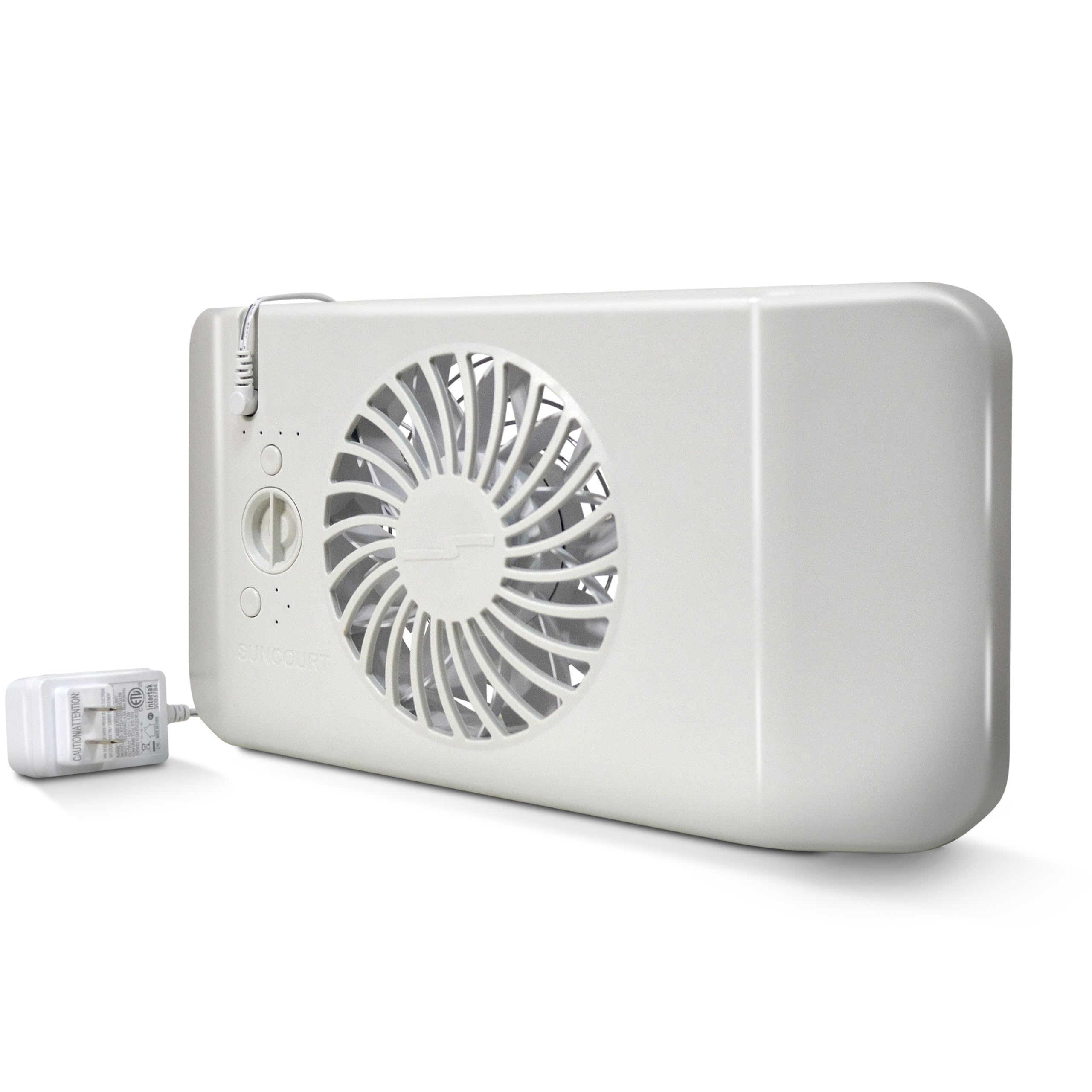
The Suncourt Equalizer EZ8 has been in production since 1988, and its longevity in the market is a direct result of a patented smart sensor that detects HVAC operation without needing a manual seasonal switch. The unit fits any floor register smaller than 6” x 12”—including 4” x 10” and 6” x 10” openings—and pushes up to 200 CFM across 8 speeds. The low-voltage motor is thermally protected and built with flame-retardant materials, and the 3-year warranty is among the longest in the category. Assembly takes under a minute: drop the fan into the vent opening, plug the 6-foot cord into a wall outlet, and the sensor handles the rest.
What makes the EZ8 stand out is its auto on/off intelligence. The sensor reads the air temperature differential from your HVAC cycle and activates the fan only when the furnace or AC is actively running. In cooling mode, it boosts airflow while the compressor runs, then shuts off immediately after the cycle ends. Users in large multifloor homes report that the fan alone solved temperature variances of 6–8°F without needing zone dampers or a mini-split system. The magic is in the simplicity—there are no apps to pair, no trigger temperatures to calibrate, and no remote to lose.
The downsides are cosmetic and acoustic. At speed 8, the fan noise is noticeable—several reviewers describe it as louder than a box fan on medium. The unit’s brackets and sensor housing protrude slightly above the floor grate, which may catch socks or vacuum heads. And the auto sensor resets to full speed after a power loss, meaning you have to manually lower the fan speed each time the grid flickers. Still, for sheer reliability and zero-fuss operation, the EZ8 is the most proven unit in this roundup.
Why it’s great
- Patented auto on/off requires no seasonal adjustment or remote
- Fits a wide range of duct sizes up to 6” x 12”
- 200 CFM at top speed; 3-year warranty backs build quality
Good to know
- High speed is loud enough to disrupt sleep for light sleepers
- Auto setting always returns to max speed after power loss
3. VELLEE Quiet Register Booster Fan 6×10
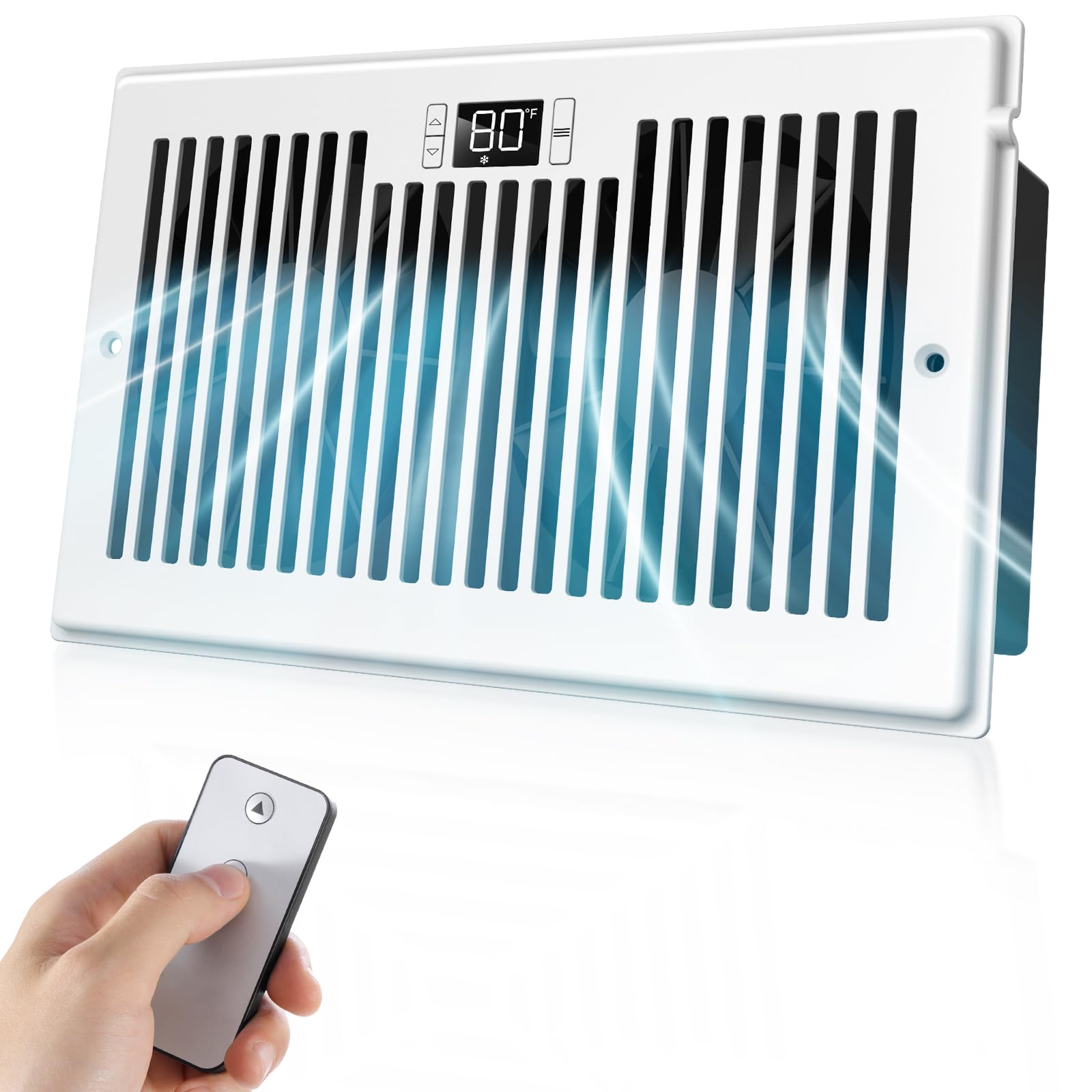
VELLEE entered the register booster category with a specific focus on larger duct openings, and their 6” x 10” model delivers 200 CFM at a claimed 18 dBA minimum noise—matching the highest airflow in this review alongside the Suncourt EZ8, but in a different size class. The high-static-pressure PWM motor is the key component here: it maintains consistent airflow even when duct runs have bends, sharp turns, or partial blockages from dust or debris. The unit’s 12-foot cord and included wall adapter make installation straightforward, and the matte white finish blends cleanly with most walls and floors.
The thermostatic control is tuned to read duct temperature rather than room temperature, which is the correct approach for a booster fan. Users with rooms that run 5–6°F hotter than the rest of the house report that the VELLEE cuts the temperature gap in half within hours of installation. Several reviewers mention an unexpected benefit: the PWM motor produces a smooth, even white noise that actually helps sleep quality, unlike the raspy blade whine common in older DC-motor designs. The potential for two-unit setups is high—multiple buyers ordered a second unit for additional problem vents after seeing the results from the first.
Where the VELLEE falls short is the initial setup manual. The thermostat temperature threshold configuration is not immediately intuitive, and several reviewers had to contact customer support to dial in the right trigger points for their specific HVAC system. Once set, the unit runs reliably, but expect a 15–20 minute setup process while you experiment with temperature offsets. The fan at speed 10 is also moderately loud—fine for daytime use but potentially disruptive in a bedroom at full blast during a nighttime cooling cycle.
Why it’s great
- 200 CFM PWM motor handles long or obstructed duct runs
- 18 dBA minimum for barely audible low-speed operation
- Excellent customer support for troubleshooting trigger settings
Good to know
- Thermostat setup requires trial and error for first-time users
- No app or Bluetooth—relies on on-unit buttons and remote only
4. SANYCASA Manhattan Smart Register Vent (Satin Nickel)
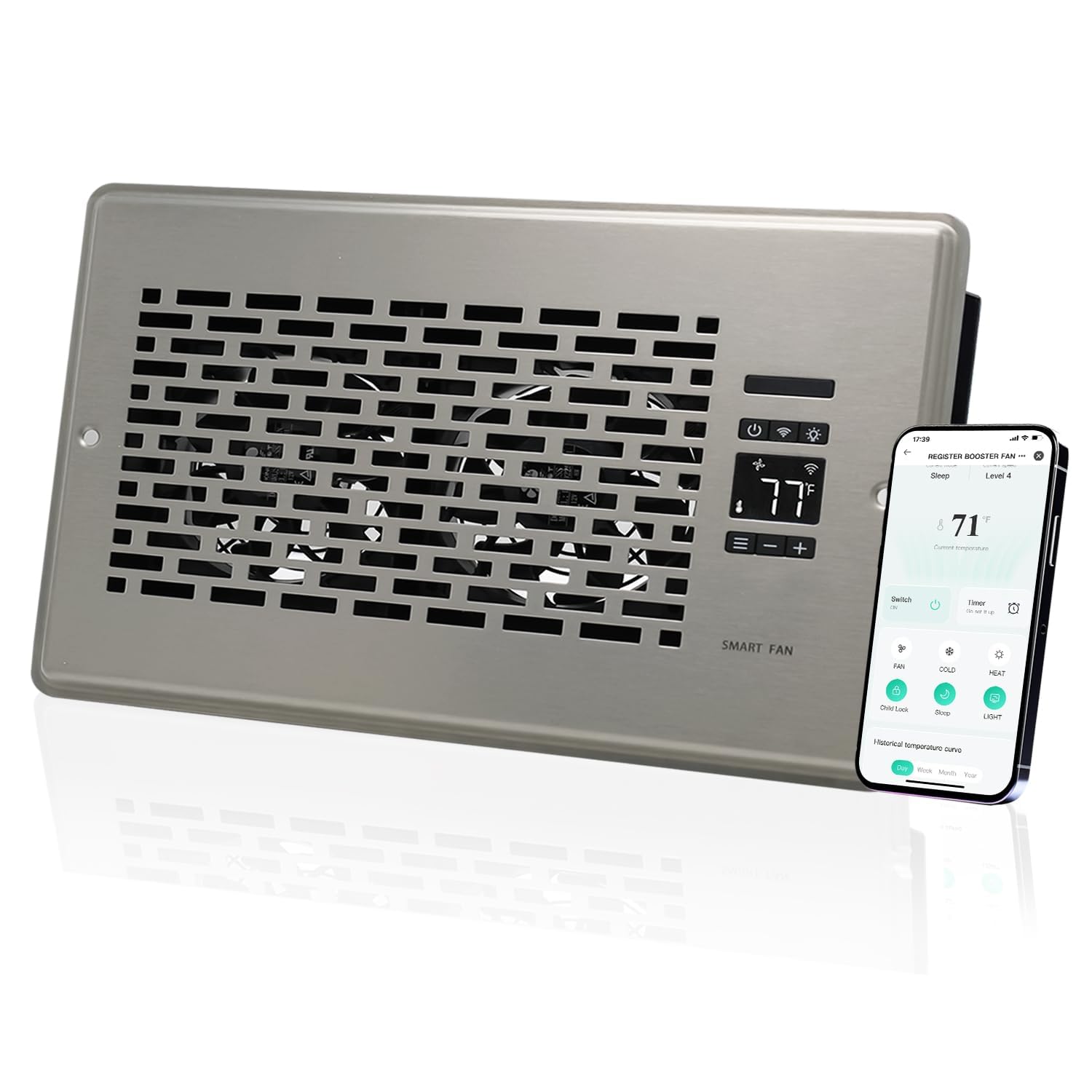
The SANYCASA Manhattan targets buyers who want smart-home integration with a design-forward aesthetic. The satin nickel face panel gives it a modern metallic look that suits contemporary or industrial interiors, and the unit is floor-standing or wall-mountable. It pushes 140 CFM through hydro-mechanical blades with a noise rating under 18 dBA, and the app allows you to control multiple Manhattan units simultaneously—useful if you’re trying to rebalance temperature across several rooms at once. The device includes a USB power cord and cable clips for tidy routing.
On the performance side, the Manhattan excels in small to medium rooms. Users report temperature drops of 7–10°F in top-floor bedrooms and noticeably faster warm-up in winter. The app displays the duct temperature and lets you set trigger points without bending down to the vent, which is a genuine convenience for wall-mounted installations or hard-to-reach floor registers. Build quality leans toward the mid-range: the metal panel feels premium, but the internal fan frame is plastic, consistent with other units at this price point.
Reviews flag two recurring issues. A small number of units arrived with a humming noise that was not present on replacements, suggesting some quality variance in the motor assembly. The app also requires Bluetooth proximity, so you cannot adjust settings from outside the house. One reviewer noted that the “Fan” mode runs continuously regardless of the temperature trigger, which can drain the fan’s mechanical life faster if left unattended. For the aesthetic value and app convenience, however, the Manhattan is a solid choice if your primary goal is balance in a single room rather than whole-home zonal control.
Why it’s great
- Satin nickel finish stands out from generic white plastic units
- App allows simultaneous control of multiple Manhattan fans
- Wall-mountable design offers flexible placement options
Good to know
- App requires Bluetooth proximity; no remote internet access
- Some units have motor hum; variance appears batch-related
5. BIOWIND Quiet Register Booster Fan 4×12

BIOWIND’s 4” x 12” model fills a specific gap: registers with a longer rectangular opening that standard 4×10 fans cannot cover. The unit delivers 140 CFM with a reported noise floor of 16 dBA—the quietest rating in this review—and uses dynamic fan balancing to minimize vibration over time. The bronze powder-coated frame is CNC-machined and fits flush against the floor, and the included wall adapter makes it plug-and-play. The remote control includes a screen lock that prevents small children from changing settings, a thoughtful detail for floor vents in high-traffic family rooms.
Users with long duct runs—upward of 15 feet to a far-end room—report that the BIOWIND is effective at pulling cool or warm air all the way to the register. The thermostat reads duct temperature and cycles the fan on and off automatically, and at speed 5 or below the fan is genuinely hard to hear, even in a quiet bedroom. Several buyers mention that the fan produces noticeably more comfortable conditions in rooms that previously required a standalone space heater or a window AC unit, reducing their dependency on those higher-energy devices.
The build quality is where BIOWIND cuts corners to hit its price point. A nontrivial number of units arrived with the remote missing or with minor cosmetic damage from shipping. One reviewer reported that the fan still functioned despite being damaged on arrival, suggesting the plastic housing is somewhat fragile but the motor is robust. The fan at speed 10 is loud—roughly half as loud as a box fan on high, per multiple accounts—so this is not a unit you’ll want running at max in a nursery. Still, for the specific 4×12 niche, it’s the most capable option available at the mid-range price point.
Why it’s great
- Fits uncommon 4×12 duct openings that standard units skip
- 16 dBA rating at low speeds is excellent for sleep environments
- Screen lock prevents accidental speed changes by children or pets
Good to know
- Remote goes missing in some shipments; check packaging immediately
- Housing plastic feels less durable than anodized aluminum alternatives
6. MATULSA Register Booster Fan 4×10

The MATULSA 4×10 is the most affordable unit in this roundup that still includes a full suite of smart thermostat features: a remote control, 10 adjustable speed levels, and separate cold-trigger and hot-trigger modes. The triangular hollowed-out surface design is unusual—MATULSA claims it protects small fingers while still allowing high airflow, and reviewers with toddlers confirm this is a legitimate safety advantage over open-grate designs. The installation is genuinely tool-free: place the fan into the 4” x 10” opening, plug the included power adapter into the outlet, and pair the remote.
Real-world performance data from buyers is encouraging. One reviewer logged a 5°F temperature drop in a far-end room above a garage after 24 hours of operation on a hot day, bringing the room from 75–80°F down to 71°F while the outside temps held at 85–86°F. Multiple users mention that the digital display shows the measured vent air temperature, allowing you to see exactly when the HVAC cycle begins and ends—helpful for dialing in the trigger settings without guesswork. The fan at speeds 6–8 produces a soft white noise that most users find tolerable for daytime use, though speeds 9–10 generate a noticeable fan sound.
The durability data is mixed. While many reviewers have used the unit for months with no issues, a small percentage report the fan failing after roughly 5 months of continuous use, producing an unusual noise before stopping entirely. MATULSA offers a support guarantee, but the replacement process takes several days. For budget-conscious buyers in mild climates who only need seasonal boost—say, 4 months of summer and 3 months of winter—this is a reasonable risk. For year-round, 24/7 operation in a home where a single room needs constant rebalancing, the mid-range or premium options offer better long-term reliability.
Why it’s great
- Includes remote, thermostat modes, and 10 speeds at an entry-level price point
- Child-safe triangular grille prevents finger insertion
- Digital display shows duct temperature for easy trigger setup
Good to know
- Reliability concerns: a minority of units fail between 4–6 months
- No app, Bluetooth, or battery option—corded installation only
7. VEVOR Register Booster Fan 4×10 Brown
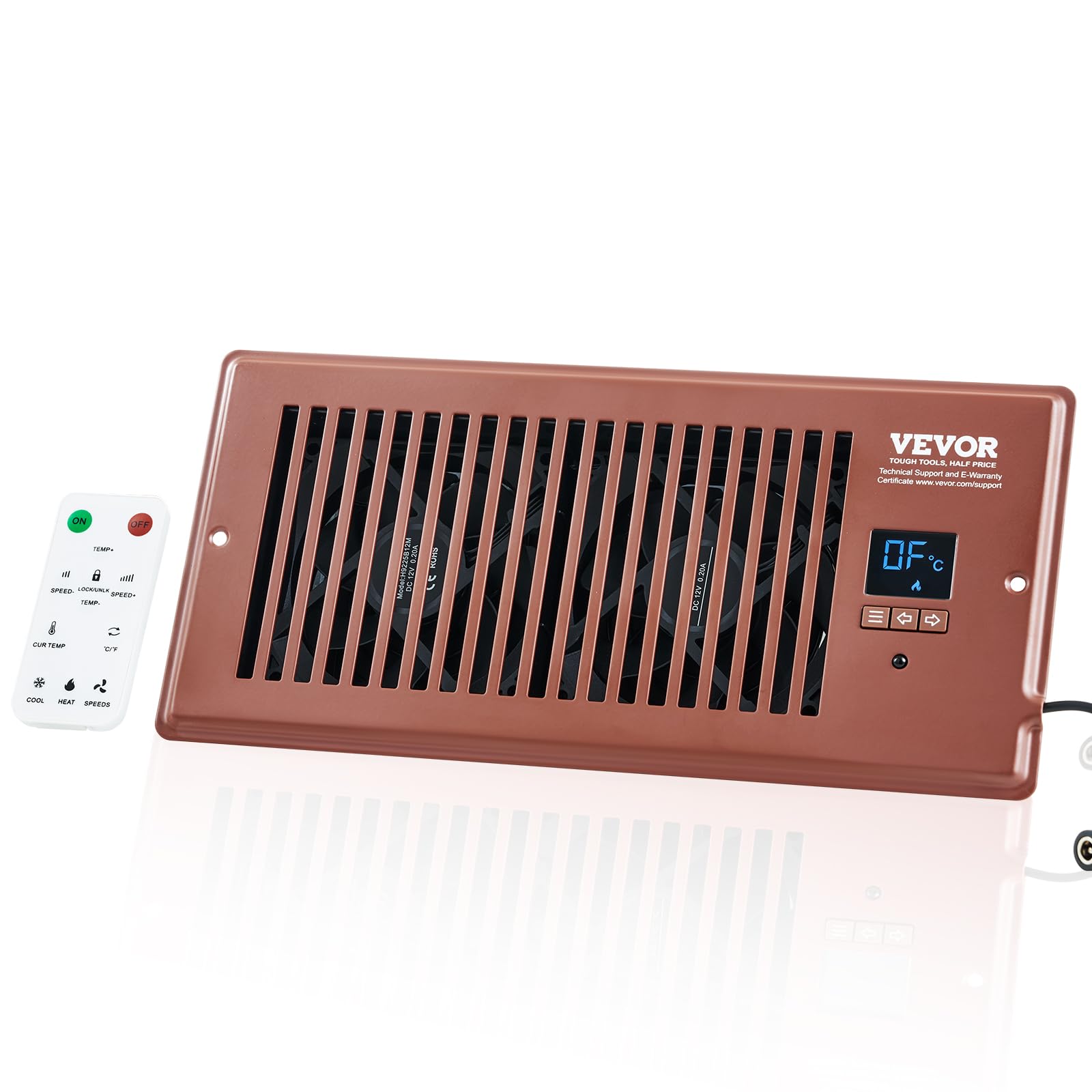
VEVOR’s 4×10 model is the quietest budget-friendly option in terms of its electrical design: a 6W PWM DC motor that draws minimal energy while producing a rated noise floor of 18 dBA. At 120 CFM, it moves less total air than the premium units, but for a small bedroom or office at the end of a short duct run, that volume is often enough to eliminate a 3–4°F temperature differential. The aluminum frame and powder-coated brown finish are more durable than fully plastic competitors, though the color is a divisive element—several reviewers describe it as “ugly brick red” and recommend hiding it with a vent cover overlay.
The included LCD controller is the standout feature at this price level. It displays the room temperature, allows push-button speed selection across 10 levels, and includes a screen auto-off function to eliminate light pollution in bedrooms. The remote works from up to 26 feet, and the thermostat trigger works reasonably well once configured. One reviewer in a cold climate reported that the booster fan raised their master bedroom temperature by 4°F in winter, allowing them to turn off a space heater entirely—a meaningful energy savings.
The downsides are primarily cosmetic and guidance-related. The instruction manual for the temperature trigger setup is minimal, leading some users to leave the fan in continuous run mode because they could not figure out the threshold programming. The fan noise is described as a constant hum rather than white noise, which some users find more distracting. And the unit is strictly corded—no battery option, no app, no Bluetooth. For users who prioritize ultra-low power consumption and a quiet motor over maximum CFM or smart features, the VEVOR delivers respectable value in a compact package.
Why it’s great
- 6W PWM motor sips electricity; costs pennies per month to run
- Aluminum frame with powder coating outlasts all-plastic alternatives
- LCD screen with auto-off prevents bedroom light pollution
Good to know
- Brown finish is unattractive per multiple buyer reviews
- Thermostat setup instructions are unclear; expect trial and error
FAQ
Can a battery powered register booster fan match the performance of a corded one?
Will a register booster fan damage my HVAC system?
Why does the booster fan run even after the AC turns off?
How do I clean a register booster fan that is installed in a floor vent?
Final Thoughts: The Verdict
For most users, the best battery powered register booster fan winner is the AC Infinity AIRTAP T4 because it combines Bluetooth app control, dual 92 mm PWM fans, and a precision anodized aluminum frame that looks and performs like a pro-grade HVAC accessory rather than a cheap plastic gadget. If you want patented auto on/off intelligence that requires no seasonal adjustment and zero app pairing, grab the Suncourt Equalizer EZ8, a no-fuss workhorse backed by a 3-year warranty and the industry’s longest track record. And for larger 6×10 duct openings requiring high CFM while still keeping noise at a reasonable 18 dBA threshold, nothing beats the VELLEE 6×10.

Mo Maruf
I created WellFizz to bridge the gap between vague wellness advice and actionable solutions. My mission is simple: to decode the research and give you practical tools you can actually use.
Beyond the data, I am a passionate traveler. I believe that stepping away from the screen to explore new environments is essential for mental clarity and physical vitality.