Our readers keep the lights on and my smoothie glass nicely filled. As an Amazon Associate, I earn from qualifying purchases.
A bench sander that wobbles, stalls under pressure, or struggles to remove material is worse than useless — it’s a bottleneck in your workflow. The difference between a frustrating session and a smooth one comes down to the motor’s sustained torque, the rigidity of the base, and whether the belt tracks true under load. Choosing a machine that holds these fundamentals straight determines whether you finish a project or fight the tool all day.
I’m Mohammad Maruf — the founder and writer behind WellFizz. I’ve analyzed dozens of sanding platforms, comparing motor amperage, belt speed consistency, table flatness, and dust port compatibility to separate the serious workshop tools from the shelf queens.
Whether you are shaping knife handles, restoring hand tools, or prepping stock for finishing, the right best bench sander saves you time and delivers repeatable, flat results on every pass.
How To Choose The Best Bench Sander
Selecting a bench sander involves more than picking the biggest belt. You need to match the tool’s power delivery, build stability, and work surface quality to the materials and volume of work you plan to do. Ignoring these factors leads to belts that drift, tables that need shimming, and motors that bog down when you lean in.
Motor Power and Drive System
The motor’s amperage and the drive mechanism define how the sander behaves under load. A 4.3-amp to 5-amp motor paired with a direct-drive system delivers consistent torque and runs quieter than a belt-driven or pulley-driven equivalent. Direct-drive designs eliminate belt tension adjustments and wasted energy — the rotor spins the drum directly, transferring 25 percent more power to the abrasive surface. For metalworking or heavy stock removal, a 1HP motor running at 5 amps provides the thermal headroom and sustained speed that smaller units lose after a few passes.
Belt and Disc Size Configuration
The 4-by-36-inch belt paired with a 6-inch disc is the dominant combo for general woodworking and light metalwork. The long belt handles edge shaping and flat surfacing, while the disc handles end-grain smoothing and small-part finesse. A 1-by-30-inch belt with a 5-inch disc suits hobbyists doing small craft work, knife making, and detail sanding where narrow access matters. A premium upgrade like an 8-inch disc paired with the standard 4-by-36-inch belt increases disc surface speed and allows for larger workpieces to be finished without repositioning.
Table and Base Construction
A cast-iron base provides the highest mass for vibration absorption and keeps the machine planted during aggressive sanding. Cast-aluminum bases offer a lighter alternative that still dampens vibration well, while stamped steel bases walk and resonate under pressure. The work tables themselves must be flat. Units with machined cast-iron or cast-aluminum tables hold a square edge without shimming. Check whether the belt table tilts from 0 to 90 degrees and the disc table tilts 0 to 45 degrees — both with positive stops or secure lock handles, not friction-only pivots that slip under load.
Dust Collection Design
A dust port is only useful if it connects to a standard shop-vac hose without an adapter hunt. The best units have separate ports for the belt and disc, each sized to accept a 2.5-inch or 2.25-inch hose. The port location matters — side-mounted ports clear the work area better than rear ports that interfere when the belt is tilted vertical. Machines without effective dust extraction fill the air with fine particulates quickly, requiring a respirator even for short sanding sessions.
Quick Comparison
On smaller screens, swipe sideways to see the full table.
| Model | Category | Best For | Key Spec | Amazon |
|---|---|---|---|---|
| WEN 6515T | Entry Combo | Light hobby & detail work | 2.3A motor, 3160 FPM belt | Amazon |
| Woodskil 4.3A | Value Combo | Home DIY & medium projects | 3/4HP, 4×36 belt, 6in disc | Amazon |
| Ingersoll Rand 360-418 | Pneumatic | Tight space & auto body | 0.6HP, 20,000 RPM air tool | Amazon |
| Woodskil 4.5A (Upgraded) | Value Combo | Budget-friendly combo | 4.5A, 3590 RPM disc speed | Amazon |
| WEN 6502T | Value Combo | Cast-iron base stability | 4.3A, cast iron base, 4×36 belt | Amazon |
| BUCKTOOL BD4603 | Mid-Range Combo | Quiet direct-drive performance | 5A direct drive, cast Al base | Amazon |
| SKIL BB9504-00 | Mid-Range Combo | Consistent power for hobbyists | 4.5A induction motor, 2.5in port | Amazon |
| Rikon 50-161VS | Premium 1in Belt | Variable speed & fine work | 3/4HP variable-speed, 1×30 belt | Amazon |
| BUCKTOOL BD4801-M | Pro Metalworking | Heavy metal & knife grinding | 1HP direct-drive, 8in disc | Amazon |
In‑Depth Reviews
1. BUCKTOOL BD4801-M 1HP Belt Disc Sander

The BUCKTOOL BD4801-M steps into professional territory with a true 1HP direct-drive motor that delivers constant torque through a 4-by-36-inch belt and an 8-inch disc. The larger disc increases the effective work surface for finishing broad pieces without repositioning. The motor direct-drive design improves efficiency by 25 percent over traditional belt-driven sanders, translating to less heat buildup and more consistent speed when grinding high-carbon steel or hardwood. The cast-aluminum base with rubber feet keeps the unit planted during aggressive passes, and the belt arm accepts an optional knife-grinding attachment.
Setup requires patience — the disc table may need squaring out of the box, and the instruction manual offers minimal guidance for the assembly steps. Once dialed in, the belt tracks reliably and the tension lever allows quick grit changes without tools. The top-mounted switch placement keeps the controls accessible even when the machine is positioned against a wall. The hook-and-loop disc backing makes swapping abrasive discs fast, and the 5-amp motor does not bog down under sustained pressure typical of metal fabrication or knife beveling.
The 39.6-pound weight provides stability, but the footprint is larger than standard combo units — confirm your bench space before ordering. The plastic disc guard is a minor weak point; some users report discoloration from heat buildup during extended metal grinding. The belt dust port is side-mounted and accepts a standard shop-vac hose, but the port diameter is smaller than ideal, requiring an adapter for full 2.5-inch systems. For anyone regularly sanding metal or needing a machine that can handle production-level stock removal, this is the most capable unit in this lineup.
Why it’s great
- 1HP direct-drive motor sustains speed under heavy metalworking loads
- 8-inch disc provides a larger work surface than standard 6-inch models
- Cast aluminum base and rubber feet absorb vibration effectively
- Tool-free belt tension lever enables fast grit changes
Good to know
- Large footprint requires dedicated bench space
- Disc table may need alignment adjustment after unboxing
- Instruction manual lacks detailed diagrams for assembly
- Dust port diameter requires adapter for standard 2.5-inch shop vacs
2. BUCKTOOL BD4603 5A Belt Disc Sander

The BUCKTOOL BD4603 delivers a maintenance-free experience thanks to its direct-drive system that eliminates belt tension adjustments entirely. The 5-amp motor provides ample torque for a 4-by-36-inch belt and a 6-inch disc while running noticeably quieter than comparable pulley-driven sanders. The cast-aluminum base with rubber feet prevents walking, and the two cast-aluminum work tables offer stable platforms for accurate bevel work. The belt tilts from 0 to 90 degrees, and the disc table tilts 0 to 45 degrees, both with secure locks.
The direct-drive design means the belt and disc are always synchronized, and there are no pulleys or drive belts to replace. Quick belt changes are handled by a tension lever and tracking knob that keeps the belt centered without drift. The dust ports are separate for the belt and disc, though both use smaller diameters that do not fit standard 2.5-inch hoses without an adapter. The belt port is side-mounted, which keeps the hose out of the way during vertical belt sanding.
Some users note that the fences are light-duty and may flex under heavy side pressure, so precise miter cuts require care. The unit is also lighter than a cast-iron bench sander at roughly 35 pounds, which makes it portable but less vibration-dampened during high-pressure operations. For home shop users who want quiet, consistent performance and do not want to fuss with drive-belt replacements, this is a strong mid-range choice that outperforms its price tier in noise reduction and power delivery.
Why it’s great
- Direct-drive design requires no belt tension maintenance
- 5-amp motor runs quieter than pulley-driven alternatives
- Cast-aluminum tables provide a flat sanding surface
- Belt tilts 0-90 degrees for vertical sanding access
Good to know
- Dust ports are small and need an adapter for standard shop vacs
- Fences are light-duty and may flex under heavy pressure
- Lighter overall weight reduces vibration absorption compared to cast iron
- No safety cover over the sanding disc
3. SKIL BB9504-00 4.5A Belt and Disc Sander

SKIL brings a no-nonsense 4.5-amp induction motor to the BB9504-00, and the motor holds speed under load better than many of its competitors in the same price tier. The 4-by-36-inch belt paired with a 6-inch disc covers the standard range of sanding tasks from edge shaping to end-grain finishing. The dust port accepts standard 2.5-inch vacuum hoses directly — a simple but critical advantage over models that require adapters. The belt angle adjusts from 0 to 90 degrees, and the disc table tilts 0 to 45 degrees with a miter gauge included for angled work.
The quick-tension release lever makes belt swaps fast, and the belt tracks precisely without drift after initial adjustment. The base has pre-drilled mounting holes for bolting to a benchtop, and the unit’s 25-pound weight is manageable for portability. The tables arrived flat and square out of the box, requiring no shimming, according to multiple users. The induction motor runs with consistent speed even when applying moderate pressure, unlike some brushed alternatives that slow audibly.
The 3-year limited warranty (extendable via registration) adds confidence, but note that both the belt and disc run simultaneously — there is no independent operation. Loose clothing near the disc is a real hazard. The fence design is functional but basic, and the miter gauge is plastic and lightweight. For a home hobbyist or DIYer who wants a reliable, out-of-box-ready bench sander without fighting alignment, the SKIL delivers dependable performance at a fair price point.
Why it’s great
- Induction motor maintains speed under load without bogging
- Dust port fits standard 2.5-inch vacuum hoses without adapter
- Tables arrive flat and square with minimal adjustment needed
- 3-year warranty adds long-term value
Good to know
- Belt and disc operate simultaneously with no independent control
- Miter gauge and fence are basic plastic components
- 25-pound unit is stable but lighter than cast-iron alternatives
- No variable speed option for specialized materials
4. Rikon 50-161VS 1×30 Belt and 6in Disc Sander

The Rikon 50-161VS stands out in the 1-inch belt category with a variable-speed dial that adjusts the belt from 1,909 to 3,248 SFPM and the disc from 2,000 to 3,400 RPM. This control range is invaluable for precision work on knife blades, jewelry, dollhouse parts, and sharpening chisels where heat buildup from excessive speed can ruin a temper. The 3/4HP, 4-amp motor paired with a 1-by-30-inch belt and a 6-inch PSA-backed disc provides a compact platform for detailed shaping without the bulk of larger combos.
The belt features removable platens that allow sanding around curved objects and into recessed areas that a standard platen cannot reach. Tracking knobs provide fine adjustment to keep the belt centered, and the variable-speed range lets you dial down for delicate materials like plastic or soft metal. The disc table measures 8 by 5-3/8 inches and tilts 0 to 45 degrees with a miter gauge slot. The heavier construction relative to other 1-inch sanders dampens vibration, and the motor runs very quietly, making this suitable for a home workshop without disturbing neighbors.
The disc fence is plastic without a keyed guide rail, so repeatable square cuts require some setup. The small table size limits the workpieces you can comfortably support, so this is not a substitute for a 4-by-36-inch belt sander for large projects. The 5-year warranty from Rikon is reassuring, but the unit is recommended for light-duty use only. For knife makers, jewelers, and scale-model builders who need precision variable speed in a small footprint, this is the best option available in this segment.
Why it’s great
- Variable-speed dial allows precise control for heat-sensitive materials
- Removable platens enable curved and recessed sanding
- Quiet motor and heavy base reduce vibration
- Compact footprint ideal for small workshops
Good to know
- Disc fence is plastic without a keyed guide rail
- Limited to light-duty use and small workpieces
- PSA disc backing requires adhesive-backed sandpaper
- 1×30 belt is narrower than standard 4×36 combos
5. WEN 6502T 4.3A Belt and Disc Sander

The WEN 6502T uses a cast-iron base to absorb vibration, making it one of the more stable machines in the mid-range price tier. The 4.3-amp motor drives the 4-by-36-inch belt at 3,600 RPM and the 6-inch disc simultaneously. The belt tilts from 0 to 90 degrees, and the tension-release lever makes grit changes a two-second operation — no tools needed. The cast-iron base provides a solid foundation that prevents the walking and wobbling that plague lighter stamped-steel units.
The fence is a highlight — it is taller and more rigid than most budget competitors, providing better support for edge sanding. Belt changes require only an Allen key to loosen the tension and swap belts, which experienced users can do in under 30 seconds. The 6502T handles metal sanding well for a non-industrial machine, with one user reporting 15 hours per week of metal work without failure. The 2-year warranty covers defects, and the motor has proven reliable for hobbyist use over several years.
The miter gauge is cheap plastic and the disc table can misalign after repeated adjustments — checking squareness before each session is recommended. The dust collection is ineffective in flat belt mode because the port is positioned poorly for horizontal sanding. The unit also bogs down if you apply heavy pressure, a limitation of the 4.3-amp motor when compared to 5-amp or 1HP options. For a stable, affordable 4×36 combo with a great fence and easy belt changes, the WEN 6502T is a proven workhorse for the home shop.
Why it’s great
- Cast-iron base minimizes vibration and walking
- Fence is taller and more rigid than budget competitors
- Quick belt changes with tension-release lever and Allen key
- Proven reliability for long-term hobbyist use
Good to know
- Motor bogs down under heavy pressure
- Dust collection is poor in horizontal belt mode
- Miter gauge is plastic and feels cheap
- Disc table alignment can shift after repeated adjustments
6. Woodskil 4.5A Upgraded Belt & Disc Sander
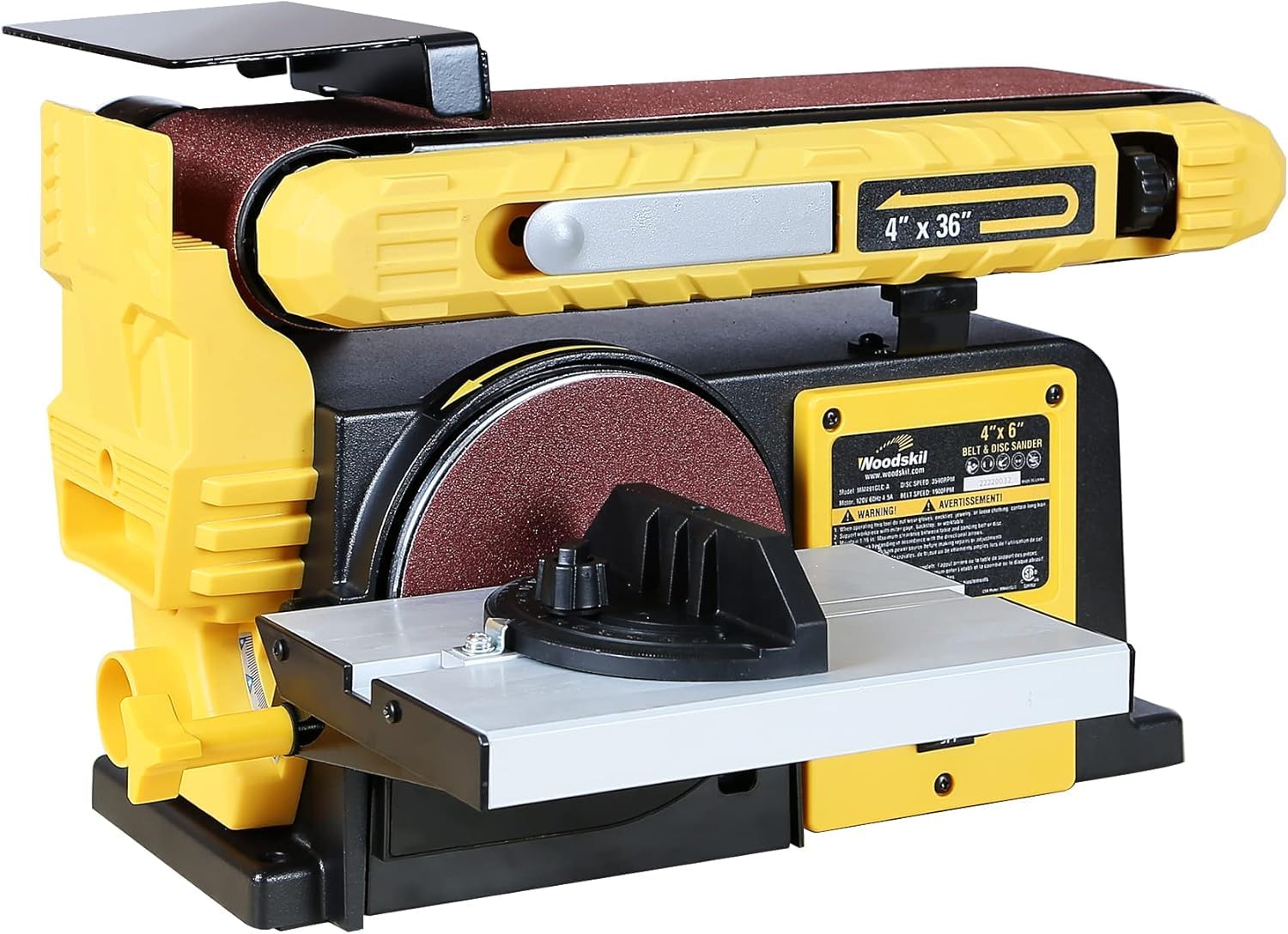
The Woodskil 4.5A upgraded model brings a 3/4HP motor with 3,590 RPM disc speed and 1,900 FPM belt speed to the budget-friendly segment. The 4-by-36-inch belt and 6-inch disc combo covers the essential sanding profiles, and the belt table tilts from 0 to 90 degrees while the disc table tilts 0 to 45 degrees with the included miter gauge. At roughly 39.6 pounds, the unit is heavy enough to stay planted during most tasks without bolting down.
Belt replacement is straightforward: loosen the screw on the dust exhaust, pull the tension lever, swap the belt, and track it with the adjustment knob. The upgraded design improves the belt tracking mechanism compared to earlier Woodskil models, keeping the belt centered during operation. The motor has enough power to handle moderate wood removal and light metal sanding, and the machine runs smoothly with minimal vibration after initial setup.
The dust collection is poor without an external vacuum — the ports are present but do not capture fine dust effectively on their own. Some users report the belt can be slightly harder to replace than on premium units, requiring patience with the tracking adjustment. The overall build quality is adequate for the price, with plastic components on the guards and the miter gauge. For a budget-conscious buyer who needs a functional 4×36 combo and is willing to perform some initial alignment, the Woodskil 4.5A offers the best value in its price bracket.
Why it’s great
- 3/4HP motor provides sufficient power for moderate wood removal
- Heavy enough at 39.6 pounds to stay stable without bolting
- Improved belt tracking mechanism on this upgraded model
- Both tables tilt for bevel sanding flexibility
Good to know
- Dust collection is ineffective without an external vacuum
- Belt replacement requires more patience than premium units
- Plastic guards and miter gauge feel less durable
- Some initial table alignment needed out of the box
7. Woodskil 4.3A Belt & Disc Sander Combo

The Woodskil 4.3A combo uses a 3/4HP motor that drives the 4-by-36-inch belt at 1,732 FPM and the 6-inch disc at 3,570 RPM. The key differentiator here is the adjustable belt position — the belt tilts from 0 to 90 degrees, and the user can lock it at any angle for horizontal or vertical sanding. The double-dust exhaust ports offer separate collection for the belt and disc, and the work table tilts 0 to 45 degrees with the included miter gauge for bevel work.
The multi-wedge belt drive mechanism extends belt life by reducing slippage, and the tension adjustment prevents the belt from loosening during operation. The transparent PC guard lets you monitor belt condition without stopping the machine. Assembly is simple and the unit feels solid for its 25-pound weight. Users report it handles wood, metal, and plastic effectively for home DIY projects, and the compact footprint fits easily on a garage workbench.
The 4.3-amp motor can bog down under heavy pressure on thicker stock, so light to medium passes are recommended for best results. The dust collection works best with a shop vac attached; standalone, the ports capture minimal debris. The fence is functional but not precision-grade — miter cuts require careful alignment. For the home DIYer who needs a flexible 4×36 combo with tilting belt capability and does not require industrial throughput, this is a capable entry-level option.
Why it’s great
- Belt tilts 0-90 degrees for versatile horizontal and vertical sanding
- Separate dust ports for belt and disc improve collection with shop vac
- Multi-wedge belt drive extends abrasive belt lifespan
- Compact footprint suits limited workshop space
Good to know
- Motor bogs down under heavy pressure on thick stock
- Dust collection is poor without external vacuum assistance
- Fence and miter gauge lack precision for fine woodworking
- 25-pound weight is lighter than cast-iron alternatives
8. WEN 6515T 1×30 Belt and 5in Disc Sander

The WEN 6515T is the entry-level champion for hobbyists who need a compact, inexpensive machine for light sanding tasks. The 2.3-amp motor drives a 1-by-30-inch belt at 3,160 FPM and a 5-inch disc at 3,450 RPM. The two-in-one design saves bench space while providing both belt and disc capabilities. The heavy-duty base with rubber feet prevents walking, and two separate dust ports allow vacuum connection for both sanding surfaces.
The belt table can be squared with a hex screw in a one-time setup, and the disc table locks with two set-screw handles that hold position reliably. The motor is quiet enough for a home garage, and there is no wobble at speed. Changing belts is simple, and off-brand consumable belts and discs are inexpensive, so stocking multiple grits is budget-friendly. The included 80-grit disc and 100-grit belt get you started, but you will want additional grits for finishing work.
The 1-by-30-inch belt is narrow, limiting you to small parts and detail work. The plastic components on the guards and adjustment knobs feel adequate for light use but would not survive heavy-duty daily operation. The dust ports are ineffective without an external vacuum connected — they are purely pass-through ports. For someone restoring hand tools, making small craft items, or needing a gentle sander for model building, the WEN 6515T delivers surprising capability in a tiny footprint.
Why it’s great
- Compact size fits small workbenches and hobby spaces
- Quiet motor with no wobble at operating speed
- Easy belt changes and cheap consumables
- Both belt and disc have separate dust ports
Good to know
- 1×30 belt is too narrow for larger workpieces
- Plastic components limit durability for heavy use
- Dust ports need external vacuum to function
- 2.3-amp motor is underpowered for aggressive sanding
9. Ingersoll Rand 360-418 Air Belt Sander

The Ingersoll Rand 360-418 is a pneumatic belt sander, not a benchtop unit, but it earns a spot for users who need to bring the sander to the workpiece rather than the other way around. The 0.6HP air motor delivers 20,000 RPM and 4,700 SFPM through a 1/2-by-18-inch belt. The tool-free articulating arm allows sanding in tight spaces and angles that a benchtop machine cannot reach, making it ideal for auto body work, removing spot welds, burrs, and surface deposits.
The lightweight design at 2.4 pounds reduces fatigue during extended overhead or detail work. Three Norton sanding belts are included in 60, 80, and 100 grit, covering coarse shaping to medium finishing. The power regulator lets you dial in the speed based on the material and task — useful when switching from aggressive metal removal to gentle surface blending. Belt changes are tool-free and fast, requiring no wrenches or tension adjustments.
The noise output is substantial — this air tool is not quiet, and hearing protection is mandatory. It requires a compressed air source with sufficient CFM to sustain 20,000 RPM under load, so a small pancake compressor will not keep up. The 1/2-by-18-inch belts are a specialty size, less common and more expensive than standard 4×36 or 1×30 belts. For professionals in metal fabrication and auto body repair who need a portable, powerful belt sander that can contort into tight spaces, this Ingersoll Rand is the right specialized tool.
Why it’s great
- Tool-free articulating arm reaches tight and angled spaces
- 20,000 RPM delivers aggressive material removal
- Lightweight 2.4-pound design reduces user fatigue
- Power regulator provides speed control for different materials
Good to know
- Extremely loud — hearing protection is mandatory
- Requires high-CFM compressed air source
- 1/2×18-inch belts are a specialty size with limited availability
- Not a benchtop unit — cannot replace a stationary belt sander
FAQ
What size belt sander should I get for general woodworking?
Is direct drive better than belt drive on a bench sander?
Why does my bench sander belt drift to one side?
Final Thoughts: The Verdict
For most users, the best bench sander winner is the BUCKTOOL BD4801-M because its 1HP direct-drive motor and 8-inch disc provide the power and work surface that hobbyists and metalworkers need without jumping to industrial pricing. If you want quiet, maintenance-free operation with a standard 4×36 combo, grab the BUCKTOOL BD4603. And for precision variable-speed work in knife making or modeling, nothing beats the Rikon 50-161VS.

Mo Maruf
I created WellFizz to bridge the gap between vague wellness advice and actionable solutions. My mission is simple: to decode the research and give you practical tools you can actually use.
Beyond the data, I am a passionate traveler. I believe that stepping away from the screen to explore new environments is essential for mental clarity and physical vitality.