Our readers keep the lights on and my smoothie glass nicely filled. As an Amazon Associate, I earn from qualifying purchases.
The line between a stills camera and a video camera has blurred, but not every mirrorless or DSLR body handles both disciplines equally. A model that delivers class-leading dynamic range for landscapes may struggle with rolling shutter during panning shots, while a video-first camera can leave stills looking soft. Finding the right tool means weighing sensor readout speed, bit depth, log profiles, and autofocus reliability under continuous recording — areas where many all-rounders compromise.
I’m Mohammad Maruf — the founder and writer behind WellFizz. I spend my time analyzing sensor architectures, codec support, and real-world noise performance across the mid-range and premium segments to separate true hybrids from marketing claims.
That deeper look at sensor behavior, stabilization, and feature overlap is exactly what this guide delivers — a practical breakdown of the best cameras for photo and video so you can invest in a body that excels at both without costly workarounds.
How To Choose The Best Cameras For Photo And Video
A true hybrid camera must balance sensor resolution, readout speed, and codec support. Focusing on only one spec — megapixels or frame rate — often leads to buyer’s remorse. Here are the key factors to weigh.
Sensor Size and Readout Speed
Full-frame sensors offer superior dynamic range and low-light performance, but readout speed determines how much rolling shutter you see in video. Stacked or BSI designs (like the Sony a7 III’s Exmor R or the Nikon D850’s BSI sensor) reduce distortion during quick pans. APS-C sensors, like the Fujifilm X-H2’s 40MP X-Trans CMOS 5 HR, can match full-frame detail in good light but require faster glass to compensate in dim conditions.
Autofocus for Continuous Tracking
Phase-detection AF with eye and subject tracking is non-negotiable for video. The Canon EOS R5’s Dual Pixel CMOS AF covers near 100% of the frame, while the Sony a7 IV’s 693-point phase-detection system locks onto moving subjects reliably. For run-and-gun shooting, contrast-detection systems found in some Micro Four Thirds bodies struggle with focus pulls during 4K recording.
Codec Support and Bit Depth
Internal 10-bit 4:2:2 recording at 4K 60p gives you room to grade without banding. The Panasonic S5II offers unlimited 4:2:2 10-bit with a fan for thermal management, while the Canon EOS R5 pushes to 8K RAW internally but has historically faced heat concerns at that resolution. If you plan to color grade, look for Log or Flat profiles (S-Log, V-Log, C-Log, F-Log) that preserve highlight and shadow detail across 13+ stops.
Stabilization: IBIS vs. Lens OIS
In-body image stabilization (IBIS) lets you use unstabilized lenses handheld, a major advantage for video run-and-gun. The Olympus E-M10 Mark IV and Panasonic G85 both offer 5-axis IBIS, but the G85 pairs it with lens-based Power O.I.S. for an extra stop. For pure photography, IBIS also helps with long-exposure handheld shots at 1 second or slower.
Quick Comparison
On smaller screens, swipe sideways to see the full table.
| Model | Category | Best For | Key Spec | Amazon |
|---|---|---|---|---|
| Sony a7 IV | Full-Frame | Hybrid Stills & Video | 33MP, 4K 60p 10-bit 4:2:2 | Amazon |
| Canon EOS R5 | Full-Frame | High-Res Stills & 8K Video | 45MP, 8K RAW Internal | Amazon |
| Nikon D850 | Full-Frame DSLR | High Resolution Stills | 45.7MP, 4K Timelapse | Amazon |
| Sony a7 III | Full-Frame | All-Around Value | 24.2MP, 4K 30p S-Log | Amazon |
| Panasonic Lumix S5II | Full-Frame | Video-Centric Hybrid | 24.2MP, Unlimited 4:2:2 10-bit | Amazon |
| Canon EOS RP | Full-Frame | Entry Full-Frame | 26.2MP, 4K 24p (Crop) | Amazon |
| Nikon D7500 | APS-C DSLR | Action & Wildlife | 20.9MP, 4K 30p, 8fps | Amazon |
| Fujifilm X-H2 | APS-C Mirrorless | Detail & Film Simulations | 40MP, 8K 30p, 7-stop IBIS | Amazon |
| OM System E-M10 Mark IV | Micro Four Thirds | Compact Travel | 20MP, 4K 30p, 5-axis IBIS | Amazon |
| Panasonic Lumix G85 | Micro Four Thirds | Stabilized Video | 16MP, 4K 30p, 5-axis Dual IS | Amazon |
| DJI Osmo Pocket 3 | Pocket Gimbal | Vlogging & Run-and-Gun | 1″ CMOS, 4K 120fps, 3-Axis | Amazon |
In‑Depth Reviews
1. Sony Alpha 7 IV

The Sony a7 IV sits at the sweet spot of the hybrid market with a 33MP Exmor R back-illuminated sensor that produces sharp, detailed stills and oversampled 4K 30p video from a 7K readout area. The BIONZ XR processor enables fast 10-bit 4:2:2 internal recording at 4K 60p, though there is a crop at 60fps. Real-time Eye AF for humans, animals, and birds works reliably in both photo and video modes, making it one of the most dependable tracking systems on the market.
The build quality matches its premium positioning — weather-sealed magnesium alloy chassis, a deep grip that suits larger lenses, and dual card slots (one CFexpress Type A, one UHS-II SD). Battery life is rated at over 2,000 shots per charge in real-world use, which is excellent for a mirrorless body. The fully articulating touchscreen helps with vlogging and low-angle video work, and S-Cinetone color science delivers pleasing skin tones straight out of camera.
Some users note that 4K 60p video uses a Super 35mm crop (1.5x), reducing the field of view. The menu system, while improved over earlier Sony bodies, still trails Canon and Fujifilm in intuitive layout. Overall, the a7 IV offers the best balance of resolution, frame rate, and autofocus for serious hybrid shooters who want one do-it-all camera.
Why it’s great
- Oversampled 4K 30p from 7K readout delivers exceptional detail
- Reliable real-time Eye AF for both stills and video tracking
- Dual card slots with CFexpress Type A support for high-bitrate recording
Good to know
- 4K 60p introduces a 1.5x crop factor
- No built-in flash requires external hotshoe unit for fill light
2. Canon EOS R5

The Canon EOS R5 pushes the boundaries of hybrid capability with a 45MP stacked BSI CMOS sensor that records 8K RAW internally at up to 30fps. The DIGIC X processor handles the massive data throughput, and the Dual Pixel CMOS AF II covers nearly 100% of the frame with subject detection for people, animals, and vehicles. In 4K HQ mode, the camera oversamples from the 8K readout, producing some of the sharpest 4K footage available from a mirrorless body.
Build quality is pro-grade with a magnesium alloy body, weather sealing, and a deep, comfortable grip. The 5-axis IBIS provides up to 8 stops of stabilization, making it possible to shoot handheld at shutter speeds that would have required a tripod on earlier cameras. The 0.5-inch OLED EVF with 5.76 million dots delivers a crisp view, and the fully articulating touchscreen is useful for both stills and video framing.
Heat management remains a consideration — 8K 30p recording is limited to roughly 20 minutes before the camera may shut down, and 4K 120p also generates significant heat. Battery life with the LP-E6NH is about 320 shots per CIPA rating, which can be extended with the battery grip. For stills-first shooters who also need top-tier video, the R5 is unmatched in resolution and DR.
Why it’s great
- 8K RAW internal recording with full-frame readout
- Dual Pixel CMOS AF II with near 100% coverage and eye control
- 8-stop IBIS enables handheld long exposures and smooth video
Good to know
- 8K and high frame rate recording limited by thermal management
- Battery life below average; grip recommended for extended shoots
3. Nikon D850

The Nikon D850 remains a benchmark for high-resolution DSLR photography, thanks to its 45.7MP back-side illuminated sensor with no optical low-pass filter. The 153-point AF system, inherited from the flagship D5, offers excellent subject tracking for action and wildlife. The optical viewfinder provides a clear, lag-free view that many photographers still prefer over EVFs, and the tilting touchscreen LCD makes live view composition more flexible.
Video capabilities are solid but not class-leading — internal 4K 30p is uncropped and uses the full sensor width, but there is no internal 10-bit recording. The camera does offer 4K timelapse and 1080p slow motion up to 120fps. The magnesium alloy body is weather-sealed and the shutter is rated for 200,000 cycles. Battery life is excellent at 1,840 shots per CIPA rating.
The D850’s weight and bulk are significant compared to mirrorless alternatives, and the optical viewfinder blocks live exposure preview for video. For stills-only work, it is arguably the best DSLR ever made, but video shooters will get better codec and stabilization options from mirrorless competitors in this price range.
Why it’s great
- 45.7MP BSI sensor with exceptional dynamic range and no moiré
- 153-point AF with 99 cross-type sensors for fast action tracking
- Excellent battery life (1,840 shots) for all-day shooting
Good to know
- No internal 10-bit or Log video profiles
- Bulky compared to mirrorless alternatives; optical viewfinder limits video preview
4. Sony a7 III

The Sony a7 III proved that full-frame performance could be democratized, and it still holds up well against newer rivals. The 24.2MP Exmor R BSI sensor offers 15 stops of dynamic range and clean high-ISO output up to 6400. The 693-point phase-detection AF system covers 93% of the frame, and Eye AF works for both humans and animals. The 10fps burst shooting with continuous AF makes it suitable for moderate action work.
Video features include 4K 30p with full pixel readout from the full sensor width, S-Log2 and S-Log3 gamma profiles for color grading, and 1080p 120fps for slow motion. The 5-axis IBIS provides about 5 stops of stabilization, enough for handheld walking shots with a wide-angle lens. The NP-FZ100 battery lasts about 710 shots per CIPA rating — excellent for a mirrorless body in this class.
The primary limitations are the older menu system, a lower-resolution 2.36M-dot EVF, and single UHS-II SD card slot (the second is UHS-I). The 4K 30p output also shows some rolling shutter in fast pans. For its price, the a7 III is a compelling entry into full-frame mirrorless that delivers good stills and serviceable video.
Why it’s great
- Excellent dynamic range (15 stops) in a compact full-frame body
- 693-point phase-detection AF with reliable Eye AF tracking
- Outstanding battery life (710 shots) for a mirrorless camera
Good to know
- Menus are less intuitive than Canon or Fujifilm systems
- Second card slot is UHS-I only, limiting backup speed
5. Panasonic Lumix S5II
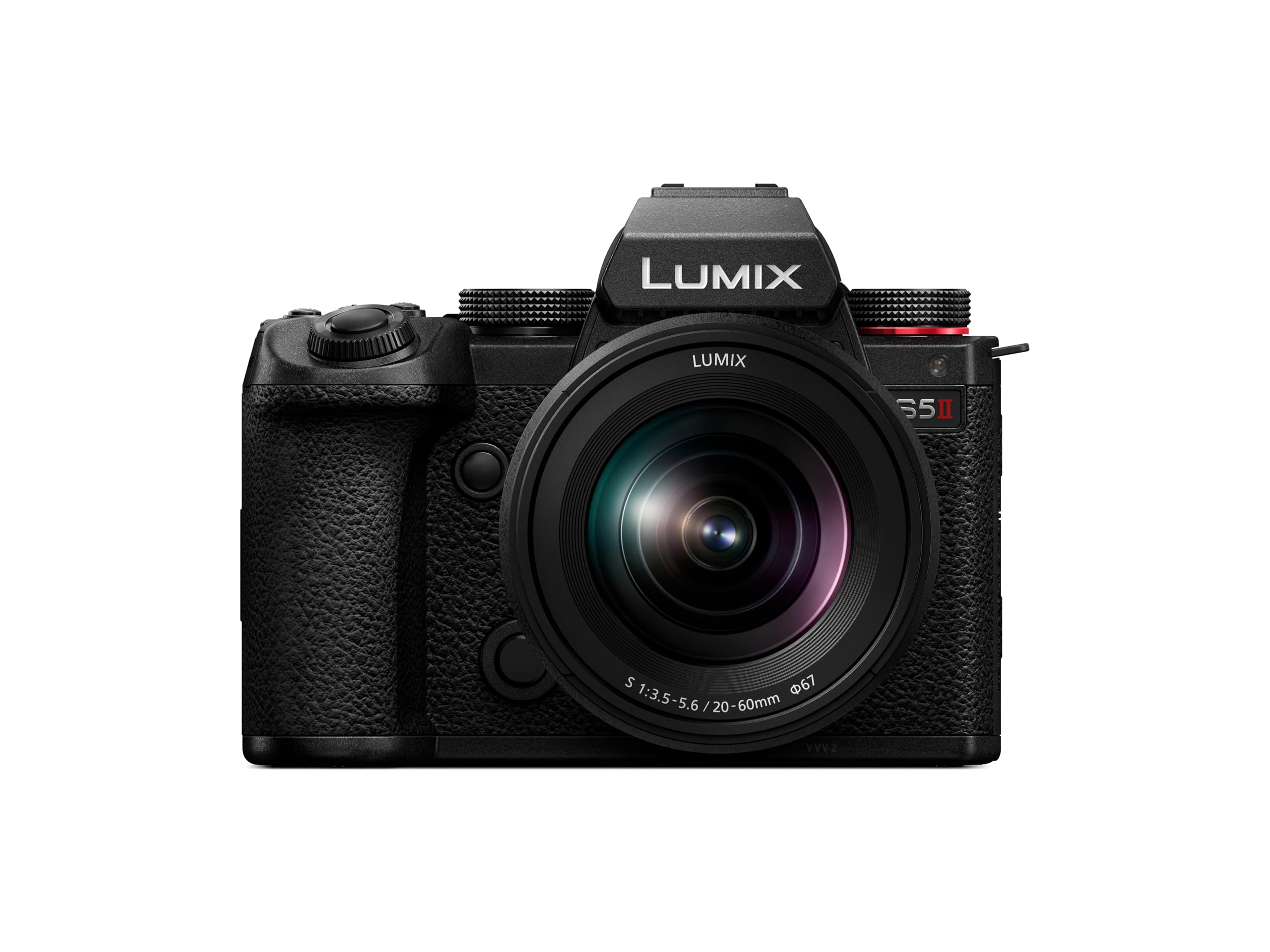
Panasonic’s S5II marks a significant turning point for the LUMIX S series by finally incorporating phase-detection autofocus. The 24.2MP full-frame sensor delivers 14+ stops of dynamic range with V-Log/V-Gamut, and the camera records unlimited 10-bit 4:2:2 internally thanks to an integrated cooling fan. Active I.S. improves stabilization during walking shots, making it a strong choice for run-and-gun videography.
The 20-60mm f/3.5-5.6 kit lens provides a useful wide-to-standard range, and the L-mount ecosystem includes lenses from Sigma, Leica, and Viltrox. The body features a weather-sealed magnesium alloy design, a high-resolution 3.68M-dot OLED EVF, and dual card slots (SD UHS-II). The S5II also offers REAL TIME LUT support, allowing in-camera color grading without a PC.
Battery life is average — about 370 shots per CIPA rating — and the 20-60mm kit lens has a variable aperture that limits low-light performance. The higher ISO range (above 51200) introduces noticeable noise. For hybrid shooters who prioritize video features and robust codec support, the S5II is one of the best options under .
Why it’s great
- Unlimited 10-bit 4:2:2 recording with integrated fan cooling
- Phase Hybrid AF finally brings reliable video autofocus to LUMIX
- Active I.S. provides gimbal-like stabilization for walking shots
Good to know
- Kit lens has variable aperture; upgrade to f/2.8 glass for low light
- Battery life below the full-frame mirrorless average
6. Canon EOS RP

The Canon EOS RP offers the most affordable entry into full-frame mirrorless, pairing a 26.2MP sensor with the RF mount. The camera is compact and lightweight, making it ideal for travel and casual vlogging. Dual Pixel CMOS AF provides fast, accurate face and eye detection in live view, and the fully articulating touchscreen is a boon for selfie-style video work.
Stills quality at base ISO is excellent, with accurate colors and good dynamic range for the price. The RF 24-105mm f/4-7.1 kit lens has optical image stabilization up to 5 stops, which helps in low light. Video recording tops out at 4K 24p, but with a significant 1.6x crop and no oversampling, resulting in softer footage than higher-end Canon bodies. 1080p 60p is cleaner but lacks DPAF microadjustment.
Battery life is rated at 250 shots, requiring spare batteries for a full day of shooting. The single SD card slot (UHS-II) limits backup options. For photographers ready to move from APS-C to full-frame without a large investment, the RP delivers solid stills with a path to RF glass, though hybrid shooters will want higher video specs.
Why it’s great
- Lightest and most affordable full-frame mirrorless body available
- Dual Pixel CMOS AF with reliable face/eye tracking
- Compact RF lens kit suitable for travel and everyday carry
Good to know
- 4K 24p uses a 1.6x crop and lacks oversampling
- Battery life of ~250 shots requires carrying spares
7. Nikon D7500

The Nikon D7500 inherits the metering and autofocus system from the D500, making it a capable action-oriented DSLR. The 20.9MP APS-C sensor delivers excellent high-ISO performance and good dynamic range. The 51-point AF system with 15 cross-type sensors and Group Area AF provides reliable tracking for moving subjects at up to 8fps continuous shooting.
The 18-140mm f/3.5-5.6 VR kit lens is a versatile all-in-one zoom that handles landscapes to portraits. 4K UHD 30p video captures with stereo sound and power aperture control during recording. The tilting 3.2-inch touchscreen LCD is bright and sharp (922K dots), though it doesn’t articulate sideways for vlogging.
The D7500 is larger and heavier than mirrorless alternatives, and it uses a single SD card slot (UHS-I only), which is a downgrade from the D7200’s dual slots. The optical viewfinder doesn’t offer exposure preview for video. For stills-focused shooters who value ergonomics, viewfinder clarity, and a mature DSLR ecosystem, the D7500 remains a strong performer.
Why it’s great
- D500-derived 51-point AF with Group Area tracking is very fast
- 18-140mm kit lens provides flexible reach for diverse shooting
- Good high-ISO performance and class-leading dynamic range
Good to know
- Single UHS-I SD card slot limits write speed and backup
- Bulky build compared to mirrorless; no side-articulating screen
8. Fujifilm X-H2

The Fujifilm X-H2 is the first APS-C camera to hit 40 megapixels, using a back-side illuminated X-Trans CMOS 5 HR sensor with an optimized pixel layout. The X-Processor 5 drives 8K 30p internal recording, 4K 120p, and Pixel Shift Multi-Shot that combines 20 frames into a 160MP DNG file for extreme detail. The 425-point hybrid AF system continues to improve with firmware updates and now offers reliable subject detection for animals and vehicles.
Film Simulation modes (Velvia, Classic Chrome, Nostalgic Neg, etc.) reduce the need for post-processing, which is a huge time-saver for editorial and social media work. The 5.76M-dot EVF is bright and crisp, and the 7-stop IBIS keeps handheld shots stable even with unstabilized lenses. The body is weather-sealed with a large, comfortable grip that rivals full-frame ergonomics.
File sizes are large — 40MP RAW files require fast CFexpress Type B cards and significant storage. The lens lineup for the X-mount is extensive, but achieving the full 40MP resolution demands high-quality glass. For photographers who want high-resolution stills with Fujifilm’s unique color science and robust video, the X-H2 is a standout.
Why it’s great
- World’s first 40MP APS-C sensor delivers extraordinary detail
- Pixel Shift Multi-Shot generates 160MP DNG files
- Film Simulations drastically reduce editing time for profiles
Good to know
- Large RAW files require CFexpress Type B and ample storage
- Lenses must be sharp to resolve the 40MP sensor fully
9. OM System Olympus E-M10 Mark IV

The OM System E-M10 Mark IV is one of the most compact interchangeable lens cameras with in-body stabilization, thanks to its Micro Four Thirds sensor and 14-42mm EZ pancake kit lens. The 20MP Live MOS sensor delivers good image quality at base ISO, and the 5-axis IBIS provides 4.5 stops of compensation — enough for sharp 1-second handheld exposures. The flip-down monitor and dedicated selfie mode make it easy for casual vloggers and group shots.
The 121-point contrast-detect AF is fast in good light but can hunt in dim conditions. Video recording goes up to 4K 30p with decent detail, but there is no 1080p 120fps slow-motion option. The compact size means the body can fit into a jacket pocket with the pancake lens attached, making it a true travel companion.
The plastic build doesn’t feel as premium as the magnesium-alloy OM-5 or E-M1 series, and the menu system can be overwhelming for beginners. Battery life is rated at 360 shots, which is average for the class. For photographers who prioritize portability and IBIS for stills, the E-M10 Mark IV is a capable, budget-friendly option.
Why it’s great
- Very compact and lightweight with pancake kit lens
- 5-axis IBIS delivers 4.5 stops of stabilization for handheld shots
- Flip-down selfie mode is intuitive for casual vlogging
Good to know
- Contrast-detect AF can hunt in low light
- No slow-motion video above 1080p 60fps
10. Panasonic Lumix G85

The Panasonic Lumix G85 is a Micro Four Thirds body that punches above its price in stabilization performance. The 16MP sensor has no low-pass filter, which improves fine detail resolution over earlier 16MP MFT sensors. The combination of in-body 5-axis IBIS and lens-based Power O.I.S. (Dual I.S. 2) allows smooth handheld 4K 30p video with very little shake, even when walking.
The 12-60mm f/3.5-5.6 Power O.I.S. kit lens offers a useful equivalent 24-120mm range in 35mm terms. The camera is splash-proof and dust-proof, and the magnesium-alloy front plate adds durability. The 2.36M-dot OLED EVF and articulating touchscreen are both above average for the price point. 4K Photo mode lets you extract 8MP stills from video at 30fps, which is useful for action sequences.
The 49-point contrast-detect AF is reliable in good light but hunts in low-light 4K video. There is no headphone jack for audio monitoring, which limits professional video work. The 16MP sensor also shows its age compared to newer 20MP MFT bodies. For videographers on a budget who need solid stabilization and a weather-sealed body, the G85 remains a compelling choice.
Why it’s great
- Class-leading Dual I.S. 2 provides near-gimbal level stabilization
- Splash-proof and dust-proof magnesium-alloy build
- 4K Photo mode extracts high-quality stills from video
Good to know
- Contrast-detect AF struggles with low-light video tracking
- No headphone jack for real-time audio monitoring
11. DJI Osmo Pocket 3

The DJI Osmo Pocket 3 is not an ILC but it deserves consideration for creators who prioritize portability and stabilization above all else. The 1-inch CMOS sensor records 4K 120fps video with excellent dynamic range, and the built-in 3-axis gimbal provides steady footage without any post-production stabilization. The 2-inch rotatable touchscreen allows quick switching between horizontal and vertical shooting for social platforms.
ActiveTrack 6.0 keeps subjects center-frame even during fast movement, and the included DJI Mic 2 transmitter in the Creator Combo delivers clear wireless audio. The camera also supports D-Log M and 10-bit color depth for advanced grading. Battery life is 166 minutes of continuous recording, which is impressive for such a small device.
The integrated gimbal is more fragile than a conventional camera body — rough handling can damage the mechanism. The 1-inch sensor cannot match Micro Four Thirds or APS-C in low light or depth of field. For on-the-go vloggers and social media creators who want the best stabilization in a pocketable form, the Pocket 3 is a dedicated tool.
Why it’s great
- Built-in 3-axis gimbal eliminates the need for a separate stabilizer
- ActiveTrack 6.0 keeps subjects centered during movement
- Wireless DJI Mic 2 included for high-quality audio
Good to know
- Integrated gimbal is fragile and requires careful storage
- 1-inch sensor limits low-light and shallow DOF capability
FAQ
Which sensor size is best for both photo and video?
Why does rolling shutter matter in hybrid cameras?
What bit depth is necessary for professional color grading?
Can I use DSLR lenses on mirrorless cameras?
Final Thoughts: The Verdict
For most users, the best cameras for photo and video winner is the Sony a7 IV because it offers the most balanced combination of 33MP stills quality, oversampled 4K 30p, reliable real-time Eye AF, and dual card slots at a price that justifies its hybrid credentials. If you want class-leading 8K resolution and Canon’s Dual Pixel AF, grab the Canon EOS R5. And for all-day handheld video with unlimited 10-bit recording, nothing beats the Panasonic Lumix S5II.

Mo Maruf
I created WellFizz to bridge the gap between vague wellness advice and actionable solutions. My mission is simple: to decode the research and give you practical tools you can actually use.
Beyond the data, I am a passionate traveler. I believe that stepping away from the screen to explore new environments is essential for mental clarity and physical vitality.