Our readers keep the lights on and my smoothie glass nicely filled. As an Amazon Associate, I earn from qualifying purchases.
The static cling of a PVC mat, the scent of chemical plasticizers, and the guilt of rolling out a non-renewable slab under your downward dog — these are the quiet pains of a conventional yoga practice. An eco friendly yoga mat swaps synthetic foam for renewable cork, natural tree rubber, or recycled TPE, delivering a surface that grounds your pose without contaminating your space or the planet.
I’m Mohammad Maruf — the founder and writer behind WellFizz. I have spent hundreds of hours cross-referencing material data sheets, studying adhesive chemistry, and isolating the real durability and grip metrics that separate a genuinely non-toxic mat from a greenwashed one.
With the right knowledge, finding the highest-performing best eco friendly yoga mat becomes a matter of matching your body to the right renewable material and thickness, not a chore.
How To Choose The Best Eco Friendly Yoga Mat
Selecting an eco friendly mat is more than choosing between cork and rubber. You need to evaluate the material’s renewable sourcing, the adhesive used to bond layers, the mat’s thickness for your joint sensitivity, and the surface texture for your typical sweat level. A mat that feels perfect in a 72-degree studio may fail you in a Bikram class or on a wood floor at home.
Core Materials: Cork, Natural Rubber, and TPE
Cork is harvested from the bark of cork oak trees without harming the tree, making it naturally renewable and biodegradable. Its microscopic air pockets provide a non-slip grip that actually increases when damp, making cork ideal for hot and power yoga. Natural tree rubber offers excellent cushioning and floor grip but carries a noticeably earthy (sometimes pungent) odor that can take days or weeks to off-gas. Recycled TPE (thermoplastic elastomer) is lighter and cheaper, but it is not fully biodegradable — it is a compromise between sustainability and cost. For the purest eco choice, prioritize 100% natural cork bonded to a natural rubber base with water-based, solvent-free adhesives.
Thickness and Joint Protection
Thinner mats (3–4mm) offer superior ground feel and stability for balancing poses but provide minimal cushioning for knees, wrists, and tailbone. Mid-range mats (5–6mm) are the sweet spot for most practitioners — enough padding for floor work without sacrificing the firm platform needed for standing poses. Extra-thick mats (8–10mm) are best for those with sensitive joints or for restorative and yin practices, though you may feel slightly less stable in balancing sequences. Always check whether the mat’s material compresses over time: natural rubber retains its thickness far longer than TPE foam.
Grip, Sweat Management, and Maintenance
Cork’s natural wax (suberin) resists moisture absorption, meaning sweat sits on the surface rather than soaking in — this makes cork mats naturally odor-resistant and easy to wipe clean. Natural rubber mats, especially those with a closed-cell surface texture, can become slippery when wet unless they have a textile or suede-like top layer. If you practice hot yoga or sweat heavily, a cork top is the most forgiving in terms of hygiene and grip. For maintenance, avoid soaking any natural mat; wipe with a damp cloth and mild soap, then air dry away from direct sunlight.
Quick Comparison
On smaller screens, swipe sideways to see the full table.
| Model | Category | Best For | Key Spec | Amazon |
|---|---|---|---|---|
| Body By Yoga Luxury Cork | Premium Cork | Hot yoga with joint sensitivity | 5mm thick cork / 2.35mm rubber base | Amazon |
| Y O GAYO Premium Cork | Mid-Range Cork | Taller yogis needing extra width | 72″ x 26″ / 5mm thick | Amazon |
| Manduka eKO Natural Rubber | Premium Rubber | Studio practice with strong grips | 5mm / 71″ x 26″ / 7 lbs | Amazon |
| GURUS Cork Travel Mat | Mid-Range Cork | Travel and heavy sweaters | 4.5mm / lightweight 1.5 lbs | Amazon |
| Plyopic Mat/Towel Combo | Premium Hybrid | Hot yoga with suede grip | 3.5mm rubber + towel layer | Amazon |
| Gaiam Cork Print Mat | Entry-Level Cork | Budget-friendly cork practice | 5mm / 68″ x 24″ | Amazon |
| UMINEUX Natural Rubber + TPE | Budget Extra Thick | Knee-cushioning on a budget | 10mm / 72″ x 24″ | Amazon |
In‑Depth Reviews
1. Body By Yoga Luxury Cork Yoga Mat
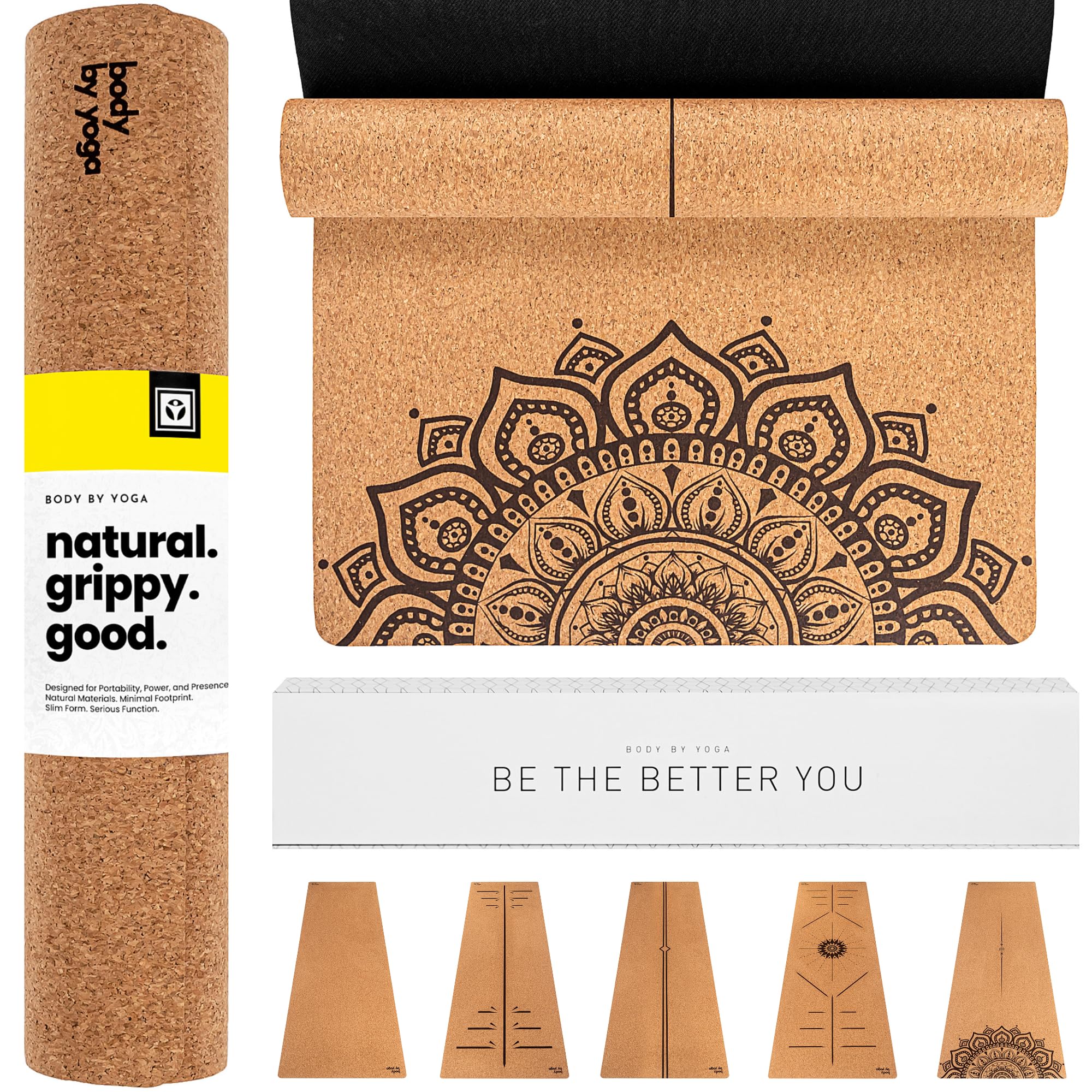
Designed by yoga instructors, this mat uses a thicker cork grain layer — not compressed cork particles — bonded to a natural rubber base with a low-odor water-based adhesive. The surface uses up to 6x more cork than typical mats, which directly translates to superior moisture-activated grip and longer life before the cork surface wears thin. At 4.25mm, it is marginally thinner than the 5mm standard, but the dense cork construction provides ample cushioning for wrists and knees without the spongy instability of foam mats.
The 72 x 24-inch footprint suits average-height practitioners, and the mat unrolls flat from day one with zero curling at the corners. In hot yoga conditions, the cork top becomes increasingly tacky rather than slick, eliminating the need for a separate yoga towel. The natural rubber base stays planted on hardwood, tile, and studio floors. The mat weighs 5.9 pounds — heavier than a travel mat but lighter than full-rubber slabs of the same size.
Select styles include subtle alignment lines that help with foot and hand placement without cluttering the visual field. The cork resists sweat absorption, so a simple wipe-down with water keeps the surface hygienic. The mat is EU REACH compliant, meaning it meets strict European chemical safety standards — a strong indicator that it avoids the phthalates and heavy metals sometimes found in cheaper natural mats.
Why it’s great
- Superior moisture-activated grip that improves with sweat
- Thicker cork layer resists wear and maintains tack over time
- Lays flat immediately with no edge curling
- Low-odor, water-based adhesive system is free from benzene and formaldehyde
Good to know
- Heavier than most cork mats at 5.9 pounds
- Limited to one width (24 inches); taller wide-shouldered yogis may prefer 26-inch options
2. Y O GAYO Premium Yoga Cork Mat

The Y O GAYO mat addresses the most common complaint from tall and broad-shouldered yogis: standard 24-inch mats force your hands and feet to the edges during wide-legged poses. At 26 inches wide and 72 inches long, this mat gives you an extra two inches of lateral room without feeling oversized or awkward to roll. The 5mm cork top sits on a dense natural tree rubber base, and the total weight of 8.36 pounds reflects that heavy-duty construction.
The cork surface is smooth to the touch — less textured than some competitors — but it still activates with moisture to provide a reliable grip. The rubber base has a slight new-car smell on unboxing, which generally dissipates within a week if the mat is unrolled in a ventilated space. The mat includes a nylon carry strap, which is helpful given its weight. Several users noted the ends curled slightly after a few weeks of storage; storing the mat loosely rolled or flat can mitigate this.
Clear alignment lines printed on the cork surface help with positioning in standing poses and transitions. The cork is naturally antimicrobial and odor-resistant, so a quick damp cloth wipe after sweaty sessions keeps the mat fresh. This is a strong option for practitioners who prioritize surface area over portability and are willing to manage a settling-in period for the edges.
Why it’s great
- One of the widest eco-friendly mats at 26 inches
- Helpful alignment lines for consistent hand and foot placement
- Excellent floor grip from the heavy rubber base
Good to know
- Heavy (8.36 pounds) and not ideal for travel
- Some users report edge curling after a few weeks of use
3. Manduka eKO Natural Rubber Yoga Mat
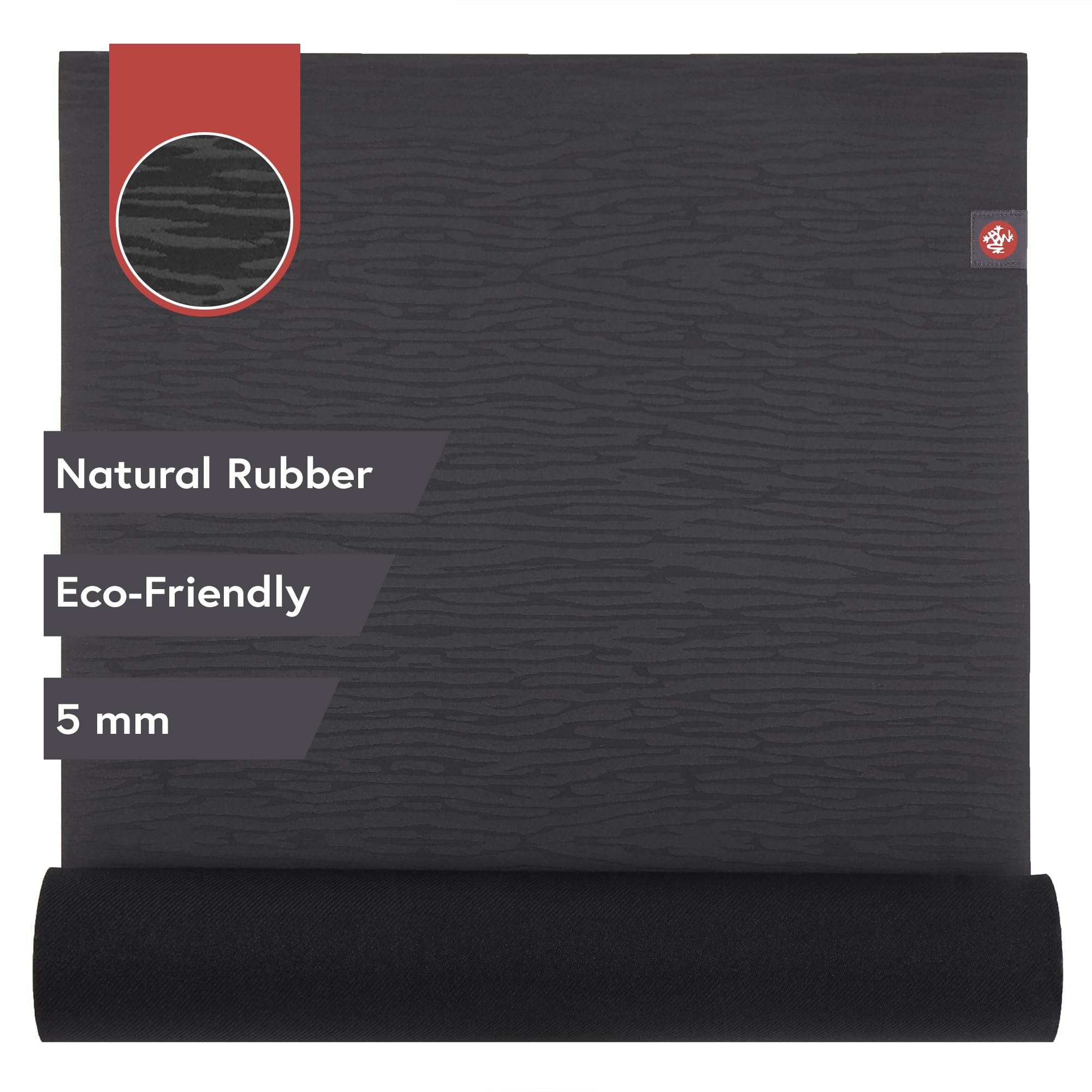
Manduka is a legacy brand in the premium yoga mat space, and the eKO series is their dedicated eco-friendly line. This mat is made from biodegradable natural tree rubber with a closed-cell surface that resists moisture absorption, sweat stains, and bacterial buildup. The 5mm thickness offers a firm platform with moderate cushioning — enough for a comfortable savasana but firm enough for stable balancing poses. The rippled catch-grip texture provides reliable traction even in cooler studio temperatures when cork may feel slippery.
The eKO measures 71 x 26 inches, giving you the same extra width as the Y O GAYO mat but with a slightly different grip profile. At 7 pounds, it is noticeably heavy and will not fit in a standard backpack. The closed-cell construction means you can clean it with Manduka’s Natural Rubber Mat Restore spray without worrying about water damage, but you should avoid soaking, harsh soaps, or direct sunlight. The mat is 99% latex-free, which is important for anyone with a latex sensitivity.
The most commonly reported issue is odor. The natural rubber emits a strong, rubbery smell that can persist for several weeks, even with airing. Some users found the smell lingered for a month and caused headaches. If you are sensitive to smells, this mat requires patience. For hot yoga, the mat can become slippery when heavily sweaty, and many practitioners pair it with a Manduka yoga towel to maintain grip during face-down poses.
Why it’s great
- Closed-cell surface resists stains and bacterial growth
- Extra width (26 inches) for spacious practice
- Extremely durable with a decades-long reputation
Good to know
- Strong rubber odor can persist for weeks
- Becomes slick during heavy sweating, requiring a towel
- Heavy at 7 pounds, difficult to carry to and from the studio
4. GURUS Sweat Proof Durable Cork Yoga Mat

The GURUS cork mat is a favorite among traveling yogis and hot yoga practitioners for a specific reason: it weighs roughly half the weight of a standard rubber mat while still delivering a full-size 72 x 25-inch surface. The natural cork top is bonded to a thin natural tree rubber base, and the entire mat rolls up to a compact cylinder that fits inside a duffel bag. Despite its light weight, the cork provides excellent traction when misted with water, making it suitable for Ashtanga and Vinyasa classes where sweat management is critical.
Experienced practitioners have reported using this mat for years — including trips through rainforests, sand, and grass — without the cork delaminating or the rubber base cracking. The cork surface is smooth and comfortable against the skin, and because cork does not absorb sweat, there is no lingering odor after repeated hot yoga sessions. Users note that the mat requires a bit of body warmth to achieve optimal grip in non-sweaty conditions; in a cold studio, the cork can feel slightly slick until you warm up.
The mat is best suited for practitioners who sweat enough to activate the cork’s grip but still want a lightweight mat for travel. It is not the best choice for people who do very gentle, dry yoga, as the grip may feel insufficient until the body heats up. The manufacturer offers a 3-month guarantee, which is shorter than many competitors, so a longer warranty is something to consider if you are a heavy-use daily practitioner.
Why it’s great
- Extremely lightweight — half the weight of full-rubber mats
- Excellent moisture-activated grip for hot yoga and heavy sweaters
- Dries quickly and resists odor even after years of use
Good to know
- Needs body warmth for grip in cold conditions
- Only 3-month manufacturer guarantee
5. Plyopic All In One Yoga Mat

The Plyopic mat solves the hot yoga slip problem with a design that eliminates the need for a separate towel. The top layer is a suede-like microfiber that becomes tacky when wet — the exact opposite of a standard mat, which becomes slippery. The base is a dense 3.5mm natural rubber that grips the floor firmly, making this mat feel planted and stable during fast-paced flows. The suede layer is machine-washable, which is a major convenience for anyone who sweats heavily.
At 3.5mm, this mat is thinner than the cork and rubber options on this list, so it offers less cushioning for knees and wrists. The trade-off is a direct floor connection for better balance and stability in standing and arm-balance poses. The mat measures 71.5 x 25 inches, giving a good middle ground between standard and wide. The limited edition graphic designs are vibrant and serve as a natural alignment reference — you can use the symmetrical patterns to center your hands and feet without printed guide lines.
The mat is made from environmentally conscious, SGS-certified materials and is free from PVC and toxic glues. It is also reversible — flip it over for the rubber side if you want to use it with footwear for gym workouts. The main drawbacks are the thin profile, which may not suit restorative or yin practitioners, and the lack of an included carry strap. The mat’s suede surface must be kept clean; dirt and oils can clog the fibers and reduce grip over time.
Why it’s great
- Machine-washable suede top eliminates the need for a separate yoga towel
- Excellent wet grip for hot yoga, Bikram, and power flows
- Vibrant limited edition designs double as alignment guides
Good to know
- Thin 3.5mm profile offers minimal joint cushioning
- No carry strap included; suede layer requires regular cleaning
6. Gaiam Cork Yoga Exercise Mat

Gaiam is one of the most recognizable names in the budget-friendly yoga mat space, and their cork model is an affordable entry point into natural materials. The mat features a cork top fused to a TPE rubber bottom, making it lightweight (4.5 pounds) and easy to roll and carry. The cork surface resists odors and provides a decent grip when damp, making it a reasonable starter mat for those curious about cork without wanting to invest heavily. At 68 inches, it is four inches shorter than full-length mats, which may be an issue for taller practitioners.
Several long-term users reported that the cork surface develops creases if rolled too tightly for storage, and the 5mm thickness provides adequate but not generous cushioning. The mat held up well for daily practice over multiple years for some users, though others found the edges curled over time. The TPE base is less grippy on polished wood floors compared to natural rubber, but it stays put on carpet and studio flooring. The mat weighs only 4.5 pounds, making it more portable than heavier premium options.
The cork on this mat is thinner than on premium competitors, so the long-term durability may not match the Body By Yoga or Y O GAYO options. The material is non-toxic and free from PVC, but the TPE bottom is not fully biodegradable, so it sits on the lower end of the eco-friendly spectrum. This is a solid pick for someone who wants to try cork without a large upfront commitment.
Why it’s great
- Affordable entry into cork yoga mats
- Lightweight (4.5 pounds) and easy to carry
- Odor-resistant cork surface stays fresh
Good to know
- Tends to develop creases if rolled too tightly
- Shorter length (68 inches) may not suit taller users
- TPE base is less grippy on smooth floors
7. UMINEUX Extra Thick Natural Rubber & TPE Mat

The UMINEUX mat targets a specific pain point: knee and wrist discomfort during floor-based practices like Pilates, restorative yoga, and kneeling stretches. At 10mm thick, it is the thickest mat in this lineup, offering pillow-like cushioning that many users report eliminates the need for additional knee pads. The mat combines a natural rubber bottom layer with a recyclable TPE top layer, weighing a moderate 6.6 pounds — lighter than a full rubber mat of the same thickness due to the TPE content.
The textured top layer provides a secure grip during dry practice, and the rubber base grips the floor well on hardwood and tile. The mat is reversible, allowing you to choose between two surface textures. The 72 x 24-inch footprint is standard length and width. An included carry strap makes transport manageable. Several users noted a strong rubber odor after unboxing that persisted despite airing out for a week. This is a common issue with natural rubber and is not unique to this brand.
The thickness that makes this mat so comfortable for knees also makes it less stable for balancing poses. Practitioners who do a lot of standing sequences may feel slightly less grounded compared to a 5mm mat. The TPE top layer is more eco-friendly than PVC but is not as durable as natural cork, and the mat may show wear sooner under heavy daily use. This is a specialized mat best suited for Pilates, restorative yoga, and practitioners with joint issues.
Why it’s great
- Plush 10mm thickness protects knees and wrists during floor work
- Reversible design with two textured surfaces
- Included carry strap for easier transport
Good to know
- Strong rubber odor that may persist for a week or more
- Too thick for stable standing and balancing poses
- TPE top is less durable and less eco-friendly than natural cork
FAQ
Why does my natural rubber mat smell so strongly?
Can I use a cork yoga mat for hot yoga?
How do I clean an eco friendly yoga mat without damaging it?
Is a thicker mat always better for joint pain?
Final Thoughts: The Verdict
For most users, the best eco friendly yoga mat winner is the Body By Yoga Luxury Cork Mat because it combines a dense, moisture-gripping cork top with a stable natural rubber base, water-based adhesives free from harsh chemicals, and proven durability across thousands of hot yoga sessions. If you need extra width for a taller frame, grab the Y O GAYO Premium Cork Mat. And for a lightweight travel companion that excels in sweaty conditions, nothing beats the GURUS Cork Mat.

Mo Maruf
I created WellFizz to bridge the gap between vague wellness advice and actionable solutions. My mission is simple: to decode the research and give you practical tools you can actually use.
Beyond the data, I am a passionate traveler. I believe that stepping away from the screen to explore new environments is essential for mental clarity and physical vitality.