Our readers keep the lights on and my smoothie glass nicely filled. As an Amazon Associate, I earn from qualifying purchases.
The difference between a standard trail helmet and a dedicated downhill helmet is the difference between a roadblock and a total shutdown. When you’re pointed down a rock garden at speed, the margin for error shrinks to zero, and the padding, chin bar, and shell of your helmet become the only negotiator between you and the dirt. You need a full-face system that manages rotational forces, doesn’t overheat on a climb, and stays planted through a rough landing—all without feeling like you’re carrying a cinder block on your head.
I’m Mohammad Maruf — the founder and writer behind WellFizz. I’ve spent hundreds of hours analyzing the safety certifications, ventilation layouts, and real-world crash data behind these lids to separate the premium builders from the also-rans. This guide distills that research down to the picks that matter.
After poring over ASTM F1952 downhill ratings, MIPS implementations, and weight specs across dozens of models, I’ve narrowed the field to the nine best contenders for any rider looking for the best downhill mountain bike helmet.
How To Choose The Best Downhill Mountain Bike Helmet
Gravity riding demands more than a simple bucket. You need a helmet that combines certified impact protection, effective ventilation, and a secure fit that doesn’t shift during the run. Here are the specific specs you should evaluate before buying.
ASTM F1952 Downhill Certification
This is the gold standard for downhill use. The ASTM F1952-15 test involves dropping the helmet onto a flat anvil and a curb-shaped anvil with a chin bar impact requirement. Helmets lacking this certification—even those with a CPSC sticker—have not proven they can survive a high-speed face-plant onto rock or hardpack. Always look for “ASTM F1952” printed on the inside label or listed in the specs.
MIPS or Equivalent Rotational Management
A straight-line impact is only half the story. When your head hits the ground at an angle, rotational forces twist the brain inside the skull. MIPS (Multi-directional Impact Protection System) uses a low-friction layer that allows the helmet to slide relative to the head, reducing these rotational loads. Some brands, like Smith with Koroyd or Leatt with 360 Turbine, achieve a similar effect through different materials. For downhill riding, some form of rotational management is a baseline requirement.
Chin Bar Design and Weight
A fixed full-face chin bar offers the most protection but adds weight and reduces airflow. Convertible systems (like the Bell Super DH or Leatt Enduro 2.0) let you remove the chin bar for pedaling, turning the helmet into a trail lid. However, every joint and latch introduces a potential failure point. A lightweight full-face, like the iXS Trigger FF at around 595 grams, sacrifices the convertible feature for a relentless focus on shedding grams and keeping the structure monolithic.
Ventilation and Sweat Management
Downhill runs are short but intense, and you build heat quickly. Look for helmets with at least 15 to 20 vents. Pay attention to exhaust ports at the back—without them, hot air stagnates inside the shell. A sweat guide brow pad (like on the Bell Super DH) diverts moisture away from your goggles, which prevents fogging during critical moments. Removable, washable liners are also a practical feature for the inevitable stink after a season of park laps.
Quick Comparison
On smaller screens, swipe sideways to see the full table.
| Model | Category | Best For | Key Spec | Amazon |
|---|---|---|---|---|
| Bell Super DH MIPS | Convertible | Aggressive Enduro & Park | Flex Spherical+MIPS, 19 Vents | Amazon |
| Smith Mainline | Full Face | DH Racing & High-Speed Runs | Koroyd Full Coverage, 680g | Amazon |
| Troy Lee Designs Stage | Full Face | All-Day Park Sessions | 690g, 25 Vents | Amazon |
| iXS Trigger FF MIPS | Full Face | Lightweight DH Performance | 595g, MIPS, ASTM F1952 | Amazon |
| Leatt MTB Enduro 2.0 | Convertible | Climb & Descend Versatility | 360 Turbine, 640g | Amazon |
| Smith Engage MIPS | Trail / Half Shell | Aggressive Trail XC | Koroyd Zonal, 20 Vents | Amazon |
| Fox Racing V Core MIPS | Motocross / DH | Heavy-Duty Freeride & Dirt | DOT/ECE22.06, MIPS | Amazon |
| Fly Racing Rayce | Full Face | Budget-Rated Downhill | ASTM F1952, 930g | Amazon |
| OutdoorMaster Grizzly | Full Face | Entry-Level Full Face | 750g, 27 Vents | Amazon |
In‑Depth Reviews
1. Bell Super DH MIPS

The Bell Super DH MIPS is the benchmark for convertible downhill helmets. It carries ASTM F1952 certification even with the chin bar removed, meaning you get full DH-rated protection in both configurations. The Flex Spherical MIPS system uses a ball-and-socket design that manages rotational forces while allowing the outer liner to rotate independently from the inner—a step above a simple slip-plane layer. With 19 vents plus four chin bar vents, airflow is generous, and the sweat guide brow pad channels moisture away from your goggles effectively.
Riders who have put thousands of miles on this helmet report that the magnetic Fidlock buckle is a daily win, and the integrated breakaway camera mount adds utility without zip ties. The Float Fit DH system provides a secure hold through a rubberized dial, and the wraparound chin bar clicks in and out without tools. Some users note that the cheek pad velcro can weaken over time, and replacement pads are occasionally hard to source, but the overall build quality and versatility are hard to beat.
At a mid-premium price point, the Super DH delivers convertible functionality that lets you pedal up in half-shell mode and descend in full-face mode without carrying two helmets. It’s the right choice for the rider who hits bike parks on weekends but needs a trail-friendly option during the week.
Why it’s great
- DH-rated with or without chin bar
- Spherical MIPS offers best-in-class rotational protection
- Sweat guide pad prevents goggle fogging
Good to know
- Chin bar reattachment requires some finagling
- Replacement pads can be difficult to find
2. Smith Mainline

The Smith Mainline is Smith’s pinnacle downhill helmet, designed for riders who prioritize safety above everything else. It deploys full Koroyd coverage—a welded tubular structure that crumples on impact to absorb energy more efficiently than standard EPS foam, while still allowing air to pass through the material. This is paired with a MIPS system to handle rotational forces. The result is a helmet that feels light on your head—around 680 grams—despite being a fixed full-face shell with ASTM F1952, CPSC, and NTA8776 e-bike certifications.
Ventilation is handled by 21 fixed vents, and the hybrid X-Static/Ionic+ lining wicks sweat and resists odor. Smith includes three cheek pad kits, two crown liners, and two neck rolls to fine-tune the fit, which is crucial for a helmet that will be worn for full-day park sessions. The visor adjusts into three positions to accommodate goggles. Some riders note that the D-ring buckle feels like overkill for enduro and that the MIPS liner can produce a slight noise during riding, but these are minor trade-offs for the level of protection on offer.
If you are racing downhill, hitting jump lines at high speed, or simply refuse to compromise on coverage, the Mainline is the top-tier choice. The premium price reflects the advanced Koroyd construction and multiple fit kits, making it a long-term investment in head safety.
Why it’s great
- Full Koroyd coverage for superior energy absorption
- Multiple padding sets for a custom fit
- NTA8776 e-bike certified in addition to ASTM F1952
Good to know
- D-ring buckle is less convenient than magnetic options
- MIPS liner can create some noise at speed
3. Troy Lee Designs Stage MIPS

The Troy Lee Designs Stage is a lightweight full-face that punches well above its weight for all-day bike park use. At approximately 690 grams, it competes with the lightest options in the category while still carrying a reinforced chin bar with an EXO-Skeleton structure. The MIPS system is paired with a dual-density foam construction—EPP for low-speed impacts and EPS for high-speed hits—providing a broader impact absorption curve than single-density shells. With 25 intake and exhaust ports, the Stage is among the most ventilated full-face helmets on the market, a critical feature for riders in hot climates like the American Southwest or Florida.
TLD includes two liners, three sets of cheek pads, two neck rolls, and a Fidlock magnetic buckle, allowing for deep customization. The break-away visor screws are designed to shear off in a crash, reducing rotational loads on the neck. Riders report that the fit runs true to size, though the M/L maxes out at about 59 cm, so larger heads may need to size up. The finish quality is excellent, and the brand’s moto heritage shows in the attention to ventilation channel design.
For riders who spend full days lapping the park and want a lid that breathes like a half shell but protects like a full face, the Stage is a standout. The premium cost is offset by the included fit kit and the long-term durability of the construction.
Why it’s great
- Extremely light at 690g for a DH-certified full face
- 25 vents provide best-in-class airflow
- Generous fit kit with multiple pad sizes
Good to know
- M/L size may be too small for larger head circumferences
- Premium price point
4. iXS Trigger FF MIPS
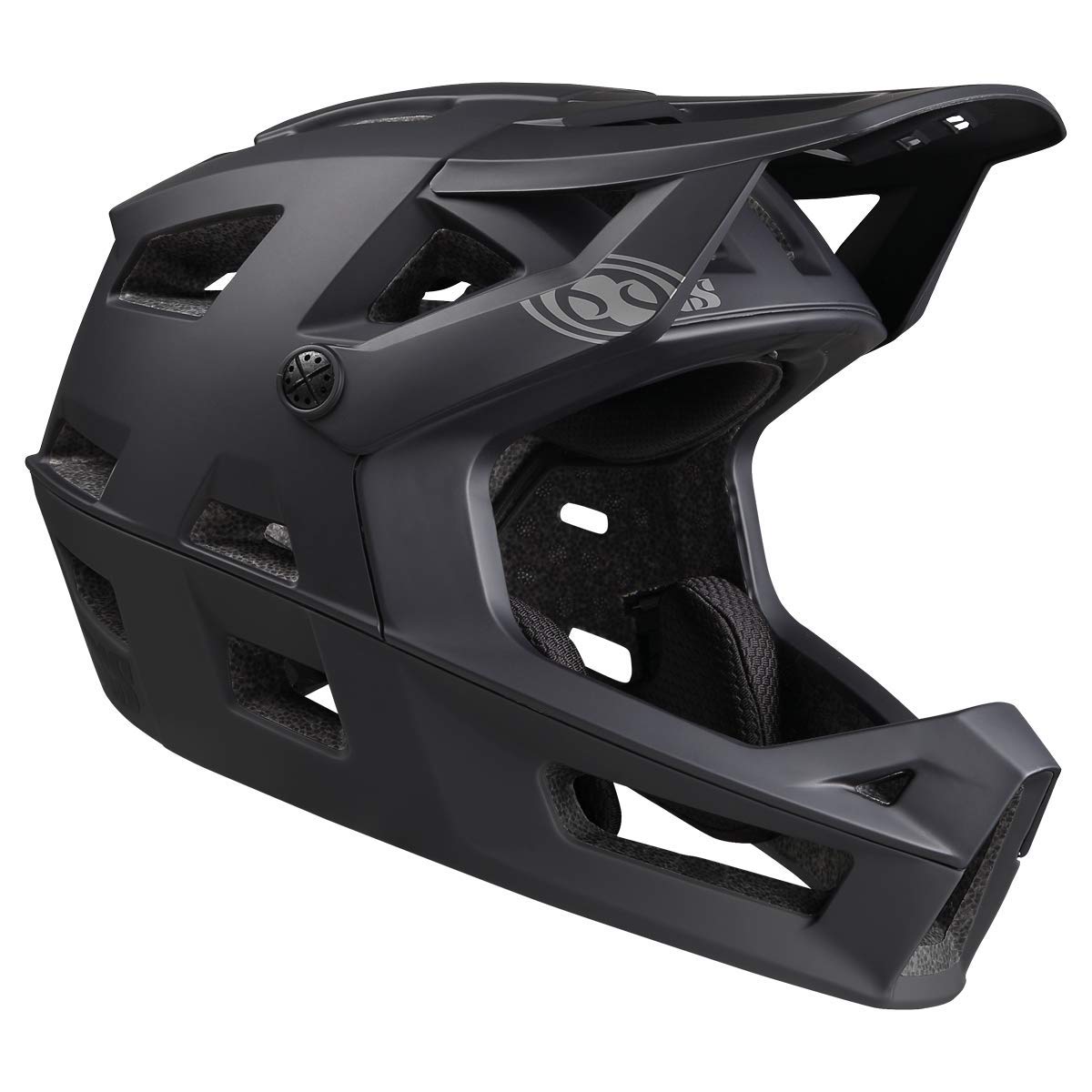
The iXS Trigger FF MIPS is the lightest full-face downhill helmet in this roundup, tipping the scales at roughly 595 grams. It achieves this featherweight status through a patented all-in-one design where the EPS liner and chin bar are fully integrated, eliminating the weight of separate bonding adhesives and overlapping shells. Despite the low mass, it carries ASTM F1952-15 certification and a MIPS system that uses a low-friction elastomer interface rather than a mechanical slip plane—this design is virtually silent and doesn’t squeak during head movement.
Ventilation is handled by strategically placed internal and external channels, and the two-position visor accommodates goggles without pressure points. The Ergo-Fit Ultra system offers both vertical and circumference dial adjustment, and the Fidlock magnetic buckle makes one-handed operation easy even with gloves on. Riders who have crash-tested this helmet report that the reinforced chin bar absorbed direct jaw impacts without transferring significant force, and the company offers a generous crash-replacement discount.
If you pedal uphill to earn your descents and every gram counts, the Trigger FF is the obvious choice. It’s also an excellent option for younger or lighter riders who need full DH protection but can’t handle the neck fatigue of a heavier helmet.
Why it’s great
- Extremely light at 595g, reducing neck fatigue
- Silent MIPS system with no squeaking
- Fidlock magnetic buckle for easy gloved use
Good to know
- No mesh on front ventilation holes, may allow bug ingress
- Premium price point
5. Leatt MTB Enduro 2.0
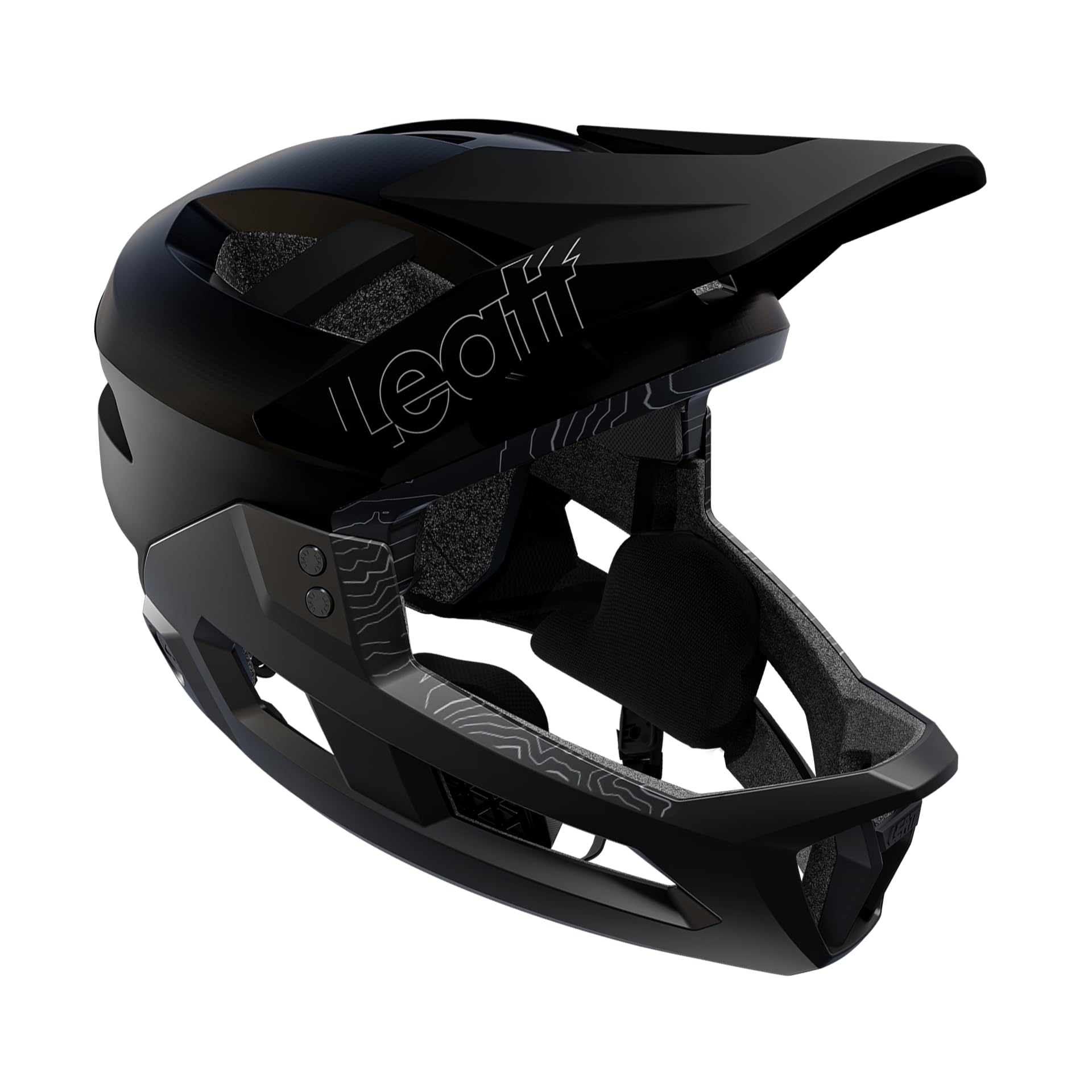
The Leatt MTB Enduro 2.0 is a 3-in-1 convertible helmet that uses 360 Turbine Technology to handle low-speed, high-speed, and rotational impacts. The turbines are soft, viscoelastic discs that deform on impact, working alongside the EPS foam to reduce energy transfer. At 640 grams, it is lighter than other convertible options like the Bell Super DH, and the chin bar attaches and detaches with a simple latch mechanism. The shell is a lightweight polymer, and the 20 vents are designed to be effective even at low climbing speeds.
The Fidlock magnetic closure system makes it easy to secure, and the moisture-wicking, anti-odor liner is removable and washable. Multiple users note that the fit runs small—a size Large comfortably fits up to about 58 cm, not the advertised 63 cm—so accurate head measurement is critical. The helmet also packs a sleek, low-profile design that doesn’t look overly bulky even with the chin bar attached.
For the enduro racer who pedals to the top and wants a single helmet for the entire race, the Leatt Enduro 2.0 offers a strong value-to-weight ratio. The 360 Turbine system provides a unique safety approach, and the convertible feature is genuinely tool-free and fast to operate.
Why it’s great
- 360 Turbine system handles multiple impact speeds
- Very light for a convertible helmet at 640g
- Tool-free chin bar removal
Good to know
- Size runs small; measure carefully and size up
- Not ASTM F1952 certified in half-shell mode
6. Smith Engage MIPS

The Smith Engage MIPS is a half-shell trail helmet that borrows technology from the brand’s downhill line, specifically zonal Koroyd coverage in high-impact areas. While it is not a full-face helmet and lacks ASTM F1952 certification, it is the best option for aggressive trail riders who want MIPS and Koroyd protection without the bulk of a chin bar. The 20 fixed vents provide excellent airflow, and the Ionic+ lining resists odor buildup through sweat-activated properties.
The adjustable visor has two positions to accommodate goggles or glasses, and the lightweight, low-bulk single-layer webbing reduces pressure points. The fit system uses an easy-to-turn dial, and the helmet’s coverage extends lower on the back of the head than standard trail helmets, giving it a secure feel on rough terrain. Some users report that the helmet can slip forward slightly if not paired with goggles, and the buckle can be a bit stiff to fasten initially.
This is the right choice for riders who spend most of their time on XC and flow trails but occasionally push into rockier, more aggressive terrain. It’s a comfortable, well-ventilated lid that doesn’t compromise on rotational protection.
Why it’s great
- Zonal Koroyd coverage in key impact areas
- Deep rear head coverage for a half shell
- Excellent ventilation for hot climbs
Good to know
- Not DH-rated; not suitable for bike park use
- May slip forward without goggles on rough descents
7. Fox Racing V Core MIPS

The Fox Racing V Core MIPS blurs the line between motocross and downhill protection. It meets DOT FMVSS 218 and ECE22.06 standards—certifications that require surviving higher-energy impacts than the ASTM F1952 test used for pure cycling helmets. The shell uses injection-molded polycarbonate and ABS, and the MIPS liner reduces rotational forces during angled impacts. Nine intake and four exhaust vents keep airflow moving, and the lightweight construction (around 5 pounds for the shell assembly) provides a precise fit with four shell and five EPS sizes.
The magnetic visor release system is a standout feature: the visor stays secure during roost and branch strikes but detaches cleanly during a crash to reduce neck strain. This is a feature more commonly found on higher-end moto helmets and adds a layer of safety that most pure MTB helmets lack. Riders who have used this helmet for heavy freeride and dirt jumping report that it has survived multiple heavy impacts without failure.
If you ride a mix of moto and mountain bike, or if you hit jump lines with high consequences, the V Core offers overbuilt protection at a mid-premium price. It’s heavier than dedicated MTB full-face helmets, so it’s less ideal for pedaling-heavy days, but for lift-served or shuttle runs, it’s a robust choice.
Why it’s great
- DOT and ECE22.06 certified for high-energy impacts
- Magnetic visor release reduces neck injury risk
- Four shell sizes ensure a precise fit
Good to know
- Heavier than dedicated MTB full-face helmets
- Not designed for pedaling; better for lift-access riding
8. Fly Racing Rayce
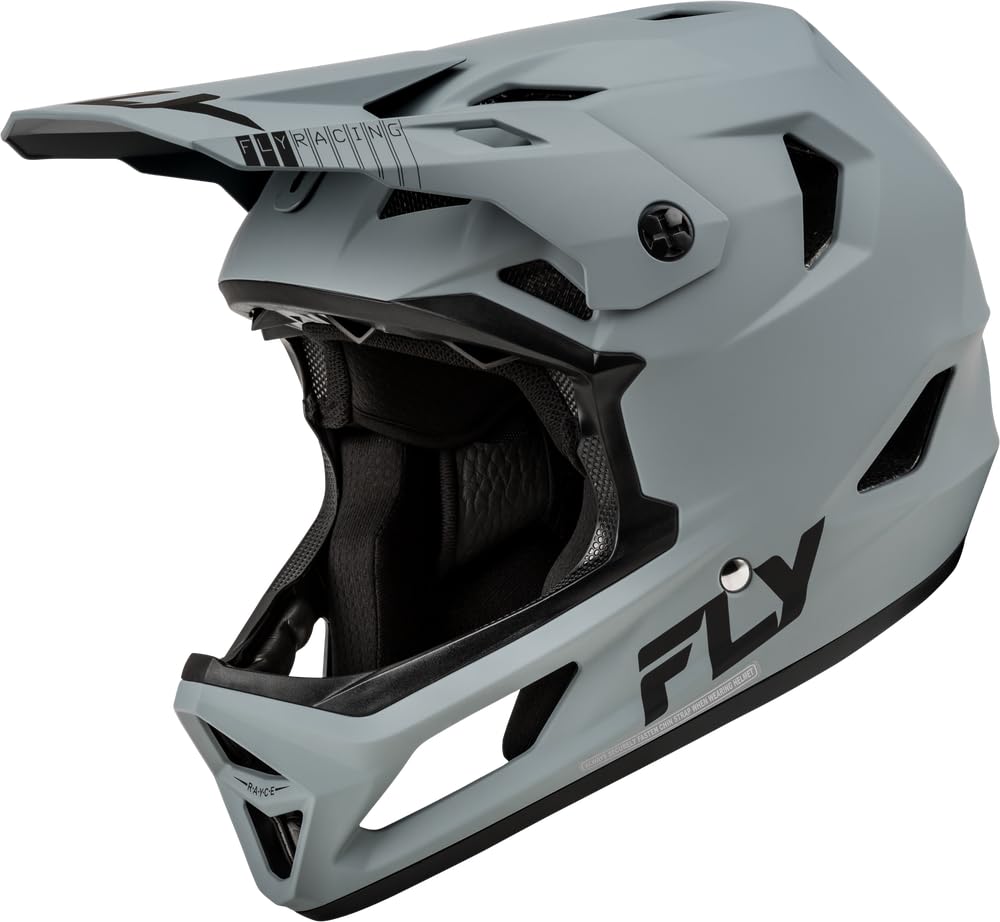
The Fly Racing Rayce is the most affordable helmet on this list that still carries an ASTM F1952-15 downhill certification. It uses a poly-alloy shell paired with an EPS liner, and the TFV (True Functional Ventilation) system employs multiple intake and exhaust ports to keep airflow consistent. At approximately 930 grams for a size medium, it’s heavier than the premium options, but that weight comes with the peace of mind of passing the same certification tests as helmets costing more than double. The D-ring strap closure is secure and proven, and the adjustable visor uses aluminum hardware for durability.
The removable and washable liner with cheek pads helps maintain hygiene between rides, and riders report that the fit is true to size—a Large is appropriate for a 7 1/4 hat size. The helmet includes a protective cloth bag and has been tested extensively for all-day comfort on bike park laps. Some users note that it runs slightly snug on larger heads, and the ventilation, while decent, is not as generous as lighter designs with more vents.
If you are on a tight budget but refuse to compromise on certification, the Rayce is the only entry-level option that gives you real downhill testing. It’s heavier and less airy than premium helmets, but it provides certified protection that will keep you safe while you save for an upgrade.
Why it’s great
- ASTM F1952 certified at a budget-friendly price
- Removable and washable liner
- Sturdy poly-alloy shell construction
Good to know
- Heavier at 930g; may cause fatigue on long days
- Ventilation is adequate but not exceptional
9. OutdoorMaster Grizzly

The OutdoorMaster Grizzly is the most budget-friendly full-face helmet in this guide, but it avoids the trap of being a cheap plastic bucket. It weighs just 750 grams thanks to an injection-molded shell with EPP collarbone impact system and chin bar shock pads. With 27 vents, it’s one of the most ventilated options here, making it a good choice for riders who want a full face for hot-weather trail riding or BMX. The helmet is not ASTM F1952 certified, so it’s not recommended for true downhill racing, but it meets CPSC and CE EN1078 standards for general cycling.
The removable and washable liner includes two sets of D-rings of different thicknesses to fine-tune the fit, and a goggle-strap channel keeps eyewear in place. The pivoting visor adjusts for sun and weather protection. Riders report that the helmet has survived serious impacts—including one verified account of saving the rider’s life in a high-speed collision with pavement. The construction feels solid, and the weight is genuinely low for a full-face at this price tier.
This is the right pick for riders transitioning from half-shell to full-face on a tight budget, or for BMX and dirt-jump use where high-speed downhill certification is less critical. It offers impressive ventilation and weight at a very accessible price point.
Why it’s great
- Extremely light at 750g for a full face
- 27 vents provide superior airflow
- Great value for entry-level full-face buyers
Good to know
- Not ASTM F1952 downhill certified
- Fit can be snug for larger head sizes
FAQ
Can I use a motocross helmet for downhill mountain biking?
What head measurement method should I use to get the right fit?
How often should I replace a downhill mountain bike helmet?
Final Thoughts: The Verdict
For most riders, the best downhill mountain bike helmet winner is the Bell Super DH MIPS because it offers ASTM F1952 certification in both convertible modes, giving you a DH-rated helmet for the park and a trail-friendly lid for the weekend loop. If you want the ultimate lightweight protection and plan to pedal to every descent, grab the iXS Trigger FF MIPS at just 595 grams with full DH certification. And for the budget-conscious rider who won’t sacrifice certification, nothing beats the Fly Racing Rayce for delivering ASTM F1952 safety at an accessible price point.

Mo Maruf
I created WellFizz to bridge the gap between vague wellness advice and actionable solutions. My mission is simple: to decode the research and give you practical tools you can actually use.
Beyond the data, I am a passionate traveler. I believe that stepping away from the screen to explore new environments is essential for mental clarity and physical vitality.