Our readers keep the lights on and my smoothie glass nicely filled. As an Amazon Associate, I earn from qualifying purchases.
The search for a vivid, stable, and truly clean colorant for your baked goods often ends in disappointment. Many so-called “natural” options deliver washed-out pastels, introduce an earthy or beet-like aftertaste, or require so much product that the texture of your frosting is ruined. The real challenge is finding a plant-based dye that offers bold saturation without compromising on flavor or safety.
I’m Mohammad Maruf — the founder and writer behind WellFizz. I’ve spent countless hours analyzing ingredient lists, customer reviews, and performance specs across dozens of dye-free food coloring brands to understand which products actually balance pigment density with a neutral taste profile.
After reviewing hundreds of verified feedback reports and technical specifications, I’ve identified the top performers that consistently deliver on their promises. This guide will help you find the best dye free food coloring for your specific baking and decorating needs.
How To Choose The Best Dye Free Food Coloring
Navigating the world of natural food coloring requires understanding more than just the label. The extraction method, the base ingredient, and the concentration determine whether your final creation will be a vibrant success or a disappointing pastel. Focus on these three key factors before opening your wallet.
Powder vs. Liquid vs. Gel Concentration
The format dictates how much dye you need to achieve a deep shade. Powders, such as those from Pixie Dust and Color Kitchen, are highly concentrated and need to be hydrated before use, offering excellent control and no added liquid that could thin your frosting. Liquid dyes like Color Garden are ready to use but often require more volume to reach vibrant tones, which can introduce unwanted moisture and a subtle plant flavor. Gel-based options, like those from ERCorArt, offer a middle ground with moderate pigment density and better heat resistance during baking.
Flavor Profile and Odor
This is the single biggest complaint in many customer reviews. A natural dye derived from beets, turmeric, or spirulina can easily transfer an earthy, grassy, or metallic taste into your buttercream or royal icing. Premium brands use purification processes to minimize these off-flavors. Always look for terms like “flavorless” (as claimed by Pixie Dust) or “odorless” (as claimed by ERCorArt) and check verified reviews for mentions of taste neutrality, especially if you are coloring a delicate frosting where the dye makes up a significant percentage of the total volume.
Color Stability Over Time and Heat
Not all natural colors hold up to baking or cold storage. Some plant-based pigments degrade under high oven heat, shifting hue significantly from batter to finished cake. Others fade or change after a few hours in the refrigerator. A high-quality dye-free coloring should maintain its vibrancy for at least 24 hours in frosting and should not break down when exposed to the moderate heat of a baked cupcake. The ERCorArt gel line specifically claims heat resistance, while Color Kitchen’s powder is noted for holding its shade in fondant and buttercream.
Quick Comparison
On smaller screens, swipe sideways to see the full table.
| Model | Category | Best For | Key Spec | Amazon |
|---|---|---|---|---|
| Color Kitchen Natural Food Coloring | Premium | Concentrated vibrant colors | 10 powder packs, 0.63 oz total | Amazon |
| Natural Food Coloring Gel 16 Colors | Mid-Range | Versatile macaron shades | 16 colors, 0.25 fl oz each | Amazon |
| Natural Food Coloring 160ml Pastel | Premium | Large capacity gel | 8 colors, 20ml each | Amazon |
| Pixie Dust All-Natural Powder | Mid-Range | Flavorless powder dye | 4 powders, 5g each | Amazon |
| Color Garden Natural Food Coloring | Budget | Simple liquid set | 5 colors, 1 oz each | Amazon |
In‑Depth Reviews
1. Color Kitchen Natural Food Coloring Vibrant Packs

The Color Kitchen set stands out because of its highly concentrated powder format. You get ten coordinated shades in individual packets, which allows you to blend custom hues like purple or teal. The powder is designed to hydrate easily with a small amount of vanilla, milk, or water before mixing into buttercream or royal icing, giving you streak-free color control without clumping.
Customer reviews consistently praise the lack of off-flavors in the final product. Users report that the colors stay vibrant in frosting and hold up well with fondant, making it a versatile choice for both beginners and experienced decorators. One reviewer noted that a little goes a long way, meaning a single packet can color a large batch of icing.
The biggest point to consider is that the color intensity changes significantly when the dye is baked into batter. The brand itself recommends using it primarily for icing, frosting, and fondant rather than for batter-heavy applications. Also, some users found the red shade to be more of a bright pink unless used generously.
Why it’s great
- Highly concentrated powder, a little goes a long way
- No artificial dyes, vegan, gluten-free, and non-GMO
- Easy to blend for custom shades
Good to know
- Colors shift drastically when used in batter
- Red shade is more pinkish than a deep red
- Requires pre-hydration for best results
2. Natural Food Coloring Gel 16 Colors
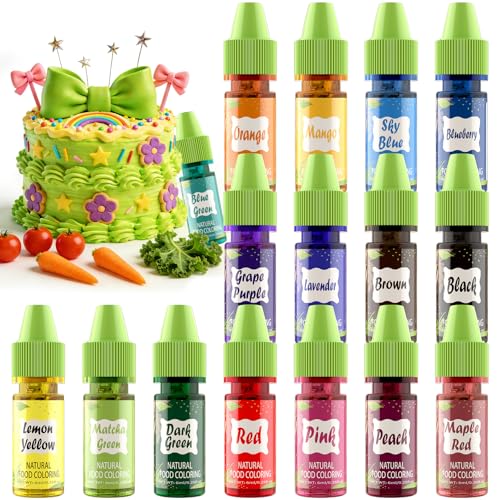
This ERCorArt set offers the widest color palette in a single package with sixteen distinct shades. The gel formula provides a thicker consistency than standard liquids, which helps prevent your icing from becoming too runny. The precision spout allows for drop-by-drop control, making it easy to achieve specific tints without over-saturating your mixture.
Buyers highlight that the colors are vibrant and “a little goes a long way.” The dye blends smoothly into frosting, dough, and icing without altering the original taste. The heat-resistant formulation is a key advantage, as it resists degradation during baking, helping your cookies and cupcakes maintain their intended color.
Some users noted that the bottles are relatively small compared to the price point. While the concentrated gel is efficient, achieving very deep shades can require using a good portion of a bottle. One reviewer also expressed confusion, believing the product was completely dye-free, which raises a point about verifying the ingredient list if you have strict allergy requirements.
Why it’s great
- 16 unique colors for maximum creative flexibility
- Heat-resistant formulation maintains color during baking
- Precision spout for accurate drop-by-drop dosage
Good to know
- Small bottle sizes given the price point
- Needs more volume for very deep, saturated shades
- Some users question the complete absence of dyes
3. Natural Food Coloring 160ml Pastel
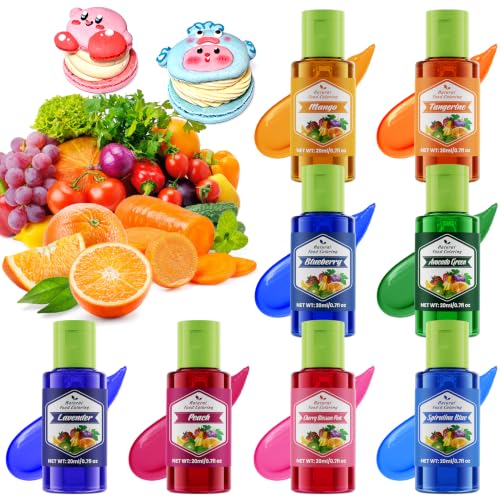
This ERCorArt set focuses on providing a larger volume per color, with each of the eight bottles holding 20ml. This makes it a preferable choice for frequent bakers or those decorating large batches of cookies and cakes. The slim squeeze bottle design enables precise application, and the gel formula is marketed as both odorless and flavorless for a neutral taste profile.
Customer feedback is very positive regarding the vibrancy and the ease of blending. Users report that the colors maintain their tone even after cold storage, which is a critical factor for make-ahead desserts. The natural, plant-based composition is free from artificial dyes, and the set is certified vegan, gluten-free, and nut-free, catering to various dietary needs.
As with many natural dyes, achieving a super deep, “neon” level of saturation requires using a significant amount of product. The bottles, while larger than the 16-color set, are still small and are considered pricy by some users. The product must be stored in a sealed container in the refrigerator after opening to maintain freshness.
Why it’s great
- 20ml per bottle offers good value for frequent bakers
- Odorless and flavorless, preserving the taste of your treats
- Colors remain stable and vibrant after refrigeration
Good to know
- Requires refrigeration after opening
- Deep shades require a larger volume of gel
- Bottles are still small for heavy usage
4. Pixie Dust All-Natural Food Coloring Powder Set
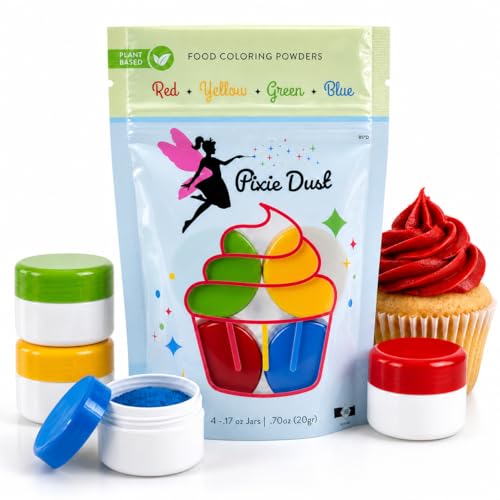
Pixie Dust differentiates itself by offering a truly flavorless and odorless powder. The set includes red, yellow, blue, and green colors, each in a 5g jar. The powder format means no added liquid to your recipes. You can sprinkle it directly into cream before whipping or dilute it in a small amount of water or vodka for use as a paint. The color deepens over time, especially in royal icing left to sit overnight.
Reviews are overwhelmingly positive about the absence of any plant-like aftertaste. Users note that a little powder goes a long way, making the jars last for multiple baking projects. The powder is free from carmine, annatto, propylene glycol, and synthetic additives, and it holds a Kosher certification from ORB.
The primary limitation is achieving dark or vibrant colors. The powder naturally yields more pastel shades, and you need a fair amount of it to approach deeper tones. The powder is super fine, so opening the jars requires caution to avoid a cloud of dust. It also needs a bit of practice to blend without clumping if you don’t pre-dilute it.
Why it’s great
- Completely flavorless and odorless in final product
- Highly concentrated, a little goes a long way
- Kosher certified and free from common allergens
Good to know
- Colors are more pastel than vibrant
- Super fine powder requires careful handling
- Best results require pre-dilution in liquid
5. Color Garden Natural Food Coloring, Multi – 5 ct
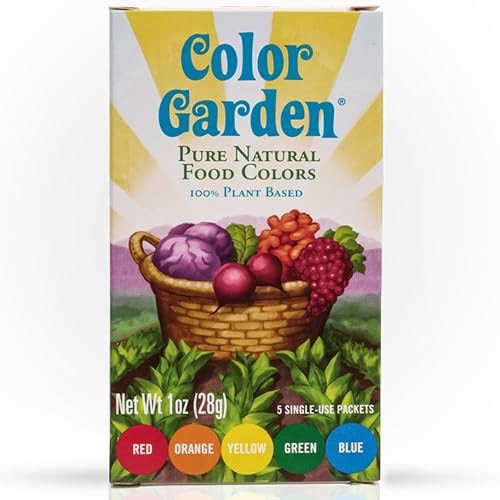
Color Garden offers an entry-level liquid option with five essential colors: red, yellow, blue, green, and orange. Each bottle is 1 oz, providing a decent volume for the price point. The product is certified non-GMO, gluten-free, vegan, and free from artificial ingredients, making it a straightforward choice for those just starting their switch from synthetic dyes.
Customer reviews are mixed regarding vibrancy. Some report “vivid” and “beautiful” colors, while others note the colors are less pigmented than artificial alternatives, requiring more liquid to achieve the desired shade. The primary trade-off is a noticeable plant taste. One reviewer specifically mentioned a “beet-like flavor” in the frosting, which is a common issue with natural red dyes derived from beets.
The liquid format can thin out your frosting if you use a lot of it to chase a deeper color. The set is best suited for pastel applications where a slight earthiness is acceptable, or for projects where the dye volume is small relative to the total batch. It is a good starting point, but serious bakers often outgrow it quickly.
Why it’s great
- Affordable entry point into dye-free food coloring
- Non-GMO, vegan, and free from common allergens
- Provides the five primary colors for basic mixing
Good to know
- Noticeable earthy taste in the red and purple shades
- Colors are less vibrant, requiring more product
- Liquid format can thin out frosting
FAQ
Why does my natural food coloring have a taste?
Can I use these dyes in batter for baked cakes?
How do I get darker or more vibrant colors from natural dyes?
Final Thoughts: The Verdict
For most users, the best dye free food coloring winner is the Color Kitchen Natural Food Coloring Vibrant Packs because its concentrated powder format delivers vivid shades without unwanted flavors, and the variety of colors offers unmatched versatility for cake decorating. If you want a wider palette of heat-resistant gel colors for baking, grab the Natural Food Coloring Gel 16 Colors. And for a truly flavorless powder that shines in royal icing and buttercream, nothing beats the Pixie Dust All-Natural Food Coloring Powder Set.

Mo Maruf
I created WellFizz to bridge the gap between vague wellness advice and actionable solutions. My mission is simple: to decode the research and give you practical tools you can actually use.
Beyond the data, I am a passionate traveler. I believe that stepping away from the screen to explore new environments is essential for mental clarity and physical vitality.