Our readers keep the lights on and my smoothie glass nicely filled. As an Amazon Associate, I earn from qualifying purchases.
Stepping into the world of aerial photography is thrilling, but the fear of a flyaway or a hard crash is real for every new pilot. The difference between a drone that ends up in a tree and one that lands safely in your hand comes down to three fundamentals: GPS stabilization, a reliable camera gimbal, and a weight under 249 grams to skip FAA registration. This guide focuses on exactly those specs so you buy a drone that flies itself steady, not one that fights you.
I’m Mohammad Maruf — the founder and writer behind WellFizz. Over dozens of hours of market research, I’ve compared brushless motor specs, gimbal axis counts, battery capacities, and GPS return-to-home logic to find the models that genuinely protect a beginner’s investment and confidence.
Whether you want a pocket-sized travel companion or a fully immersive FPV experience, the best drones for beginners blend automated safety features with enough camera quality to make your first flights look like you’ve been flying for years.
How To Choose The Best Drones For Beginners
The drone market is flooded with cheap toy-grade quads that lack GPS and brushless motors, leading to drift, crashes, and frustration. A true beginner drone must have a specific set of safety and image-stabilization features. Here are the three most critical specifications to verify before you click buy.
GPS Auto Return-to-Home (RTH)
This is the single most important safety feature for a new pilot. A GPS module lets the drone lock its home position before takeoff. If the signal drops, the battery gets low, or you simply press a button, the drone flies itself back to that exact spot. Without GPS, a beginner drone can drift away in light wind and become lost forever. Every model in this guide includes GPS-based RTH, but the precision and speed of the return varies — models with multi-constellation support (GPS + GLONASS + Galileo) lock satellites faster and hold position tighter.
Camera Stabilization: Gimbal vs. EIS
A camera that shakes produces unusable footage. Beginners often confuse electronic image stabilization (EIS) with a mechanical gimbal. EIS crops the video to smooth out minor vibrations, but it cannot handle aggressive wind or fast turns. A 2-axis mechanical gimbal stabilizes pitch and roll but leaves yaw movement uncorrected. A 3-axis gimbal counteracts all three axes — pitch, roll, and yaw — delivering the buttery-smooth footage you see in demo reels. For any real aerial photography beyond casual backyard flying, a 3-axis gimbal is worth the step up in budget.
Weight and FAA Registration Status
In the United States, drones weighing less than 250 grams at takeoff are exempt from FAA registration and Remote ID requirements. This matters enormously for beginners because it eliminates paperwork and allows worry-free flying in most public spaces where recreational operation is permitted. A sub-250g drone also causes less damage if it hits someone or something, reducing your liability. Many of the best beginner drones are designed specifically to hit this weight ceiling while still carrying a 4K camera and GPS module — a delicate engineering balance that separates premium options from heavier, more regulated models.
Quick Comparison
On smaller screens, swipe sideways to see the full table.
| Model | Category | Best For | Key Spec | Amazon |
|---|---|---|---|---|
| Ruko Drone 4K UHD | Premium Compact | Long flights with 3 batteries | 3-Axis Gimbal, 48MP Sensor | Amazon |
| Holy Stone HS790 | Premium Feature-Rich | Long-range 9KM transmission | 3-Axis Gimbal, 6K Photo | Amazon |
| DJI Neo 2 Combo | Premium FPV | Immersive FPV flying with goggles | 151g, ActiveTrack, 4K/30fps | Amazon |
| DJI Flip (RC-N3) | Premium Compact | Best camera quality in sub-250g | 1/1.3″ CMOS, 4K/60fps HDR | Amazon |
| Bwine F7MINI | Premium Travel | Built-in screen controller, 96-min flight | 3-Axis Gimbal, 249g, 48MP | Amazon |
| Bwine F7GB2 Pro | Mid-Range Power | High altitude and wind resistance | 3-Axis Gimbal, 2000m Altitude | Amazon |
| Potensic ATOM LT | Mid-Range Value | Long flight time, 4KM transmission | EIS 2.5K, 80 Mins, 3000mAh Bat. | Amazon |
| REDRIE HK33 | Budget All-Rounder | Budget pick with GPS Follow | 2-Axis Gimbal, 4K Photo, 249g | Amazon |
| Oddire HK11 | Budget All-Rounder | Stable flyer with great wind resistance | 48 Mins, 5G WiFi, 249g | Amazon |
In‑Depth Reviews
1. Ruko Drone with 4K UHD Camera for Adults with 3-Axis Gimbal

The Ruko drone hits the perfect balance for a serious beginner who wants professional-grade footage without stepping into heavy regulations. It weighs under 249 grams, exempting you from FAA registration and Remote ID requirements, yet it packs a 1/2-inch 48MP CMOS sensor capable of 8K stills and 4K/30fps video. The true star here is the 3-axis brushless gimbal with integrated EIS — this combination eliminates the jello effect and horizon tilt that plague lesser drones, even in winds up to 16 MPH. The 20,000-foot (6KM) digital transmission system uses a wired protocol rather than standard Wi-Fi, which means zero signal dropouts from interference.
Flight time is a class-leading 96 minutes across three intelligent 2200mAh batteries. Each battery delivers roughly 32 minutes of real-world hovering and cruising, and the included carrying case makes it easy to cycle through them during a single outing. Smart features like AI-assisted takeoff and landing, quadruple positioning (GPS, barometer, TOF, and optical flow), and a built-in beeper for locating the drone in tall grass remove the anxiety of your first flights. The GPS auto-return system activates on low battery, signal loss, or manual command — and it brings the drone back to the exact takeoff point with impressive precision.
Customer feedback consistently praises the responsive 24/7 support team and the robust build quality after dozens of flights. The only notable downside is the sensitive joysticks, which new pilots may find twitchy until they dial in the sensitivity settings. The controller feels solid in hand, and the app interface is intuitive for mapping waypoints and setting follow-me parameters. For anyone looking to capture family vacations, road trips, or scenic landscapes with cinematic stability, this Ruko bundle delivers the highest value-per-dollar in the beginner segment.
Why it’s great
- True 3-axis mechanical gimbal for buttery-smooth footage
- 96 minutes total flight time with three included batteries
- 20,000ft digital transmission — no Wi-Fi interference
- Under 249g, no FAA registration needed
Good to know
- Joysticks are sensitive; plan to practice in an open field first
- No audio recording on the video files
2. Holy Stone HS790 6K Photo Drone with Camera for Adults
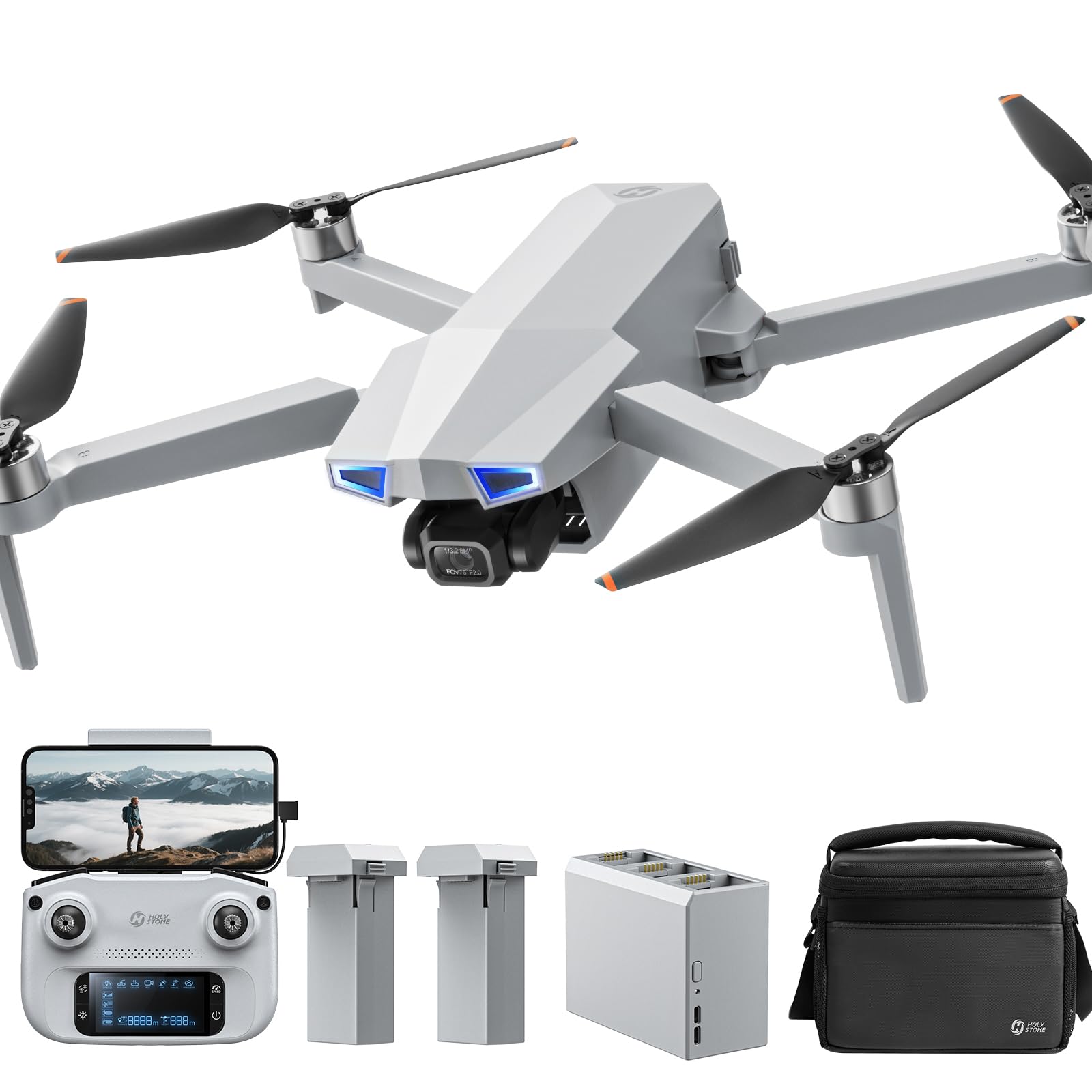
The Holy Stone HS790 is built for the beginner who wants to explore vast landscapes without worrying about losing signal. Its headline feature is the 30,000-foot (9KM) HD transmission system using Holy Stone’s proprietary WiFi Repeater tech. In practice, this means you can fly the drone over a mile away and still see a clear, low-latency 4K video feed on your phone or tablet. The 3-axis mechanical gimbal paired with a 38MP effective sensor captures 6K photos and 4K/30fps video that stays level and stable even during aggressive yaw maneuvers. The built-in Remote ID (RID) module keeps you compliant with FAA regulations automatically, which is rare at this price point.
Power comes from two 3200mAh intelligent batteries that deliver a combined 60 minutes of flight time. The Smart PD Charging Hub doubles as a power bank, letting you charge your phone or controller in the field — a thoughtful detail during long shooting sessions. Beginner-friendly features include one-key takeoff/landing, Altitude Hold, Headless Mode, and three adjustable speed levels. Advanced users can unlock full manual controls and access AI QuickShots like Dronie, Rocket, and Circle for cinematic moves with a single tap. The dedicated Night Mode enhances low-light visibility, though it mostly helps with navigation lights rather than actual camera quality in near-darkness.
Real-world user reports highlight stable flight in winds up to 28 MPH and a maximum speed of roughly 28 MPH in Sport Mode. The drone handles well in cold temperatures (down to near 0°F) without battery performance drops, and the Follow Me and Tap to Fly functions work reliably as long as you maintain a clear GPS lock. The main caveat is the app — some users find the HT FLY app buggy on newer Android phones, and the FPV feed can lag slightly during fast turns. The gimbal also struggles to keep the horizon level during rapid lateral movements. Still, for range and stabilization, the HS790 is a standout mid-premium option that grows with your skill level.
Why it’s great
- 9KM transmission range for long-distance exploration
- 3-axis gimbal with excellent wind resistance
- Smart PD charging hub doubles as a power bank
- Built-in Remote ID for FAA compliance
Good to know
- Weighs 375g — requires FAA registration
- App stability varies across Android devices
3. DJI Neo 2 Motion Fly More Combo With RC Motion 3 & Goggles N3
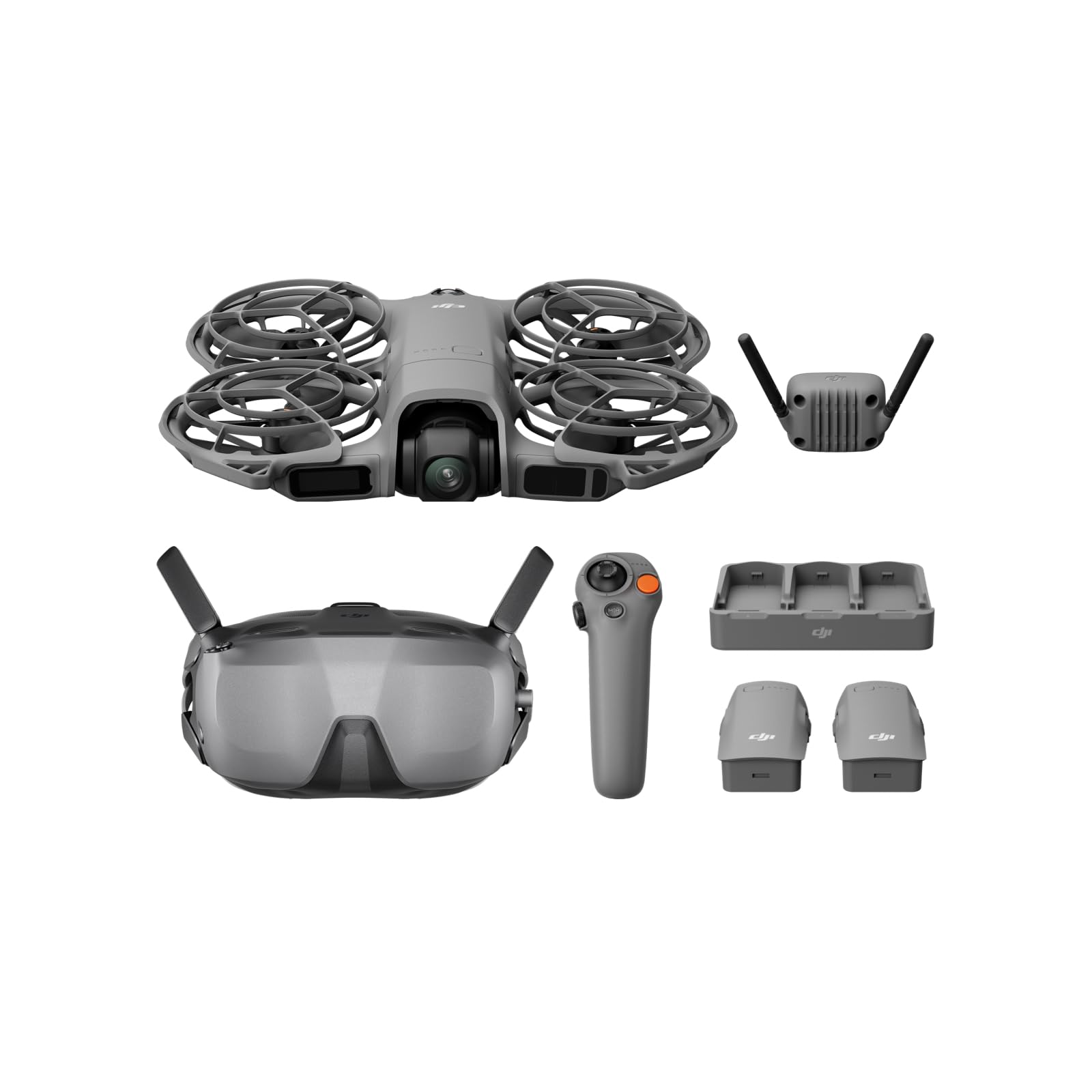
The DJI Neo 2 Combo is the most beginner-friendly FPV system on the market because it removes every barrier to entry. At just 151 grams with full-coverage propeller guards, it is C0 certified and requires zero registration of any kind. The package includes the RC Motion 3 controller and Goggles N3, creating an immersive flying experience where you steer the drone by tilting your wrist — exactly like a video game. The goggles provide a low-latency, high-resolution feed that makes you feel like you are in the cockpit, which is the entire point of FPV flying. For beginners who want that rush without the steep learning curve of traditional rate-mode FPV, this combo is unmatched.
The camera captures 4K/30fps stabilized video and 12MP stills with the 1/2-inch sensor, and ActiveTrack 4.0 keeps subjects locked in the frame even during dynamic movements like cycling or running. Palm takeoff and landing combined with gesture control mean you can launch and retrieve the drone without ever touching the controller. The Fly More Combo includes three batteries and a two-way charging hub, though each battery provides only about 15-20 minutes of real flight time. The built-in 49GB of internal storage eliminates the need for a microSD card on short shoots. Omnidirectional obstacle sensing is present, but it is primarily forward and downward — it will not detect branches coming from the sides or behind during fast FPV turns.
User feedback consistently praises the intuitive motion controls and the sheer fun factor. The Neo 2 is loud during flight compared to the DJI Flip, but the sound is not obtrusive. The short battery life is the main practical downside — three batteries are essential for a satisfying session, and charging in the field requires a power bank. The RC Motion 3 is less precise than traditional dual-stick controllers for cinematography, but that is not the point of this package. This is a drone designed to make you smile from the first flight, and it delivers that experience more effectively than any other product in this roundup.
Why it’s great
- Complete FPV system with goggles and motion controller
- 151g ultralight with propeller guards, no registration
- Palm takeoff/landing and gesture control
- ActiveTrack for smooth subject following
Good to know
- Short 15-20 minute battery life per pack
- Motion controls are not as precise as dual-stick for cinematic shots
4. DJI Flip (RC-N3)

The DJI Flip redefines what a sub-249-gram drone can capture. Its 1/1.3-inch CMOS sensor is the largest sensor in this weight class, pulling in significantly more light than the smaller 1/2-inch and 1/2.3-inch sensors used by competitors. The result is 4K/60fps HDR video with genuine highlight and shadow detail — sunrise and sunset shots look cinematic straight out of the camera without heavy grading. The 3-axis mechanical gimbal stabilization is DJI’s signature, keeping the horizon perfectly level even during 15 MPH winds. The full-coverage carbon fiber propeller guards mean you can fly safely in tighter spaces like parks or backyards without worrying about blade strikes.
The RC-N3 remote controller connects to your phone for a full FPV display, and the 13KM (44,000ft) transmission system uses DJI’s O4 digital video transmission for a rock-solid connection in interference-heavy environments. The 31-minute maximum flight time per battery is the longest single-battery endurance in this comparison, allowing for a full shoot without swapping packs mid-flight. Subject tracking via ActiveTrack 4.0 is intuitive — just draw a box around a person or object on the screen, and the drone keeps them centered automatically. Palm takeoff and landing are seamless, and the app-based operation (including Apple Watch support) means you can fly hands-free for quick selfies or follow-me shots.
The main drawback for budget-conscious beginners is the accessory ecosystem — you will want additional batteries (each sold separately), a solid carrying case, and high-speed microSD cards, which adds to the overall investment. The Flip also lacks rear and side obstacle avoidance, relying only on forward-facing sensors. This means you must be mindful when reversing or flying laterally near obstacles. However, the camera quality and flight stability are so far ahead of the competition that most users consider the extra investment worthwhile. It is the best choice for anyone who prioritizes image quality above all else.
Why it’s great
- Largest 1/1.3″ sensor for superior low-light and HDR video
- 4K/60fps HDR with 3-axis gimbal
- 31-minute flight time per battery
- 13KM O4 digital video transmission
Good to know
- Only forward-facing obstacle avoidance
- Extra batteries and case sold separately, increasing total cost
5. Bwine F7MINI 4K Video 8K Photo Drone
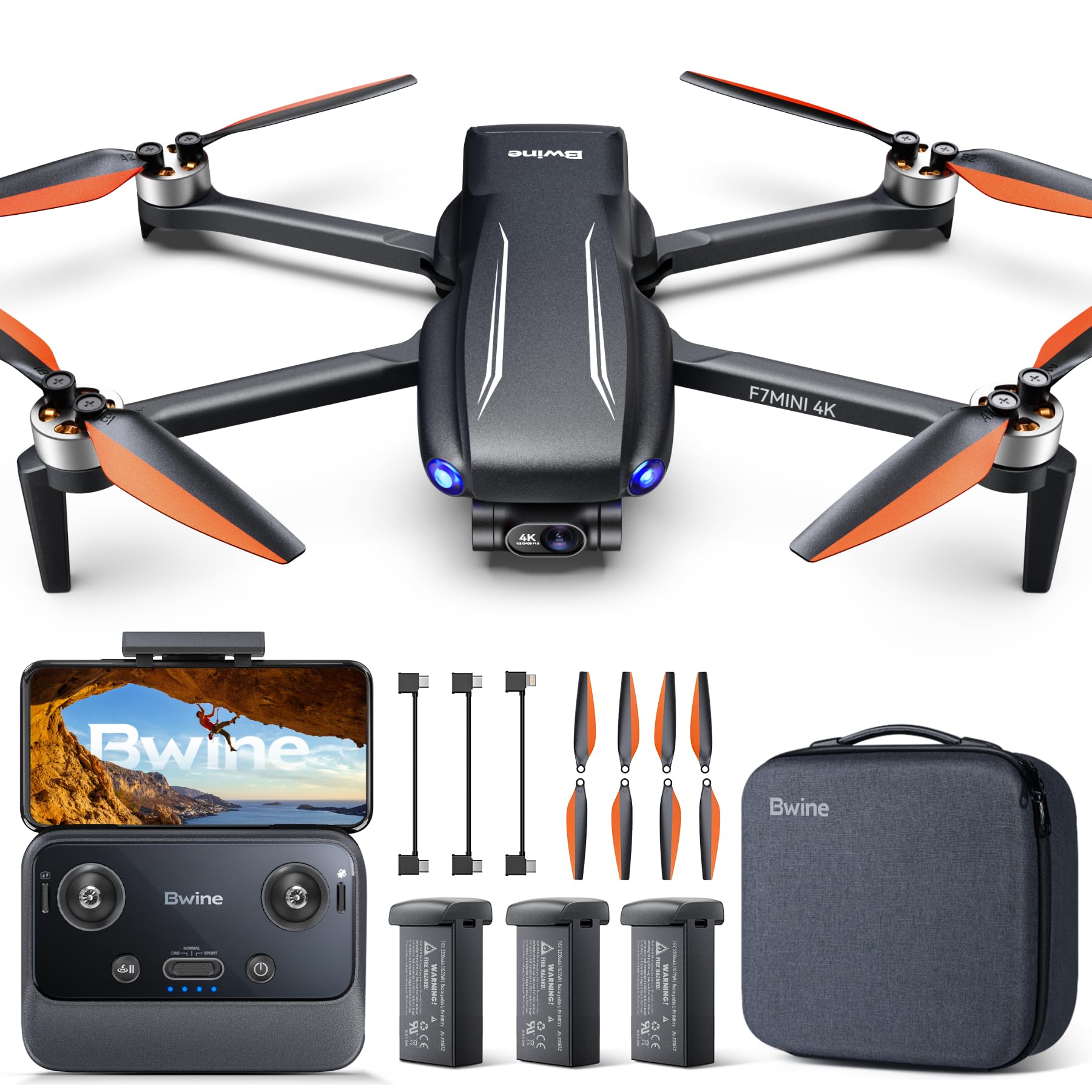
The Bwine F7MINI solves a pain point that most beginner drones ignore: you do not need a smartphone to fly it. The remote controller has a built-in 5.5-inch bright touchscreen, so you can see the live FPV feed, adjust camera settings, and manage flight modes without connecting a phone. This is a massive convenience if you do not want to drain your phone battery or if you prefer a dedicated screen that works reliably in bright sunlight. The drone itself weighs exactly 249 grams, staying below the FAA registration threshold, and folds down to a compact 5.55 x 3.42 x 2.28 inches — truly pocketable for travel.
The camera uses a 48MP 1/2-inch CMOS sensor with an F1.8 aperture and a 3-axis stabilized gimbal, capturing 8K photos and 4K/30fps video. The 3-axis gimbal uses motors and sensors to counteract movement in real-time, keeping footage smooth even during fast flight or windy conditions — 31 MPH top speed with Level 5 wind resistance is impressive for a sub-250g frame. The 6KM wired digital transmission system provides zero-latency feed with 150% stronger anti-interference than standard Wi-Fi, meaning you can fly confidently in urban parks or near power lines. Flight time totals 96 minutes across three 2200mAh batteries, with each battery supporting PD 3.0 fast charging.
Safety is comprehensive: Smart Return-to-Home, dynamic home point updating, a 120dB locator buzzer, and optical flow positioning for stable indoor flight when GPS is unavailable. Beginners report that the three flight speed modes (slow, medium, fast) make the learning curve extremely gentle. The built-in screen shows telemetry overlays like altitude, distance, and battery level, so you never need to look down at a phone mid-flight. The only common complaint is that transferring videos from the controller to a phone is slower than using a computer with a microSD card reader. Still, for sheer ease of use and a no-phone-required workflow, the F7MINI is a top-tier choice.
Why it’s great
- Built-in 5.5″ screen controller — no phone needed
- 3-axis gimbal with 48MP 8K photo capability
- 96-minute total flight time with 3 batteries
- 249g weight, FAA registration-free
Good to know
- Slow file transfer from controller to phone
- Controller screen can be hard to see in direct midday sun
6. Bwine F7GB2 Pro Drones with Camera for Adults 4K UHD

If you plan to fly in mountainous terrain or coastal areas where wind is a constant factor, the Bwine F7GB2 Pro is the right tool. It features a certified Level 6 wind resistance rating and a 2000-meter maximum flight altitude, thanks to the powerful 1806 brushless motors and a barometer that adjusts to thin air. The 3-axis gimbal with a one-click detachable 4K camera supports 5x digital zoom and a 120° FOV lens with a larger CMOS sensor for night scenes. The combination of the gimbal and 6-level wind resistance means footage remains stable even when the drone is fighting gusts that would send lesser quadcopters tumbling.
Three 2600mAh 11.1V intelligent batteries provide 75 minutes of total flight time. These batteries are UL 2054 safety-certified, which is a meaningful reassurance for novice users. The remote controller has a clear overlay showing telemetry, and the transmission range is rated at 10,000 feet with a stable signal up to 3,000 meters. The built-in remote ID (QR code on the arm) makes this drone fully compliant with FAA mandates out of the box — no additional module needed. Smart flight modes include Follow Me, Waypoint, Orbit Fly, and Auto Return on low battery, signal loss, or manual command.
Field reports confirm that the drone is ready to fly out of the box with no assembly, and beginner mode limits altitude and distance until you gain confidence. The camera delivers confirmed 5700×3200 photo resolution and 3840×2160 video. The standout feedback point is the build quality — one user survived a collision with a net and only had to replace blades and reattach the camera, with spare parts readily available and cheap on Amazon. The main usability issue is the remote screen, which washes out in direct sunlight. For anyone living near hills, mountains, or open plains where wind is a daily reality, this is the most capable mid-range option.
Why it’s great
- 2000m altitude and Level 6 wind resistance
- 3-axis gimbal with detachable 4K camera
- UL-certified 2600mAh batteries, 75-min total flight
- Remote ID compliant with FAA
Good to know
- Remote screen difficult to read in bright sunlight
- 540g weight — requires FAA registration
7. Potensic ATOM LT GPS Drone Under 249g

The Potensic ATOM LT is the best pure-value pick for beginners who want DJI-adjacent specs without the DJI price. It comes in at under 249 grams with a foldable frame that shrinks to 3.5 x 5.6 x 2.3 inches — small enough to slide into a jacket pocket. The headline feature is the flight time: two 3000mAh intelligent batteries deliver a real-world 40 minutes each, totaling 80 minutes of airtime. That is the highest per-battery endurance in this price tier, made possible by the efficient PixSync 2.0 transmission system that uses dedicated controller cables (Type-C and Lightning included) rather than standard Wi-Fi.
The camera uses a Sony sensor for 2.5K/30fps HD video and 2560×1440 photos. It is a step down from true 4K, but the ShakeVanish 2.0 EIS stabilization does a commendable job of smoothing out vibrations as long as you avoid aggressive wind. The 118° FOV with vertical tilt adjustment (+20° to -90°) gives you enough flexibility for dynamic angles. The 4KM maximum transmission range is generous for the price, and the controller includes a cable connection for a tethered, interference-free FPV feed. Quad-positioning (GPS, GLONASS, Galileo, BeiDou) ensures fast satellite locks — though some users report waiting up to 60 seconds in obstructed areas.
The SurgeFly 2.0 control system is tuned specifically for beginners, with three flight modes that progressively remove limitations as your skills grow. GPS functions — Auto Return, Follow Me, Waypoint, and Circle Fly — work reliably once the drone has a solid satellite lock. Build quality is robust, and the included accessories (spare propellers, screwdriver, adapter cables) cover everything you need to start flying. The downsides are the lack of 4K resolution and the absence of a mechanical gimbal. The EIS struggles with fast turns and wind above Level 4, so frame your shots in calm conditions. For the price, the ATOM LT is a phenomenal training platform to learn orientation, battery management, and GPS flight modes before upgrading to a more expensive camera drone.
Why it’s great
- 80 minutes of total flight time (40 min per battery)
- Fast satellite locking with 4 GNSS constellations
- 4KM PixSync 2.0 tethered transmission
- Compact foldable design under 249g
Good to know
- 2.5K resolution — no 4K capability
- EIS stabilization only; no mechanical gimbal
8. REDRIE HK33 Drones with Camera for Adults 4K
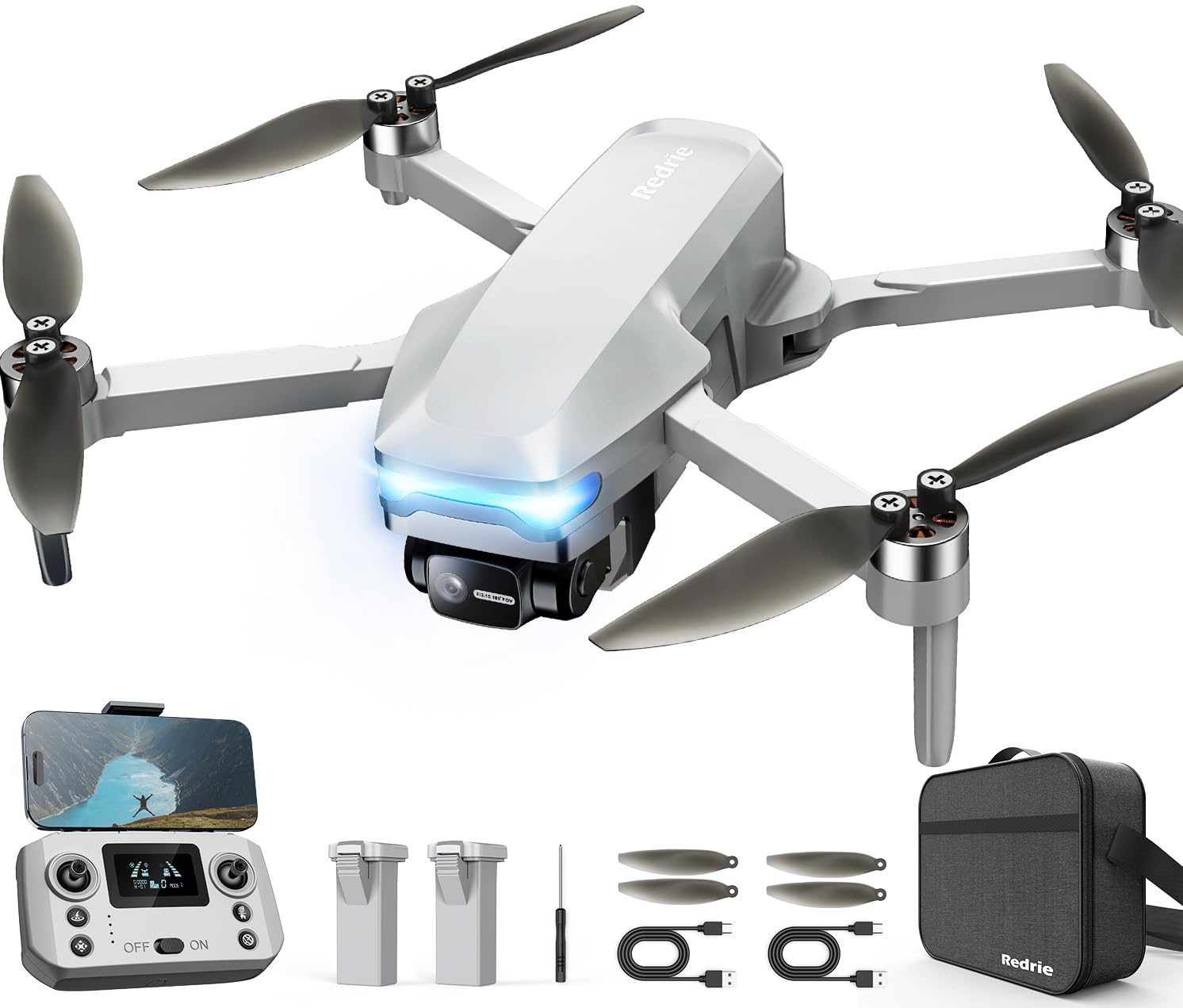
That is a remarkable feature set for the budget tier. Weighing under 249 grams, it requires no FAA registration, and the foldable design with a hardshell carrying case makes it truly portable. The brushless motors provide reliable thrust and Level 5 wind resistance, which is unheard of at this price point. The HK33 proves that entry-level drones no longer have to feel like a gamble.
The 5G WiFi FPV transmission offers 300 meters stable video range and 500 meters signal range using the repeater. Battery life is 40-45 minutes across two 1800mAh packs — enough for a picnic session without rushing. Smart flight modes include GPS Follow, Route Planning, Circle Fly, and Tap Fly, all accessible through the app. The 90° remote-controlled camera angle adjuster lets you switch between horizontal and vertical framing mid-flight, which is handy for social media content. Beginners praise the QR-code-generated setup videos that walk you through calibration and first flight step by step.
Real-world footage from the 4K camera is decent in good light, though the 2-axis gimbal (pitch and roll only) means yaw movements introduce a slight wobble that careful flying can minimize. The cell phone holder on the controller feels a bit flimsy, so a secure phone case is recommended. Durability is a standout — multiple crash survivors report that the drone keeps flying after impacts that would shatter cheaper models. For a first drone to learn the basics of orientation, GPS reliance, and battery management without a big financial risk, the HK33 is a smarter buy than any toy-grade quadcopter.
Why it’s great
- GPS Auto Return and smart flight modes at a budget price
- 2-axis gimbal for stabilized 2K video
- Brushless motors with Level 5 wind resistance
- Includes carrying case and two batteries
Good to know
- 2-axis gimbal does not stabilize yaw — fly gentle turns
- Cell phone holder on controller is not very sturdy
9. Oddire HK11 Drones with Camera for Adults 4K

The Oddire HK11 builds on the same platform as the REDRIE HK33 but focuses on flight stability and ease of use. Weighing 249 grams with a foldable frame, it is another FAA-exempt drone that packs brushless motors, GPS, and a 4K camera with a 2-axis gimbal. The standout difference is the flight behavior — users consistently describe the HK11 as “motionless” in hover, with a rock-solid GPS hold that makes it feel like a much more expensive drone. The 5G WiFi transmission with a signal repeater offers 500 meters of range, and the controller app (XDRONE GO) includes filters and background music for direct social media sharing.
Battery life totals 48 minutes across two 1800mAh 7.7V packs. The higher 7.7V voltage compared to standard 7.4V or 3.7V batteries provides more consistent power delivery and longer life per charge cycle. Smart flight modes — GPS Follow, Waypoint, Orbit Fly, and Route Planning — work reliably once the compass and ACC calibration are completed (a step that is absolutely mandatory before every flight). The camera captures 4096x3072P photos and 2048x1088P video, which is true 2K with decent dynamic range in good lighting. The 90° remote tilt adjustment is smooth and responsive via the controller wheel.
The main learning curve is the initial setup: users report that the main app listed in the manual may not work, and you must download the “XDRONE GO” app instead. Compass recalibration is required at every power-on and is signaled by a beeping pattern that is not explained in the manual. Once calibrated, the drone is exceptionally stable and fun to fly. The carrying case is sturdy, and the construction handles minor crashes without issue. For beginners who want the most stable hover possible at an entry-level price and are willing to read the manual carefully, the Oddire HK11 is a satisfying choice.
Why it’s great
- Extremely stable GPS hover, holds position in wind
- 48 minutes total flight with 7.7V batteries
- Smart flight modes (Follow, Waypoint, Orbit)
- Under 249g, no FAA registration needed
Good to know
- Compass calibration required before every flight
- Main app listed in manual may not work — use XDRONE GO
FAQ
Do I need a license to fly a beginner drone under 250 grams?
Why does my beginner drone need GPS if I just want to fly around my backyard?
Final Thoughts: The Verdict
For most users, the best drones for beginners winner is the Ruko Drone with 4K UHD Camera because it packs a true 3-axis gimbal, 48MP sensor, and 96 minutes of flight time into a sub-249g frame at a price that undercuts premium brands. If you want the absolute best camera quality in a portable body, grab the DJI Flip. And for an immersive FPV experience that feels like a video game, nothing beats the DJI Neo 2 Motion Fly More Combo.

Mo Maruf
I created WellFizz to bridge the gap between vague wellness advice and actionable solutions. My mission is simple: to decode the research and give you practical tools you can actually use.
Beyond the data, I am a passionate traveler. I believe that stepping away from the screen to explore new environments is essential for mental clarity and physical vitality.