Our readers keep the lights on and my smoothie glass nicely filled. As an Amazon Associate, I earn from qualifying purchases.
Stepping into the drone world with a one-thousand-dollar ceiling puts you in a sweet spot where sub-250-gram portability, 3-axis gimbal stabilization, and 4K HDR sensors become achievable without financing a commercial cinematographer’s kit. The hard part isn’t the budget—it’s separating the gimmicks from the genuinely stable flyers as transmission protocols, gimbal axes, and sensor sizes vary wildly across this bracket.
I’m Mohammad Maruf — the founder and writer behind WellFizz. I’ve spent dozens of hours dissecting manufacturer datasheets, cross-referencing user flight logs, and matching real-world performance claims against the atmospheric conditions that separate a keep-it drone from a send-it-back disappointment.
Whether you want a pocket-sized travel companion or a longer-flight imaging platform, this guide cuts through the marketing haze to reveal the best drone under $1000 for your exact skill level and shooting priorities.
How To Choose The Best Drone Under $1000
The sub-thousand-dollar drone market is crowded with kits that promise cinematic footage but deliver shaky 1080p clips. To cut through the noise, focus on four critical factors that define real-world performance: gimbal type, transmission protocol, flight time configuration, and sensor quality. Each spec directly impacts whether your aerial shots look polished or amateur.
Gimbal Axes: 2-Axis vs 3-Axis Stabilization
A 3-axis mechanical gimbal compensates for pitch, roll, and yaw, keeping the horizon level even during aggressive turns or wind gusts. Many entry-level drones use a 2-axis gimbal that omits yaw stabilization, producing footage that tilts during side-to-side flight. For anything beyond casual hovering, prioritize a 3-axis gimbal—it is the single biggest determinant of smooth video.
Transmission Technology: Wi-Fi vs Digital Relay
Wi-Fi-based transmission, common in lower-cost models, is susceptible to interference in populated areas and typically caps range below 2,000 feet with noticeable latency. Premium digital relay systems use dedicated radio frequencies, providing stable 1080p live feeds at 10,000 feet or more. Look for digital transmission that connects via cable to the controller; it bypasses phone Wi-Fi bottlenecks.
Battery Configurations and Real Flight Time
Manufacturers advertise max flight time achieved in perfect, windless conditions. Expect 60-70% of that number in practice. A kit with three batteries often delivers around 45-60 minutes of total usable airtime, while a single battery kit may leave you grounded after 20 minutes. The practical benchmark: a three-battery Fly More combo is almost essential for meaningful shooting sessions.
Sensor Size and Low-Light Performance
Larger sensors—1/1.3-inch CMOS class—capture more light, reducing noise in twilight and shadow detail compared to the 1/2.3-inch sensors found in budget 4K drones. If you plan to shoot golden hour or overcast scenes, the sensor size matters more than the pixel count. A 48MP sensor with a tiny die can produce noisier images than a well-tuned 12MP sensor with a larger die.
Quick Comparison
On smaller screens, swipe sideways to see the full table.
| Model | Category | Best For | Key Spec | Amazon |
|---|---|---|---|---|
| Potensic ATOM 3 Fly More Combo | Mid-Range | Travel creators needing long flight time | 1/1.3″ CMOS, 16KM transmission | Amazon |
| DJI Flip (RC-N3) | Premium | Beginner-friendly cinematic flights | 1/1.3″ CMOS, 44,000ft range | Amazon |
| Holy Stone Sentinel HS600D | Premium | Wind-resistant stabilized shooting | 603g frame, 8K photo capture | Amazon |
| DCX Volo X EZ AI | Premium | Obstacle avoidance and AI tracking | 360° LiDAR, 45-min flight time | Amazon |
| K600PRO GPS Drone | Premium | Built-in controller screen convenience | 5.5″ touchscreen, 55-min flight | Amazon |
| Ruko Drone with 4K UHD Camera | Mid-Range | Ultra-portable sub-249g flyer | 248g weight, 96-min total flight | Amazon |
| Holy Stone HS600 2-Axis Gimbal | Mid-Range | FAA-compliant budget entry point | 541g, 2-axis gimbal + EIS | Amazon |
| Bwine F7GB2 Pro | Budget-Friendly | High-altitude and long flight sessions | 2600mAh x3, Level-6 wind resistance | Amazon |
| DJI Neo 2 Motion Fly More Combo | Premium | Immersive FPV and action tracking | 151g, 4K/60fps, Goggles N3 | Amazon |
In‑Depth Reviews
1. Potensic ATOM 3 Fly More Combo (RC PTD 2)
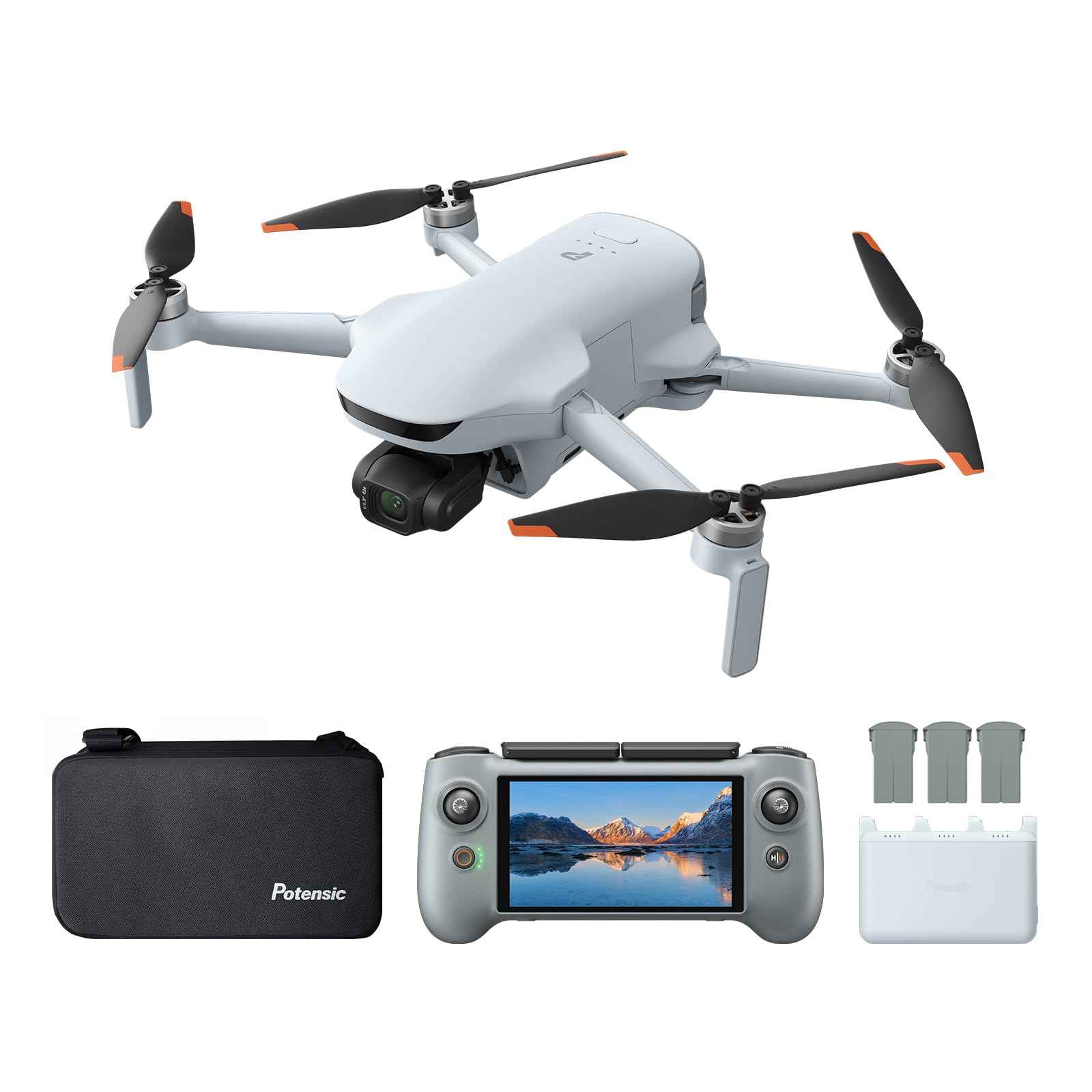
The ATOM 3 is the rare sub-1000 drone that doesn’t force you to compromise on sensor quality. Its 1/1.3-inch CMOS sensor captures 4K 60fps HDR video with P-Log mode for color grading, and the PixSync 5.0 digital transmission delivers a stable 16-kilometer range with a 1080p 60fps live feed—numbers that would have been unthinkable at this price point two years ago.
Under 249 grams, it sidesteps FAA registration entirely, and the three-battery Fly More setup provides a genuine 120 minutes of flight time when you factor in the 65W parallel charging hub that refuels all three packs in about 90 minutes. The AI Tracking 2.0 system supports low-altitude tracking below 4 meters, and the AR return-to-home with apron recognition adds a layer of landing precision that reduces pucker factor on windy days.
Where it shows its mid-range roots is in the absence of omnidirectional obstacle sensors—you get bottom-facing sensors but no upward or lateral avoidance, so manual flying in tight spaces demands caution. For travel creators who want the best possible image quality in a pocket-sized package, this is the benchmark.
Why it’s great
- Professional-grade 1/1.3-inch sensor with 4K 60fps HDR and P-Log
- Long 16-kilometer PixSync 5.0 digital transmission
- Three-battery kit provides 120 minutes total flight time
Good to know
- No lateral or upward obstacle avoidance sensors
- Propeller guard for low-altitude tracking is sold separately
2. DJI Flip (RC-N3)

The DJI Flip reframes what a beginner drone can do. Its full-coverage carbon fiber propeller guards make it one of the safest drones to fly in the sub-1000 bracket, and the 1/1.3-inch CMOS sensor delivers 4K 60fps HDR video with subject tracking that keeps a hiking companion or party host in sharp focus without manual stick adjustment.
Weighing under 249 grams, it requires no FAA registration or Remote ID, and the palm takeoff and landing feature removes the need for a flat launch pad entirely. The 31-minute max flight time is moderate, but the 44,000-foot transmission range using DJI’s OcuSync digital feed means you can explore distant landscapes without losing a clear 1080p view.
The single-battery kit is the main limitation—additional Intelligent Flight Batteries and a proper carrying case add cost beyond the base price. Also, the Flip only has forward obstacle avoidance, so reversing while distracted requires your full attention. For beginners who prioritize safety and image quality above all, this is the most confidence-inspiring opener.
Why it’s great
- Full propeller guards and palm launch for beginner safety
- Excellent 1/1.3-inch sensor with reliable subject tracking
- No FAA registration needed at sub-249g weight
Good to know
- Only forward obstacle avoidance, no rear or side sensors
- Additional batteries and a case are essential but sold separately
3. Holy Stone Sentinel HS600D

The HS600D steps into a heavier weight class at 603 grams, and that extra mass pays dividends in gusty conditions. Its reinforced frame, paired with a 3-axis brushless gimbal and EIS, holds horizon lock through Level-6 wind resistance—a spec most sub-250-gram flyers can’t match. The Sony 1/2-inch CMOS sensor with f/1.8 aperture captures 4K HDR video and 8K 48MP photos with noticeably better low-light performance than budget drones.
Holy Stone’s wired-relay digital transmission extends control out to 20,000 feet, using a cable tether to the controller rather than phone Wi-Fi, which cuts interference in suburban environments. The two-battery setup nets around 80 minutes of total flight time, and the GNSS plus optical flow positioning keeps the drone stable even during low-altitude hovering.
The aircraft is large enough that it requires FAA Remote ID compliance (which Holy Stone has integrated), so it’s not a grab-and-travel drone for countries with strict weight limits. For anyone flying in open areas where wind is the main adversary, the HS600D provides the most stable airframe in this list.
Why it’s great
- 603-gram reinforced frame handles Level-6 wind well
- Sony CMOS sensor with f/1.8 aperture for better low-light
- Wired-relay digital transmission at 20,000 feet
Good to know
- FAA Remote ID requires registration due to weight
- Camera may overexpose in bright sun without manual ISO control
4. DCX Volo X EZ AI
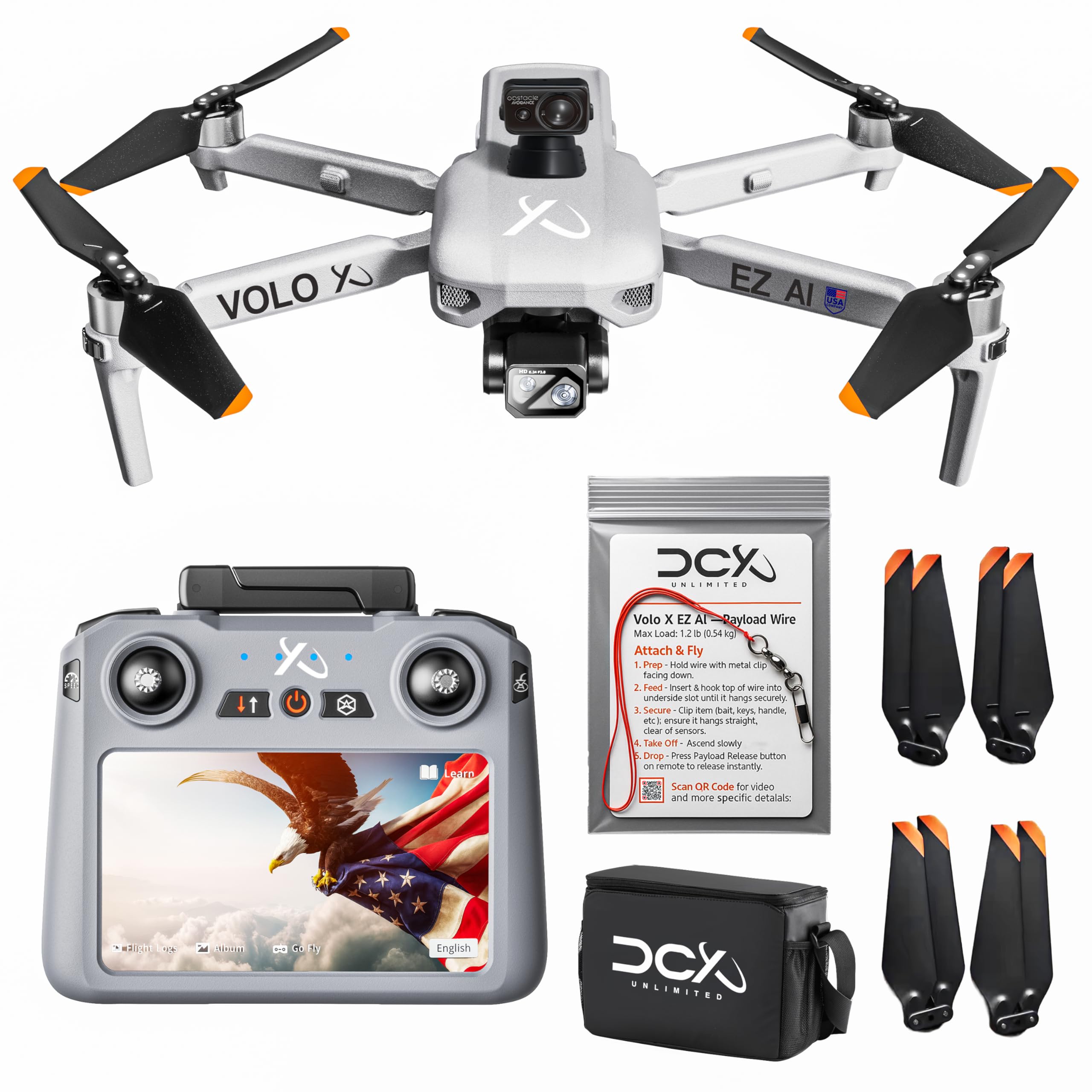
DCX’s Volo X EZ AI distinguishes itself with 360-degree LiDAR obstacle detection that works in all flight directions—forward, backward, upward, and downward. This is the only drone in the sub-1000 group with full spherical awareness, making it the safest choice for flying through tree canopies or indoors. The 5,000mAh battery provides a real-world 45-minute flight time, and the 4-mile range keeps you connected across long landscapes.
The 4K camera with a 3-axis gimbal and EIS delivers smooth footage, though the 12MP effective still resolution is lower than the competition’s 48MP sensors—so don’t expect pixel-peeping zoom capability. A unique payload release mechanism can carry and drop up to 1.2 pounds on command, a feature rarely seen at this level. U.S.-based customer support and no geofencing restrictions mean you skip the authorization calls other drone brands sometimes require.
Some users report a finicky power-on sequence and occasional controller sync freezes, and the obstacle avoidance can miss very thin branches. For beginner or intermediate pilots who want the maximum automated safety net, the LiDAR system is a genuine advantage over cameras-only avoidance systems.
Why it’s great
- 360-degree LiDAR obstacle avoidance in all directions
- 45-minute flight time from 5,000mAh battery
- Built-in 1.2-pound payload release mechanism
Good to know
- 12MP still resolution is lower than 48MP rivals
- Power-on sequence and controller sync can be quirky
5. K600PRO GPS Drone
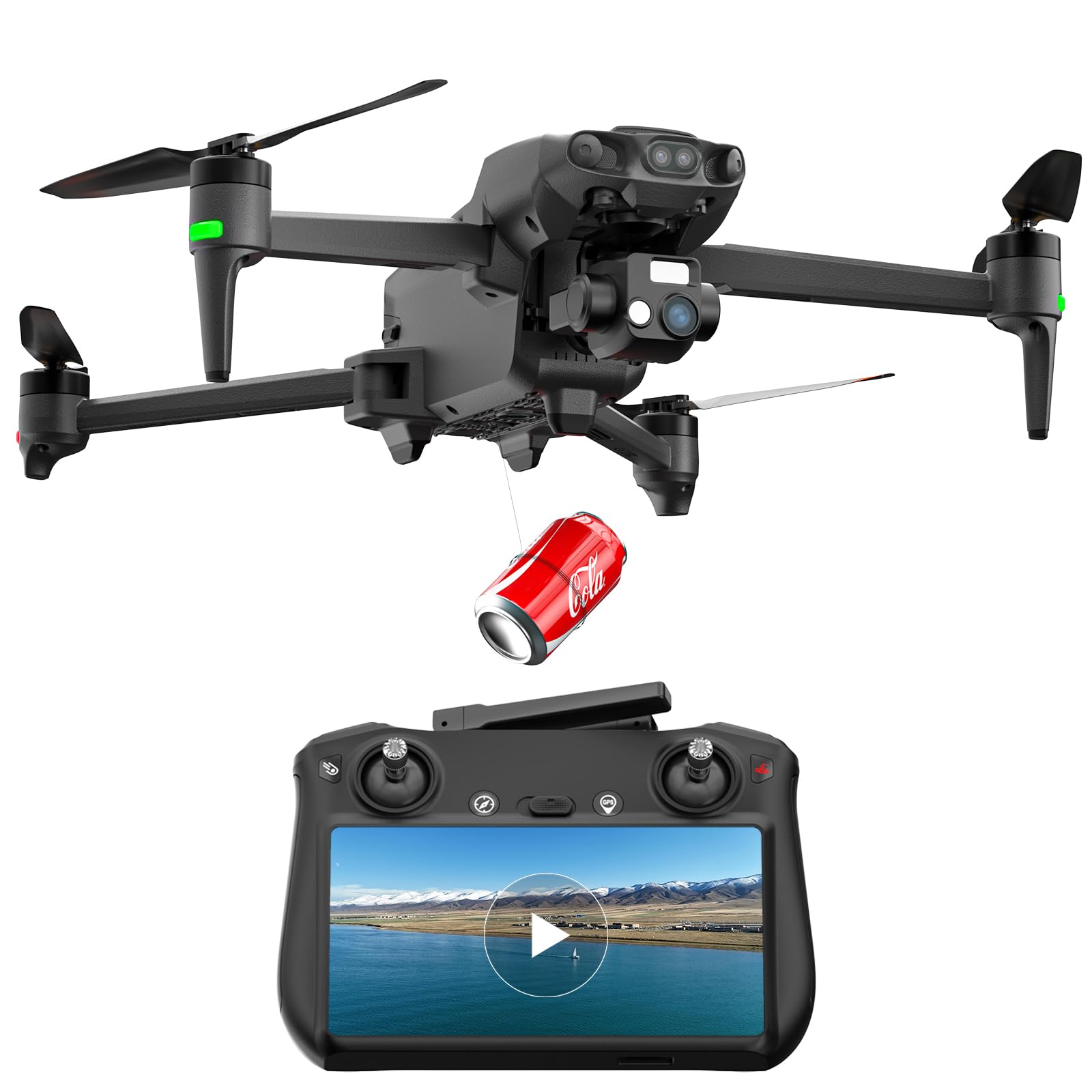
The K600PRO tackles the most persistent annoyance for drone pilots—fumbling with a smartphone mount. Its 5.5-inch FHD touchscreen controller eliminates the phone tether entirely, displaying the live FPV feed directly on the remote. That alone cuts pre-flight setup time in half. The 3-axis gimbal and EIS produce smooth 4K video, and the 50x digital zoom is useful for reconnaissance but becomes pixelated beyond 10x in practice.
With a 15-kilometer digital transmission range and an 11.1V 3,500mAh battery that delivers a claimed 55-minute flight time, it outlasts most drones in this list on a single charge. The TOF sensor array plus six GPS sensors improve low-altitude stability by a noticeable margin, and the Follow Me mode tracks subjects reliably without dropping lock.
The camera’s low-light performance is adequate but not class-leading, and the digital zoom is more marketing tool than daily-driver feature. For pilots who dislike phone-dependent flying and want the controller screen convenience without stepping to DJI’s premium tier, the K600PRO is the most practical package.
Why it’s great
- Built-in 5.5-inch touchscreen removes phone tether
- Long 55-minute flight time from one battery
- TOF plus six GPS sensors for stable low-altitude flying
Good to know
- Digital zoom quality degrades quickly past 10x
- Camera struggles in low-light compared to larger sensor models
6. Ruko Drone with 4K UHD Camera

At 248 grams, the Ruko sits on the FAA exemption line with precision—it’s under 250 grams, so no registration or Remote ID is required, making it the ultimate international travel drone in this guide. The 3-axis brushless gimbal paired with EIS keeps the 4K 30fps footage stable, and the 48MP sensor captures 8K photos that are detailed enough for social media and light cropping.
The three-battery kit provides a combined 96 minutes of flight time, and the digital transmission system offers a 20,000-foot range without the interference issues common to Wi-Fi relay. The built-in beeper helps locate the drone in tall grass, and the AI takeoff/landing system paired with quadruple positioning (GPS, barometric, TOF, and optical flow) makes it genuinely beginner-friendly.
The joysticks feel sensitive out of the box—reducing the stick rate in the app helps. Some users report occasional battery defects, though Ruko’s customer service appears responsive with replacements. For globetrotters who want a full-featured gimbal drone that slips into a small bag without triggering airport customs, this is the top choice.
Why it’s great
- Under 250 grams — no FAA registration needed
- 96 minutes total flight time with three batteries
- 3-axis gimbal plus EIS for professional-level stabilization
Good to know
- Joystick sensitivity may need adjustment out of the box
- Occasional battery quality inconsistency reported
7. Holy Stone HS600 2-Axis Gimbal

The HS600 is one of the few drones in the mid-range bracket that ships with integrated FAA Remote ID compliance, saving you the hassle of buying an external broadcast module. Its 2-axis gimbal combined with EIS stabilization handles the majority of flight scenarios well, though you’ll notice slight horizon roll during yaw maneuvers that a 3-axis gimbal would suppress. The Sony sensor delivers solid 4K 30fps footage with decent color reproduction.
The 20,000-foot transmission range is achieved through a Wi-Fi repeater integrated into the controller, which works well in open fields but can lag in Wi-Fi-congested areas. The single 2,500mAh battery provides around 28 minutes of real flight time, and the Level-6 wind resistance keeps it stable in moderate breezes. The carrying case included in the box adds value for first-time buyers.
Users note that the camera tends to overexpose and lacks manual ISO or exposure control, so bright snowy or sandy environments may blow out highlights. For budget-conscious pilots who need FAA compliance out of the box and can live without 3-axis yaw stabilization, this is a reliable starting point.
Why it’s great
- Integrated FAA Remote ID compliant out of the box
- Sony sensor with 4K 30fps and EIS for steady footage
- Included carrying case adds travel convenience
Good to know
- 2-axis gimbal lacks yaw stabilization compared to 3-axis models
- No manual ISO or exposure control in camera app
8. Bwine F7GB2 Pro

The Bwine F7GB2 Pro is engineered for thin-air performance. Its 1806 brushless motors, compass, gyroscope, and barometer allow it to launch from altitudes up to 2,000 meters—useful for mountain adventurers and plateau residents who find other drones gasping for lift. The Level-6 wind resistance test report confirms it holds stable in breezes that would push lighter sub-250g drones off course.
The 3-axis gimbal and 4K camera with 120-degree FOV produce clear footage, and three 2,600mAh UL-certified batteries deliver a combined 75 minutes of flight. The wired transmission system provides a 10,000-foot range in ideal conditions, and GPS smart modes—including Follow Me, Waypoint, and Orbit—work reliably once the drone has locked enough satellites.
The controller’s screen overlay is helpful, but the display washes out in direct sunlight, making it hard to read telemetry. Some users note slight camera distortion on turns and a conservative auto-return that triggers sooner than expected. For pilots flying from elevated terrain who need a drone that won’t lose performance at 6,500 feet, the Bwine is the specialized tool.
Why it’s great
- Certified to fly at 2,000-meter altitude with stable performance
- Three UL-certified batteries provide 75 minutes total flight
- 3-axis gimbal with 120-degree FOV for wide landscape captures
Good to know
- Controller screen hard to read in bright sunlight
- Auto-return can engage conservatively, cutting flights short
9. DJI Neo 2 Motion Fly More Combo
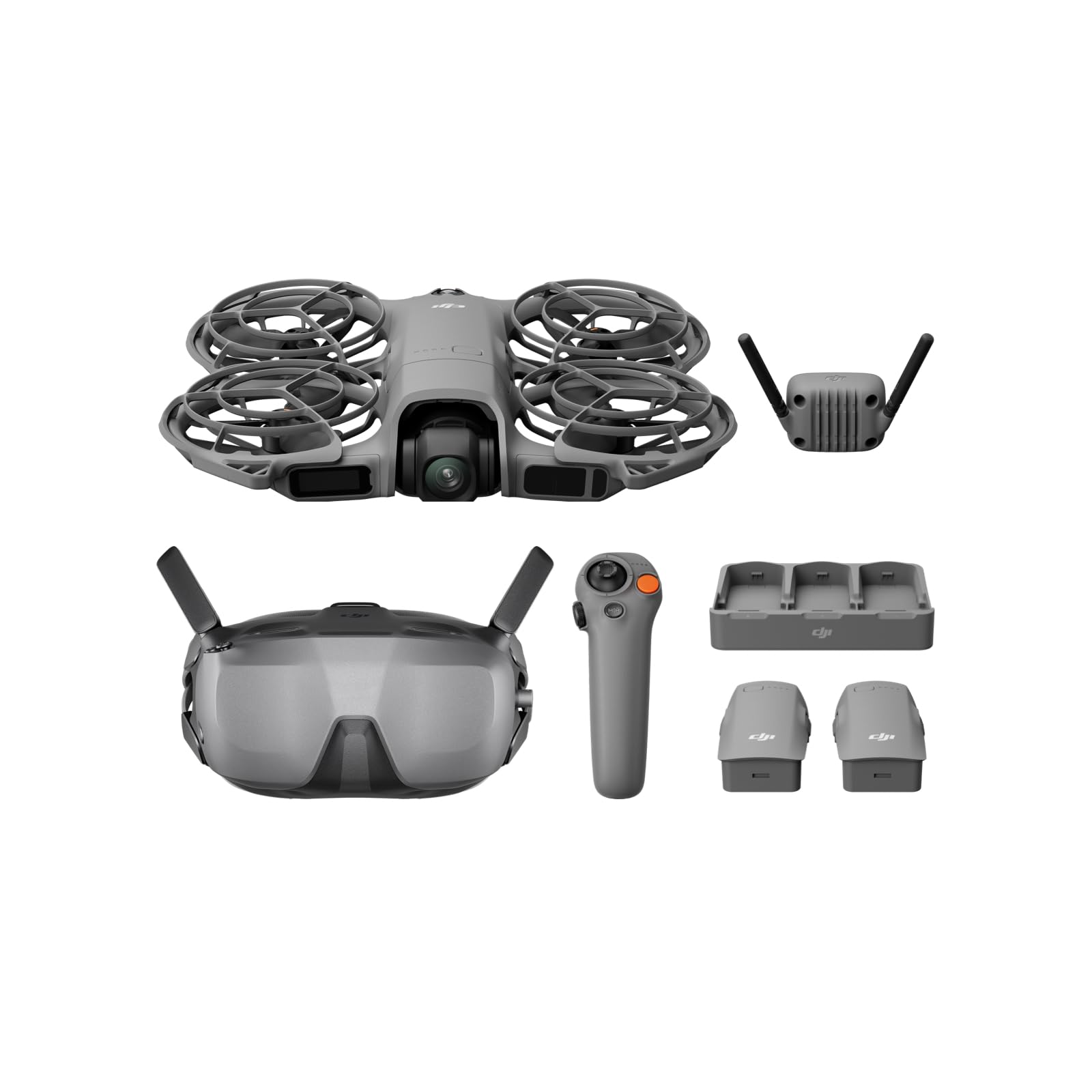
The DJI Neo 2 is a category of its own: a 151-gram, C0-certified drone that comes with the RC Motion 3 controller and Goggles N3 for a complete first-person-view flying experience out of the box. The motion controller lets you steer by tilting your wrist, making FPV feel intuitive even for pilots who have never flown manually. The 4K camera with 3-axis stabilization delivers smooth footage that looks cinematic through the goggles.
Omnidirectional obstacle sensing provides a safety buffer, and the palm takeoff/landing means you can launch without a pad. The three-battery setup provides around 30-45 minutes of total flight time depending on how aggressively you fly, and the ActiveTrack and gesture controls work reliably for tracking subjects hands-free.
The flight time per battery is the shortest in this list—around 10-15 minutes under real FPV conditions—so the Fly More Combo is non-negotiable. The goggles and motion controller add bulk to your carry. For pilots who want the thrill of immersive FPV flight with DJI’s polish, this is the only complete package in the sub-1000 space.
Why it’s great
- Complete FPV kit with goggles and motion controller included
- 151-gram weight makes it the most portable option
- Omnidirectional obstacle sensing for confident flying
Good to know
- Short 10-15 minute flight time per battery in FPV mode
- Goggles and motion controller add carry volume
FAQ
Do I need FAA registration for a drone under 250 grams?
Is a 3-axis gimbal worth the extra cost over a 2-axis model?
What does FAA Remote ID compliance mean for my purchase?
Final Thoughts: The Verdict
For most users, the best drone under $1000 winner is the Potensic ATOM 3 Fly More Combo because it combines a professional-grade 1/1.3-inch CMOS sensor, a 3-axis gimbal, 120 minutes of total flight time, and sub-250-gram portability into a single package that doesn’t require compromise. If you want omnidirectional obstacle avoidance and the safest automated flying experience, grab the DCX Volo X EZ AI. And for immersive FPV flight with goggles and motion control, nothing beats the DJI Neo 2 Motion Fly More Combo.

Mo Maruf
I created WellFizz to bridge the gap between vague wellness advice and actionable solutions. My mission is simple: to decode the research and give you practical tools you can actually use.
Beyond the data, I am a passionate traveler. I believe that stepping away from the screen to explore new environments is essential for mental clarity and physical vitality.