Our readers keep the lights on and my smoothie glass nicely filled. As an Amazon Associate, I earn from qualifying purchases.
A quality center punch solves this with a single, precise dimple that guides your bit straight into the work.
I’m Mohammad Maruf — the founder and writer behind WellFizz. This guide analyzes spring tension ranges, tip material hardness, and body construction across the most popular center punches available today to find the ones that actually deliver repeatable accuracy.
Whether you work with mild steel, aluminum, wood, or hardened alloys, finding the best center punch means matching the tool’s impact force and point geometry to the materials you mark most often.
How To Choose The Best Center Punch
Selecting a center punch isn’t just about grabbing the first steel rod you see. The difference between a clean mark and a mangled surface lies in three specific attributes: the mechanism type, the tip material, and the adjustable force range. Each factor changes how the tool behaves on different substrates, from soft pine to hardened steel.
Automatic vs. Traditional Hammer-Style
Automatic punches use an internal spring mechanism that fires the tip when you press down—no hammer required. This gives consistent strike force every time and works in tight spaces where swinging a hammer is impossible. Traditional hammer punches cost less and let you control the force by your own swing, but they rely on your aim and can overstrike soft metals. For most users, the automatic style offers better repeatability and safety.
Tip Material and Heat Treatment
The tip takes the full impact, so its composition determines how many marks you’ll get before it goes dull. High-carbon steel tips hold an edge longer than basic alloy steel. Hardened steel or 6150 Cr-V steel tips, often with a black oxide finish, resist chipping when striking hardened surfaces like drill rod or stainless steel. Check whether the tip is replaceable—some budget punches require replacing the whole tool when the point rounds off.
Adjustable Tension Range
Adjustable tension lets you dial in the impact force. Light settings work on acrylic, fiberglass, or thin sheet metal without bending the material. High settings produce a deep dimple in structural steel or cast iron. A tool with a narrow tension range forces you to accept a one-size-fits-all force that rarely fits all.
Grip and Ergonomics
Knurled bodies improve grip when your hands are oily or gloved. Round smooth bodies slip under pressure, leading to off-center marks. A longer body (around 5 to 6 inches) gives better leverage and a stable hand position, while compact pen-sized punches tuck into a pocket but offer less control. Consider the typical position you’ll be marking—vertically on a wall or flat on a bench—and choose the body length accordingly.
Quick Comparison
On smaller screens, swipe sideways to see the full table.
| Model | Category | Best For | Key Spec | Amazon |
|---|---|---|---|---|
| WHLLING 2-Piece Automatic Center Punch | Premium | Heavy metal marking | 6150 Cr-V steel tip | Amazon |
| Lisle 30280 Automatic Center Punch | Mid-Range | Light duty pocket carry | Adjustable tension | Amazon |
| General Tools 70079 Automatic Center Punch | Mid-Range | Versatile one-handed use | Hardened steel point | Amazon |
| Klein Tools 66310 Center Punch | Budget | Manual hammer-style marking | High-carbon steel shank | Amazon |
| HILBERTBROOK 2 Pack Center Punch | Budget | Multi-toolbox backup | 5-inch alloy steel body | Amazon |
In‑Depth Reviews
1. WHLLING 2-Piece Automatic Center Punch

The WHLLING automatic center punch stands out because of its 6150 Cr-V steel tip, a material typically found in impact-rated sockets and premium screwdrivers. This tip resists chipping on hardened steel and stainless steel far longer than generic alloy steel points. The knurled body spans the full length, giving a secure grip even with oily fingers, and the 6-inch length provides good mechanical advantage for controlled downward presses.
Adjustable tension covers a wide range: at the lightest setting it leaves a clean dimple in acrylic and soft aluminum without cracking the surface, and at maximum tension it drives a deep mark into mild steel plate. The two-pack gives you a spare for the toolbox or allows one punch set to low tension and the other to high tension so you don’t have to re-dial between materials.
Some users report that the punch needs a break-in—a few dry snaps on a solid surface—before the internal mechanism seats properly. After that initial step, the action is smooth and repeatable. The knurling also helps when using the tool as an emergency window breaker, a secondary function mentioned by several buyers.
Why it’s great
- 6150 Cr-V tip stays sharp on hardened metals
- Wide adjustable tension range covers soft and hard materials
- Two-pack provides a spare or dual-tension setup
Good to know
- May require a break-in dry-fire before consistent operation
- Larger than compact pen punches for pocket carry
2. Lisle 30280 Automatic Center Punch
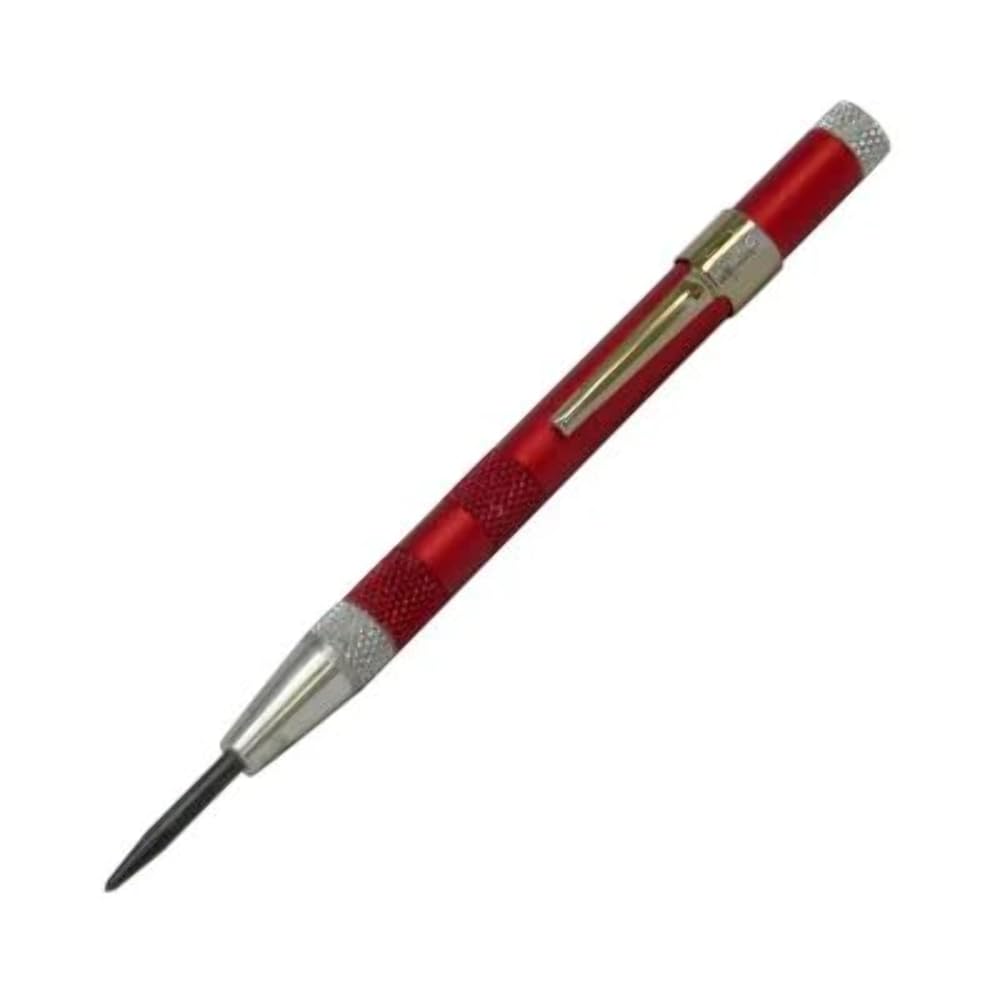
The Lisle 30280 is a compact automatic punch roughly the size of a fat pen—slender enough to slide into a pocket with its integrated clip, and light enough to forget it’s there. Its adjustable tension lets you choose between a soft tap for plastics and a moderate mark for aluminum or fiberglass. The alloy steel tip is adequate for lighter gauge materials, though it will dull faster on hardened steel than the premium picks in this lineup.
The punch works well through paper templates on fiberglass, where a hammer swing would crack the gel coat. Reducing the tension prevents chipping when marking thin materials—a thoughtful design detail the adjustable cap provides.
The main limitation is that the Lisle is not built for heavy steel or cast iron. Pushing it beyond light to medium duty risks rapid tip wear and possible mechanism failure, as noted by a buyer whose unit stopped working after a few marks on harder metals. For toolboxes focused on electrical work, wood, plastics, and soft metals, it earns its spot as a reliable secondary punch.
Why it’s great
- Compact pen size with pocket clip for easy carry
- Adjustable tension suits soft materials and gels well
- Proven longevity on electrical and light industrial work
Good to know
- Not intended for hardened steel or heavy striking
- Some units may fail early if used beyond light duty
3. General Tools 70079 Utility Automatic Center Punch

The General Tools 70079 uses a lightweight aluminum body to keep the overall weight low, reducing hand fatigue during repetitive marking. Despite the light frame, the point is hardened alloy steel that penetrates wood, aluminum, and mild steel reliably. The knurled finger grip runs the length of the body and gives a non-slip hold, which is critical when pressing down on curved surfaces like tubing or lock cylinders.
One user noted it works flawlessly on automotive lock cylinders and unrelated metalworking projects where a traditional hammer punch would struggle to reach. The automatic mechanism fires consistently with each press, and the spring tension is pre-set at a moderate level—adequate for most general shop tasks. This punch also serves as a functional emergency glass breaker in a vehicle door panel.
The trade-off is that the tension is not adjustable, so you cannot lighten it for delicate plastics or crank it up for heavy steel. The aluminum body, while light, is also less impact-resistant than a full steel construction; a hard drop on concrete could dent the housing and bind the internal spring. For general workshop use on wood, soft metals, and composites, it offers an honest balance of weight and function.
Why it’s great
- Lightweight aluminum body reduces hand fatigue
- Hardened steel point cuts cleanly into aluminum and mild steel
- Knurled grip provides stable hold on curved surfaces
Good to know
- Tension is fixed and not adjustable for different materials
- Aluminum body is less durable than steel on drops
4. Klein Tools 66310 1/4-Inch Center Punch
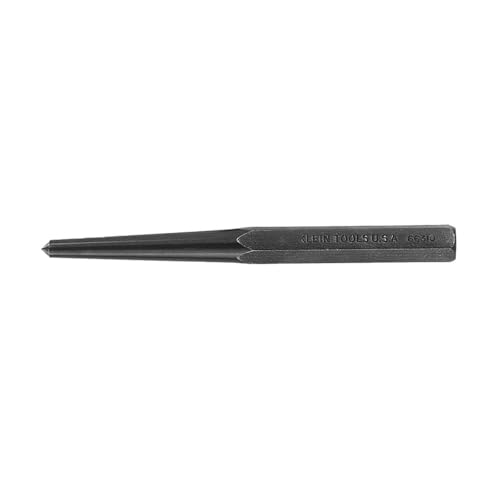
Klein Tools 66310 is a manual hammer-style punch, which means you control the impact force entirely with your hammer swing. This gives you the ability to vary force from a gentle tap on brass to a heavy strike on steel plate, something automatic punches cannot match without adjusting tension. The high-carbon steel shank is heat-treated through the point, keeping the tip sharp and true through hundreds of strikes.
The black oxide finish provides corrosion resistance, which matters for toolboxes that sit in damp garages or job trucks. At 4.25 inches long and 0.25 inches in diameter, it’s a shorter, narrower tool than the automatic punches, making it easy to stash in a small toolbox drawer. Customers with decades of Klein experience report the tip holds up well on castle nuts and general layout work.
The trade-off is that a hammer punch requires two hands and a swinging motion, limiting use in tight spaces or overhead work. The lack of a spring mechanism also means every strike is as accurate as your hammer swing—there’s no internal guide to keep the force axial. For those who prefer the tactile feedback and control of a traditional punch, Klein delivers USA-made reliability.
Why it’s great
- Variable force controlled by your hammer swing
- High-carbon steel point holds up to heavy use
- Black oxide finish resists corrosion
Good to know
- Requires two hands and a hammer—not for tight spaces
- Short 4.25-inch body offers less leverage than longer punches
5. HILBERTBROOK 2 Pack Automatic Center Punch

The HILBERTBROOK 2 Pack delivers two automatic punches that work on wood, plastic, glass, and softer metals. The alloy steel bodies have a reinforced head and a knurled surface for grip, and the adjustable tension cap lets you dial in force level. At 5 inches in length, they are a middle ground between the compact Lisle and the long WHLLING, offering decent leverage without being unwieldy.
Multiple buyers highlight the supplementary use as a car window breaker, and the hardened steel point holds up for general workshop tasks. The set gives you a spare for the glovebox or allows you to keep one at the bench and one in the tool bag. For quick marks on wood studs, drywall, or angle iron, the punches work out of the box with no break-in required.
The drawback is inconsistency on harder metals. One user reported faint marks on soft metal even after adjusting to maximum tension, suggesting that the spring strength is capped relatively low. These punches are best kept for woodworking, plastics, and thin sheet metal rather than structural steel. If your work is primarily light-duty, the two-pack value is hard to beat.
Why it’s great
- Two punches for the price of one single unit
- Adjustable tension cap suits various materials
- Knurled grip works well with gloved hands
Good to know
- Spring power may be insufficient for harder metals
- Some units need a drop of oil to operate smoothly
FAQ
What material can an automatic center punch mark without damaging the tip?
Why does my automatic center punch sometimes not fire when I press down?
Final Thoughts: The Verdict
For most users, the best center punch winner is the WHLLING 2-Piece Automatic Center Punch because its 6150 Cr-V steel tip, wide adjustable tension range, and two-pack value cover everything from hobby woodworking to automotive steel. If you need a compact pocket punch for light electrical or composite work, grab the Lisle 30280. And for those who prefer the control of a traditional hammer-style punch with a USA-made high-carbon steel shank, nothing beats the Klein Tools 66310.

Mo Maruf
I created WellFizz to bridge the gap between vague wellness advice and actionable solutions. My mission is simple: to decode the research and give you practical tools you can actually use.
Beyond the data, I am a passionate traveler. I believe that stepping away from the screen to explore new environments is essential for mental clarity and physical vitality.