Our readers keep the lights on and my smoothie glass nicely filled. As an Amazon Associate, I earn from qualifying purchases.
Landscape photography from above demands a drone that can freeze the texture of a ridgeline at golden hour without introducing noise, and stabilize a sweeping vista through a gust of wind without jitter. The sensor, the gimbal, and the flight logic need to work together to deliver a frame that actually looks better than what a smartphone on a hilltop can produce. Choosing the wrong model means ending up with oversharpened, blurry files that no amount of post-processing can fix.
I’m Mohammad Maruf — the founder and writer behind WellFizz. I’ve spent hundreds of hours analyzing camera specs, transmission protocols, and flight performance data to separate the drones that deliver genuine image quality from those that simply print a high number on the box.
Whether you are shooting for stock, print, or portfolio depth, the right drone for landscape photography must balance sensor size, gimbal stability, and battery endurance without weighing you down on the trail.
How To Choose The Best Drone For Landscape Photography
Selecting a drone for landscape work comes down to four interconnected pillars: camera hardware, stabilization mechanics, flight endurance, and transmission reliability. Each piece directly impacts the final image or clip you bring back to the edit suite.
Sensor Size and Aperture
Landscape photographers shoot in challenging dynamic range situations — deep shadows under a canopy against a bright sky. A larger sensor, typically 1/2-inch or the superior 1-inch CMOS, pulls more light and retains detail in highlights and shadows. A wide aperture like f/1.7 or f/1.8 helps in low-light dawn and dusk conditions, but you also want manual shutter control to prevent overexposure in bright snow or sand.
Gimbal Axis Count
Only a true 3-axis brushless gimbal can correct for pitch, roll, and yaw simultaneously. Electronic image stabilization alone clips the edges of your frame and introduces warping in straight horizon lines. For landscape work, a mechanical gimbal is non-negotiable — it keeps tree lines straight and water surfaces flat even in a level-5 breeze.
Transmission Range and Bitrate
To frame a distant mountain or coastline, you need a low-latency feed that stays crisp beyond a few hundred meters. Look for digital transmission systems (not plain Wi-Fi) that maintain a 1080p live preview at ranges of 6 km or more. A wired relay or dedicated frequency-hopping protocol resists interference far better than consumer Wi-Fi repeaters.
Quick Comparison
On smaller screens, swipe sideways to see the full table.
| Model | Category | Best For | Key Spec | Amazon |
|---|---|---|---|---|
| DJI Mini 5 Pro Fly More Combo Plus | Premium | Professional landscape prints | 1-inch CMOS sensor | Amazon |
| Potensic ATOM 2 Fly More Combo | Premium | Manual exposure control with ND/CPL | 10 km PixSync 4.0 transmission | Amazon |
| SKYROVER X1 Fly More Combo | Premium | Obstacle avoidance in tight canyons | 360° obstacle sensing | Amazon |
| DJI Flip (RC-N3) | Mid-Range | Ultra-portable palm-launch travel | 4K/60fps HDR with carbon-fiber guards | Amazon |
| Holy Stone Sentinel HS600D | Mid-Range | Wind resistance above tree line | Level-6 wind resistance, Sony CMOS | Amazon |
| Ruko U11MINI | Mid-Range | All-day hiking with multiple batteries | 96-min flight time (3 batteries) | Amazon |
| Bwine F7MINI | Mid-Range | No-phone-required flying | Built-in 5.5″ FHD touchscreen controller | Amazon |
| Bwine F7GIM | Mid-Range | Night landscape and farm patrol | Night Mode 2.0 reduces noise by 90% | Amazon |
| Ruko F11PRO 2 | Mid-Range | First-time flyer capturing estate vistas | 10,000 ft digital transmission | Amazon |
| Holy Stone HS790 | Mid-Range | Night flying over lit cityscapes | 9 km transmission, AI Night Shot | Amazon |
| Potensic ATOM 4K | Budget | Entry-level landscape on a tight budget | 6 km PixSync 3.0, 3-axis gimbal | Amazon |
In‑Depth Reviews
1. DJI Mini 5 Pro Fly More Combo Plus
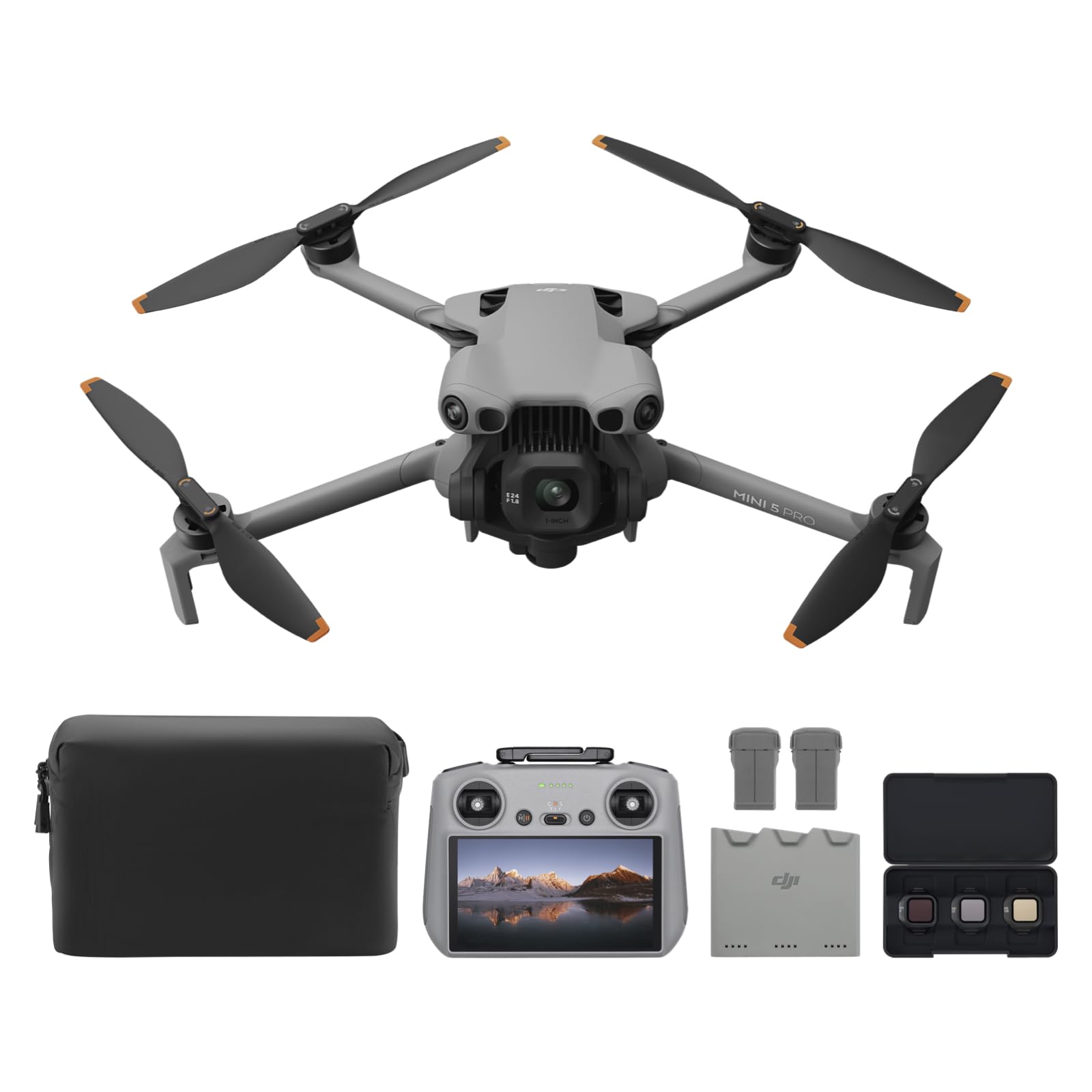
The DJI Mini 5 Pro is the only sub-250g drone on this list with a true 1-inch CMOS sensor. That extra sensor real estate translates directly into cleaner shadows and less noise in the deep blues of a twilight sky. The 225° gimbal roll rotation allows true vertical framing for social media crops without cropping into the sensor, preserving every pixel of the 50 MP stills.
ActiveTrack 360° and omnidirectional obstacle sensing add a safety layer when you are flying backward to track a ridge line or orbiting a lone tree. The Fly More Combo Plus extends each battery to roughly 52 minutes, though the larger packs push the total weight over the FAA registration threshold. The RC 2 controller displays a bright, low-latency 1080p feed that makes precise composition possible at long range.
Buyers should note that adding any accessory can tip the scale beyond 249 grams, requiring Remote ID compliance. The internal 42 GB storage eliminates the immediate need for a microSD card, but transferring large 4K/60fps HDR clips to a computer requires a USB-C cable. For landscape photographers who demand the highest dynamic range in a portable airframe, this is the benchmark.
Why it’s great
- Best-in-class dynamic range from 1-inch sensor
- 5252-minute flight time with Plus batteries
- True vertical rotation without cropping
Good to know
- Fly More Combo weight exceeds FAA 249g limit
- DJI Care Refresh not currently available for US buyers
- Premium price reflects professional-grade hardware
2. Potensic ATOM 2 Fly More Combo
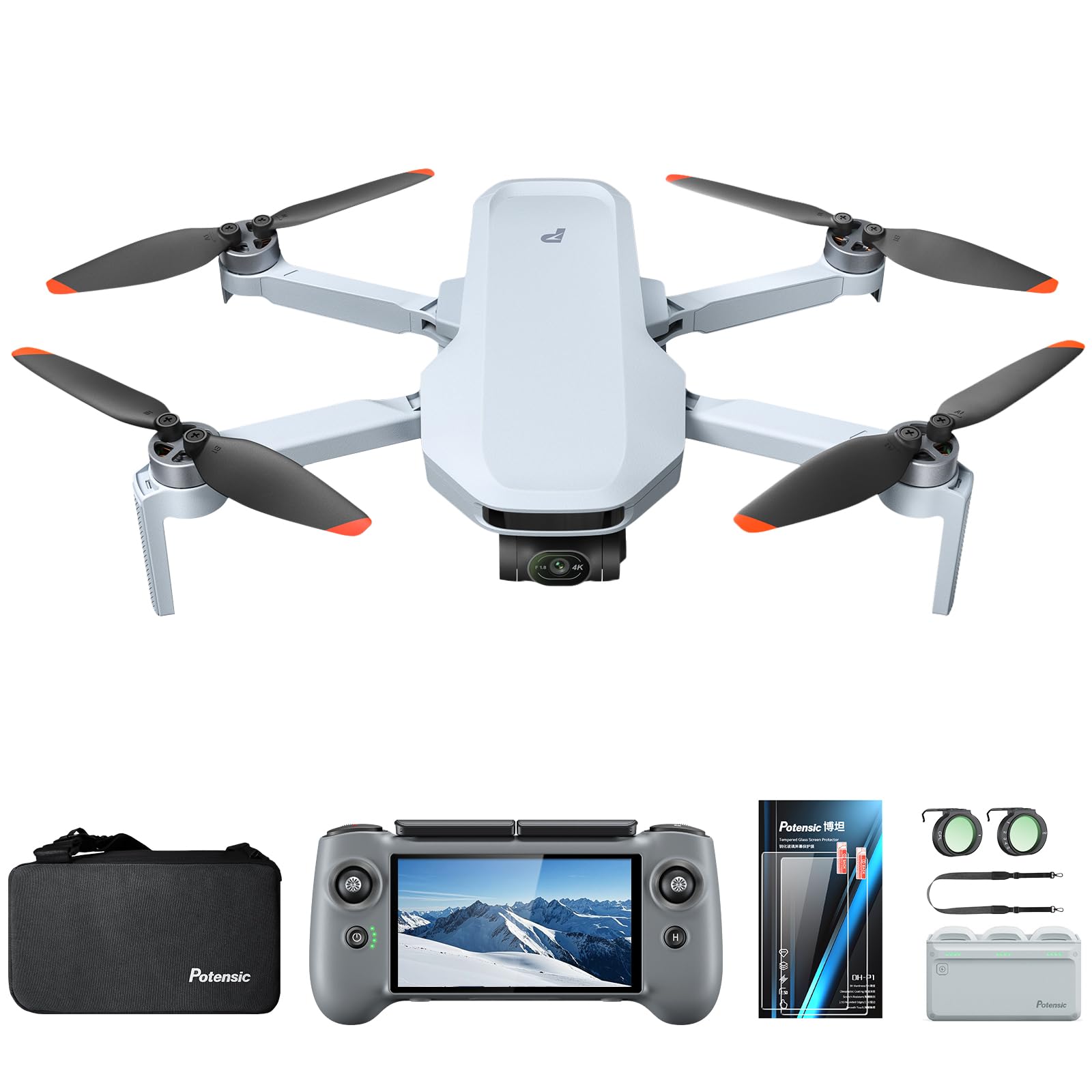
The Potensic ATOM 2 Fly More Combo ships with ND and CPL filters included, a rare feature at this tier. The ND filter provides 1 to 5 stops of reduction, letting you maintain a cinematic shutter angle even in bright midday sun. The CPL cuts reflections off water and wet foliage, which is extremely useful for coastal or post-rain landscape work. The 1/2-inch Sony CMOS shoots 4K/30fps HDR video and 48 MP photos through a 3-axis brushless gimbal.
The PTD 1 remote controller includes a 5.5-inch 1080p display rated at 700 nits. That brightness means you can keep your composition in full sun without shading the screen. PixSync 4.0 transmission reaches up to 10 km, and the 1080p/30fps live feed stays usable. The Fly More bundle includes three batteries that charge simultaneously in 1.3 hours via the parallel hub. AI tracking modes — Spotlight, Follow, and Parallel — expand creative options without requiring manual stick inputs.
One gap is that the ATOM 2 lacks omnidirectional obstacle avoidance, relying on forward sensors for basic collision prevention. The controller screen, while bright, is glossy and benefits from the included matte screen protector. For landscape shooters who want ready-to-use exposure control filters out of the box, this is a compelling mid-premium choice.
Why it’s great
- Includes ND and CPL filters for exposure control
- 700-nit built-in screen, no phone needed
- 10 km transmission range with PixSync 4.0
Good to know
- Only forward obstacle avoidance
- Glossy screen can glare at certain angles
- Requires firmware updates out of box
3. SKYROVER X1 Fly More Combo

The SKYROVER X1 introduces omnidirectional obstacle avoidance at a price point where most competitors only offer forward sensors. For landscape photographers navigating through tree canopies or narrow canyon slots, this 360° sensing reduces the mental load of constant orientation checks. The 1/1.32-inch CMOS sensor with an f/1.7 aperture captures clean 48 MP stills and 4K/60fps HDR video with smooth slow-motion capability at 4K/100fps.
SkyBridge digital transmission reaches 9.32 miles, maintaining a 1080p/60fps live view that makes distant composition fluid. The Fly More bundle provides three batteries for a total flight time of roughly 96 minutes. AI Night Mode and Smart Spotlight help pull details from dusk scenes without aggressive noise reduction. The bright yellow body also makes the drone easier to spot against a dark sky or treeline.
Photographers coming from DJI will need to download the Skyrover app separately, and the shoulder bag, while adequate, lacks the rigid protection of a hard case. Some users have noted that the live feed can occasionally drop bitrate in heavy interference zones. For those who prioritize safety sensors and high frame rate video over brand recognition, the X1 delivers impressive specs.
Why it’s great
- Full 360° obstacle avoidance in all directions
- 4K/60fps HDR and 4K/100fps slow motion
- 9.32 mile transmission range
Good to know
- No built-in screen on controller
- Live feed bitrate can fluctuate in high interference
- Carrying bag is soft, not hard-shell
4. DJI Flip (RC-N3)

The DJI Flip is built for photographers who want a launch-ready drone that fits in a jacket pocket. Weighing under 249 grams and requiring no FAA registration, it lifts off from an open palm without needing a flat surface. The full-coverage propeller guards are made from lightweight carbon fiber, making it safe to fly near people or over rocky terrain where a prop strike could end a session.
The 1/1.3-inch CMOS sensor captures 4K/60fps HDR video and 48 MP stills stabilized by a 3-axis gimbal. Subject tracking keeps a moving target — like a hiker on a trail — centered in the frame without manual yaw corrections. The 31-minute flight time per battery is shorter than some competitors, but the rapid deployment and portability compensate for that limitation. The RC-N3 remote uses your phone as a display, keeping the hardware weight low.
This drone has only front-facing obstacle avoidance, so lateral and backward maneuvers require active caution. The vibration of the propeller guards at higher speeds can sometimes introduce micro-jitters in the footage. For the landscape photographer who values spontaneity and packability above maximum flight time, the Flip is a unique tool.
Why it’s great
- Palm takeoff, no flat surface needed
- Full carbon-fiber propeller guards
- Under 249g, no FAA registration
Good to know
- Only front obstacle detection
- 31-minute flight time is below average for class
- Propeller guard vibration can affect stability at speed
5. Holy Stone Sentinel HS600D

The Holy Stone Sentinel HS600D is engineered to hold stable footage where lighter drones would be buffeted off course. The 603-gram reinforced frame paired with a 3-axis gimbal and EIS maintains a level horizon even in level-6 wind conditions — the kind you encounter above the tree line on a gusty afternoon. The 1/2-inch Sony CMOS sensor with f/1.8 aperture captures 4K HDR video and 8K/48 MP photos.
The relay controller uses a wired digital transmission system, bypassing standard Wi-Fi for a more interference-resistant feed at up to 20,000 feet. Two 3500 mAh batteries deliver a combined 80 minutes of flight time, with each battery lasting about 35 to 40 minutes in moderate wind. Smart modes include Follow Me, Smart Tracking, Time-Lapse, and Panorama, which automate complex flight paths without requiring pilot skill.
Users report that the camera can overexpose bright scenes because manual ISO and exposure time controls are limited. There is no RAW photo format, which reduces post-processing flexibility. The backpack-style carrying case is functional but minimal. For landscape shooters who frequently fly in exposed, high-wind locations, the HS600D provides a stable platform that heavier competitors cannot match.
Why it’s great
- 603g frame resists level-6 winds
- 80 minutes total flight with both batteries
- 20,000 ft digital transmission via wired relay
Good to know
- No manual ISO or shutter control
- No RAW photo format support
- Overexposure risk in bright snow or sand
6. Ruko U11MINI
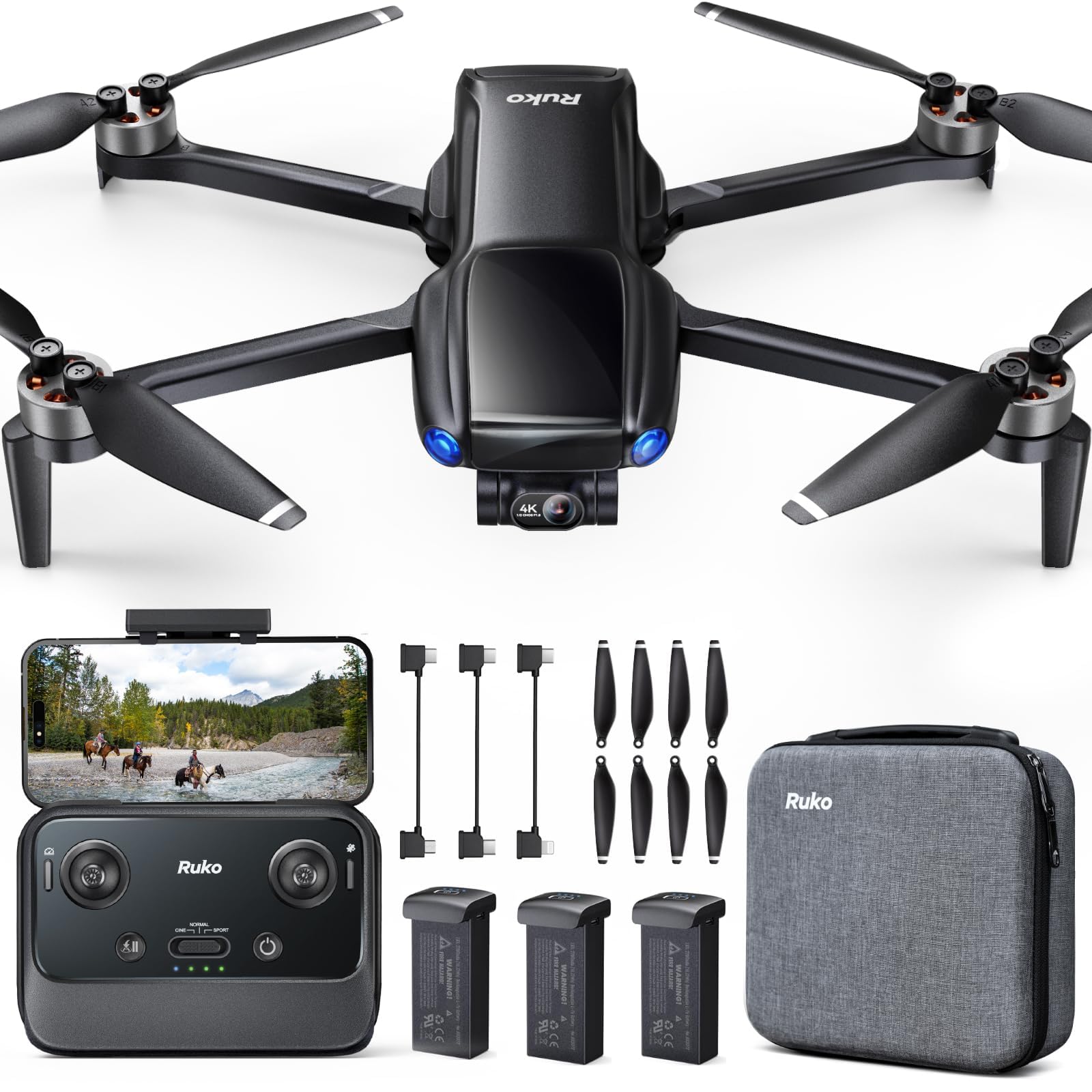
The Ruko U11MINI packs a 3-axis brushless gimbal and EIS into a sub-249g airframe, keeping you FAA-exempt. The 48 MP sensor captures 8K photos and 4K/30fps video. The total flight time of 96 minutes across three smart batteries is a standout feature for landscape photographers who spend a full morning or afternoon in the field without returning to charge.
The RC3 controller communicates via a wired USB connection rather than Wi-Fi, reducing latency and interference. Quadruple positioning — GPS, TOF, and optical flow — keeps the hover rock solid, which is helpful when framing a precise composition. Smart features like Follow Me, Waypoints, and Point of Interest allow automated orbits around a chosen landscape feature.
Some users have reported that the video transfer from the drone to the phone via Wi-Fi can be slow, and the firmware download process can be time-consuming. The included carrying case is soft, offering minimal drop protection. For extended hiking trips where charging access is limited, the three-battery solution ensures you land with the footage you need.
Why it’s great
- 96 minutes total flight with 3 batteries
- Quadruple positioning for stable hover
- FAA-exempt at 248 grams
Good to know
- Slow Wi-Fi transfer to phone
- Firmware download can be tedious
- Soft carrying case, not hard-shell
7. Bwine F7MINI
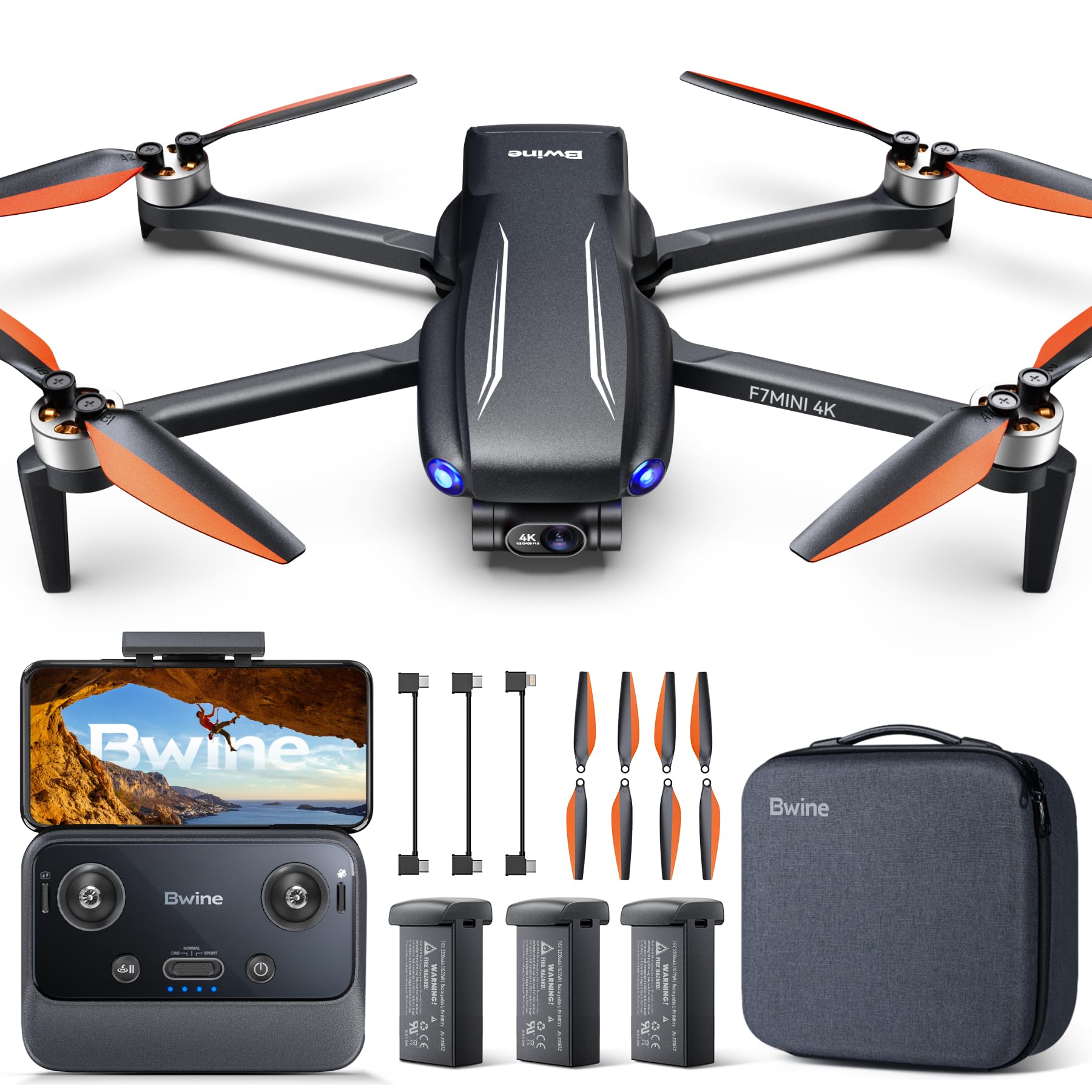
The Bwine F7MINI eliminates the need to tether your phone to the controller with a built-in 5.5-inch FHD touchscreen display. For photographers who want to preserve their phone battery for navigation or backup, this is a practical advantage. The sub-249g frame avoids FAA registration, and the 3-axis gimbal keeps the 48 MP, 4K/30fps camera steady in level-5 wind conditions.
The controller screen delivers a crisp 1080p live feed, and the touch interface allows quick access to Smart RTH, Waypoint, Orbit, and Follow modes. The 6 km wired digital transmission resists interference better than standard Wi-Fi. Three batteries offer 96 minutes of total flight time, with each battery lasting roughly 32 minutes. The bright orange-accented body improves visibility against a green or brown landscape.
The trade-off for the built-in screen is that transferring video files to a computer requires connecting both the drone and the controller via USB-C, which is slower than using a direct microSD card reader. The glossy screen also benefits from a matte protector in bright sun. For landscape photographers who dislike fumbling with phone mounts, the F7MINI is a practical all-in-one tool.
Why it’s great
- Built-in controller screen, no phone needed
- Under 249g, no FAA registration required
- 6 km wired digital transmission
Good to know
- File transfer is slower without direct card reader
- Screen can be glossy in direct sunlight
- Limited manual camera controls
8. Bwine F7GIM
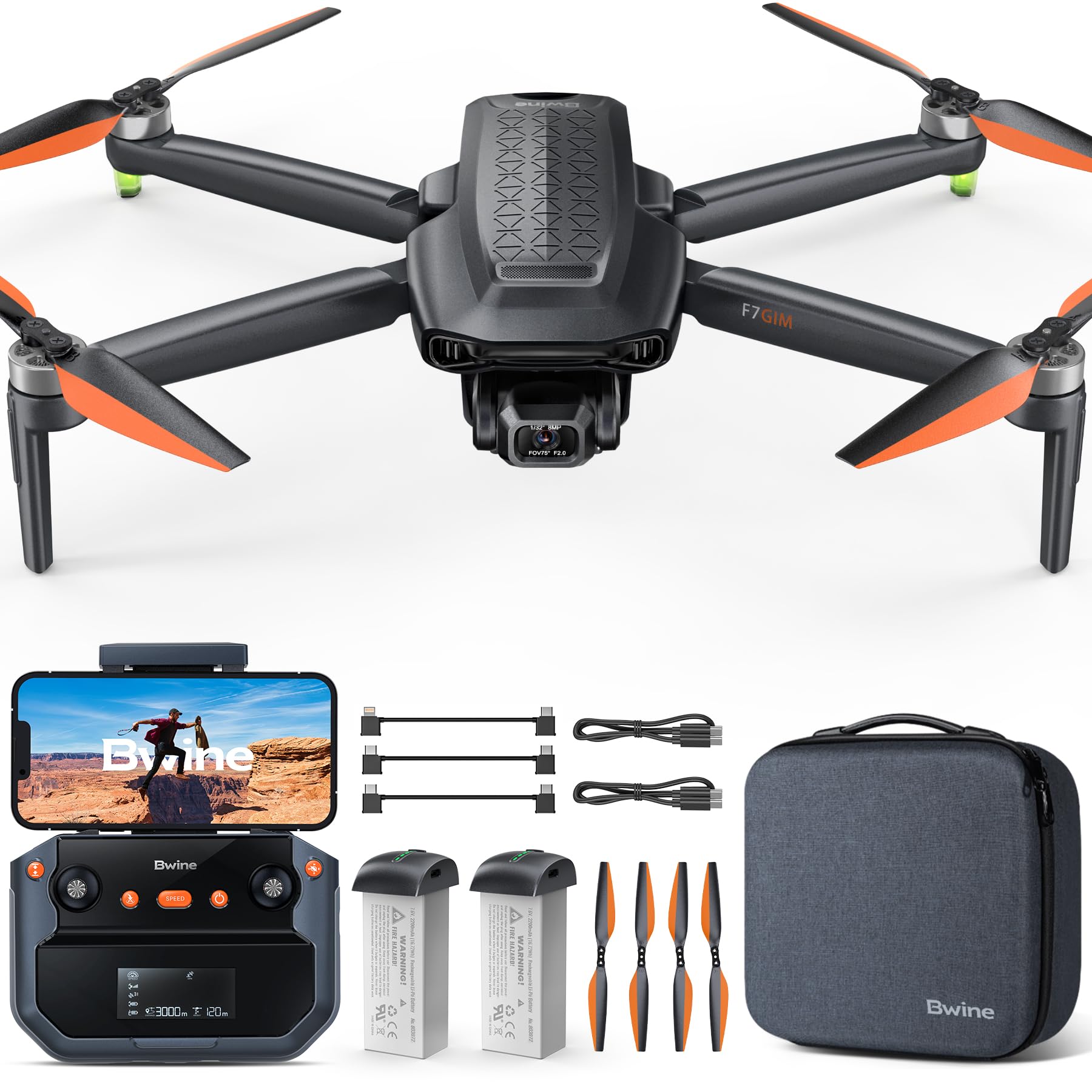
The Bwine F7GIM features Night Mode 2.0, which claims to reduce image noise by 90% in low-light conditions. For landscape photographers shooting cityscapes at twilight or coastal cliffs under a half moon, this mode pulls more usable detail from shadows without aggressive smoothing. The 3-axis brushless gimbal absorbs vibration and wind buffeting, maintaining a stable frame for the 18 MP camera that records 4K/30fps video and 6K photos.
Digital transmission reaches 10,000 feet, and the controller supports 5x digital zoom for framing distant subjects. Two batteries deliver a combined 70 minutes of flight time, and the included hard-shell case adds confidence when transporting through airports or rough terrain. The orange propellers and textured body design improve visibility and handling. GPS smart modes include Follow, Orbit, Cruise Control, and Waypoint.
A common user note is that the controller screen can be difficult to read in direct sunlight because the on-screen overlay competes with glare. The remote stores its USB-C cable inside the phone holder slot, which is easy to overlook during unpacking. For shooters who regularly extend sessions into the blue hour, the F7GIM’s low-light processing is a tangible asset.
Why it’s great
- Night Mode 2.0 reduces noise for dusk shooting
- Includes hard-shell explosion-proof carrying case
- 10,000 ft digital transmission range
Good to know
- Overlay on controller screen hard to read in sun
- USB-C cable hidden inside phone holder slot
- 5x digital zoom reduces image quality
9. Ruko F11PRO 2

The Ruko F11PRO 2 offers a 3-axis mechanical gimbal and 4K/30fps video at an accessible price point, making it a sensible entry point for landscape photographers who are still learning the basics of aerial composition. The 6K photo mode provides enough resolution for moderate crops without visible pixelation. GPS Auto Return-to-Home activates on low battery or signal loss, reducing the risk of losing the drone over a large property or remote trail.
Two batteries provide a total of 70 minutes of flight time, which covers a standard outing without needing to pack extras. The digital transmission reaches 10,000 feet, enough for open landscapes with clear line of sight. Beginner Mode restricts altitude and speed, which helps new pilots build confidence before tackling complex maneuvers like orbits or waypoint flights.
The F11PRO 2 does not support RAW image capture, and the 19 MP effective still resolution is lower than the 48 MP sensors found on many competitors. The app connection can occasionally fail if mobile data is not turned off. For photographers who are primarily sharing web-resolution images and want a stable, forgiving first drone, this delivers reliable basics.
Why it’s great
- 3-axis gimbal for smooth, shake-free video
- 70 minutes total flight with two batteries
- GPS Auto Return for low battery or lost signal
Good to know
- No RAW photo format
- 19 MP stills are lower than competitors
- Requires turning off mobile data for stable app
10. Holy Stone HS790
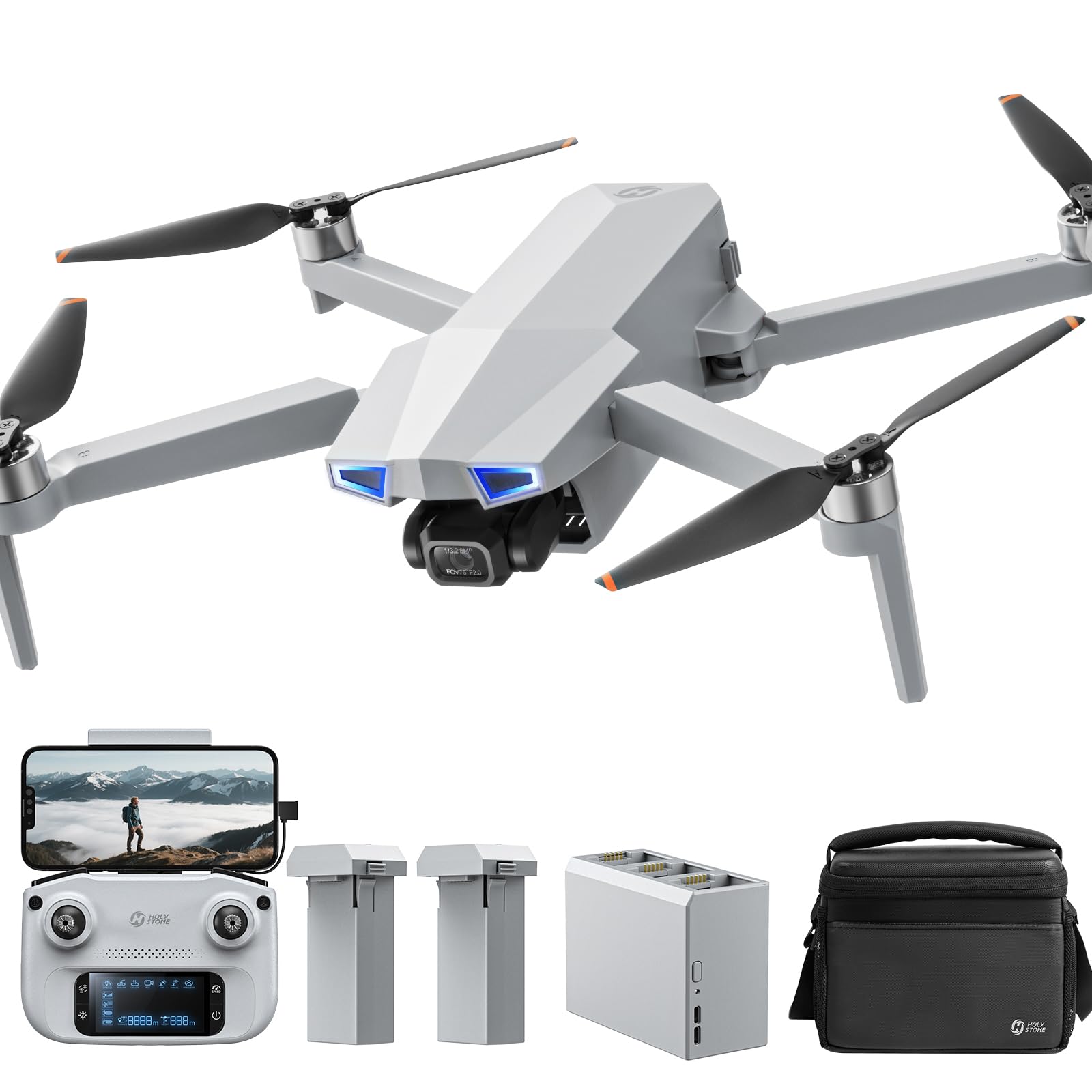
The Holy Stone HS790 comes with a dedicated AI Night Shot mode designed to capture usable landscape images after the sun dips below the horizon. The 3-axis gimbal stabilizes the 6K photo and 4K/30fps camera, while the Wi-Fi repeater transmission pushes a 4K live feed up to 9 km. For photographers who want to shoot city lights or desert nightscapes, the night mode reduces noise and brightens details algorithmically.
The dual intelligent batteries provide a total of 60 minutes of flight time, and the Smart PD Charging Hub doubles as a power bank for topping up other devices in the field. Built-in Remote ID compliance means you can fly without attaching an external module. Beginner-friendly features like One-Key Takeoff and Headless Mode make the HS790 accessible to less experienced pilots.
The Wi-Fi repeater transmission, while long-range, is more susceptible to interference than a wired digital system. The controller does not have a built-in screen, so you need a phone for the live feed. The effective still resolution of 38 MP is decent but not class-leading. For photographers who prioritize night shooting capability in a mid-range package, the HS790 earns its place.
Why it’s great
- AI Night Shot for low-light landscapes
- 9 km transmission range with Wi-Fi repeater
- Built-in Remote ID, no external module required
Good to know
- Wi-Fi transmission more interference-prone than wired
- Requires phone for live view
- 38 MP effective still resolution
11. Potensic ATOM 4K

The Potensic ATOM 4K brings a Sony CMOS sensor and 3-axis brushless gimbal to the budget-friendly tier, offering real stabilization where cheaper drones rely on software-only correction. The 12 MP camera captures 4K/30fps video that holds up for web sharing and small prints. PixSync 3.0 transmission reaches 6 km, and the under-249g weight keeps you FAA registration-free.
The Fly More bundle includes three batteries for a total of 96 minutes of flight time and a parallel charging hub that tops all three packs in 1.3 hours. Visual Tracking and QuickShots like Rocket, Circle, and Boomerang automate cinematic moves. The lightweight design and soft storage bag make this easy to throw into a daypack for spontaneous shoots.
The 12 MP sensor is the lowest resolution on this list, limiting your ability to crop heavily without losing detail. The gimbal calibration process can be picky, and some users have reported persistent calibration prompts. For photographers on a tight budget who still demand a real mechanical gimbal, the ATOM 4K provides the essential hardware foundation.
Why it’s great
- True 3-axis gimbal at an entry-level price
- 96 minutes total flight time with Fly More combo
- Under 249g, no FAA registration required
Good to know
- 12 MP effective resolution limits cropping
- Gimbal calibration can be finicky
- Soft case offers minimal drop protection
FAQ
Is a 48-megapixel sensor better than a 12-megapixel one for landscape shots?
How does flight time affect landscape photography workflows?
Do I need to register my drone with the FAA for landscape photography?
Final Thoughts: The Verdict
For most users, the drone for landscape photography winner is the DJI Mini 5 Pro Fly More Combo Plus because the 1-inch sensor and omnidirectional obstacle avoidance set a new standard for portable aerial image quality. If you want built-in ND filters and a bright controller display without tethering a phone, grab the Potensic ATOM 2 Fly More Combo. And for budget-conscious shooters who refuse to compromise on gimbal stabilization, nothing beats the value of the Potensic ATOM 4K.

Mo Maruf
I created WellFizz to bridge the gap between vague wellness advice and actionable solutions. My mission is simple: to decode the research and give you practical tools you can actually use.
Beyond the data, I am a passionate traveler. I believe that stepping away from the screen to explore new environments is essential for mental clarity and physical vitality.