Our readers keep the lights on and my smoothie glass nicely filled. As an Amazon Associate, I earn from qualifying purchases.
Choosing the right dressing for an open wound goes beyond simple coverage — it directly impacts how quickly the tissue regenerates and whether complications like maceration or infection develop. The wrong choice can stick to the wound bed, shed fibers, or fail to manage exudate, turning a minor injury into a prolonged healing ordeal.
I’m Mohammad Maruf — the founder and writer behind WellFizz. I’ve spent hundreds of hours analyzing wound care material science, customer usage patterns, and clinical recommendations to identify the dressings that genuinely support healing rather than just covering a cut.
This guide breaks down the exact material, absorbency level, and construction features that define a reliable dressing for open wound management, tailored to different wound types and exudate levels.
How To Choose The Best Dressing For Open Wound
Selecting an open-wound dressing requires evaluating three interdependent factors: the material’s interaction with the wound bed, its absorbency relative to exudate volume, and the sterility protocol needed for the healing stage. Ignoring any of these can stall recovery or introduce infection risk.
Match Material to Wound Bed Sensitivity
Granulating tissue and new epithelial cells are fragile. A dressing that sticks — like dry woven gauze — rips these cells away on removal, causing pain and delaying closure. Non-adherent materials (silicone contact layers, non-woven fabrics, and alginate fibers that gel upon contact) prevent this trauma. For wounds with minimal exudate, a silicone or non-adherent pad is ideal. For moderate-to-heavy drainage, alginate or ABD pads offer the absorbency needed without adhering.
Exudate Volume Determines Absorbency Tier
Low-exudate wounds (minor abrasions, nearly healed surgical sites) need a light dressing that maintains moisture without oversaturating. Moderate-exudate wounds (venous stasis ulcers, post-op incisions) require a 4-ply non-woven or alginate pad that wicks fluid away from the periwound skin. Heavy-exudate wounds (infected ulcers, full-thickness trauma) demand an ABD pad or high-absorbency alginate that can hold significant fluid and prevent strike-through, reducing dressing change frequency and protecting surrounding skin from maceration.
Sterility and Individually Wrapped Packaging
An open wound is a portal for bacteria. Non-sterile bulk dressings belong only in first-aid kits for intact skin coverage. For any dressing that contacts an open wound bed, individually wrapped sterile packets are non-negotiable. Each packet should remain sealed until moments before application, and the dressing should never be touched with ungloved hands. Individually wrapped units also allow you to carry multiple sterile dressings in a kit without cross-contamination.
Quick Comparison
On smaller screens, swipe sideways to see the full table.
| Model | Category | Best For | Key Spec | Amazon |
|---|---|---|---|---|
| LotFancy Calcium Alginate | Alginate | Moderate to heavy exudate | 20x more absorbent than gauze | Amazon |
| Dimora Silicone Contact Layer | Silicone | Pain-free removal on fragile skin | 2″ x 3″ non-adherent sheets | Amazon |
| McKesson Sterile ABD Pad | ABD Pad | Large post-op or heavy drainage | 8″ x 10″ sealed-edge design | Amazon |
| General Medi Sterile Gauze | Non-Woven | Everyday cuts and minor wounds | 4-ply non-woven, 120 pieces | Amazon |
| Vive Care Sterile Gauze | Non-Woven | Compact travel-ready wound care | 3″ x 3″ 4-ply cotton blend | Amazon |
In‑Depth Reviews
1. LotFancy Calcium Alginate Wound Dressing Pads
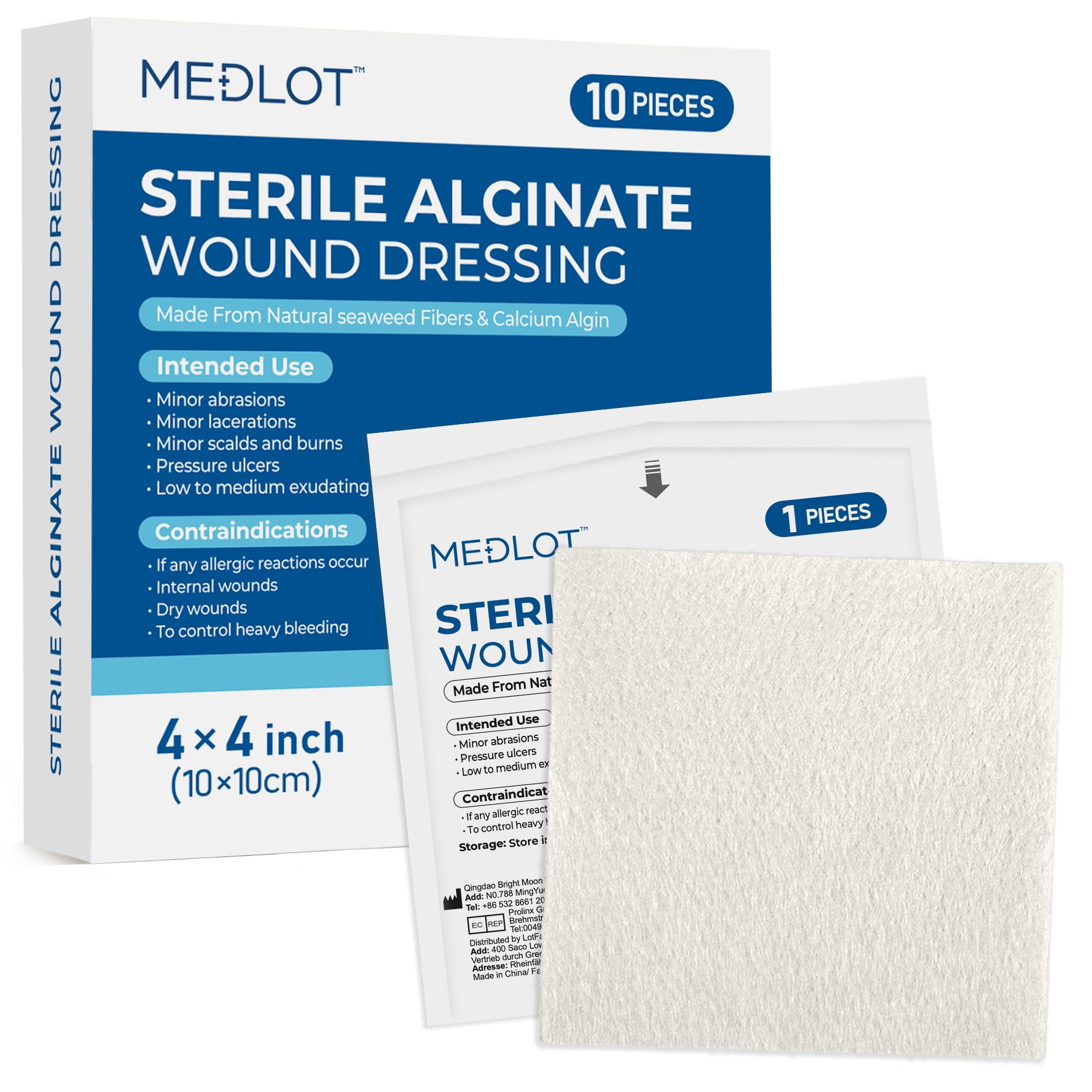
LotFancy’s alginate dressing derives its absorbency from natural seaweed fiber infused with calcium ions. When it contacts wound exudate, the calcium ions initiate a gel-forming reaction that locks fluid inside the fiber matrix rather than letting it spread across the wound bed. This gel-based absorption mechanism is critical for moderate-to-heavy exudate wounds because it prevents maceration of the surrounding healthy skin while keeping the wound environment moist — the ideal condition for cell migration and tissue repair.
At 4″ x 4″ and up to 20 times more absorbent than standard gauze, each pad can stay in place longer between changes, reducing disturbance to newly forming tissue. The non-adherent property means the dressing lifts away cleanly without pulling at granulation tissue, which directly eliminates the pain and trauma associated with dry gauze removal. Customers consistently report fewer dressing changes and less discomfort compared to cotton gauze alternatives.
Each pad is sterile and individually wrapped, making it suitable for clinical use at home. The material is latex-free and conforms to body contours — important for wounds on joints or curved surfaces. Note that branding may show MEDLOT on the packet, but the product is identical to the LotFancy version.
Why it’s great
- Alginate gel locks exudate away from healthy skin, reducing maceration risk
- Pain-free removal because the dressing does not adhere to the wound bed
- Thicker and more absorbent than many medical-supply alternatives at comparable cost
Good to know
- Not intended for dry or low-exudate wounds where it could desiccate the tissue
- Packaging may vary between LotFancy and MEDLOT branding
2. Dimora Silicone Wound Contact Layer
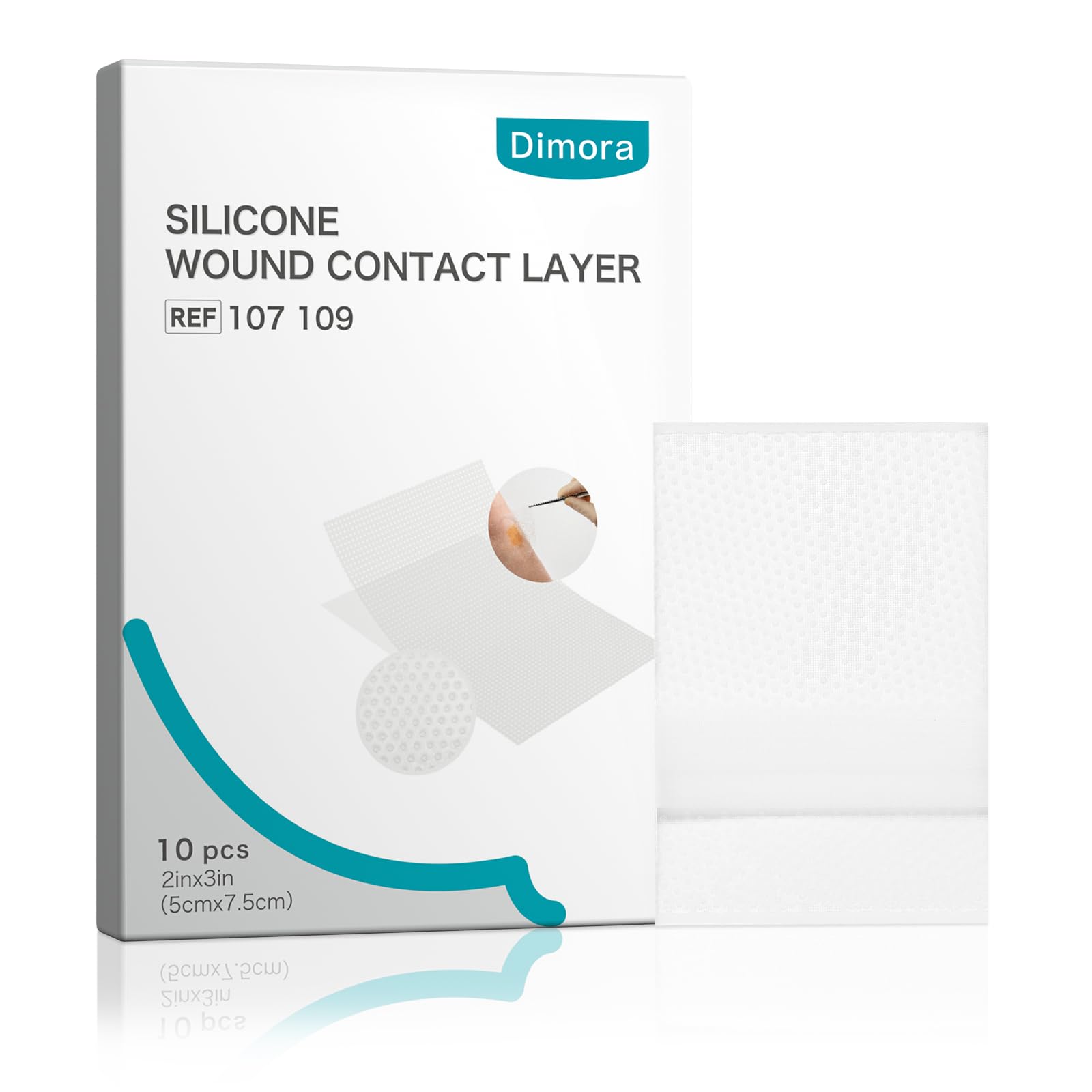
Dimora’s silicone contact layer addresses a specific wound-care challenge: dressings that protect fragile periwound skin while allowing exudate to pass through to a secondary absorbent pad. The thin silicone sheet gently adheres to dry surrounding skin without bonding to the moist wound bed itself. This selective adhesion means the dressing stays in place between changes but lifts off without pulling at new epithelial tissue — a major advantage for chronic wounds, skin tears, or donor graft sites where the surrounding skin is already compromised.
The transparent mesh design lets you monitor the wound through the layer without removing the dressing, reducing unnecessary disturbance during the first 48 to 72 hours. Each 2″ x 3″ sheet is well-suited for small wounds on fingers, toes, elbows, or heels where conformability matters. Users confirm that the layer works well underneath a standard gauze pad or ABD pad as a secondary absorbent, allowing the silicone to handle the contact surface while the secondary layer manages fluid.
One practical detail to note: one side of the sheet has a mild adhesive. For users with highly sensitive skin or known adhesive allergies, patch-testing on intact skin is recommended before applying over an open wound.
Why it’s great
- Non-adherent to the wound bed while staying secure on surrounding skin
- Transparent mesh allows visual inspection without removal
- Flexible enough to conform to small joints and curved body areas
Good to know
- One side has mild adhesive — not ideal for severe adhesive allergies
- Requires a secondary absorbent dressing for moderate-to-heavy exudate
3. McKesson Sterile ABD Pad 8 x 10
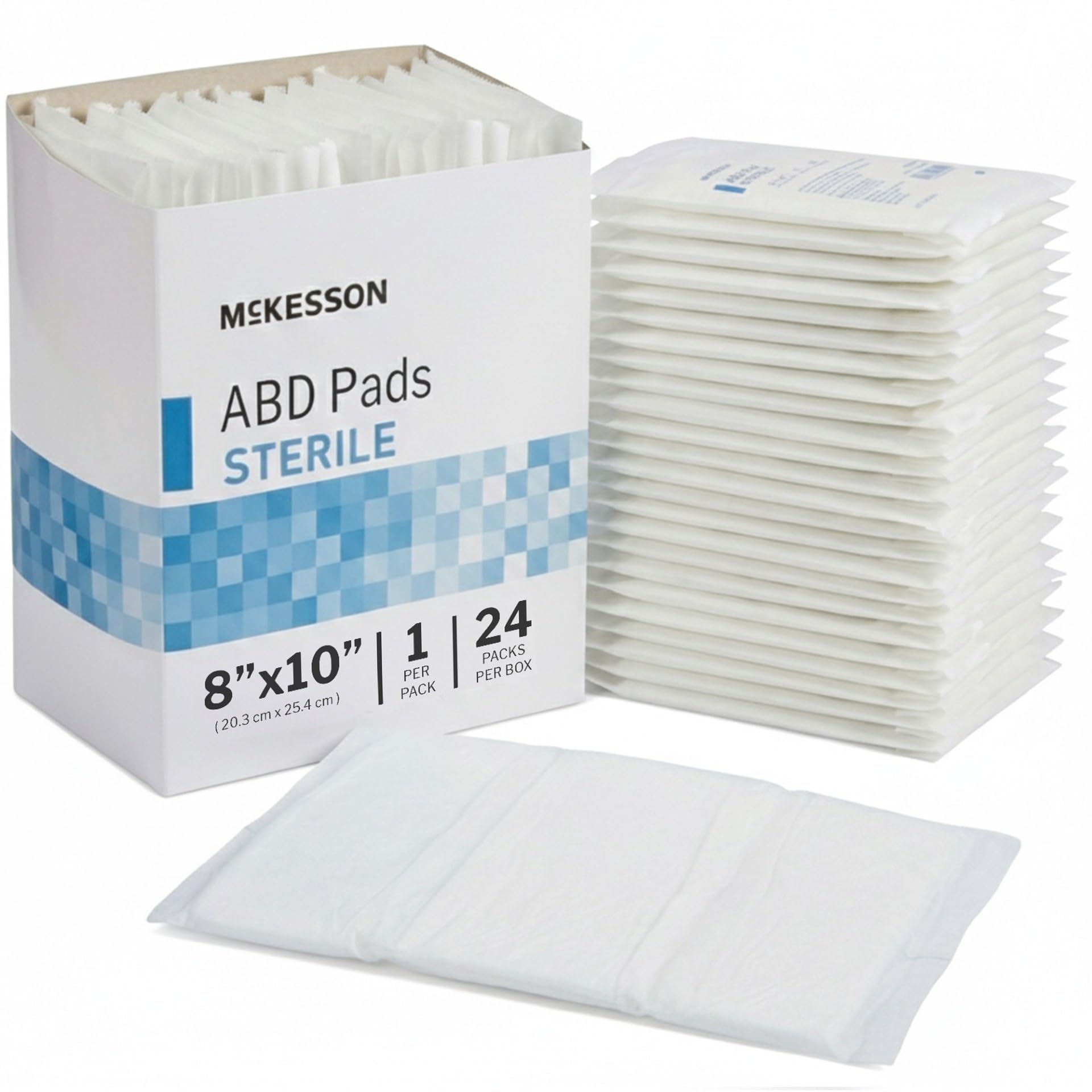
The 8″ x 10″ ABD pad from McKesson is engineered for the heaviest-draining wounds — post-surgical abdominal incisions, deep trauma sites, or dehisced surgical wounds where fluid output is substantial. Its inner cellulose core provides rapid wicking and fluid retention, pulling exudate away from the wound into the core’s capillary network rather than letting it pool at the dressing surface. The sealed-edge design contains fluid within the pad, preventing side leakage that could soil clothing or bedding and create a pathway for bacteria to reach the wound.
The non-woven, lint-free exterior is critical here: any loose fibers from a woven gauze could embed in a deep wound and act as a foreign body, triggering inflammation or infection. This pad eliminates that risk while remaining soft against fragile periwound skin. At over an inch thick when uncompressed, it also provides cushioning — a meaningful feature for incisions under a binder or tape where pressure points could cause discomfort.
Each pad is sterile and individually wrapped, and multiple pads are often needed per change for high-output wounds. The large size also makes it a strong option for covering multiple adjacent dressings or for use as a secondary absorbent over a silicone contact layer or alginate primary dressing.
Why it’s great
- Large surface area with thick cellulose core for heavy drainage
- Sealed edges prevent strike-through and side leakage
- Lint-free construction reduces foreign-body risk in deep wounds
Good to know
- Large size may be excessive for small wounds — stock smaller pads for everyday use
- Not designed to contact the wound bed directly; best over a non-adherent layer
4. General Medi Sterile Gauze Sponges 4×4
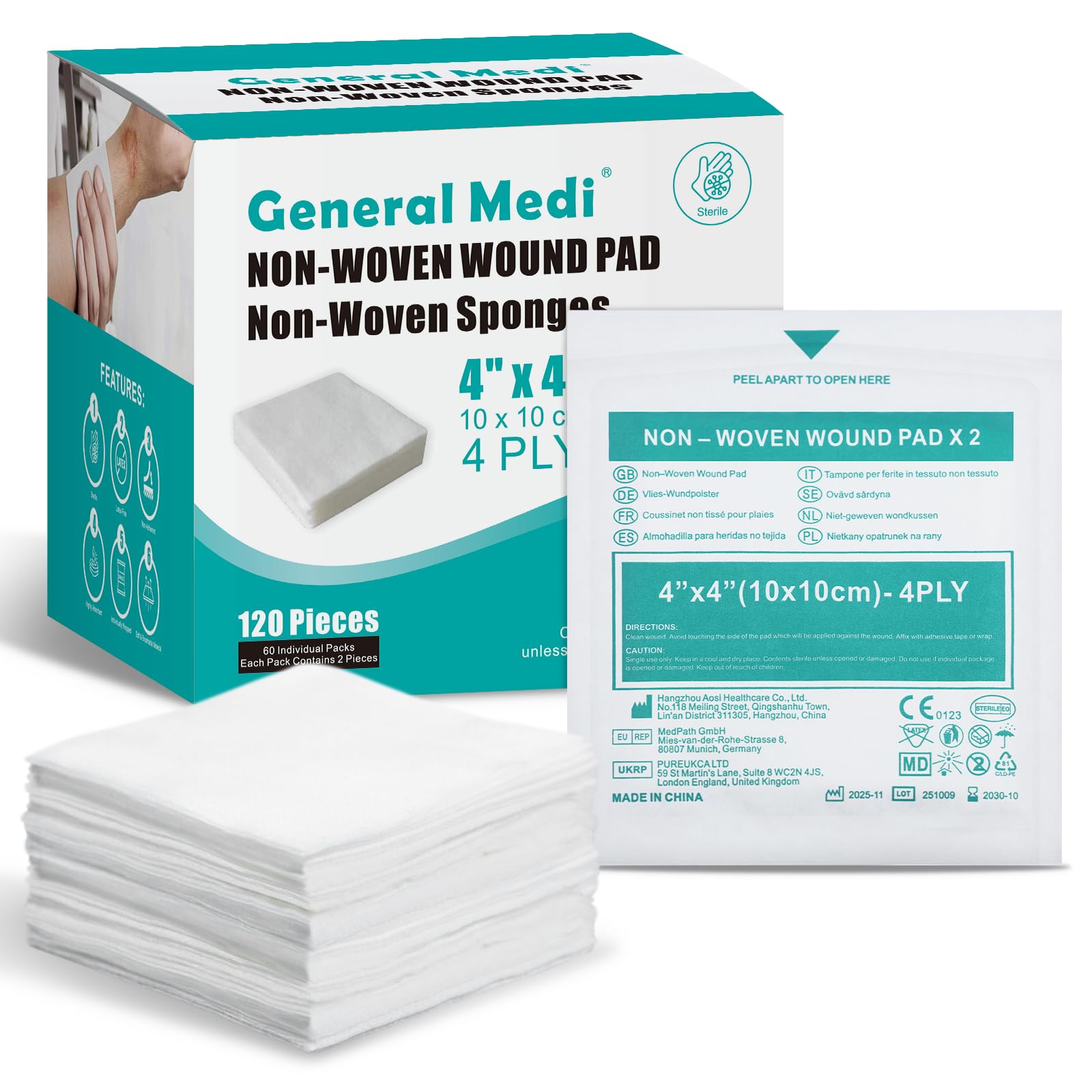
The General Medi gauze sponges deliver the highest piece count in this comparison — 60 individually wrapped packs, each containing two 4″ x 4″ sponges, for a total of 120 sterile dressings. The 4-ply non-woven construction offers better wicking and absorbency than woven gauze while producing no loose lint that could shed into an open wound. This makes them a practical workhorse for daily wound care: cleaning around incisions, cushioning minor cuts, or applying topical ointments with a sterile barrier.
Non-woven material also feels softer against skin than traditional woven cotton gauze, which can feel rough and leave fiber trails. Customers report the sponges are flexible enough to conform to curved body parts without folding awkwardly, and the individual wrapping means you can grab a single sterile pad without exposing the rest to contamination. The 4-ply thickness provides enough absorbency for low-to-moderate exudate wounds — it will handle a draining abrasion or post-op oozing without immediate saturation.
At this volume, the value is strong. However, for a heavily draining wound or a deep cavity wound, the absorbency is moderate compared to alginate or ABD pads. Use these as the primary dressing for simple wounds or as the secondary absorbent layer over a silicone contact layer for wounds that need protection.
Why it’s great
- 120 sterile sponges per order — enough for frequent dressing changes
- Non-woven, lint-free design prevents fiber contamination in wounds
- Softer than woven gauze, reducing irritation on intact skin around the wound
Good to know
- Not designed for heavy exudate; requires frequent changes on draining wounds
- 4-ply may be thick for packing small cavity wounds — a thinner gauze may be needed
5. Vive Care Sterile Gauze Pads 3×3
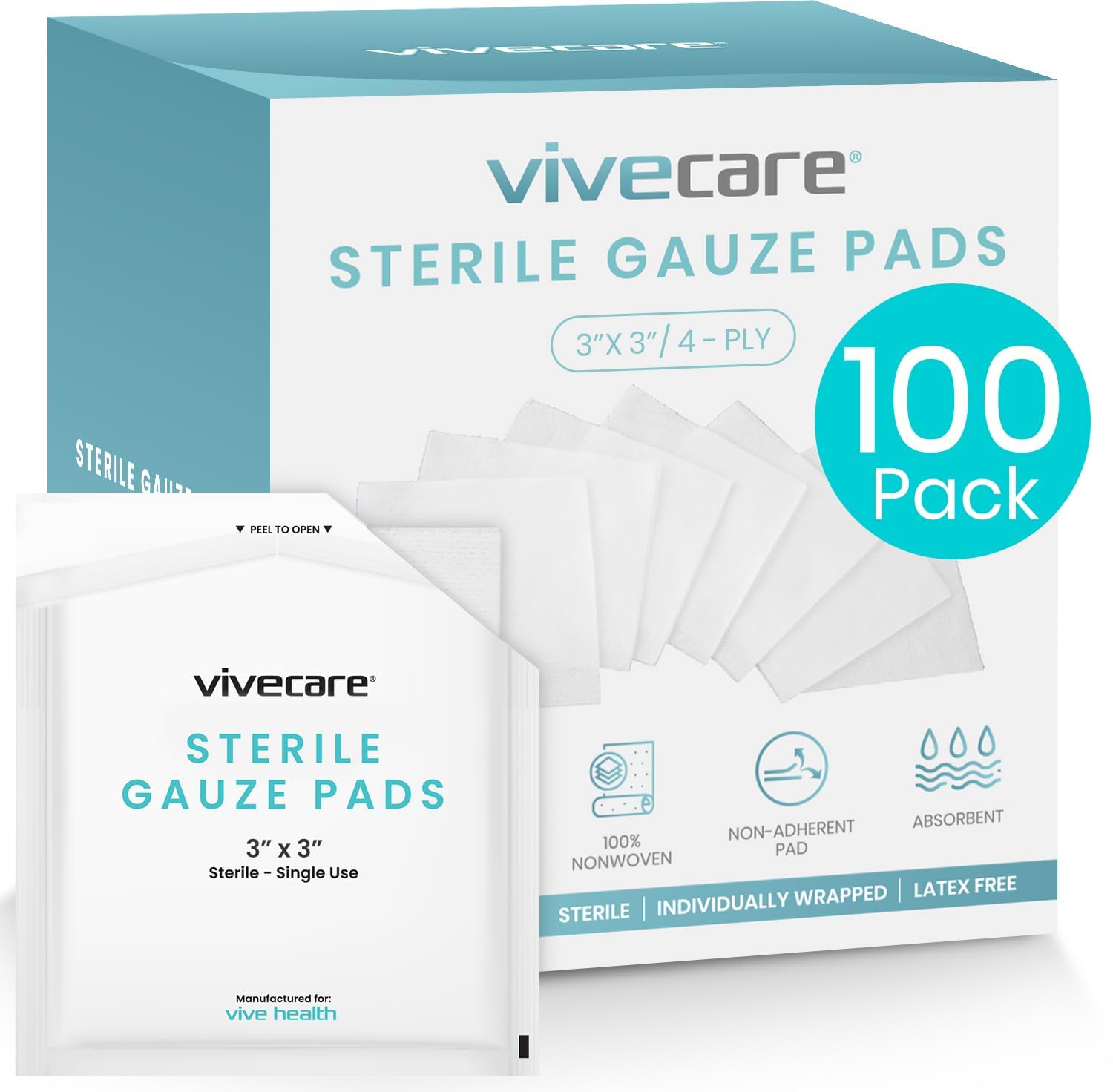
Vive Care’s 3″ x 3″ gauze pads fill a specific niche: compact sterile dressings for smaller wounds where a full 4″ x 4″ pad would be overkill and wasteful. The 4-ply construction uses a cotton blend that provides absorbency sufficient for minor cuts, scrapes, ulcers, and small surgical sites. The 3-inch dimension is particularly useful for finger wounds, pediatric injuries, or facial lacerations where a smaller footprint improves fit and tape application.
Each pack contains two individually wrapped pads, so you get 100 sterile units in total. The non-adhesive design is important here — woven or non-woven pads that are not explicitly non-adherent can still stick to a dry wound bed. Vive Care’s material is soft and latex-free, and users confirm it releases cleanly from healing tissue when saturated. The 3×3 size also fits neatly into a first-aid kit or a small travel pouch without adding bulk.
The trade-off is absorbency volume. At 3″ x 3″ and 4-ply, these pads will saturate quickly on a heavily draining wound. They are best suited for wounds in the low-to-moderate exudate range or as a secondary cover pad over a primary non-adherent dressing. For larger incisions or high-output wounds, the McKesson ABD pad or LotFancy alginate would be more appropriate.
Why it’s great
- Compact 3″ x 3″ size reduces waste on smaller wounds
- Individually wrapped in 2-pad packs, keeping 100 units sterile
- Latex-free and soft enough for facial or pediatric wound care
Good to know
- Small size saturates quickly on moderate-to-heavy exudate wounds
- Cotton blend may leave slight fibers if the wound bed is very dry
FAQ
Can I use regular woven gauze as a dressing for an open wound?
How do I know if my wound needs an alginate dressing versus a silicone contact layer?
How often should I change an open wound dressing?
Final Thoughts: The Verdict
For most users, the dressing for open wound winner is the LotFancy Calcium Alginate because it delivers superior absorbency through its natural gel-forming mechanism, eliminates pain during changes, and suits the widest range of moderate-to-heavy draining wounds. If you want gentle, pain-free removal for fragile skin, grab the Dimora Silicone Contact Layer. And for large post-surgical coverage or heavy drainage, nothing beats the McKesson Sterile ABD Pad.

Mo Maruf
I created WellFizz to bridge the gap between vague wellness advice and actionable solutions. My mission is simple: to decode the research and give you practical tools you can actually use.
Beyond the data, I am a passionate traveler. I believe that stepping away from the screen to explore new environments is essential for mental clarity and physical vitality.