Our readers keep the lights on and my smoothie glass nicely filled. As an Amazon Associate, I earn from qualifying purchases.
Watching your dog’s paw scrape along the pavement on every step is more than distressing—it’s a sign that the nerves and muscles responsible for lifting the foot are struggling. Dog boots designed for knuckling go beyond simple paw protection to actually lift the toes off the ground, restoring a more natural gait and preventing painful abrasions. Whether caused by degenerative myelopathy, IVDD, a spinal injury, or simple old age, the right corrective boot can make the difference between a dog that shuffles and one that walks with confidence again.
I’m Mohammad Maruf — the founder and writer behind WellFizz. I’ve spent hundreds of hours analyzing veterinary rehabilitation devices, studying material science in canine orthopedic gear, and cross-referencing customer results with real clinical outcomes to find which boots actually solve the toe-drag problem.
After weeks of research into dozens of models, I’ve narrowed the field to the six most effective options. This guide delivers everything you need to confidently choose the best dog boots for knuckling for your dog’s specific condition and activity level.
How To Choose The Best Dog Boots For Knuckling
Selecting a knuckling boot isn’t like buying a winter paw protector. You need a device that actively lifts the toe, stays put during movement, and doesn’t irritate the skin or interfere with the dog’s balance. The three factors below are non-negotiable.
Toe Lift Mechanism vs. Simple Boot Coverage
A standard boot that just wraps the paw does nothing for knuckling—the toes will still fold under and scrape. Look for a design that includes an integrated strap, paracord, or rigid toe cradle that physically elevates the front of the paw and holds it at a neutral walking angle. The lift point must be located above the carpal or tarsal joint for effective correction.
Strap Security and Material Durability
The strap system is the most common failure point. Velcro that loses grip, elastic that stretches out, or buckle straps that break after two weeks render the boot useless. Prioritize boots with reinforced webbing, hook-and-loop that extends the full width of the strap, and non-stretch paracord or webbing for the toe lift line. Rubber sole integrity matters too—thin rubber splits quickly on asphalt.
Measurement Accuracy and Fit Precision
Knuckling boots fail more often from bad sizing than from bad design. Measure the paw width and length with the dog standing and bearing weight—a flopped paw reads shorter than a loaded one. Also measure the circumference of the leg just above the joint where the anchor strap sits. Too loose and the boot slides down; too tight and circulation is compromised. Check the manufacturer’s sizing chart against these three numbers, not just breed or weight.
Quick Comparison
On smaller screens, swipe sideways to see the full table.
| Model | Category | Best For | Key Spec | Amazon |
|---|---|---|---|---|
| Walkabout Toe’sUP | Premium Boot | All-terrain daily use with paracord lift | Rubber sole with fleece lining | Amazon |
| Ortocanis Proprioceptive Support | Premium Sock | Neurological rehabilitation without bulk | Nylon material, 11.5-14 cm length | Amazon |
| HAGGEMI Strap-On Drop Foot Brace | Mid-Range Boot | Senior dogs needing immediate toe lift | Neoprene/polyester, adjustable straps | Amazon |
| Walkin’ Pets Front No-Knuckling Sock | Training Sock | Front paw proprioception training, 15-25 lbs | Neoprene with fleece pad, 2.25 in | Amazon |
| Idepet Dog Drop Foot Brace | Budget Brace | Entry-level corrective boot for medium breeds | Fabric & rubber, buckle closure | Amazon |
| Walkin’ Pets Rear No-Knuckling Sock | Training Sock | Rear paw proprioception, up to 15 lbs | Neoprene with fleece pad, 3 in | Amazon |
In‑Depth Reviews
1. Walkabout Toe’sUP No Knuckling Boot Brace
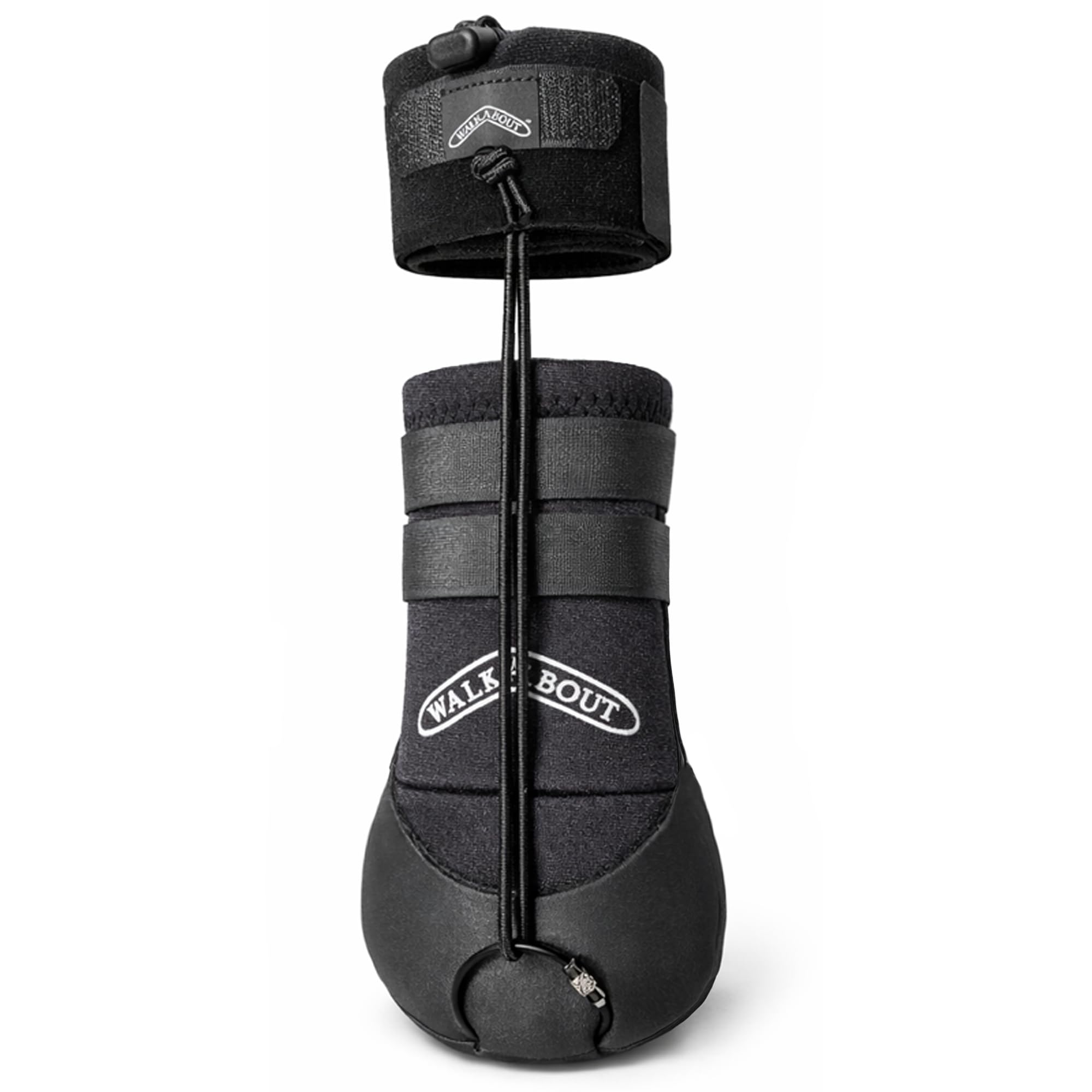
The Walkabout Toe’sUP uses a 2-in-1 boot-and-paracord system that cradles the paw without splitting the toes—a critical detail for dogs with sensitive interdigital skin. The anchor strap sits above the bootstrap to prevent slippage on front paws, and the supportive rubber sole combined with a fleece inner lining protects the paw on concrete, asphalt, and gravel. Users report that the boot stays in place during walks and keeps the foot correctly positioned even on dogs with degenerative myelopathy.
Durability is the main trade-off. The rubber sole can split after roughly four to six weeks of daily use, especially on heavy dogs walking half a mile or more per day. The elastic components also lose tension over time, and some users mention that the boot slides down the leg if not anchored perfectly above the carpal joint. That said, no other model in this tier offers the same combination of all-terrain traction and a secure, non-splitting toe lift.
Veterinarians frequently recommend the Toe’sUP for dogs recovering from spinal surgery or managing chronic IVDD because the adjustable paracord allows caregivers to dial in the exact lift angle. For owners willing to replace the boot every two months or apply a duct-tube reinforcement, this is the most effective on-the-market solution for moderate to severe knuckling.
Why it’s great
- Paracord lift mechanism keeps toes elevated without splitting them
- All-terrain rubber sole with fleece lining provides traction and comfort
- Adjustable anchor strap with bootstrap prevents slippage during movement
Good to know
- Rubber sole and elastic components wear out after 4–6 weeks of daily use
- Requires precise sizing; incorrect sizing leads to sliding or poor lift
- Premium pricing means higher long-term cost if frequent replacement is needed
2. Ortocanis Proprioceptive Support for Dogs

Made in Barcelona, the Ortocanis brace is more of a proprioceptive training tool than a heavy-duty walking boot. It wraps around the dog’s tarsus and uses a padded toe support area to stimulate nerve feedback so the dog instinctively lifts the paw higher. This design is especially effective for dogs with mild to moderate knuckling caused by sciatic nerve damage, degenerative myelopathies, or herniated discs where the brain still receives partial signals from the limb.
The nylon hook-and-loop closure allows for a snug fit around the lower leg, and the open-toe design means the dog’s pads remain in direct contact with the ground—essential for maintaining sensory input. Sizing must be precise: the medium fits paw lengths of 11.5–14 cm, but some users with very small dogs report the toe lift portion is proportioned for much larger paws. Gradual introduction starting with 15-minute sessions is recommended to avoid interdigital irritation.
Where this brace falls short is in structural protection. It does not shield the paw from abrasion if the dog still drags the toes on concrete; it relies on the dog correcting its own gait. For dogs with profound neurologic weakness where the paw has zero active lift, the Ortocanis may not provide enough mechanical elevation. It works best as a rehabilitation aid used alongside controlled exercise and professional therapy.
Why it’s great
- Stimulates proprioception for natural gait correction without heavy hardware
- Open-toe design maintains ground contact for sensory feedback
- Lightweight nylon construction with hook-and-loop adjustment
Good to know
- Not a mechanical toe lift—requires some active motor function to work
- Toe support pad may be oversized for very small breeds like Chihuahuas
- Does not protect against paw abrasion if the dog continues to drag
3. HAGGEMI Strap-On Drop Foot Brace
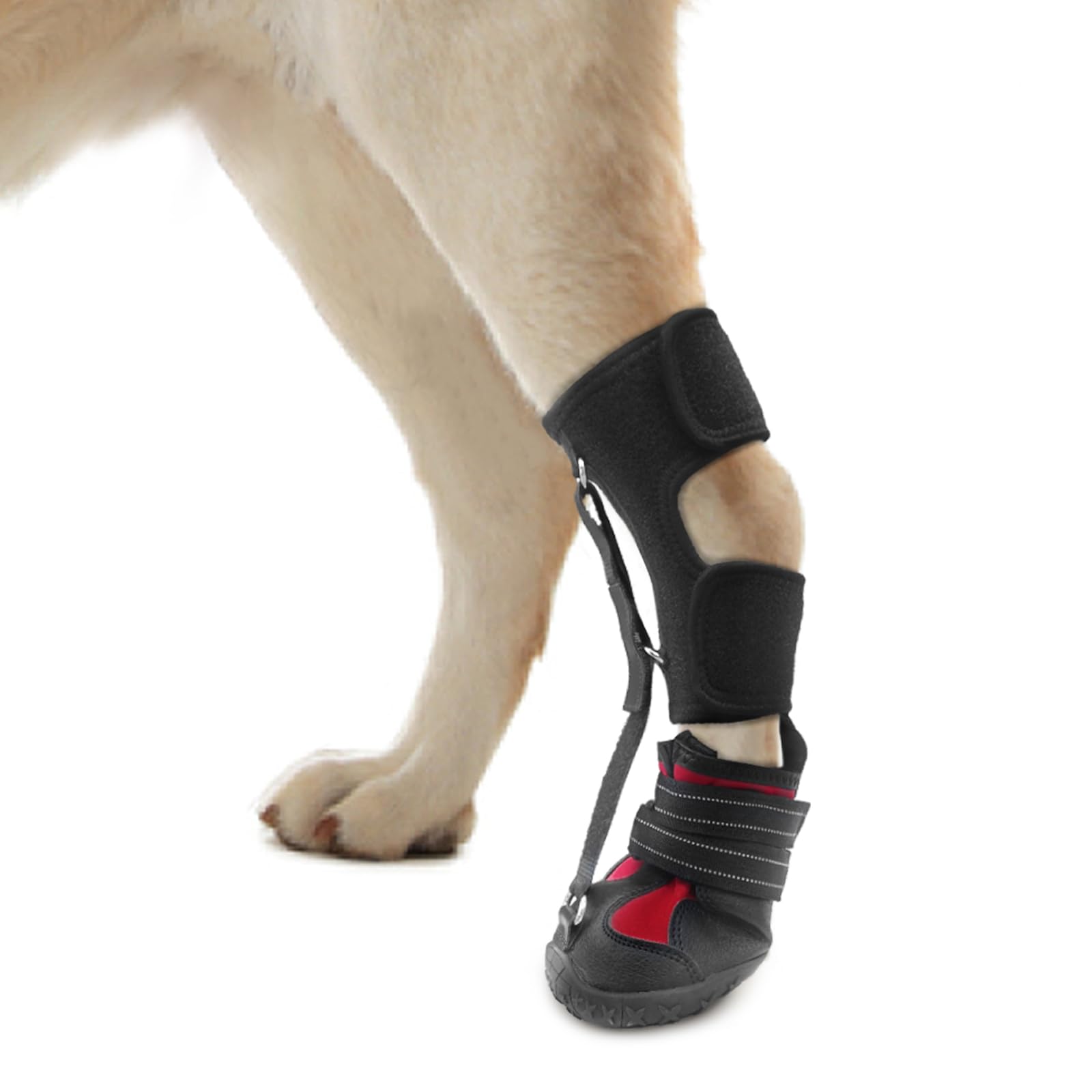
The HAGGEMI brace uses a strap-on boot design with adjustable webbing that lifts the toe from above the carpal or tarsal joint. Users consistently report that a 16-year-old dog with severe knuckling shows immediate improvement in paw placement and stops losing fur from dragging. The rubber bottom provides noticeable grip on concrete, which gives the dog more confidence to push off during the walk cycle.
Constructed from neoprene, polyester, and spandex, the boot is comfortable enough that most dogs adjust within minutes. The reflective lacing adds a safety layer for low-light walks. Durability is the weak link: the front strap has been reported to break after about two weeks of use on larger, more active dogs, and some users report the Velcro on the leg attachment loses grip during walks, especially on dogs with fluffy legs.
For senior dogs with mild to moderate knuckling that walk short distances indoors and on concrete, this brace delivers excellent value. The breakage issues are real, but many owners find they can reinforce the strap with a stitch or replace the Velcro with a stronger aftermarket strip. It is not ideal for high-energy dogs that pull hard or cover long daily mileage.
Why it’s great
- Immediate toe lift correction for senior dogs with knuckling
- Rubber sole offers dependable traction on pavement and concrete
- Neoprene build is comfortable and adjusts quickly
Good to know
- Front strap may break within two weeks on active or larger dogs
- Velcro leg attachment can slip on fluffy or narrow legs
- Not designed for extended daily mileage or heavy pulling
4. Walkin’ Pets Front No-Knuckling Training Sock

The Walkin’ Pets Front No-Knuckling Training Sock is a lightweight neoprene sleeve with a fleece pad under the toes and a toe cord that provides gentle upward tension. Designed for dogs weighing 15–25 lbs with a measurement of up to 2.25 inches from the paw to the carpal joint, this sock functions primarily as a proprioceptive training aid. It encourages the dog to self-correct paw placement rather than mechanically forcing the toe up.
The sock works well for mild front-paw knuckling, especially in dogs with degenerative myelopathy or recovering from spinal surgery. Several users report that after a few weeks of consistent wear, their dogs no longer needed the sock at all—the gait correction persisted. The neoprene material is breathable and machine-washable, which is helpful for dogs that drool or step in mud.
The main limitation is that the string tension can become stretchy after repeated use, causing the sock to slide down the leg. It also does not provide any sole protection, so dogs that still drag their toes on rough surfaces will wear through the fleece pad and may still abrade the paw. For dogs that need more than light tactile feedback, a boot with a rigid sole is a better fit.
Why it’s great
- Lightweight neoprene with fleece toe pad for comfortable training
- Machine-washable for easy hygiene maintenance
- Can produce lasting gait correction after a few weeks of use
Good to know
- Toe cord stretches over time, reducing lift effectiveness
- No sole protection—paw can still abrade on rough surfaces
- Best suited for mild knuckling, not severe dragging
5. Idepet Dog Drop Foot Brace Strap On
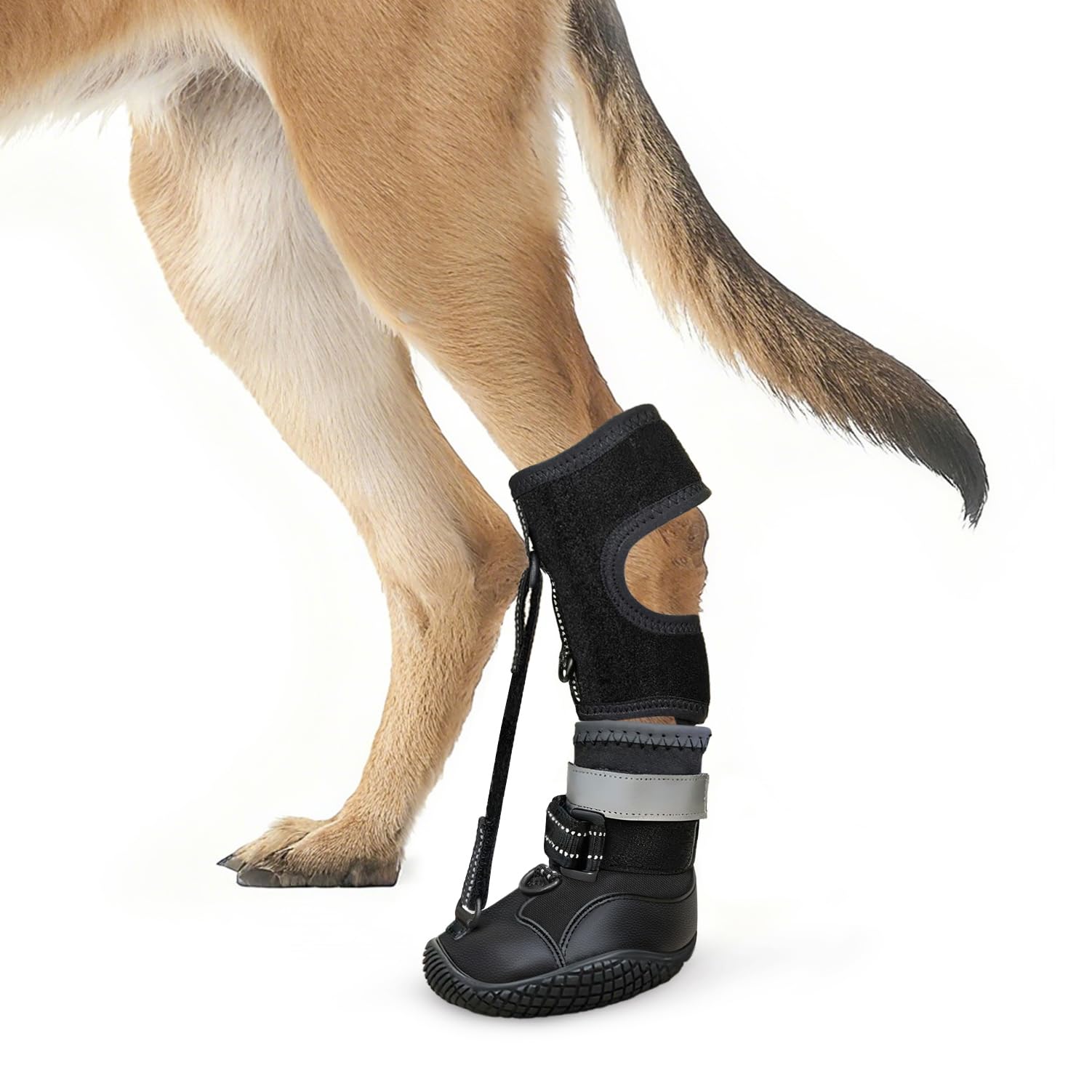
The Idepet brace uses a buckle closure system paired with a fabric-and-rubber boot to provide a basic toe lift for dogs with knuckling. The adjustable straps are designed to deliver enough lift to prevent the paw from folding under without restricting the dog’s natural range of motion. The non-slip rubber sole adds stability, and reflective strap material improves visibility on evening walks.
For a 14-year-old German Shepherd with age-related knuckling, this brace allowed walking without hurting the knuckles—a result many owners achieve with products costing much more. The included 2-year manufacturer warranty is a standout feature at this price tier, offering some peace of mind. However, quality control is inconsistent: some units arrive with Velcro that fails within hours, and the front strap stitching can pull loose after minimal use.
This brace is best suited as an entry-level trial device for owners unsure whether a knuckling boot will work for their dog. If the brace proves effective but the strap fails, owners can upgrade to a more robust model with confidence. The lack of printed instructions is a notable inconvenience, and the sizing starts at Size 4, meaning very small dogs may not fit.
Why it’s great
- Buckle closure provides a secure hold that some Velcro models lack
- Non-slip rubber sole with reflective straps aids safe outdoor use
- 2-year manufacturer warranty offers extra value at a entry-level price
Good to know
- Inconsistent quality control—some units have strap failure within hours
- No printed instructions included, making proper fitting harder
- Smallest size (Size 4) still too large for very small or toy breeds
6. Walkin’ Pets Rear No-Knuckling Training Sock

The Walkin’ Pets Rear No-Knuckling Training Sock targets hind-paw knuckling specifically, designed for dogs up to 15 lbs with a hock-to-paw measurement of up to 3 inches. The pull-on neoprene sleeve incorporates an extra fleece pad under the toes and a toe cord that provides gentle lift. It is intended as a temporary training tool to enhance proprioception and encourage the dog to pick up the rear feet.
Users with a 95 lb lab-shepherd mix reported significant gait improvement after just five uses—the dog lifted its foot properly and could walk longer distances. The sock works well for mild to moderate hind-end knuckling, especially when used consistently during short walks or therapy sessions. The neoprene is light and durable, and the entire sock is machine-washable.
The main drawbacks are that the fleece cushion pad shows visible wear after about a week of daily use, and the bungee lock system can slide through the Velcro channel, requiring modification. Some users with fluffy breeds report that the hook-and-loop fasteners stick to the fur rather than the loop material, reducing hold. For severe knuckling where the rear paw curls under completely, this sock may not provide enough mechanical lift.
Why it’s great
- Designed specifically for rear paw knuckling with targeted strap geometry
- Lightweight neoprene construction is comfortable and machine-washable
- Users report noticeable gait improvement after just a few sessions
Good to know
- Fleece pad wears out quickly—may need replacement within a week
- Bungee lock can slide through the Velcro channel, needing user modification
- Hook-and-loop fasteners may snag on fluffy fur rather than secure
FAQ
Can my dog wear a knuckling boot all day?
How do I stop the boot from sliding down the leg?
Will a knuckling boot cure my dog’s neurological condition?
What’s the difference between a training sock and a brace boot?
Final Thoughts: The Verdict
For most users, the dog boots for knuckling winner is the Walkabout Toe’sUP because the paracord lift mechanism and all-terrain sole provide the most reliable toe elevation across different surfaces and conditions. If you want a non-boot option that stimulates natural gait correction for mild knuckling, grab the Ortocanis Proprioceptive Support. And for an immediate budget-friendly trial to see if a corrective boot improves your dog’s mobility, nothing beats the Idepet Dog Drop Foot Brace.

Mo Maruf
I created WellFizz to bridge the gap between vague wellness advice and actionable solutions. My mission is simple: to decode the research and give you practical tools you can actually use.
Beyond the data, I am a passionate traveler. I believe that stepping away from the screen to explore new environments is essential for mental clarity and physical vitality.