Our readers keep the lights on and my smoothie glass nicely filled. As an Amazon Associate, I earn from qualifying purchases.
Turning stacks of receipts, family photos, and legal documents into organized digital files used to mean fighting with a bulky flatbed all-in-one. The category has split: portable sheet-feds for speed, overhead book scanners for bound pages, and duplex workhorses that clear an ADF tray in under two minutes. Choosing wrong means either crushing delicate photos or spending hours feeding paper one sheet at a time.
I’m Mohammad Maruf — the founder and writer behind WellFizz. This guide comes from cross-referencing optical sensor types, rated daily duty cycles, and real-world duplex failure rates across nine models that span the to research zone.
Whether you are archiving a lifetime of Polaroids or digitizing a quarterly stack of invoices, the best document photo scanner needs to balance resolution, paper path design, and software that does not fight you. This breakdown covers the concrete specs that separate a usable scanner from a drawer-filling regret.
How To Choose The Best Document Photo Scanner
Nine models sound like a lot until you realize each one prioritizes a different trade-off: portability versus ADF capacity, photo-safe rollers versus OCR speed, or curved-book flattening versus simplex simplicity. Nail these three factors first and the right choice becomes obvious.
Sensor Technology: CIS vs CCD
CIS (Contact Image Sensor) scanners are thinner, draw less power, and start up instantly — ideal for portable USB-powered models. CCD (Charge-Coupled Device) sensors capture better depth of field and truer color, which matters for photos with texture or slight curvature. If most of your work is flat documents under 600 dpi, CIS is fine. For archival photo work at higher bit depths, CCD justifies the extra weight and cost.
Paper Path and Media Handling
A straight paper path with a direct manual feed slot handles thick or delicate items (creased receipts, Polaroids, laminated cards) without jamming. U-turn paper paths common in ultra-compact models can catch dog-eared pages. Auto Document Feeder (ADF) capacity from 20 sheets to 100 sheets determines batch size. The front manual feeder on models like the ScanSnap iX1300 lets you slip in a single photo without clearing the ADF tray — a feature worth paying for if you mix document batches with odd-sized items.
Software Ecosystem and OCR Quality
Hardware is only half the equation. Scanners bundle everything from bare TWAIN drivers to full suites that auto-name files, detect blank pages, and convert to searchable PDF. Doxie’s smart routing and ScanSnap Home are gold standards for document organization. CZUR’s software includes AI page-flattening and 180+ language OCR. If the bundled software requires online registration or insists on proprietary file formats, check that you can also output standard JPEG, PDF, or searchable PDF without friction.
Quick Comparison
On smaller screens, swipe sideways to see the full table.
| Model | Category | Best For | Key Spec | Amazon |
|---|---|---|---|---|
| ScanSnap iX1300 | Duplex Wireless | Mixed document + photo batches | 30 ppm duplex, 600 dpi. | Amazon |
| Canon imageFORMULA RS40 | Photo Specialist | Batch photo archiving | 40 ipm, 600 dpi, RGB LED. | Amazon |
| Epson ES-580W | High-Volume Office | Heavy daily document workflows | 35 ppm, 100-sheet ADF, 4.3″ touch. | Amazon |
| Epson ES-500W II | Wireless Duplex | Mobile notary and small office | 35 ppm, 50-sheet ADF, Wi-Fi. | Amazon |
| Brother ADS-3100 | Workgroup Speed | High-speed single-user office | 40 ppm, 60-sheet ADF, USB 3.0. | Amazon |
| CZUR Aura Pro | Book & Overhead | Curved book and bound document | 4320×3240, AI page flatten. | Amazon |
| Doxie Pro | Duplex Compact | Home office and receipt digitizing | Auto-duplex, 20-sheet ADF, USB. | Amazon |
| HP PS100 | Budget Portable | Light travel scanning | 15 ppm simplex, 300 dpi. | Amazon |
| Plustek S410 Plus | Ultra-Compact | Bus-powered personal digitizing | 600 dpi, <1 lb, button-free. | Amazon |
In‑Depth Reviews
1. ScanSnap iX1300

The iX1300 earned its reputation by shrinking a reliable duplex scanner into a space-saving chassis that works both USB-tethered and over Wi-Fi. Its 20-sheet ADF handles mixed sizes — receipts, legal documents, and plastic cards — without the constant paper-jam anxiety that plagues cheaper sheet-feds. The front manual feed slot is the killer feature: you can slide in a single photo or a torn receipt without clearing the main tray.
Scan quality at 600 dpi is crisp for both text OCR and 4×6 color photos. The bundled ScanSnap Home software auto-names files, detects blank pages, and lets you drag-drop scans directly into Dropbox or Evernote. Setup on Mac and PC is genuinely plug-and-play, and the lack of driver configuration will save you a headache on day one.
The trade-off is a 20-sheet ADF that feels small for large archiving projects. Users who scanned hundreds of photos reported needing to clean the sensor after about a week of heavy use. The iX1300 also cannot scan above 600 dpi interpolated, so if you need 1200 dpi for tiny text or fine art prints, step up to a higher-resolution CCD model.
Why it’s great
- Front manual feeder handles odd-sized items without clearing ADF
- Reliable Wi-Fi connectivity and intuitive ScanSnap Home software
- Space-saving design with 30 ppm duplex speed
Good to know
- ADF capacity is only 20 sheets, limiting big batch jobs
- Sensor may need periodic cleaning with heavy photo use
- Setup software can take up to 4 days of troubleshooting in rare cases
2. Canon imageFORMULA RS40

Canon designed the RS40 specifically for people drowning in paper photos. Unlike general-purpose document scanners, this model uses an RGB LED light source that illuminates photographic paper evenly, reducing the glare and shadow that plague CIS-based photo scanning. It handles Polaroids, 4×6 prints, and business cards through a dedicated photo-feeder path that minimizes roller marks on glossy surfaces.
The bundled software includes red-eye correction and digital face smoothing — features you rarely see outside dedicated photo scanners. At 40 images per minute duplex, you can clear a shoebox of 4×6 prints in under 15 minutes. The RS40 also scans documents up to legal size, so it doubles as a fast office scanner when needed.
The downsides surfaced in long-session use: the feeder can misalign mixed-size stacks, and after roughly 800 scans a temp file bug can fill your C: drive if not manually cleared. A few users reported that dust on the roller caused streaks about every ten photos, requiring a quick wipe. The photo enhancement software also has a learning curve that steeper than ScanSnap Home.
Why it’s great
- RGB LED light source delivers superior photo color accuracy
- 40 ipm duplex speed makes batch photo archiving fast
- Bundled photo enhancement tools (red-eye, face smoothing)
Good to know
- Feeder can jam when mixing different photo sizes in one stack
- Dust buildup on roller requires frequent cleaning during heavy sessions
- Temp file bug can crash the app after ~800 scans without manual cleanup
3. Epson WorkForce ES-580W
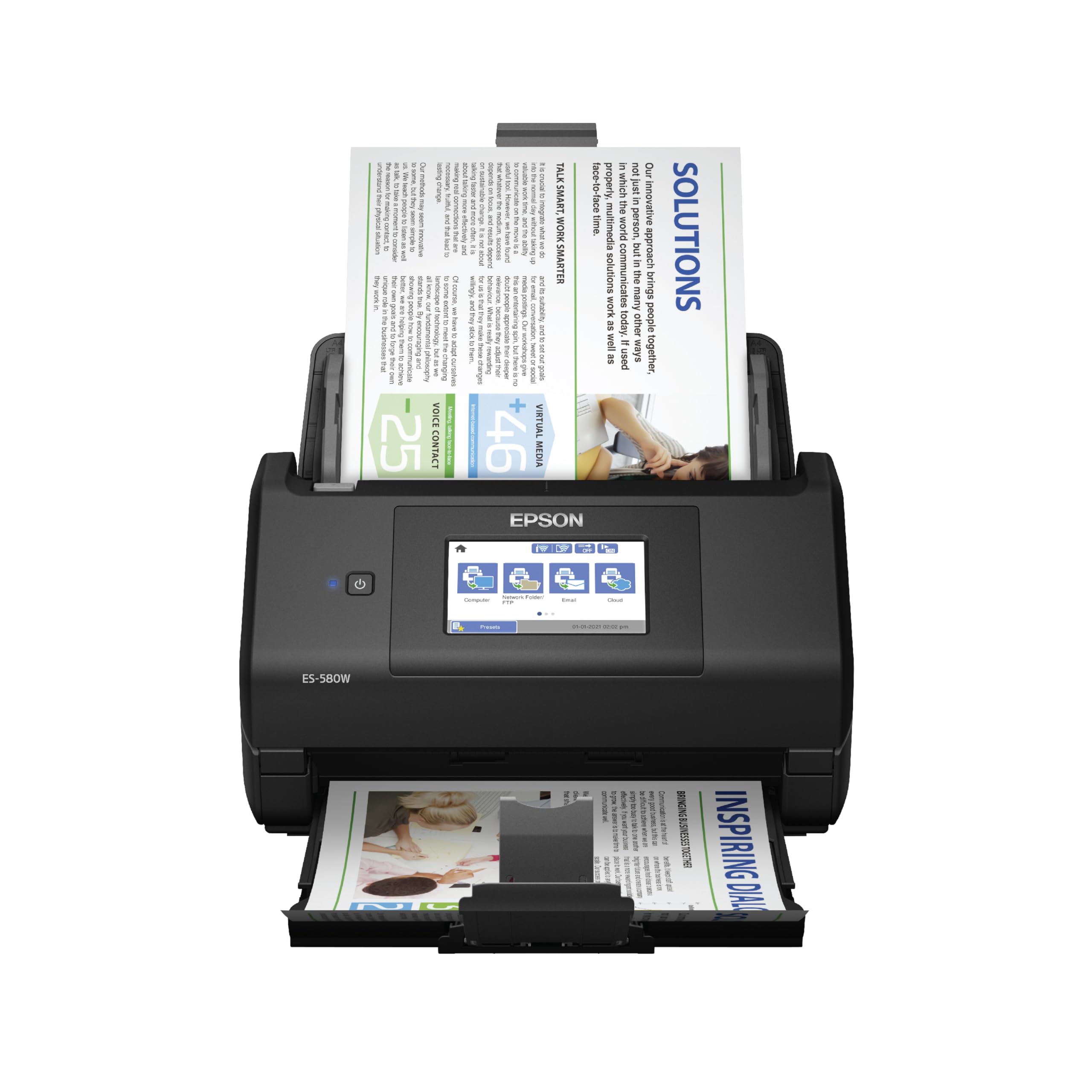
The ES-580W is built for environments where scanning never stops — a notary office, a small legal practice, or any desk that processes hundreds of pages weekly. Its 100-sheet auto document feeder is the largest in this roundup, and the 4.3-inch color touchscreen lets you select scan destinations and presets without touching a computer. This model uses a CCD sensor, giving it better depth of field for slightly curled or thick documents than CIS-based rivals.
Wireless scanning works reliably once the initial network setup is completed. You can scan directly to email, cloud services (Dropbox, Google Drive, OneDrive), or a USB drive without a PC. The single-pass duplex captures both sides at 35 ppm, and Epson’s image processing auto-crops, deskews, and removes blank pages. The included TWAIN driver integrates with most document management software including medical EMR systems.
The main compromises are the lack of an Ethernet port — you are limited to USB or Wi-Fi — and a footprint that is larger than any portable model. A handful of users reported initial setup required multiple re-installs, especially when switching between WiFi and USB modes. At its price point, this is a dedicated office machine, not a casual home scanner.
Why it’s great
- 100-sheet ADF handles the biggest batch jobs without reloading
- CCD sensor delivers superior scan depth for thick or curled originals
- Touchscreen and wireless allow PC-free scanning to cloud or USB
Good to know
- No Ethernet port; relies solely on USB and Wi-Fi
- Initial network setup can be finicky and require repeated installs
- Larger footprint than portable or compact models
4. Epson WorkForce ES-500W II
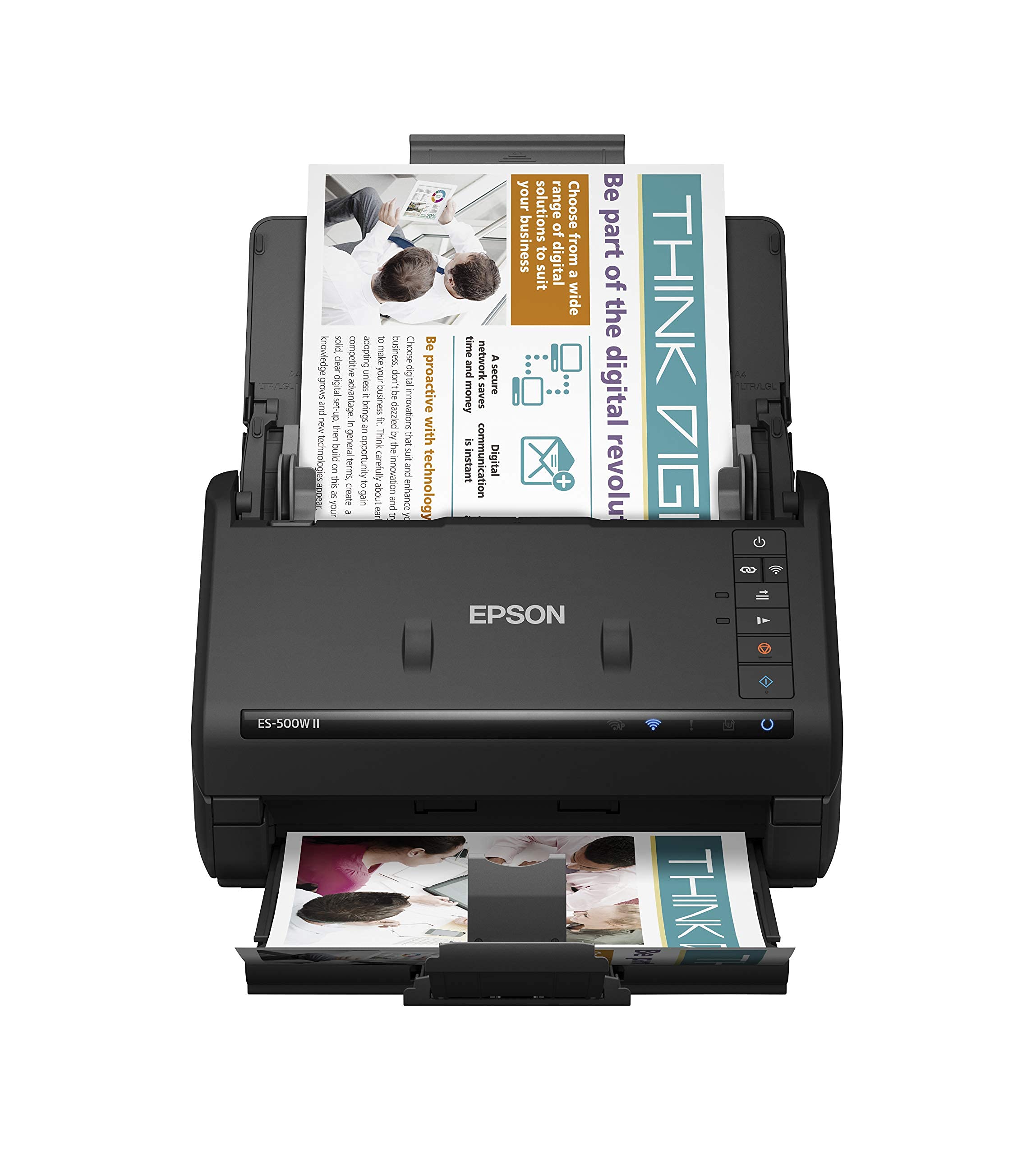
The ES-500W II strips out the touchscreen and larger ADF of its ES-580W sibling while keeping the same CCD sensor and 35 ppm duplex speed. That makes it a smart pick for users who want professional-grade image quality — especially for photos with texture or embossing — without paying for a color display. Ultrasonic double-feed detection catches stapled or stuck-together pages before they become jams, a feature that justifies the price jump over budget models.
The 50-sheet ADF is a practical middle ground: big enough to scan a small file folder in one go, small enough to fit on a shelf. Epson ScanSmart software provides auto-crop, background removal, and blank page skip. Wireless connectivity to smartphones and tablets via the Epson Smart Panel app works smoothly after the initial pairing. Users scanning extra-long documents (up to 240 inches) will appreciate the continuous feed capability.
Setup can be a pain point — the box lacks printed instructions, and switching between Wi-Fi and USB modes requires a full driver reinstall. A few users reported memory overflow when scanning legal-size documents in color at high resolution, though a later driver update addressed the problem. The 8.1-pound weight also makes this a desktop anchor, not a travel companion.
Why it’s great
- CCD sensor captures deeper detail than CIS for photos and thick documents
- Ultrasonic double-feed detection prevents skipped pages and staple damage
- Extends to 240-inch long-page scanning for banners and blueprints
Good to know
- Switching between Wi-Fi and USB requires a full driver reinstall
- No printed setup guide included; relies on online manual
- Legal-size high-res scans can trigger memory overflow without driver update
5. Brother ADS-3100

Brother’s ADS-3100 is a no-nonsense desktop scanner that prioritizes straight-line paper handling and raw speed. At 40 ppm duplex, it outpaces every other model in this roundup for sheer page throughput. The 60-sheet ADF handles business cards, ID cards, receipts, and plain paper, and the scanner intelligently skips blank pages — a small time-saver that adds up over large batches.
The USB 3.0 connectivity ensures that even high-resolution scans transfer without bottlenecking. The bundled software includes seven applications covering optical character recognition, document management, and workflow customization. Triple-layer security features help protect sensitive documents in healthcare or legal settings by securing connections and devices.
The biggest complaint involves page-feeding reliability: some units pull multiple pages at once, causing missed content. Brother’s support was described as unhelpful for this issue. The driver selection page is also confusing — the correct driver is not obvious, and the printed instructions lack clear guidance. For problem-free units, the ADS-3100 is a fantastic speed machine; defective units are a headache.
Why it’s great
- Fastest duplex speed in the roundup at 40 ppm
- 60-sheet ADF and blank page skip improve batch productivity
- USB 3.0 ensures fast transfer at high resolutions
Good to know
- Some units exhibit page-feeding issues with multi-page pulls
- Driver selection online is confusing; printed manual lacks clarity
- Customer support was unhelpful for feeding-related defects
6. CZUR Aura Pro

The CZUR Aura Pro breaks the sheet-fed mold by using an overhead camera system rather than rollers. This design is ideal for scanning bound books, magazines, and delicate documents that a feeder would destroy. The 32-LED array plus two supplemental side lights eliminates shadows and glare. AI-powered auto-flattening uses three laser lines to correct page curvature, producing results that look like they came from a flatbed — without pressing the spine down.
Speed is the real standout: the Aura Pro captures a spread in roughly two seconds, making it about ten times faster than a flatbed for book scanning. The software supports OCR in 180+ languages and outputs to JPG, Word, searchable PDF, and more. The foldable design and 1.5 kg weight make it portable enough to move between office and home.
Several users noted a learning curve: the hand-detect autoscan can trigger on fingers, and the page border detection occasionally misses the edges, requiring a redo. OCR quality varied — excellent for English but poor for Fraktur German. The curved page flattening works best with practice trial runs. The Aura Pro also doubles as a desk lamp, which is a nice bonus but not a primary scanning feature.
Why it’s great
- Overhead design scans books without spine damage or page removal
- AI flattening corrects curve distortion from bound pages
- Ultra-fast at ~2 seconds per spread with 180+ language OCR
Good to know
- Autoscan can trigger on fingers and miss page borders
- OCR accuracy for non-English scripts like Fraktur German is weak
- AI flattening requires practice to achieve consistent results
7. Doxie Pro

Doxie built its reputation on making duplex scanning approachable for the home office. The Pro model keeps the same intuitive interface as the rest of the Doxie line but adds a collapsible document feeder and a direct feed slot for thick or delicate paper. The auto-duplex scans both sides in a single pass, and the software auto-crops, rotates, and boosts contrast without any manual intervention.
The hardware is robust for its class — sturdy plastic construction with a 20-sheet ADF that jams only about once every 300 pages based on user reports. Doxie’s software routes scans to Dropbox, Evernote, OneNote, and iCloud with minimal clicks. Setup on both Mac and PC takes under five minutes, and the package includes USB-A and USB-C cables plus multiple power adapters for international travel.
At 3 pounds, the Doxie Pro is heavier and bulkier than the Plustek or HP portable models, so it is not an everyday travel scanner. The lack of an SD card slot or external battery means it is tethered to a computer. Some users felt the price was justified at the used market rate but steep at full retail compared to newer rivals with wireless connectivity.
Why it’s great
- Collapsible feeder and direct feed slot for thick or delicate paper
- Auto-duplex scanning with minimal user setup
- Smart software routes scans directly to cloud apps with one click
Good to know
- No wireless connectivity; must be connected via USB
- Heavier and less portable than ultra-compact competitors
- Full retail price feels high compared to newer wireless duplex models
8. HP PS100

The HP PS100 is the lightest scanner in this roundup at just 3 ounces — barely noticeable in a laptop bag. It is a simplex (single-sided) sheet-fed scanner targeting travelers and home users who need occasional document digitization without the bulk of a desktop unit. At 15 ppm, it is not built for batch jobs, but for quick scans of contracts, receipts, or single pages it is perfectly adequate.
Image quality at 300 dpi is sharp enough for text OCR and basic photo reproduction. HP WorkScan software provides auto-scan, size detection, and basic editing like background cleanup and cropping. The scanner runs on USB power, so no external power brick is required. Users report setup taking just a few minutes on both Windows and Mac.
The limitations stack up quickly for anything beyond light use. The 300 dpi resolution is fixed — the software cannot override it to 600 dpi for finer detail. Simplex scanning means you must manually flip pages for two-sided originals, doubling the time per stack. The 10-sheet capacity feels restrictive, and the bundled software is limited compared to what Doxie or ScanSnap offer. Several users suggested using third-party scanning software instead.
Why it’s great
- Weighs only 3 ounces, making it the most portable option
- USB-powered with no external power adapter needed
- Simple setup with HP WorkScan software for basic editing
Good to know
- Simplex only — must manually flip pages for double-sided originals
- Resolution locked at 300 dpi; no option for 600 dpi scans
- Bundled software is limited; consider third-party scanning tools
9. Plustek S410 Plus

It targets the user who wants to digitize documents and cards directly to a folder without pushing any buttons. The button-free design automatically detects when a page is fed and starts scanning immediately, saving the output to a preset destination.
At 600 dpi, the optical resolution outclasses the budget HP PS100 and matches the ScanSnap iX1300 for basic document and photo work. The Plustek DocAction software includes OCR for converting scans into searchable PDF, Word, or Excel files. The slim chassis (1.6 inches thick) slides into a briefcase compartment easily.
The drawbacks are mostly about connectivity and workflow. This scanner is tethered — no wireless option — and the software can sometimes hang if the memory cache fills, requiring a manual reset. Some users found that after using the S410 Plus, they wished they had bought a cordless model for greater flexibility. The manual feeder accepts one page at a time, so batch scanning is a slow, hands-on process.
Why it’s great
- USB bus-powered, no battery or power brick required
- Button-free auto-scan feeds directly to a preset folder
- 600 dpi resolution delivers sharp document and photo scans
Good to know
- No wireless connectivity; must remain tethered to a computer
- Single-page manual feeder slows down batch jobs
- Software cache can hang and require manual reset
FAQ
Can a sheet-fed scanner handle old or fragile photos without damage?
What is the difference between CIS and CCD sensors for photo scanning?
Final Thoughts: The Verdict
For most users, the best document photo scanner winner is the ScanSnap iX1300 because it balances duplex speed, wireless flexibility, and a front manual feeder that handles odd-sized items without the premium price of the Epson ES-580W. If you are archiving thousands of photos, grab the Canon imageFORMULA RS40 for its RGB LED source and dedicated photo enhancement tools. And for scanning bound books without ripping pages, nothing beats the CZUR Aura Pro with its two-second AI-powered page flattening.

Mo Maruf
I created WellFizz to bridge the gap between vague wellness advice and actionable solutions. My mission is simple: to decode the research and give you practical tools you can actually use.
Beyond the data, I am a passionate traveler. I believe that stepping away from the screen to explore new environments is essential for mental clarity and physical vitality.