Our readers keep the lights on and my smoothie glass nicely filled. As an Amazon Associate, I earn from qualifying purchases.
Managing a lighting rig without a dedicated hardware controller means relying on a laptop that can freeze mid-set, or fumbling with a phone app that disconnects at the worst possible moment. A dedicated DMX controller gives you tactile faders, instant scene recall, and a hardwired signal path that software simply cannot match for reliability during a live performance.
I’m Mohammad Maruf — the founder and writer behind WellFizz. I’ve analyzed dozens of DMX controller specifications, cross-referenced hundreds of verified user reports, and compared channel counts, build materials, scene storage, and wireless integration to separate gear that truly performs from gear that just advertises.
Whether you are outfitting a mobile DJ rig or a permanent installation, this guide to the best dmx controller breaks down the real-world trade-offs between channel capacity, scene programming depth, and physical build quality.
How To Choose The Best DMX Controller
Selecting the right DMX controller begins with matching channel count to your fixture inventory. A controller that supports 192 channels handles twelve 16-channel fixtures, while a 384-channel unit doubles that capacity. Beyond raw channel count, scene storage, chase sequences, and build materials determine whether a controller serves you for years or frustrates you after the first gig.
Channel Capacity and Fixture Compatibility
Every intelligent light — moving head, LED par, laser, or fog machine — consumes a specific number of DMX channels. Verify the channel profile of each fixture in your rig, then total those channels. Leaving headroom of 30-40 channels prevents you from hitting the limit mid-program. A 192-channel controller suits smaller bands and mobile DJs with eight to twelve basic pars, while 384-channel boxes handle theatrical setups with moving heads and multi-feature washes.
Scene, Chase, and Bank Memory
Scene storage defines how many static looks you can recall instantly. Thirty banks of eight scenes gives you 240 looks, which covers most one-hour sets. Chase sequences chain those scenes together with adjustable fade and speed — look for at least six programmable chases. The best controllers also offer manual override of individual sliders during a chase, so you can tweak a color wash without killing the entire sequence.
Physical Build and Connector Layout
DMX controllers live in road cases and get thrown into gear bags. A metal chassis with reinforced XLR jacks survives years of transport, while thin plastic housings develop cracked corners and loose buttons within months. Evaluate fader feel — smooth, moderate resistance indicates better potentiometers. A built-in LED gooseneck lamp is a practical convenience for dark stages, and gel side handles protect adjacent gear from scratches.
Quick Comparison
On smaller screens, swipe sideways to see the full table.
| Model | Category | Best For | Key Spec | Amazon |
|---|---|---|---|---|
| Rockville ROCKFORCE 384 | 384-Channel | Mobile DJs needing MIDI | 384 channels, 30 scene banks | Amazon |
| CHAUVET DJ OBEY40 | 192-Channel | Entry-level bands & clubs | 192 channels, 30 banks of 8 | Amazon |
| ENTTEC DMX USB Pro | USB Interface | Laptop-based show control | 512 channels, optical isolation | Amazon |
| ADJ MyDMX Go | Wireless/App | Tablet-controlled rigs | 2 universes, 15000+ fixture lib | Amazon |
| Donner Wireless DMX Kit | Wireless System | Wireless uplight setups | 7 receivers, 500m range | Amazon |
| CHINLY Wireless DMX Kit | Wireless System | Battery-powered receivers | 8 hr battery, 2.4G ISM | Amazon |
| Wiwreenm 384CH Controller | 384-Channel | Budget-conscious DJs | 384 channels, mic sound mode | Amazon |
| DMX512 DJ Controller 384CH | 384-Channel | First-time controller buyers | 384 channels, metal case | Amazon |
| U`King 10-Pack LED Par Lights | Fixture Bundle | Complete lighting packages | 10 pars, 7 channels each | Amazon |
In‑Depth Reviews
1. Rockville ROCKFORCE 384 Channel DMX Controller

The Rockville ROCKFORCE 384 stands out as the most complete controller in the mid-range bracket, combining a full 384-channel capacity with MIDI control — a feature rarely found at this price point. The 30 banks of 8 scenes give you 240 programmable looks, and the six chases with adjustable fade speeds let you automate transitions across an entire set. Manual override sliders are reversible, which makes the layout adaptable for left-handed operators or unusual rack orientations.
The metal housing provides genuine roadworthiness, though the buttons and knobs use lower-cost components that may feel less premium than high-end competitors. The built-in microphone for music-triggered mode works but requires the unit to be placed relatively close to an audio source or the music must be loud — a common limitation at this tier. The included LED gooseneck lamp is a thoughtful touch for dark stage wings.
Users consistently report that the controller functions reliably for uplighting, moving heads, and basic pars after an initial learning curve. The MIDI integration allows external triggers from sequencers or drum machines, which opens creative possibilities for bands running synchronized light shows. For most mobile DJs and small club installs, this controller delivers every essential programming tool without stepping into the premium price bracket.
Why it’s great
- MIDI control for external sequencing and automation
- 384 channels with reversible sliders for flexible layouts
- Metal chassis with LED gooseneck lamp included
Good to know
- Mic sensitivity is not adjustable — needs loud audio for sound mode
- Buttons and knobs feel budget-grade compared to pro units
- Some units arrive with slight chassis warping
2. CHAUVET DJ OBEY40 Universal DMX Controller
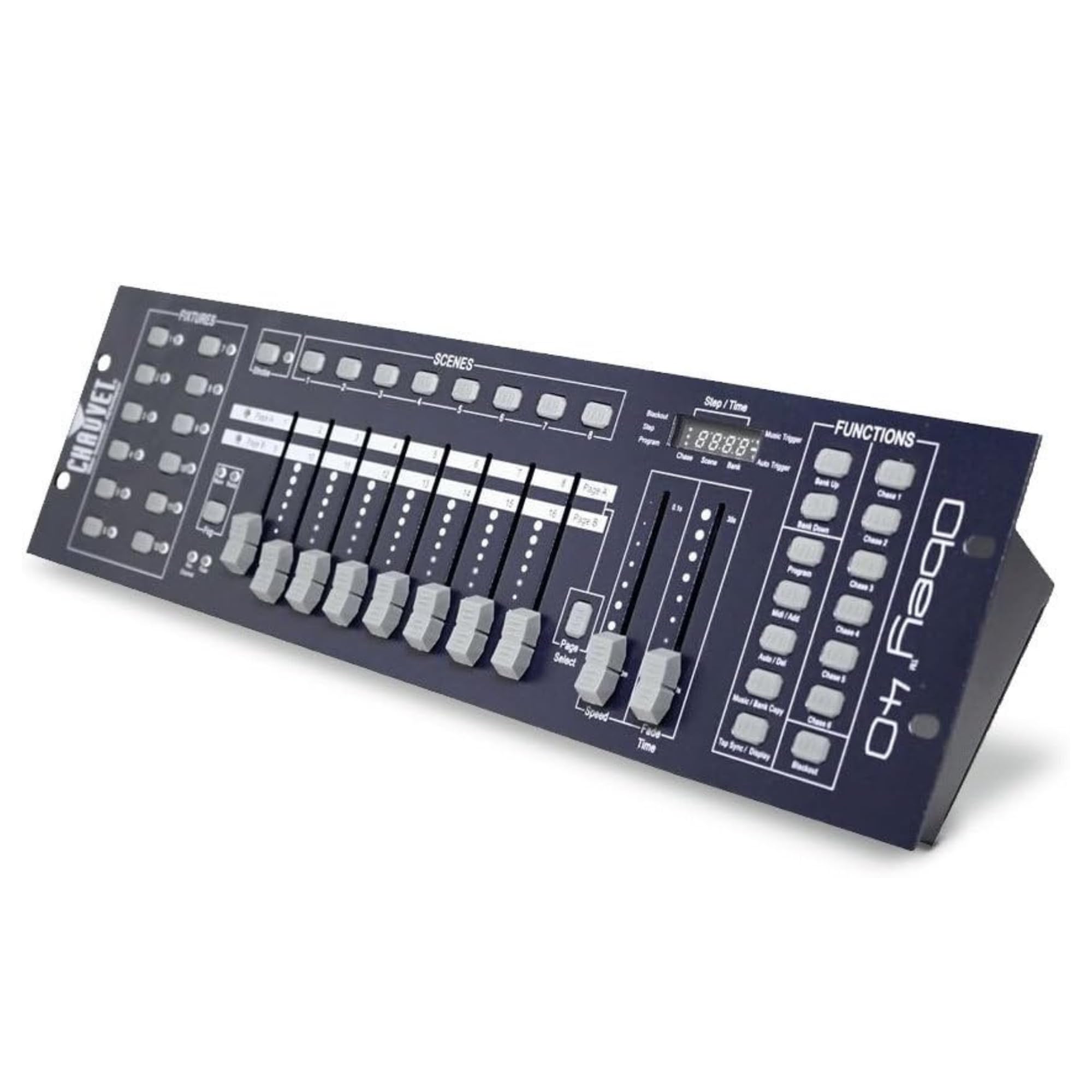
The CHAUVET DJ OBEY40 is a proven entry-level controller that has been a staple in mobile DJ kits for years. Its 192-channel capacity handles twelve 16-channel fixtures, which covers a typical rig of pars, wash lights, and a few moving heads. The 30 banks of 8 scenes provide 240 stored looks, and the six chase sets allow dynamic sequences with up to 240 scenes. Dedicated fog and strobe controls give you quick access to atmospheric effects without digging into menus.
Build quality is durable enough for hobbyist and semi-pro use, but the plastic chassis and basic faders are not designed for daily rental abuse. The music mode triggers scene changes based on audio input, but the sensitivity is fixed and tends to change too quickly for slower rock or ballad tempos — a tradeoff that matters more for live bands than DJs. MIDI compatibility adds flexibility for integrating with other hardware.
Users praise the OBEY40 for its ease of use after watching a few tutorial videos, and Chauvet’s customer support is responsive when issues arise. Some units have failed within months, but the manufacturer has a good track record of warranty replacements even after the first year. This controller is a solid starting point for anyone building their first DMX-controlled rig.
Why it’s great
- Dedicated fog machine and strobe control buttons
- 30 banks of 8 scenes for 240 total looks
- Reversible sliders for personalized layout
Good to know
- Music mode lacks sensitivity adjustment — can feel rushed
- Plastic housing feels less durable than metal alternatives
- Basic manual requires online video tutorials to master
3. ENTTEC DMX USB Pro 512-Ch Interface

The ENTTEC DMX USB Pro is not a standalone controller — it is a USB-to-DMX interface that turns your laptop into a powerful lighting console when paired with software like Show Buddy, QLab, or Lightkey. The 512-channel output covers a full DMX universe, and the optical isolation protects your computer from power surges that can travel down DMX cables in venues with dirty electrical systems. This feature alone makes it the safest choice for laptop-based show control.
The stainless steel housing is compact and light, but the plastic casing on the connector end feels fragile — this is a device best kept in a padded case or rack drawer. The buffer circuit maintains the last DMX data after a PC reboot, preventing fixtures from snapping to black during a crash recovery. Compatibility spans Windows, macOS, and Linux, which gives theater and live-sound engineers software freedom.
Users running wireless DMX transmitters with the ENTTEC interface report rock-solid signal handling with zero flickering, even with cheap Chinese LED pars. The interface does not pass through signals from another DMX source, so it functions purely as a node. For anyone who prefers programming complex cues on a laptop rather than on hardware faders, this interface provides professional-grade stability at a mid-range price.
Why it’s great
- Optically isolated DMX output protects computer hardware
- Last-value buffer keeps fixtures stable after PC reboot
- Cross-platform compatibility with major lighting software
Good to know
- Requires external software — no standalone operation
- Plastic connector housing is vulnerable to crushing
- Cannot pass-through signals from another DMX controller
4. ADJ MyDMX Go Wireless DMX Controller

The ADJ MyDMX Go takes a fundamentally different approach to DMX control: instead of hardware faders, it uses an Android or iPad app to manage up to 256 channels per universe with support for two universes. The fixture library contains over 15,000 profiles, which eliminates the tedious process of manually programming channel maps. The 50 user presets and 21 automatic effects get you a quick show without any programming at all.
The hardware interface is compact and lightweight, mounting easily to truss with the included O-Clamp brackets. Power comes via USB, and the 3-pin XLR outputs integrate with any standard DMX chain. The system works reliably when connected properly, but the app has a reputation for connection instability — especially on iPads, where users report frequent disconnects mid-show. Android tablets appear to maintain a more stable connection.
This controller is best suited for operators who are comfortable with touch-screen interfaces and want to minimize hardware bulk. The lack of physical faders means you cannot make quick live adjustments by feel — everything goes through the tablet. If your rig uses only name-brand fixtures from the library, the setup speed is unmatched. For those who prefer tactile control, stick with a hardware board.
Why it’s great
- Vast fixture library eliminates manual profile creation
- 50 presets and 21 automatic effects for instant shows
- Compact size with truss-mount brackets included
Good to know
- App connectivity can be unreliable, especially on iPad
- No tactile faders — fully dependent on touch screen
- May not work with generic or Chinese-brand fixtures
5. Donner Wireless DMX512 Controller Kit

The Donner Wireless DMX512 Controller Kit eliminates the need for long DMX cable runs by providing one transmitter and seven battery-powered receivers. Each receiver has a built-in rechargeable battery that lasts roughly 4-5 hours under typical show conditions — enough for a full wedding reception or club night. The 2.4G ISM frequency band with 126 auto-jumping channels keeps the signal clean even in crowded RF environments.
The 500-meter visible-range distance is generous, allowing the transmitter to sit at front of house while receivers are scattered around a large venue. Each receiver pairs via a 7-group ID code system, so up to seven different wireless networks can operate simultaneously in the same space without interference. The receivers are small enough to mount directly to light stands or truss points using the provided brackets.
Users report that the wireless response feels identical to a wired DMX connection — no perceptible lag. Battery storage is the main concern: the lithium cells drain even when the units are switched off, so you must charge all receivers before every show. The on/off switch hole is small and requires a pointed tool to toggle reliably. Despite these quirks, this kit drastically reduces setup time for any mobile lighting rig.
Why it’s great
- No DMX cables needed — huge time savings on setup
- 7-group ID system allows multiple networks in one venue
- 500m range covers even the largest event spaces
Good to know
- Batteries self-discharge in storage — must charge before each show
- On/off toggle requires a small tool to operate
- Receivers are somewhat fragile — need padded transport
6. CHINLY 8pcs Wireless DMX512 Kit

The CHINLY Wireless DMX512 Kit pushes the battery-life standard higher than most competitors, with receivers rated for up to 8 hours of continuous operation from a 2-hour charge. This makes it a strong choice for all-day festivals, corporate events, or situations where power outlets at fixture locations are scarce. The 2.4G ISM frequency band with auto-hopping ensures reliable transmission with zero noticeable latency compared to a wired DMX line.
The kit includes one transmitter and seven receivers, all housed in metal shells that feel more robust than the plastic enclosures on some competing wireless systems. The 7-group ID code system prevents cross-talk between multiple rigs operating in the same venue — useful for multi-stage events. The transmitter does not have a built-in battery and requires constant USB power, so plan a power source for the transmitter location.
Users running these receivers with ENTTEC or DMXIS interfaces report stable performance across multiple shows with no dropouts. Some units have required a terminator on the final receiver when daisy-chaining multiple lights. The battery life holds up well in practice, with users logging 7-hour runs without the units dying mid-set. For wireless DMX, the CHINLY kit delivers the longest usable runtime at this price tier.
Why it’s great
- Up to 8 hours of battery life from a 2-hour charge
- Metal receiver housing is more durable than plastic alternatives
- 7-group ID system prevents interference between multiple rigs
Good to know
- Transmitter lacks a battery — must be plugged into power
- Daisy-chained lights may require a terminator on the last unit
- On/off button hole can be finicky to press reliably
7. Wiwreenm 384CH DMX-512 DJ Controller

The Wiwreenm 384CH Controller brings professional-level channel capacity to the entry-level price bracket. With 30 banks of 8 programmable scenes and six chases totaling 240 scenes, it matches the programming depth of controllers costing twice as much. The slim form factor and gel side handles make it easy to pack in a laptop bag, and the LED gooseneck lamp is useful for dark stages.
The plastic construction is the most obvious concession to the low price — the case flexes under moderate pressure, and the faders, while responsive, lack the smooth damped feel of metal-chassis units. The built-in microphone for sound-active mode triggers scene changes to the beat, but the sensitivity is not adjustable and may need loud music nearby to work consistently. The 180-day warranty is shorter than the industry standard.
Users confirm that the controller handles 12 to 24 fixtures reliably after the initial programming curve. The learning curve is real — expect to spend an hour with the manual or YouTube tutorials before your first programmed scene. For anyone on a tight budget who needs 384 channels and does not plan to gig with heavy road cases, this controller offers the most channels per dollar.
Why it’s great
- Full 384-channel control at a very accessible price point
- Includes LED goose neck lamp for dark stage operation
- Gel side handles prevent scratches during transport
Good to know
- Plastic case flexes — not ideal for heavy road use
- Sound mode sensitivity is non-adjustable
- 180-day warranty is shorter than most competitors
8. DMX512 DJ Controller 384CH Stage Lighting Console

The generic-branded 384CH DMX512 DJ Controller offers nearly identical hardware to the Wiwreenm model — same 384-channel capacity, 30 banks of 8 scenes, and 24-fixture compatibility — but it ships with clearer printed instructions and a helpful YouTube tutorial link. For first-time DMX buyers, this documentation advantage cuts the setup time significantly. The controller is quiet in operation with no fan noise.
The plastic chassis is compact enough to fit in a standard 19-inch rack with minor modifications, though it is not a true rack-mount form factor. The 10W power consumption means it runs cool even during long programming sessions. The 3-pin XLR output works with standard DMX cabling without adapters, and the included LED gooseneck lamp illuminates the sliders in dark environments.
Users who have purchased multiple units report consistent build quality and reliable performance across different batches. The controller works well with both LED pars and moving heads, and the sound-active microphone mode responds cleanly to bass frequencies. The learning curve is typical for the category — expect to invest an evening watching tutorials before you can program a full set. This is a solid entry point for hobbyists and cover bands.
Why it’s great
- Clear printed instructions and video tutorial for beginners
- Compact design fits in a standard rack with minor mods
- Low 10W power consumption runs cool for long sessions
Good to know
- Plastic construction limits durability for heavy touring
- Not a true rack-mount form factor out of the box
- Sound mode still lacks adjustable sensitivity
9. U`King 10-Pack 36LED RGB Par Lights with DMX

The U`King 10-Pack bundles ten 36-LED RGB par cans with DMX control capability, giving you a complete lighting rig in one box. Each fixture operates on 7 DMX channels, so a full set of ten consumes 70 channels — leaving plenty of headroom on a 192 or 384-channel controller for additional moving heads or wash lights. The aluminum housing and adjustable brackets allow mounting on truss, T-bars, or floor placement.
The fixtures support five operating modes: automatic, sound-activated, master-slave, and full DMX 512 control. The sound-active mode uses a built-in microphone to trigger color jumps and fades to the beat, which works well for parties and small events without a dedicated operator. The 72-watt total power draw per fixture means the whole rig runs on a standard 15-amp circuit with room to spare.
Users consistently report that these pars are bright enough to wash walls and dance floors effectively. The DMX functionality is straightforward to integrate with any standard controller, and the included remote provides quick override without walking to the board. The main limitation is the 7-channel profile — more advanced pars offer 8-12 channels for finer control over strobe, macro effects, and color temperature. For most mobile DJs and event spaces, this package delivers everything needed to get started.
Why it’s great
- Complete 10-fixture kit with DMX control included
- Aluminum housing with adjustable mounting brackets
- 72W per unit — runs on standard household circuits
Good to know
- 7-channel profile limits per-fixture control granularity
- Included remote is useful but not as robust as DMX programming
- Sound mode triggers inconsistently at low volume
FAQ
Can I control both moving heads and LED pars from the same DMX controller?
What is the difference between a DMX controller and a USB DMX interface?
Do I need a wireless DMX system or can I run cables?
How do I set the DMX address on my fixtures to work with a controller?
Final Thoughts: The Verdict
For most users, the best dmx controller winner is the Rockville ROCKFORCE 384 because it delivers full 384-channel capacity with MIDI control and a metal chassis at a price that undercuts most competitors with similar specs. If you want a laptop-based setup with optical isolation and software flexibility, grab the ENTTEC DMX USB Pro. And for a cable-free rig that cuts setup time drastically, nothing beats the Donner Wireless DMX Kit — just remember to charge the receivers before the gig.

Mo Maruf
I created WellFizz to bridge the gap between vague wellness advice and actionable solutions. My mission is simple: to decode the research and give you practical tools you can actually use.
Beyond the data, I am a passionate traveler. I believe that stepping away from the screen to explore new environments is essential for mental clarity and physical vitality.