Our readers keep the lights on and my smoothie glass nicely filled. As an Amazon Associate, I earn from qualifying purchases.
There is nothing worse than zipping a wet wetsuit and sandy fins into a standard duffel, only to find a pool of stale seawater soaking through your car trunk days later. A properly designed dive bag solves this with heavy-duty mesh panels that let grit fall through and moisture evaporate, keeping your expensive gear free of mildew and corrosion. Whether you are walking to a shore entry, boarding a crowded dive boat, or flying to a remote reef, the bag you choose determines how easy it is to rinse, dry, and organize your kit.
I’m Mohammad Maruf — the founder and writer behind WellFizz. My research process for this guide involved cross-referencing hundreds of verified customer reviews, examining fabric denier, zipper metallurgy, and compartment geometry across seven distinct models to identify which designs truly hold up to repeated saltwater exposure and heavy daily use.
After comparing capacity, material quality, and specialized features like integrated fin pockets and roller wheels, the options narrowed to a focused set that balances durability with real-world convenience. This guide breaks down the best dive bags available today so you can confidently choose one that matches your specific diving routine.
How To Choose The Best Dive Bags
Selecting a dive bag comes down to matching the material, closure mechanism, and capacity to where and how often you dive. Mesh bags dominate for daily shore and boat use because they rinse clean and dry fast, while roller bags with reinforced fabric are the better choice for airport travel where gear must survive rough baggage handling.
Material & Build Quality
The denier of the fabric tells you a lot about puncture resistance. 1680D polyester is the standard for heavy-duty dive bags because it resists abrasion from sand, boat decks, and sharp fin edges. Corrosion-resistant zippers are non-negotiable — saltwater eats standard metal zippers quickly, so look for plastic or coated zipper pulls that will not seize up after a season of use.
Carry Style & Accessibility
Backpack-style bags free your hands when walking down a dock or up a rocky path, but they can be awkward to stuff when full. Duffel bags offer a wide opening that makes packing and unpacking fast, while roller bags with inline skate wheels save your back during long airport transits. The best choice depends on whether you need to carry the bag over rough terrain or roll it across smooth floors.
Capacity & Compartment Design
For a single diver with a BCD, regulator, fins, and exposure suit, look for a bag in the 80L to 115L range. If you frequently carry gear for two or need extra space for clothing and accessories, bags around 142L provide room without becoming unmanageable. Dedicated fin pockets on the side keep long blades from poking into your back and make it easier to separate wet gear from dry items.
Quick Comparison
On smaller screens, swipe sideways to see the full table.
| Model | Category | Best For | Key Spec | Amazon |
|---|---|---|---|---|
| Stahlsac Bonaire Mesh Backpack | Mesh Backpack | Cold-water divers with heavy kit | 142L capacity, PVC bottom | Amazon |
| TUSA BA-0103 Mesh Backpack | Mesh Backpack | Day boat trips & lightweight carry | Full-length zipper opening | Amazon |
| Cressi Strong Capacity Roller | Roller Luggage | Air travel & liveaboard cruises | 115L, side fin pockets | Amazon |
| Cressi Dry Bag Gara | Dry Backpack | Shore dives & two-person loads | 60L dry compartment | Amazon |
| AKONA Globetrotter Backpack | Carry-On Backpack | Travel divers needing a carry-on | Water-resistant fabric shell | Amazon |
| Mares Cruise Mesh Duffel | Mesh Duffel | Family snorkel trips & group gear | 108.5L all-mesh body | Amazon |
| Aqualung Adventurer Mesh Duffel | Mesh Duffel | Budget-conscious solo divers | 1680D polyester body | Amazon |
In‑Depth Reviews
1. Stahlsac Bonaire Mesh Backpack

The Stahlsac Bonaire is a 142-liter beast designed for divers who need to haul a full cold-water kit including a thick wetsuit, backplate, and long fins. The dense mesh material is far thicker than the thin nylon found on budget bags, and the tough PVC bottom stands up to sharp coral and rocky shore entries without wearing through. Side zippers allow you to reach the bottom of the bag without digging, and the drawstring top provides flexible closure for irregularly shaped gear.
Owners report this bag surviving well over 1,500 dives with only minor repairs, which speaks directly to the construction quality. The bag conforms around your gear so it carries closer to your body than a rigid duffel, and the mesh lets sand and water drain instantly. The front stash pocket is useful for smaller accessories, though the Velcro closure can work loose under a fully packed load.
The biggest trade-off is that the shapeless design means long fins or sharp regulator yokes can poke into your back during long walks. The drawstring closure can also be less convenient than a full zipper when you are trying to quickly grab a specific item. Still, for raw durability and sheer volume, this bag is a long-term investment that pays for itself.
Why it’s great
- Proven longevity in heavy use conditions with thick mesh and PVC base
- Massive 142L capacity swallows a complete cold-water setup
- Side zipper access avoids digging through the top
Good to know
- Drawstring closure is less secure than a zipper when fully packed
- Bag has no internal structure, so gear can shift and poke you
- Front pocket Velcro may open under heavy weight
2. TUSA BA-0103 Mesh Backpack
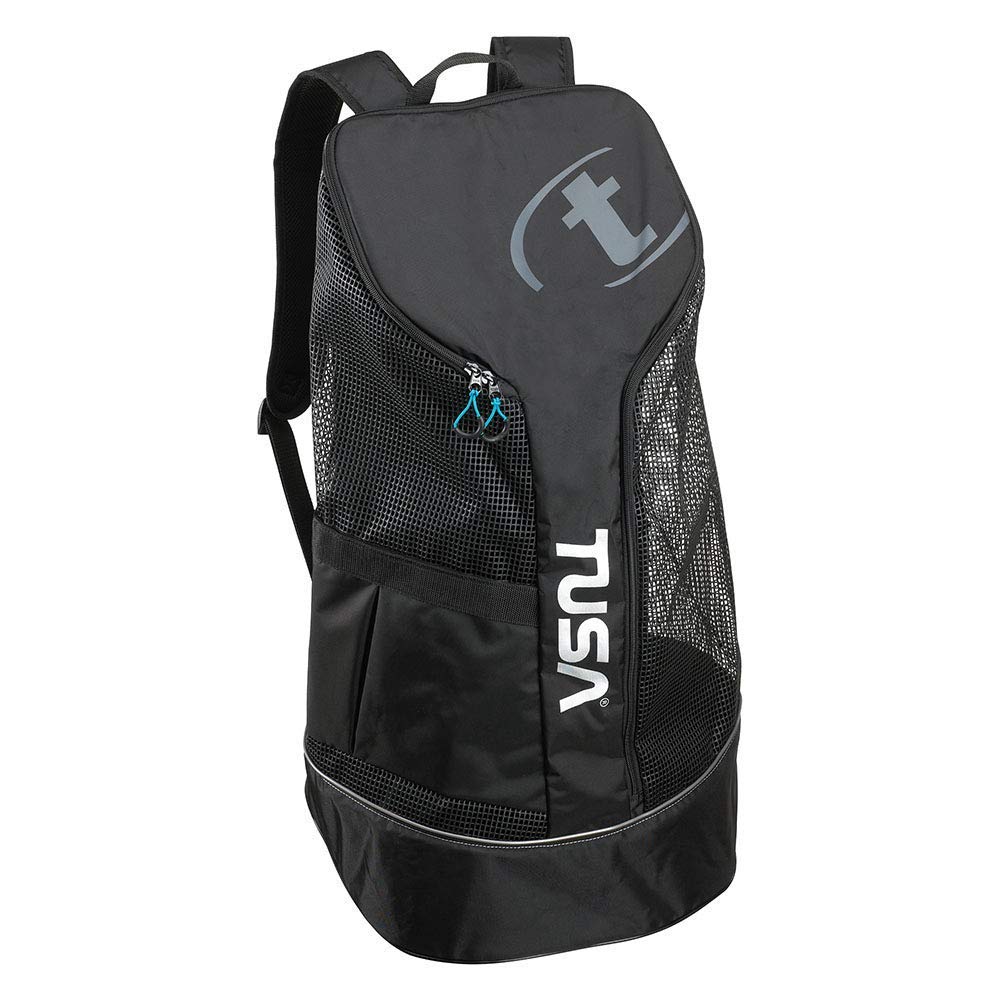
The TUSA BA-0103 stands out because of its full-length zipper opening, which is a rare feature in mesh backpacks. Instead of pulling wet, tangled gear out through a narrow neck, you can unzip the entire front panel and lay the bag flat for easy organization. The backpack straps are padded and comfortable, making it a strong choice for boat divers who need a hands-free carry down the dock.
With dimensions of 14.2 by 16.2 by 29.5 inches, this bag fits a full rig including a 7mm wetsuit without feeling overly large or cumbersome. The large outer pocket with a hook-and-loop flap is convenient for reef hooks or a dive computer, though some users wish it had a zipper for better security. The internal zippered pocket provides a safe spot for car keys or a wallet.
The main mesh material feels substantial and breathable, allowing wet boots and wetsuits to dry quickly between dives. The bag is relatively light when empty, but the sturdy zipper adds confidence that it will survive daily saltwater exposure. If you frequently rotate between shore and boat diving and value accessibility over sheer volume, this is a versatile daily driver.
Why it’s great
- Full-length zipper provides unparalleled access to the main compartment
- Padded shoulder straps make carrying heavy loads more comfortable
- Fits a full 7mm kit without being oversized or unwieldy
Good to know
- Outer pocket uses Velcro instead of a zipper for closure
- Bag is heavier than some mesh duffels even when empty
- Side pocket could be larger for storing accessories
3. Cressi Strong Capacity Roller Luggage Bag

The Cressi Strong Capacity Roller is the go-to bag for divers who fly to their destinations. At 115 liters, it fits a single diver’s full setup plus a few days of clothes, and the integrated side fin pockets keep long blades separate and accessible without unzipping the main compartment. The telescopic handle and inline skate wheels roll smoothly through airport terminals, sparing your shoulders from the weight of a fully loaded backpack.
Build quality is a clear priority here — the fabric is thick and abrasion-resistant, and the zippers feel solid enough to withstand baggage handlers. Two large exterior pockets provide quick access to regulators, computers, or documents, and the bag converts to a backpack via hidden straps for those moments when you need to carry it up stairs or across uneven ground. The fin pockets are generous enough to hold both standard and travel fins.
One common complaint is that the backpack straps tend to hang loose and can get caught in the wheels when rolling, which may cause fraying over time. The bag is also quite large for use on small dive boats, so you will likely need a smaller mesh bag for daily excursions once you reach your destination. However, as a checked luggage solution for dive travel, it offers exceptional value.
Why it’s great
- Roller wheels and telescopic handle eliminate carrying stress during airport travel
- Side fin pockets keep wet blades separate from dry clothing
- Sturdy fabric and zippers survive rough baggage handling
Good to know
- Backpack straps dangle and can get caught in the wheels
- Too large for most day-boat dive lockers
- Price point is higher than mesh alternatives
4. Cressi Dry Bag Gara Backpack
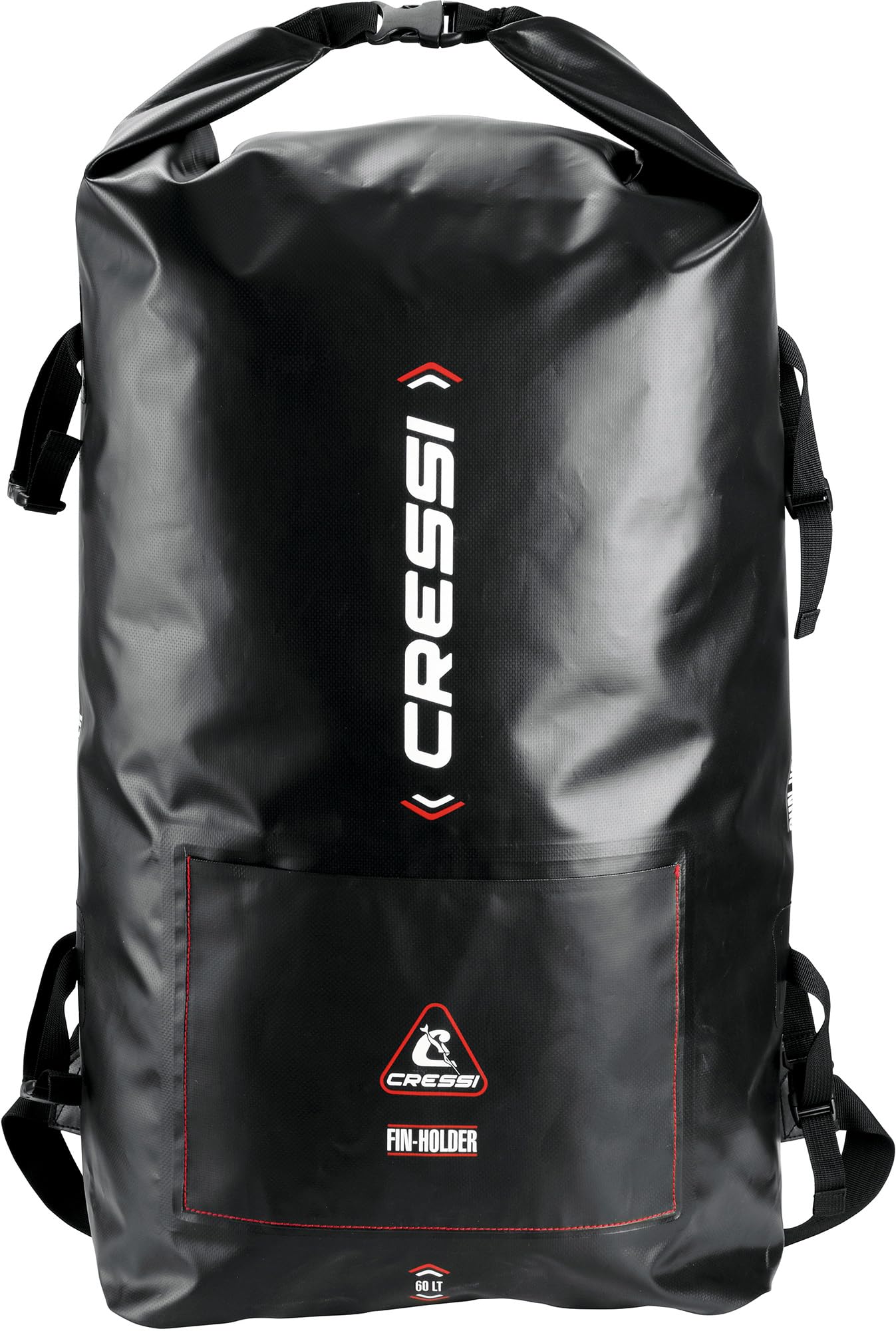
The Cressi Dry Bag Gara is a 60-liter backpack that combines a waterproof dry compartment with external attachment points for spearguns or extra gear. This makes it especially useful for shore divers or freedivers who need to keep sensitive items like electronics or dry clothes separate from soaking equipment. The ergonomic harness distributes weight well, and the straps are comfortable enough for longer walks from the parking lot to the water.
Owners appreciate how much gear it can swallow — two pairs of fins, masks, snorkels, and rashguards fit easily, and the dry roll-top closure keeps everything inside secure. The bag can double as a carry-on for airlines that are lenient with personal items, though the 60-liter capacity is better suited for day trips than extended liveaboard travel. The external compression straps help cinch down the load for a tighter carry.
The fabric is a thick plastic-coated material that should resist wear, but some users report that the bottom can develop abrasions after several months of shore dives on rough surfaces. A reinforced base would improve long-term durability. The dry bag design also means there is no mesh drainage, so wet gear must be removed and rinsed separately if you want it to dry inside the bag.
Why it’s great
- Waterproof dry compartment keeps clothes and electronics safe
- External straps allow attaching spearguns or extra fins
- Comfortable carry for medium loads over uneven terrain
Good to know
- Bottom fabric can wear through on abrasive shore entries
- No mesh drainage — wet gear stays in contact with dry items
- 60L capacity limits use for full cold-water setups
5. AKONA Globetrotter All-in-One Backpack

The AKONA Globetrotter is designed for the traveling diver who wants to avoid checked baggage fees. It functions as a carry-on backpack that fits a BCD, regulator, wetsuit, fins, mask, and accessories into one manageable pack. The fabric is water-resistant and rugged, holding up well to the abuse of overhead bins and airport conveyor belts. Multiple pockets on the front and sides keep small items organized without requiring a separate accessory pouch.
The main compartment is a single undivided cavern, which means you will need packing cubes or roll your gear strategically to keep it organized. There is no mesh bottom for sand or water drainage, so it is best used as a travel bag that gets emptied at your destination rather than a daily rinse-and-dry bag. Users consistently mention how much gear fits — one reviewer packed a 3mm wetsuit, reg, BC, mask, and snorkel with room to spare.
When fully loaded, the backpack becomes quite heavy, and it lacks a hip belt to transfer weight to your lower body. Some users wish it had wheels, though the backpack form factor is necessary for carry-on compliance. For the price point, this is an excellent value for divers who prioritize flying with their own gear over luxury features.
Why it’s great
- Carry-on compatible size saves airline baggage fees
- Water-resistant fabric protects gear from rain and spills
- Exceptionally roomy for its footprint
Good to know
- No mesh bottom for drainage — wet gear must be packed carefully
- Very heavy when fully loaded and lacks a hip belt
- No wheels or rolling option for airport transit
6. Mares Cruise Mesh Duffel Bag

The Mares Cruise Mesh Duffel is a spacious 108.5-liter all-mesh bag that prioritizes rinsing and drying over structured organization. The large size accommodates a full set of scuba gear including a BCD, regulator, fins, and wetsuit, and still has room for snorkel gear for two or three more people. The entire bag is breathable, so you can hose it down with all your gear inside and let everything air dry without taking anything out.
The construction features non-corrosive zippers and reinforced handle straps that distribute weight well when the bag is packed full. The bag folds down small enough to slip into larger luggage when not in use, making it convenient for travel. Stitching along the seams is robust, and the mesh itself feels thick and resistant to snagging compared to cheaper alternatives.
The lack of a shoulder strap is a notable omission — the bag relies on web handles that can be uncomfortable when carrying a heavy load over a distance. The side zipper compartment is only accessible from inside the main cavity, which is an odd design choice that reduces its practicality. For group trips where everyone’s gear needs to be transported and rinsed together, this duffel is a solid workhorse.
Why it’s great
- Full mesh construction allows complete rinsing and quick drying
- Generous 108.5L capacity fits multiple sets of gear
- Corrosion-resistant zippers survive saltwater exposure
Good to know
- No shoulder strap included — carry handles only
- Side compartment zipper is inconveniently located inside the bag
- Folds small but lacks any structure when empty
7. Aqualung Adventurer Mesh Duffel Bag

The Aqualung Adventurer Mesh Duffel is a well-rounded entry-level bag that punches above its price tier with a 1680D polyester base and corrosion-resistant zippers. The mesh body is soft and collapsible, folding down to the size of a sweatshirt for easy packing inside larger luggage. At 33 by 14 inches, it holds a full solo kit including fins, BCD, regulator, and wetsuit without feeling stretched.
The removable padded shoulder strap makes carrying the bag comfortable when it is full, and the web handle provides a secondary grip point. Users consistently report that the zipper is the first component to wear out on cheaper bags, so the quality zippers on this model give confidence in its longevity. One owner noted they bought multiple units after their previous bag from a different brand failed at the zipper.
The bag lacks a waterproof pocket or any internal organization, so small items like dive lights or computers must be packed in a separate pouch. The mesh is not as thick as the Stahlsac or TUSA offerings, but it is adequate for recreational divers who take a few trips per year. For the budget-conscious diver who still wants a brand-name build, this is a smart choice.
Why it’s great
- Heavy-duty 1680D polyester adds durability at an accessible price point
- Corrosion-resistant zippers avoid common failure points
- Collapses flat for packing inside checked luggage
Good to know
- No waterproof pocket for small electronics or valuables
- Soft mesh lacks structure when filling or emptying
- Not ideal for heavy cold-water kits due to thinner mesh
FAQ
How do I prevent mildew in my dive bag?
What size dive bag do I need for a full scuba kit?
Should I get a mesh bag or a dry bag?
Can I use a dive bag as airline carry-on luggage?
How do I repair a hole or tear in my mesh dive bag?
Final Thoughts: The Verdict
For most users, the best dive bag winner is the TUSA BA-0103 Mesh Backpack because it combines a full zipper opening, padded backpack straps, and a durable mesh build at a mid-range price point that works for both shore and boat diving. If you want massive volume for cold-water gear and proven longevity, grab the Stahlsac Bonaire Mesh Backpack. And for air travel where you need to roll your gear through terminals, nothing beats the Cressi Strong Capacity Roller.

Mo Maruf
I created WellFizz to bridge the gap between vague wellness advice and actionable solutions. My mission is simple: to decode the research and give you practical tools you can actually use.
Beyond the data, I am a passionate traveler. I believe that stepping away from the screen to explore new environments is essential for mental clarity and physical vitality.