Our readers keep the lights on and my smoothie glass nicely filled. As an Amazon Associate, I earn from qualifying purchases.
Measuring current safely without disconnecting a single wire is the core promise of a clamp meter, but the real skill lies in knowing whether your tool can handle non-linear loads, variable frequency drives, and DC circuits without giving you a false sense of security. Too many meters on the market struggle with ghost voltages or fail to capture inrush spikes, leaving technicians chasing phantom faults that waste hours and erode confidence in your measurements.
I’m Mohammad Maruf — the founder and writer behind WellFizz. My approach to this guide involved cross-referencing market data, verifying safety certifications against category-specific standards like CAT III and CAT IV, and analyzing hundreds of verified buyer experiences to isolate which specs actually separate a reliable daily driver from a frustrating gadget.
Whether you are a professional electrician inspecting motor windings or a homeowner tracing a parasitic battery drain in your car, the best digital clamp meter must deliver consistent True-RMS accuracy, robust safety ratings, and practical features like inrush capture or real-time curve recording to match your specific electrical environment.
How To Choose The Best Digital Clamp Meter
A clamp meter is not just a multimeter with a jaw — the jaw fundamentally changes what you can measure and how safely you can measure it. You need to match the meter’s capabilities to the specific circuits you work with, paying attention to three critical dimensions: accuracy architecture, safety certification, and real-world feature set.
True-RMS vs Average-Responding
If your work involves variable frequency drives, switched-mode power supplies, or any non-sinusoidal waveform, an average-responding meter will give you readings that are off by 30-40 percent. True-RMS meters compute the heating value of the waveform mathematically, delivering reliable numbers even when the signal is distorted. Every meter on this list is True-RMS, but the count resolution (6000 vs 10000 counts) affects how fine your decimal places can be on low-voltage DC circuits.
Safety Ratings: CAT III and CAT IV
The category rating defines the meter’s ability to survive transient voltage spikes without exploding in your hand. CAT III 600V is the minimum for residential panel work — it can handle the 4kV spike typical on a 600V distribution circuit. CAT IV 600V, found on the intendvision HT208D, adds protection for service-entrance and utility-level transients, which matters if you ever clamp around the main feed before the breaker panel.
DC Current Measurement
Measuring DC amps with a clamp requires a Hall-effect sensor, which is inherently more complex and less stable than the current transformer used for AC. Some budget-oriented meters omit DC current entirely, or include it but struggle with zero drift after temperature changes. If you work on automotive systems, solar arrays, or battery banks, confirm the meter includes DC clamp functionality with zero-adjust capability.
Quick Comparison
On smaller screens, swipe sideways to see the full table.
| Model | Category | Best For | Key Spec | Amazon |
|---|---|---|---|---|
| Intendvision HT208D | Premium | Inrush & VFD diagnostics | 1000A AC/DC, CAT IV 600V | Amazon |
| FNIRSI DMC-100 | Mid-Range | Graphing & data recording | 10000 counts, TFT screen | Amazon |
| KAIWEETS HT206D | Mid-Range | LowZ & LPF filtering | 6000 counts, TRMS, CAT III | Amazon |
| UNI-T UT204+ | Entry-Level | General-purpose HVAC | 600A AC/DC, 60MΩ | Amazon |
| MAYILON MY2610D | Budget | Basic home & auto | 6000 counts, 1.02-inch jaw | Amazon |
In‑Depth Reviews
1. Intendvision HT208D Inrush Clamp Meter
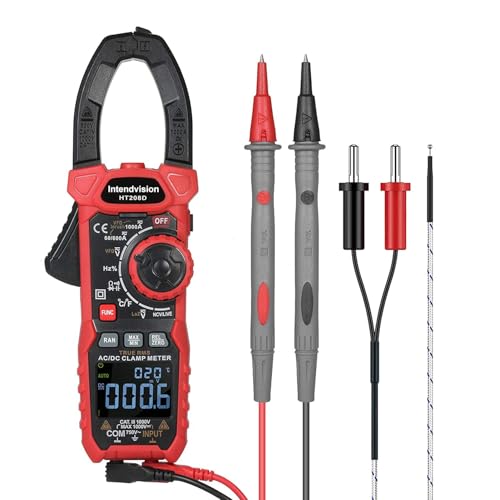
This is the only meter in the roundup that carries both CAT IV 600V and CAT III 1000V safety ratings, which means it can survive the nastiest transients at the service entrance or on industrial motor circuits. The 1000A AC/DC range handles everything from panel feeders to high-current DC loads, and the dedicated inrush function locks onto the startup spike in about 100 milliseconds — a critical feature for diagnosing motor starting circuits without guessing at peak values.
Variable Frequency Drive filtering (VFD) and Low Input Impedance (LoZ) modes are baked into the selector, so you get clean readings on PWM-driven motors and false-voltage rejection on dead circuits without needing to dig through a menu. The large LCD screen stays legible in dimly lit panels, and the included thermocouple expands your diagnostic reach to overheating components and HVAC ports.
Buyers report accuracy that rivals meters costing three times as much, with several noting reliable inrush capture for pump and compressor troubleshooting. The dial selector has shown slight stiffness after a year of regular use, and the included test leads are functional but not premium — upgrading to silicone leads is a worthwhile investment for daily professional use.
Why it’s great
- Highest safety rating in the group (CAT IV 600V)
- Dedicated inrush current capture for motor diagnostics
- VFD and LoZ modes improve accuracy on noisy circuits
Good to know
- Selector switch can feel stiff after extended use
- Stock test leads are adequate but not premium
2. FNIRSI DMC-100 Clamp Meter
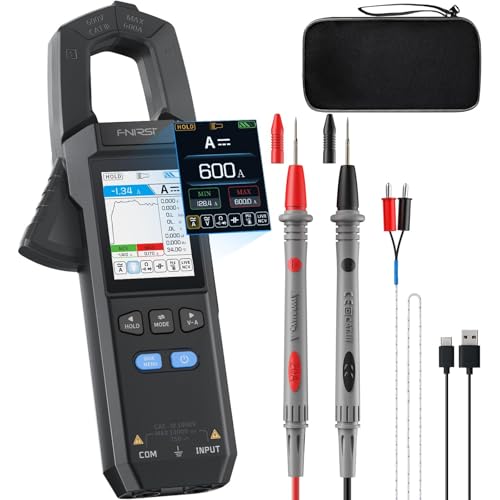
The FNIRSI DMC-100 breaks away from the traditional segment LCD design by packing a 2-inch TFT full-color display that shows a real-time trend graph of your readings — a huge advantage when hunting intermittent faults like a capacitor that drifts out of spec only when warm. The 10000-count resolution gives you a finer granularity on low-voltage DC measurements compared to the 6000-count meters, and the simultaneous voltage/current display helps you correlate both values without switching modes repeatedly.
This meter runs on a built-in 1500mAh lithium battery charged via USB-C, which eliminates the annoyance of swapping 9V or AAA cells mid-job. The clamp manages DC current using a Hall-effect sensor, but buyers report that zero drift can require occasional re-zeroing on the lowest range for precision work. Eight sets of real-time data and thirty historical records can be stored internally, giving you a basic data-logging capability without needing a separate recorder.
Build quality is solid for the price tier, though the plastic chassis lacks the drop protection of rubber-armored professional meters. Several long-term users note that readings closely match high-end Fluke instruments for voltage and resistance, making this a very capable backup or workshop meter. The flashlight is dim compared to dedicated inspection lights, but the adjustable screen brightness helps in dark enclosures.
Why it’s great
- Live trend graph helps catch intermittent faults
- Rechargeable lithium battery with USB-C charging
- 10000-count resolution for precise low-voltage work
Good to know
- DC clamp zero can drift and requires adjustment
- Non-replaceable LiPo battery complicates long-term ownership
3. KAIWEETS HT206D Clamp Meter

The KAIWEETS HT206D packs two advanced filtering modes — LowZ and Low Pass Filter — that directly address the two most common sources of false readings in residential and light commercial work. LowZ mode loads down the circuit to bleed off ghost voltages induced by adjacent live wires, while the LPF cleans up signals from variable frequency drives so you can measure motor current accurately without the carrier frequency corrupting the reading.
The two-color backlit LCD transitions from white to red when voltage exceeds 80V or current surpasses 3A, which functions as a quick visual danger cue during fast-paced panel work. True-RMS on a 6000-count base gives you enough resolution for most troubleshooting tasks without the cost of a premium meter. The included K-type thermocouple probe allows temperature checks on air conditioning lines and overheated bus bars.
DC current measurement is available, but several users note inconsistency after zeroing — the Hall-effect sensor drifts more than on premium units, making it less suitable for precise milliamp-level DC diagnostics. The case is protective and well-molded, and the manual is more thorough than most in this price bracket. For the balance of filtering features and safety compliance (CAT III 600V), this is where the value peak sits for technicians who regularly face ghost voltage and VFD noise.
Why it’s great
- LowZ and LPF filtering eliminate ghost voltage errors
- Red backlight warns of dangerous voltage levels
- Excellent documentation and 36-month warranty
Good to know
- DC current accuracy drifts after zero adjustment
- No direct mA probe measurement for small signals
4. UNI-T UT204+ Clamp Meter

UNI-T has built a strong reputation among electrical professionals in markets outside North America, and the UT204+ continues that tradition with a no-nonsense layout that prioritizes access to the most common measurements without sub-menus. The 600A AC/DC current range covers residential panels and most automotive circuits, and the MAX/MIN recording function captures peak and trough values during motor startup or load cycling without requiring a separate logging mode.
The 60MΩ resistance range and 60mF capacitance support are unusually wide for an entry-level meter, allowing you to check insulation resistance on long cable runs and test large electrolytic capacitors found in power supplies. The frequency measurement on AC voltage extends to 60kHz, which covers most VFD carrier frequencies. The included thermocouple adds temperature diagnostics for HVAC work.
Safety certification stops at CAT III 300V, which is adequate for residential branch circuits but not for panel main feeds or industrial distribution boards. The backlit LCD is clear and large, and the overall weight at 235 grams is light enough for all-day carry in a tool pouch. Longevity is a strong point — multiple buyers report four or more years of trouble-free residential electrical service with this meter, which speaks to the consistency of UNI-T’s manufacturing.
Why it’s great
- Proven long-term reliability in residential service
- Wide resistance and capacitance range for the size
- Lightweight and compact for daily tool pouch carry
Good to know
- CAT III 300V limits use at the service entrance
- No LowZ or LPF filtering for ghost voltage rejection
5. MAYILON MY2610D Clamp Meter
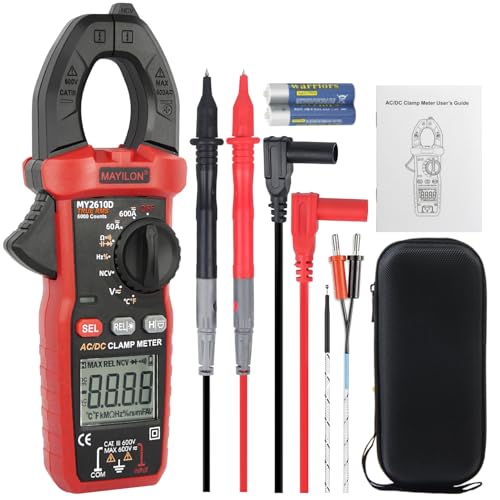
The MAYILON MY2610D delivers a surprisingly broad feature set at an entry-level price point, including AC/DC current and voltage, capacitance, frequency, temperature, and NCV detection — all wrapped in a body with a 1.02-inch jaw opening that can fit around thicker cables and bus bars. The built-in flashlight and backlit LCD make it usable in dim electrical closets, and the 15-minute auto power-off extends battery life between checks.
True-RMS is notably included even at this price level, which means you get correct readings on non-sinusoidal loads like LED drivers and small switching power supplies — a feature often omitted from budget meters. The 6000-count display provides enough resolution for basic troubleshooting, and the continuity test with audible beep works reliably for tracing wires and checking fuse integrity.
The included alkaline batteries drain faster than expected based on user reports — switching to premium cells resolves the issue. The test leads are long and well-built for the price, but the protective cap on the probes must be removed before use, which is easy to overlook on first unboxing. Build quality is respectable for the price, though the plastic case lacks the rubber overmold that protects against drops on concrete. This meter is best suited for homeowners, DIYers, and technicians who need a backup unit that covers the basics without breaking the budget.
Why it’s great
- True-RMS at entry-level pricing
- Wide 1.02-inch jaw fits larger cables
- Measures AC/DC current and voltage plus temperature
Good to know
- Included batteries drain quickly — replace with premium cells
- No protective rubber boot for drop resistance
FAQ
Can a clamp meter measure DC current accurately?
What does inrush current measurement actually tell you?
Do I need LowZ and LPF filters on my clamp meter?
Final Thoughts: The Verdict
For most users, the best digital clamp meter winner is the Intendvision HT208D because its CAT IV 600V safety rating, dedicated inrush capture, and VFD/LoZ filtering give you professional-grade diagnostics without the Fluke price tag. If you want a trending graph that helps identify intermittent faults, grab the FNIRSI DMC-100. And for budget-conscious homeowners who still need True-RMS capability, nothing beats the MAYILON MY2610D.

Mo Maruf
I created WellFizz to bridge the gap between vague wellness advice and actionable solutions. My mission is simple: to decode the research and give you practical tools you can actually use.
Beyond the data, I am a passionate traveler. I believe that stepping away from the screen to explore new environments is essential for mental clarity and physical vitality.