Our readers keep the lights on and my smoothie glass nicely filled. As an Amazon Associate, I earn from qualifying purchases.
An 18-month-old’s brain is a firestorm of connection-making. Every grasp, every stack, every cause-and-effect discovery lays down neural pathways that shape coordination, problem-solving, and language for years to come. The toy your toddler ignores is a missed opportunity. The one they can’t put down is pure developmental gold, and finding that distinction is what separates a playroom full of clutter from a curated learning environment.
I’m Mohammad Maruf — the founder and writer behind WellFizz. I’ve spent hundreds of hours analyzing the engineering, material safety, and Montessori alignment behind the most effective toddler learning tools on the market today so you don’t have to guess what actually works.
Parents who search for the best developmental toys for 18 month old toddlers quickly realize that the difference between a fleeting distraction and a skill-building powerhouse comes down to a few non-negotiable design choices.
How To Choose The Best Developmental Toys For 18 Month Old
At 18 months, toddlers are transitioning from reflexive grasping to intentional manipulation. The wrong toy is either too simple (boring) or too complex (frustrating). The right one sits in the Goldilocks zone: challenging enough to demand focus but achievable enough to reward persistence. Below are the four critical filters every parent should run before adding a toy to the cart.
Material Safety and Construction
Eighteen-month-olds explore with their mouths as much as their hands. Any toy that enters your home must be constructed from solid wood with smooth, polished edges rather than particleboard or brittle plastic. Look for CPC/CE certification and water-based, non-toxic paint finishes. Avoid anything with small parts that fit entirely inside a toilet paper tube — those are choking hazards regardless of the age label. The toy should survive being dropped, thrown, and chewed without splintering or shedding paint chips.
Fine Motor and Cognitive Demands
The best developmental toys for an 18 month old require the pincer grasp (thumb and forefinger), wrist rotation, and bilateral coordination — using both hands together. A toy that only demands a single button press won’t build grip strength or dexterity. Prioritize activities like pounding pegs, threading shapes, pulling cords, and stacking rings. Each of these actions recruits different muscle groups in the hand and forearm, preparing the child for writing and self-feeding down the line.
Open-Ended Play Potential
Toys with a single correct answer — press this button, hear that noise — limit a toddler’s creative range. Open-ended designs allow the child to invent their own rules. A wooden car ramp can be a race track, a parking garage, or a counting exercise depending on the day. A set of stacking blocks can become a tower, a fence for toy animals, or a pretend cake. The more ways a child can use a toy, the longer it stays relevant and the richer the cognitive engagement.
Sensory Variety Without Overstimulation
You want toys that engage multiple senses — sight, touch, hearing — but not all at once in a chaotic assault. Neutral-colored wood with subtle paint tones is preferable to blinding neons and strobe-like LED sequences. Soft ringing sounds and gentle wooden clacks are better than shrill electronic sirens. The goal is focused attention, not sensory overload. A child who can concentrate on a single toy for ten uninterrupted minutes is building the same neural circuits that later support reading comprehension and math problem-solving.
Quick Comparison
On smaller screens, swipe sideways to see the full table.
| Model | Category | Best For | Key Spec | Amazon |
|---|---|---|---|---|
| Joyreal Wooden Montessori Toy | Premium Multi-Activity | All-around skill building | 4-in-1: pounding, xylophone, fishing, gears | Amazon |
| Belleur Montessori Car Ramp | Mid-Range Wooden Set | Cause-and-effect tracking | 5 ramps + 5 mini cars, solid wood | Amazon |
| Flycoost LED Busy Board | Mid-Range Sensory Board | Switch exploration and travel | 17 LED lights, 10 switches, carry handle | Amazon |
| KMTJT Wooden Farm Toy | Mid-Range Themed Playset | Imaginative farm play | 8 carrots, 10 animal blocks, game map | Amazon |
| Wuzhineisn 4-in-1 Sensory Set | Budget-Friendly Kit | Multi-sensory starter bundle | Pull strings, stacking rings, shape bin, blocks | Amazon |
In‑Depth Reviews
1. Joyreal Wooden Montessori Toy
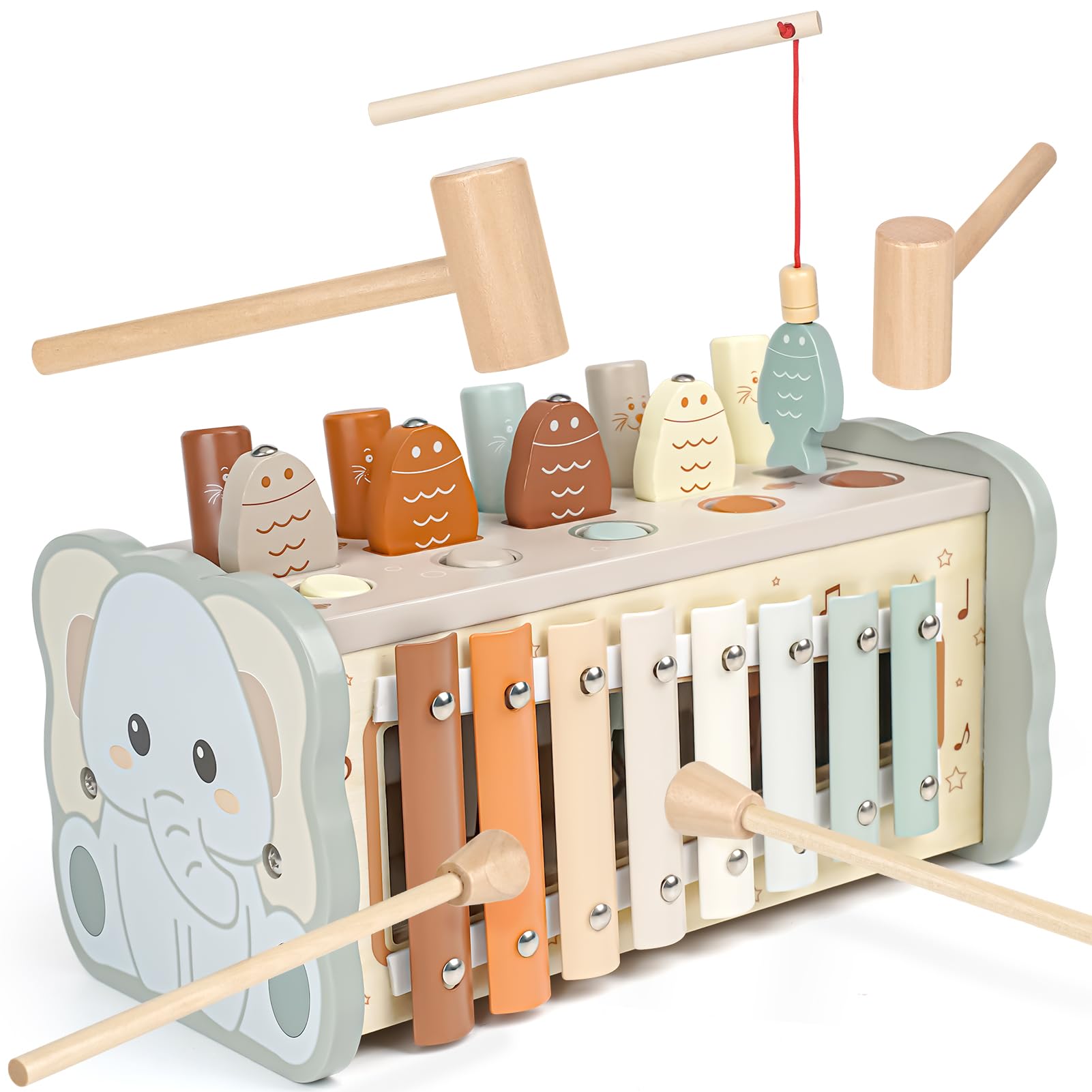
This is the rare toy that delivers four distinct developmental activities in a single solid-wood footprint. The pounding bench sends wooden hamsters bouncing when tapped with the mallet, training force modulation and hand-eye tracking. The removable xylophone bar introduces pitch recognition and cause-and-effect — hit it and hear a note. The magnetic fishing game demands precise pincer-grasp coordination to land each fish, and the gear-spinning station rewards wrist rotation with satisfying mechanical motion.
What sets this apart from typical toddler sets is the construction. The wood is dense and the water-based paint finish is smooth to the touch with no chemical odor. The neutral color palette is deliberately understated; it doesn’t compete for attention but rather invites the child to focus on the action itself. Two hammers and two mallets are included, so siblings or parents can play alongside without tug-of-war friction.
At roughly 10.4 by 5.9 inches, it’s compact enough for a play mat or a high-chair tray yet substantial enough to stay put during enthusiastic pounding. The xylophone bars produce a pleasant tone rather than a harsh clang, and the magnets inside the fishing rods are strong enough to hold the fish securely without being frustratingly weak. This is the closest thing to a complete fine-motor curriculum in a single box.
Why it’s great
- Four distinct activities in one toy maximize engagement variety
- Neutral colors reduce visual overstimulation and promote focus
- Two mallets enable cooperative play and social skill development
- Sturdy construction survives drops and rough handling
Good to know
- Xylophone bars are removable but could be misplaced by very young toddlers
- Fishing game magnets require adult demonstration initially
2. Belleur Montessori Car Ramp

There is something almost hypnotic for an 18-month-old about watching a car roll down a ramp. This wooden race track from Belleur capitalizes on that innate fascination with gravity and motion. The set includes a slotted parking lot on top, five brightly colored ramps, and five miniature wooden cars. The child places a car at the top, releases it, and watches it cascade down — a pure cause-and-effect loop that reinforces prediction and attention span.
The wood is CPC/CE certified with polished edges and no sharp corners. The cars are small — about the size of a standard matchbox car — which is perfect for developing the pincer grasp but also means the set requires supervision if your toddler still mouth-explores. Parents report that the 18-month-old age group engages with this toy for sustained 15-to-20-minute sessions, which is an eternity in toddler attention spans.
Beyond the racing action, the toy teaches counting and color recognition. Each ramp can be assigned a color, and parents can ask the child to send the red car down the red ramp. After play, the cars store in the top parking slot, introducing the concept of cleanup and organization. The whole unit breaks down easily for shelf storage and comes in packaging sturdy enough for gift-giving.
Why it’s great
- Pure cause-and-effect loop builds prediction and focus
- Five bright colors support color recognition learning
- Car storage on top teaches organization habits
- Sturdy wood frame won’t tip during play
Good to know
- Cars are small enough to pose a choking hazard under close supervision
- No magnets or locks to keep cars secure during travel
3. Flycoost LED Busy Board
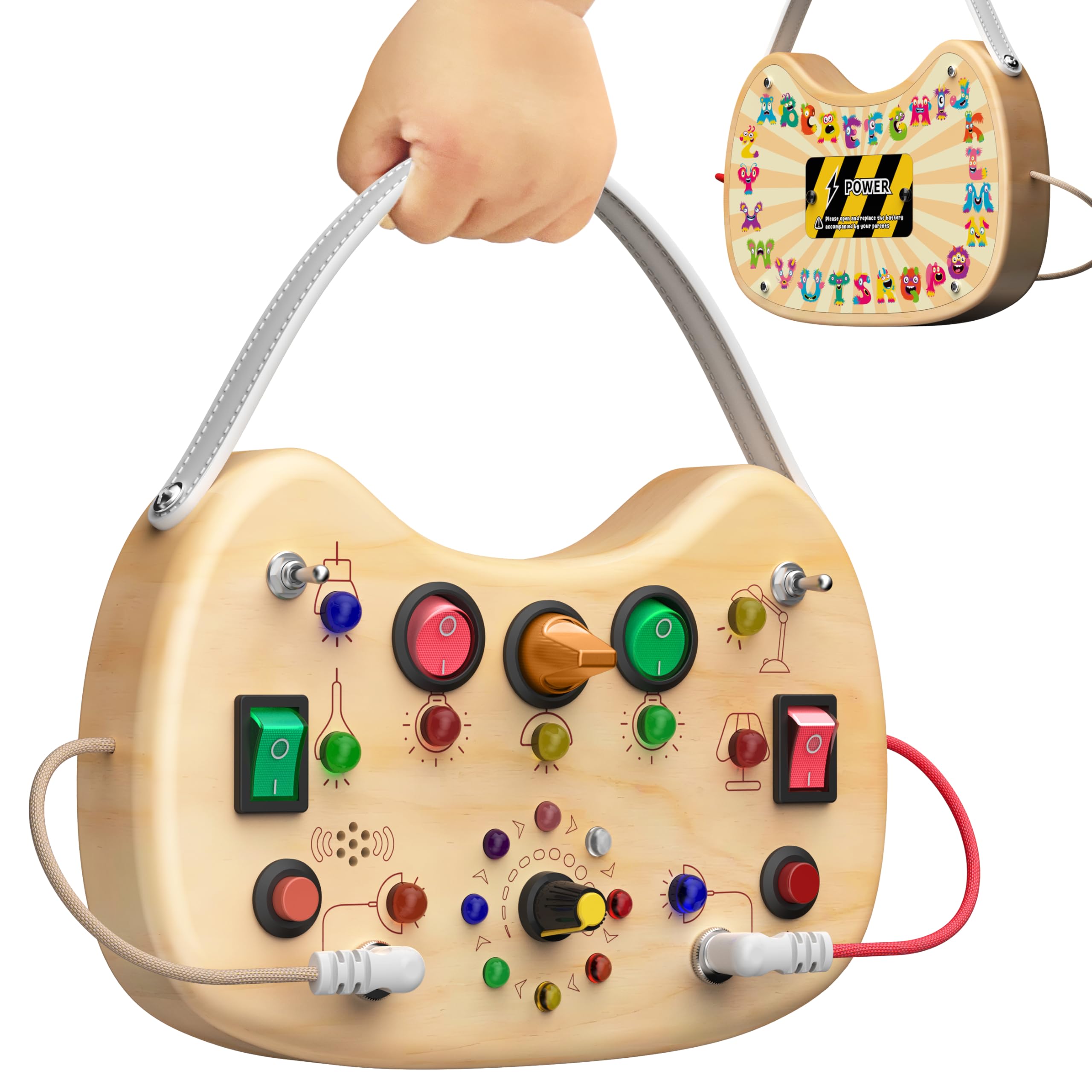
For families who need a screen-free diversion during car rides, restaurant waits, or airplane travel, this wooden busy board with integrated LED lights is a strong contender. The board is built from solid wood with smooth edges and features 17 LED lights controlled by 10 different switches — toggle switches, push buttons, a horn that beeps, and a siren that is notably not earsplitting. The carrying handle is built into the frame, making it easy for small hands to lug around.
The Montessori-inspired design encourages trial-and-error exploration. Flicking a switch produces immediate visual feedback — the corresponding LED lights up. This closed-loop system teaches the child that their actions cause predictable outcomes, which is the foundation of logical reasoning. The board also includes spinners, a drag car piece, and a GPS flip component, adding variety beyond just the lights.
The unit requires two AAA batteries (not included) and weighs enough that it won’t slide off a car seat but is light enough for a toddler to carry. The LED brightness is moderate — enough to be engaging in daylight but not harsh enough to bother sensitive eyes. One minor quality note: the printed word on one switch reads “off/star” instead of “off/start,” a manufacturing typo that does not affect functionality.
Why it’s great
- Built-in handle makes it genuinely portable for travel
- Variety of switch types builds fine motor differentiation
- LED feedback reinforces cause-and-effect understanding
- Durable wood frame withstands drops and tossing
Good to know
- Requires 2 AAA batteries that are not included
- Heavier than a fabric busy book — not ideal for diaper-bag carry
4. KMTJT Wooden Farm Toy

This wooden farm playset from KMTJT is a narrative playground disguised as a sorting toy. The set includes a wooden base with slots, eight carrot vegetables that fit into designated holes, ten animal blocks, one boy block, and a game map with a farm scene. At its most basic level, the child practices shape matching by fitting each vegetable into its correct slot. But the toy’s real power emerges when children start assigning roles: the farmer drives the tractor, the cow stands in the barn, the carrots grow in the field.
The construction is high-quality rubberwood with polished edges and brightly colored, non-toxic paint. The pieces are large enough to be safe but small enough to require deliberate grasping. The carrots are particularly satisfying — they have green felt tops that simulate leafy stems, though parents should note the felt is glued on and may detach if chewed aggressively. The base measures about 8.2 by 6.3 inches, which is smaller than some might expect but ideal for small tabletop play.
The side puzzle pieces add an extra layer of challenge, though some reviewers note they are difficult for a one-year-old to manipulate independently. That’s fine — the toy grows with the child, offering simple sorting at 18 months and progressing to map-based storytelling and animal-name recognition as vocabulary expands. The wooden boy figure and animal blocks also work well as standalone loose parts for open-ended imaginative scenarios.
Why it’s great
- Multiple play modes — sorting, matching, storytelling — extend longevity
- Thick rubberwood construction with smooth, safe edges
- Carrot-pulling motion strengthens finger strength and dexterity
- Animal and vegetable pieces support language development
Good to know
- Felt carrot tops may detach if mouthed extensively
- Side puzzle pieces are too difficult for most 18-month-olds alone
5. Wuzhineisn 4-in-1 Sensory Set
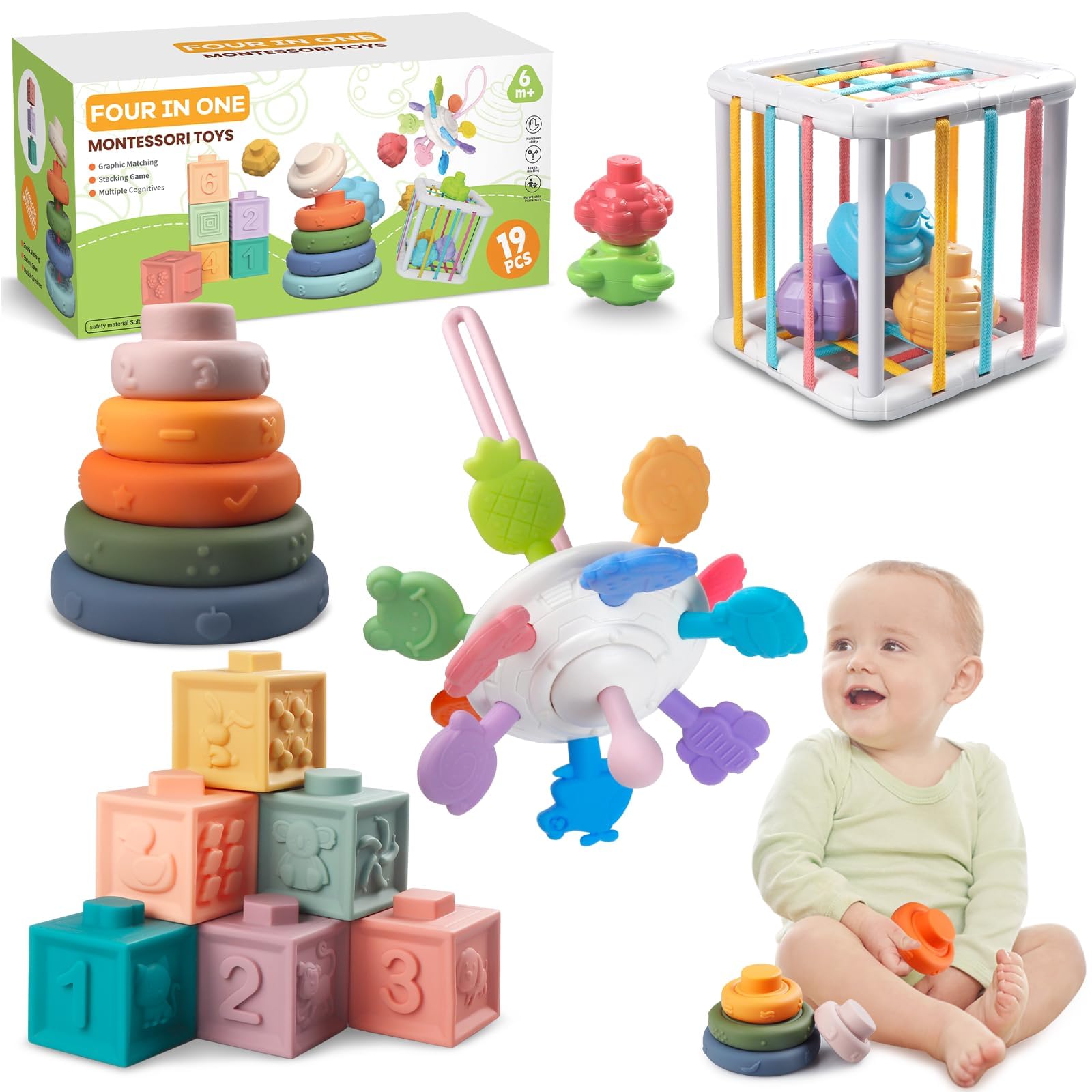
This four-piece sensory kit takes a different approach from the wood-heavy options above: it’s built primarily from food-grade silicone and soft plastics, making it the most forgiving choice for teething toddlers who need to chew as they explore. The set includes a pull-string crab teether with six silicone cords of varying thicknesses, a set of stacking rings with engraved numbers and letters, embossed building blocks with animal and fruit textures, and a sensory cube bin with elastic bands and shape blocks.
The pull-string toy is the star of the show. The crab shape is cute and graspable, and each silicone pull cord offers a different resistance level, teaching the child to modulate grip strength. The disc case includes a button ball and bubble popper surfaces that provide tactile variety. The stacking rings are soft enough to chew but structured enough to stack, and the cubes produce a gentle ringing sound when shaken — a much more pleasant auditory experience than a plastic rattle.
The sensory bin component — a cube with elastic bands stretched across openings — challenges the child to push shapes through the bands, building spatial reasoning and bilateral coordination. The entire set is lightweight and portable, making it suitable for bath time, car rides, or quiet floor play. The muted color palette is easy on the eyes, and the materials are simple to wipe clean with a damp cloth, which matters when toys end up in mouths, on the kitchen floor, and everywhere in between.
Why it’s great
- All components are teether-safe — perfect for mouthing toddlers
- Four distinct activity types provide variety without clutter
- Lightweight and portable for travel and bath play
- Engraved textures on blocks support tactile sensory development
Good to know
- Silicone material attracts lint and dust — requires regular cleaning
- Set is smaller than expected; not ideal for large-group play
FAQ
Are wooden toys safer than plastic for an 18-month-old who mouths everything?
How many toys should an 18-month-old have access to at once?
Can an 18-month-old play with toys labeled for 12-month-olds?
Final Thoughts: The Verdict
For most users, the best developmental toys for 18 month old winner is the Joyreal Wooden Montessori Toy because it packs four distinct fine-motor challenges into one compact, neutral-colored wood frame that keeps toddlers engaged without visual overload. If you want travel-friendly sensory feedback, grab the Flycoost LED Busy Board. And for the best value bundle that doubles as teether-safe entertainment, nothing beats the Wuzhineisn 4-in-1 Sensory Set.

Mo Maruf
I created WellFizz to bridge the gap between vague wellness advice and actionable solutions. My mission is simple: to decode the research and give you practical tools you can actually use.
Beyond the data, I am a passionate traveler. I believe that stepping away from the screen to explore new environments is essential for mental clarity and physical vitality.