Our readers keep the lights on and my smoothie glass nicely filled. As an Amazon Associate, I earn from qualifying purchases.
A dead deep cycle battery isn’t just an inconvenience — it’s a day of lost fishing, a canceled road trip, or a frozen campsite. The difference between waking up to a fully charged battery bank and waiting hours for a trickle charge comes down to the charger you choose. Selecting the right deep cycle battery charger means understanding the specific chemistry of your batteries, the amp rate that matches your capacity, and the charging profile that extends lifespan instead of shortening it.
I’m Mohammad Maruf — the founder and writer behind WellFizz. I’ve spent hundreds of hours cross-referencing manufacturer specs, analyzing charging algorithms, and reading verified buyer experiences to separate the chargers that actually deliver on their promises from those that overheat, undercharge, or fail prematurely.
This guide walks you through the critical specs, real-world performance, and hidden trade-offs of the top models so you can confidently pick the best deep cycle battery charger for your setup without wasting money or burning out your batteries.
How To Choose The Best Deep Cycle Battery Charger
Deep cycle batteries demand a different charging philosophy than standard starter batteries. They require a steady, controlled current that matches their internal chemistry and capacity. Choosing blindly based on the biggest amp number is the fastest way to damage a battery bank.
Match the Charging Profile to Your Battery Chemistry
Lead-acid (flooded, AGM, Gel) and lithium (LiFePO4) batteries have fundamentally different voltage requirements. A charger that maxes out at 14.4V won’t fully charge a LiFePO4 battery that needs 14.6V. Conversely, a lithium-specific charger delivering a constant 14.6V will overcharge and damage a Gel battery. Look for chargers with selectable profiles or automatic chemistry detection to avoid this mismatch.
Amperage vs. Battery Capacity — The 20% Rule
A general guideline is to charge at roughly 20% of your battery’s amp-hour (Ah) capacity. A 100Ah battery benefits from a 20A charger, while a 50Ah battery is better served by 10A. Exceeding this rate on a small battery can trigger thermal runaway, while undershooting on a large bank means waiting all day for a full charge. The charger’s amperage must align with your battery’s maximum recommended charge rate.
Multi-Stage Charging and Temperature Compensation
A basic charger simply pushes current until voltage hits a threshold, then stops. A quality deep cycle charger uses a multi-stage algorithm: bulk phase for the rapid main charge, absorption phase for the final topping, and float phase for maintenance without overcharging. Temperature compensation adjusts the voltage target based on ambient heat or cold, preventing undercharging in winter and overcharging in summer — critical for batteries stored in unconditioned garages or RVs.
Quick Comparison
On smaller screens, swipe sideways to see the full table.
| Model | Category | Best For | Key Spec | Amazon |
|---|---|---|---|---|
| Victron Energy Blue Smart IP22 | Premium | Bluetooth monitoring, multi-bank | 30A, 3 outputs, Li-Ion | Amazon |
| KAISAL 12V 40A | Premium | Ultra-fast LiFePO4 charging | 40A, 14.6V, 3 connectors | Amazon |
| VEVOR Smart 35-Amp | Mid-Range | High current for large banks | 35A, LCD, desulfation | Amazon |
| NOCO GENIUS5 | Mid-Range | Compact maintainer, 1V recovery | 5A, 6V/12V, thermal sensor | Amazon |
| CRAFTSMAN CMXCESM258 | Mid-Range | 4-in-1 testing and reconditioning | 12A, 6V/12V, desulfation | Amazon |
| LiTime 12V 20A | Mid-Range | Dedicated LiFePO4 charging | 20A, 14.6V, Anderson connector | Amazon |
| RCGCBC 25A | Budget | Entry-level 12V/24V versatility | 25A, LCD, 9-stage | Amazon |
In‑Depth Reviews
1. Victron Energy Blue Smart IP22 12V 30A

The Victron Blue Smart IP22 is the gold standard for multi-battery management. With three fully independent charging outputs, it can simultaneously charge and maintain three separate batteries with different states of charge, as long as they share the same chemistry. The 30A output is ample for medium to large battery banks, and the adaptive management algorithm automatically adjusts the charge curve based on battery usage patterns.
Bluetooth connectivity is the standout feature here. The VictronConnect app provides real-time voltage, current, and historical data, plus expert mode for customizing absorption voltage, float voltage, and charge current. This level of control is invaluable for users running non-standard battery configurations or Odyssey Extreme AGMs that require a 14.7V absorption target. The 94% efficiency means the unit runs cool, even at sustained high output.
Build quality is exceptional — the IP22 housing is splash-resistant and designed for marine and workshop environments. The lack of a physical on/off switch is a minor inconvenience, and all batteries on the three outputs must share the same chemistry. But for users who want remote monitoring, precision tuning, and reliable multi-bank charging, this is the benchmark.
Why it’s great
- Bluetooth app with full data logging and custom charge profiles
- Three independent outputs charge multiple batteries simultaneously
- 94% efficiency keeps the unit cool and safe for enclosed spaces
Good to know
- No physical on/off switch — must unplug to power down
- All connected batteries must have identical chemistry
2. KAISAL 12V 40A LiFePO4 Charger
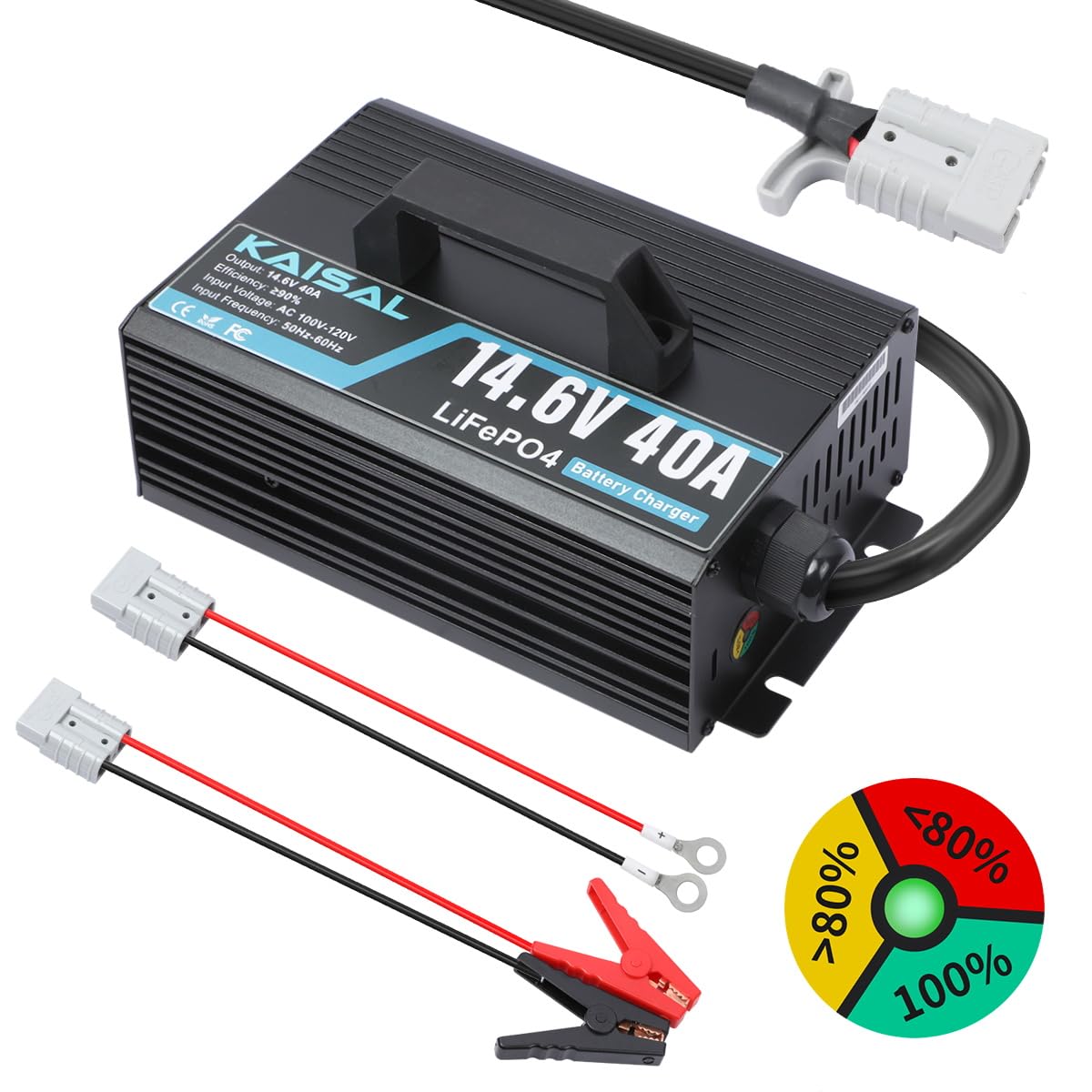
The KAISAL 40A charger redefines speed for LiFePO4 batteries. It can refill a 200Ah battery from complete discharge to 100% in about 5 hours — roughly double the speed of a 20A unit. This makes it the ideal choice for RV and marine users who need to recharge a depleted bank during a short stopover or overnight at a marina with limited shore power. The 3-stage smart charging algorithm (bulk, absorption, float) ensures the battery isn’t subjected to harmful overcurrent as it nears full charge.
Three connection methods — Anderson SB-50, M8 terminals, and alligator clips — offer flexibility for different battery terminal setups. The 9-foot cable provides generous reach, and the eddy current cooling fan keeps the aluminum housing at safe operating temperatures even during extended high-amp cycles. The 0V wake-up mode effectively resets a BMS-protected battery that has been deeply discharged, saving a battery that would otherwise be discarded.
There is no LCD screen — status is indicated via a 3-color LED system. The alligator clamps are not rated for sustained 40A use and may overheat if used as the primary connection. For permanent or semi-permanent installations, the M8 terminals are the only safe choice at this current level. The 3-year warranty provides peace of mind, but the lack of a display means you won’t see real-time voltage or current.
Why it’s great
- 40A output cuts charge time in half for large lithium banks
- 0V wake-up mode revives deeply discharged BMS-protected batteries
- Includes three connector types for versatile installation
Good to know
- Alligator clips are not suitable for sustained 40A charging
- No LCD screen — relies on simple LED indicators only
3. VEVOR Smart 35-Amp Battery Charger

The VEVOR smart charger punches well above its tier. It delivers up to 35A for lead-acid batteries and 20A for lithium, with a large 3.6-inch LCD that shows charging voltage, current, power percentage, and temperature in Fahrenheit or Celsius. The desulfation mode uses pulse repair to break down sulfate crystals on lead-acid plates, restoring lost capacity — a feature typically found on more expensive units.
A force mode allows charging from as low as 1V, which is critical for reviving deeply discharged batteries that standard chargers refuse to recognize. The four distinct modes — charging, maintain, desulfation, and supply — cover virtually every use case from daily topping to long-term storage. The figure-eight tail plug and included copper wire terminals make connection straightforward, though the cable length is only 9.8 feet.
The LCD is difficult to read in direct sunlight, which limits outdoor usability. Some units have arrived as warehouse returns with missing or incorrect connectors. Despite these minor issues, the core charging performance is solid — users have successfully revived 105Ah AGM batteries from 2.6V in force mode. The UL certification adds a layer of safety assurance that is rare at this price point.
Why it’s great
- 35A peak output for fast charging of large lead-acid batteries
- Desulfation mode extends the service life of aging batteries
- Force mode charges batteries from as low as 1V
Good to know
- LCD screen is hard to read in bright outdoor conditions
- Some units arrive as returns with missing accessories
4. NOCO GENIUS5 5A Smart Charger

The NOCO GENIUS5 is the definitive choice for battery maintenance and recovery of moderately sized deep cycle batteries. Its 5A output is ideal for 50Ah to 100Ah batteries, and the integrated thermal sensor dynamically adjusts the charge voltage based on ambient temperature — preventing overcharging in hot garages and undercharging in cold storage. The precision pulse charging algorithm automatically detects and reverses sulfation and acid stratification, which can restore up to 30% of lost capacity on neglected batteries.
The standout capability is Force Mode, which allows the charger to initiate charging on batteries with voltage as low as 0V. This is a lifesaver for batteries that have been sitting dead for months and are no longer recognized by standard chargers. The unit is 34% smaller than the previous G3500 model yet delivers 65% more power, making it easy to store in a glove box or tool bag. The 80-inch DC cable with integrated eyelet terminals allows for a permanent vehicle-side connection.
The plastic housing is durable but not impact-resistant — dropping it on concrete may cause cracks. The user guide has very small print and lacks detailed information on the desulfation algorithm. It’s also relatively expensive for a 5A charger, though the combination of Force Mode, thermal compensation, and multi-chemistry support justifies the premium for users who need a reliable maintainer.
Why it’s great
- Force Mode charges batteries from 0V, reviving deeply dead units
- Integrated thermal sensor adjusts voltage for hot and cold conditions
- Compact size and included eyelet terminals for permanent installation
Good to know
- Plastic case can crack if dropped on a hard surface
- User guide has small print and limited desulfation details
5. CRAFTSMAN CMXCESM258 12A Charger

The CRAFTSMAN 12A charger is a genuine 4-in-1 device that charges, maintains, tests, and reconditions batteries. The built-in battery tester provides instant diagnostics on battery health, letting you know if a battery is worth charging or if it needs replacement. The reconditioning mode uses advanced desulfation to break down lead sulfate crystals, which can restore performance on batteries that have lost capacity from deep discharge cycles.
With 12A output at 12V, it’s fast enough for standard car, truck, and marine batteries up to 120Ah. The 3A 12V maintainer mode is ideal for long-term storage, and the 2A 6V mode accommodates classic cars and power sport vehicles. Compatibility with standard, AGM, lithium LiFePO4, and deep-cycle batteries gives it broad utility across a multi-vehicle household. The reverse polarity protection prevents damage from accidental clamp reversal.
The unit is AC-powered with a 6-foot cord and booster cables — it must be plugged in during use. It lacks an LCD screen and instead uses a simple LED interface, which provides less feedback than digital competitors. The plastic casing feels durable for home garage use but not rugged enough for professional shop environments. For the price, the built-in tester and reconditioning function add genuine value that standalone chargers at this level rarely offer.
Why it’s great
- Built-in battery tester provides instant health diagnostics
- Desulfation reconditioning extends the life of aging batteries
- Flexible 12A, 3A, and 2A outputs for 6V and 12V batteries
Good to know
- No digital display — uses basic LED indicators only
- 6-foot AC cord may be short for some garage layouts
6. LiTime 12V 20A LiFePO4 Charger

The LiTime 20A charger is optimized exclusively for 12.8V LiFePO4 batteries, delivering a precise 14.6V absorption voltage that matches the charging requirements of lithium iron phosphate chemistry. It fully charges a 100Ah battery in approximately 5 hours, making it a strong choice for RV, off-grid, and solar system owners who need reliable daily charging without the complexity of multi-chemistry settings. The 3-stage CC/CV/Float algorithm ensures the battery is charged safely without overvoltage stress.
0V activation allows the charger to restore deeply discharged batteries whose BMS has cut off output — a critical feature for lithium batteries that have been stored for extended periods. The aluminum alloy housing with integrated cooling fins and a temperature-controlled fan keeps the unit cool even during sustained 20A output. The 50A Anderson connector provides a secure, locking connection that is standard in many RV and solar installations, and the included M8 terminals allow for a permanent hardwired connection.
The charger is designed specifically for LiFePO4 chemistry — it will not correctly charge standard lead-acid, AGM, or Gel batteries. The lack of a digital display means you rely on LED indicators for status feedback. The 240V input rating on some units has caused confusion for North American users who need 120V input — verify the input voltage version before purchasing. For dedicated lithium systems, its performance is reliable and consistent.
Why it’s great
- Exact 14.6V absorption voltage for optimal LiFePO4 charging
- 0V activation revives BMS-protected deeply discharged batteries
- 50A Anderson connector provides a secure locking connection
Good to know
- Only supports LiFePO4 chemistry — not for lead-acid or AGM
- Input voltage may be 240V AC on some versions
7. RCGCBC 25A 12V/24V Smart Charger

The RCGCBC 25A charger provides a versatile entry point for users who need to charge a mix of 12V and 24V deep cycle batteries, including lithium, LiFePO4, and lead-acid chemistries. The 9-stage charging algorithm includes bulk, absorption, float, and pulse repair stages, giving it a level of sophistication that belies its accessible price point. The large LCD screen displays charging voltage, current, temperature, and percentage, providing real-time feedback that is rare at this tier.
The unit automatically detects 12V or 24V systems and features a winter mode that increases charging voltage for cold-weather performance, and a summer mode that reduces voltage to prevent overcharging in heat. The pulse repair function can recondition sulfated lead-acid batteries, potentially extending their working life. The ABS flame-retardant shell and built-in protections against reverse polarity, overcharge, overvoltage, and overtemperature provide essential safety coverage.
Several users have reported that the AC plug is not compatible with standard US outlets — it uses a different plug standard, which may require an adapter or replacement cord. The charger cannot start a battery with voltage below 2V and will not repair a completely dead battery. The one-touch interface is simple but lacks the fine-grained control of more advanced units. For users who can work around the plug issue, it offers solid performance for the investment.
Why it’s great
- 25A max output delivers fast charging for 12V and 24V systems
- Winter and summer modes optimize charging for temperature extremes
- 9-stage charging with pulse repair for desulfation
Good to know
- AC plug may not be compatible with standard US outlets
- Cannot charge batteries with voltage lower than 2V
FAQ
What happens if I use a deep cycle charger on a standard starter battery?
Can I leave a deep cycle battery charger connected indefinitely?
Final Thoughts: The Verdict
For most users, the best deep cycle battery charger winner is the Victron Energy Blue Smart IP22 because it combines Bluetooth monitoring, three independent outputs, and adaptive charge profiles in a single splash-resistant package. If you need ultra-fast charging for a large lithium bank, grab the KAISAL 40A. And for reliable maintenance with desulfation and a built-in tester, nothing beats the CRAFTSMAN 12A for garage duty.

Mo Maruf
I created WellFizz to bridge the gap between vague wellness advice and actionable solutions. My mission is simple: to decode the research and give you practical tools you can actually use.
Beyond the data, I am a passionate traveler. I believe that stepping away from the screen to explore new environments is essential for mental clarity and physical vitality.