Our readers keep the lights on and my smoothie glass nicely filled. As an Amazon Associate, I earn from qualifying purchases.
A subwoofer that merely goes “boom” is not a deep bass subwoofer. The real test is whether it reproduces the lowest octaves—the sub-40 Hz region you feel in your chest, not just hear with your ears—without turning bass lines into a muddy blur. That distinction separates a room-shaking cinema experience from a fatiguing, one-note thump that ruins the rest of your system.
I’m Mohammad Maruf — the founder and writer behind WellFizz. I’ve spent hundreds of hours analyzing driver material, amplifier topologies, cabinet bracing, and DSP tuning across the full spectrum of home subwoofers to understand exactly which engineering decisions produce clean, articulate low-end pressure rather than distortion-laden noise.
This guide evaluates nine models ranging from compact 8-inch units for desktop listening to reference-grade 13-inch sealed cabinets, isolating the concrete specifications that actually govern sub-40 Hz output and transient response. My goal is simple: help you identify which best deep bass subwoofer aligns with your room size, system, and listening habits without falling for marketing fluff.
How To Choose The Best Deep Bass Subwoofer
Buying a subwoofer for deep bass means wading through peak power ratings, driver material claims, and a dizzying array of cabinet designs. Three factors matter more than everything else combined: low-frequency extension, amplifier headroom, and the physical coupling between the driver and the enclosure. Ignoring any one of these guarantees disappointment.
Low-Frequency Extension and the 20–40 Hz Band
“Deep bass” is a useless phrase without a number attached. A subwoofer that reaches 35 Hz at -3 dB can reproduce the fundamental of most bass guitars and kick drums, but it will struggle with the sub-30 Hz content found in action movie LFE tracks and electronic music drops. The SVS SB-3000 hits 18 Hz at -3 dB; the Edifier T5s reaches 35 Hz. Both are legitimate subwoofers, but they serve entirely different rooms and expectations. Always compare the -3 dB point, not the -10 dB point, which manufacturers sometimes use to inflate their specs.
Amplifier Power and Headroom (RMS, Not Peak)
Peak power ratings are meaningless for sustained bass reproduction. A 400-watt peak subwoofer may deliver only 100 watts RMS, which limits its ability to maintain clean output during demanding passages. RMS power determines how loud the subwoofer can play before the amplifier clips. For a 250–300 cubic foot room, 200–300 watts RMS is a solid baseline; for larger spaces or reference-level listening, 500+ watts RMS provides the dynamic headroom needed to avoid compression on the loudest transients.
Sealed vs. Ported: Which Cabinet Type Delivers Deeper Bass?
Sealed cabinets produce tighter, more articulate bass with a gradual roll-off below the tuning frequency, making them ideal for music and smaller rooms where bass linearity matters. Ported (vented) cabinets increase output in a narrow band around the port tuning frequency, giving more perceived “slam” for movies but risking port chuffing and phase rotation that can muddy transients. The best choice depends on your priority: precision and extension (sealed) or maximum output at a given frequency (ported).
Quick Comparison
On smaller screens, swipe sideways to see the full table.
| Model | Category | Best For | Key Spec | Amazon |
|---|---|---|---|---|
| Rockville Rock Shaker 12 | Ported | Budget 12-inch room-filling bass | 800W peak, 12-inch driver | Amazon |
| Rockville Rock Shaker 8 | Ported | Desktop/entry-level system | 400W peak, 8-inch driver | Amazon |
| Klipsch R-8SW | Ported | Small room with Klipsch speakers | 150W peak, 8-inch driver | Amazon |
| Edifier T5s | Ported | Desktop near-field with Edifier speakers | 70W RMS, 8-inch driver, 35 Hz | Amazon |
| Polk Audio PSW10 | Ported | Small room music/movie hybrid | 100W peak, 10-inch driver | Amazon |
| Audioengine S8 | Down-firing, Sealed | Desktop/studio with Audioengine speakers | 250W peak, 8-inch driver, 27 Hz | Amazon |
| Klipsch R-101SW | Front-firing, Ported | Home theater with Klipsch speakers | All-digital amp, 10-inch driver | Amazon |
| SVS SB-1000 Pro | Sealed | Music/movies in medium rooms | 325W RMS, 12-inch driver, 20 Hz | Amazon |
| SVS SB-3000 | Sealed | Reference-level music & home theater | 800W RMS, 13-inch driver, 18 Hz | Amazon |
In‑Depth Reviews
1. Rockville Rock Shaker 12

The Rockville Rock Shaker 12 occupies a specific sweet spot: a 12-inch driver powered by 800W peak amplification in a ported MDF cabinet, all at a price point that undercuts most 10-inch competitors. Its adjustable crossover spans 50–150 Hz, giving you enough range to blend with both bookshelf speakers and larger towers, while the phase switch helps reduce cancellation nodes in tricky room layouts.
Owners report deep, clean bass that fills medium-sized rooms (up to 350 sq ft) without the distortion or port chuffing that often plagues budget ported designs. The cabinet’s laminate finish and relatively lightweight MDF construction are the most obvious cost-saving choices—some units show minor finish imperfections around the port edges—but the acoustic performance punches well above its tier. The 12-inch driver moves enough air to pressurize a living room for action movies and electronic music.
Integration with a standard A/V receiver via RCA or speaker-level inputs is straightforward. The subwoofer lacks any DSP-based room correction, so you’ll need to trust your receiver’s bass management or manual placement. For buyers who prioritize raw output and low-frequency extension without stepping into premium pricing, the Rock Shaker 12 delivers a level of deep bass that typically costs twice as much.
Why it’s great
- Massive output from a 12-inch driver at a value-driven price
- Adjustable crossover and phase control for flexible system integration
- Easy RCA and speaker-level connectivity for most receivers
Good to know
- Cabinet build quality and laminate finish reflect the lower price point
- No DSP or app-based tuning; relies on manual placement and receiver settings
2. SVS SB-3000
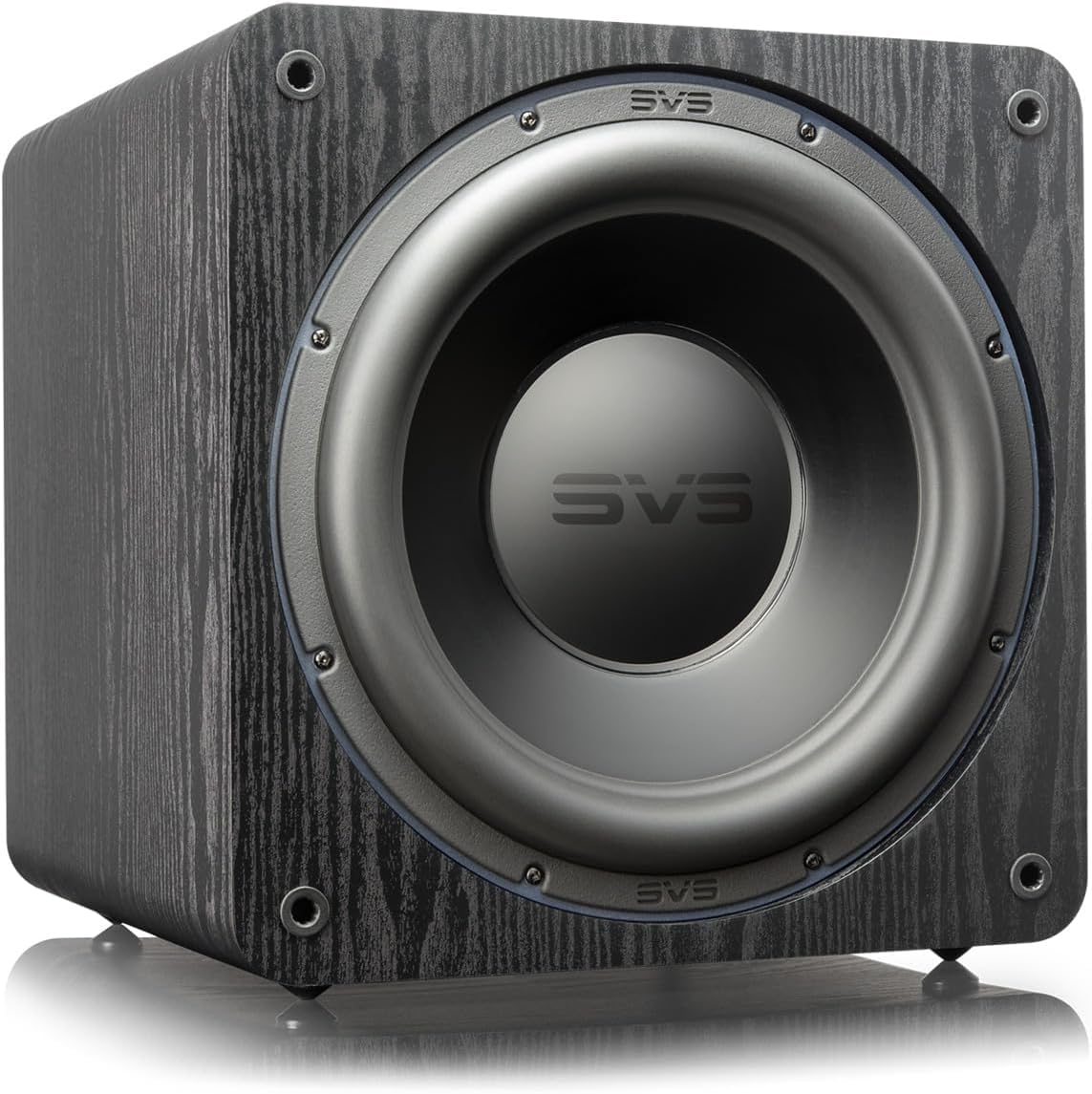
The SVS SB-3000 is a reference-class sealed subwoofer that redefines what a compact 13-inch cabinet can achieve. Its 800-watt RMS Sledge amplifier drives a 13-inch high-excursion driver with an aluminum vented cone, delivering measured output to 18 Hz at -3 dB with vanishingly low distortion. The 50 MHz Analog Devices Audio DSP allows parametric EQ, adjustable crossover slopes, and polarity inversion—all controllable via the SVS smartphone app.
In practice, the SB-3000 produces bass that feels physically present without the one-note boom associated with lesser sealed designs. Transient response is exceptional: the driver stops and starts with the speed required for double bass drum passages and complex synth pads, yet it can shake a couch during the low-frequency sweeps in sci-fi films. The sealed cabinet means no port noise and a gradual, natural roll-off below 20 Hz, making it forgiving in rooms that would excite standing waves with a ported design.
The trade-off is price: the SB-3000 sits in a premium bracket that only makes sense if you have the system and room to exploit its capabilities. It pairs best with high-quality bookshelf or tower speakers that can keep up with its speed and dynamic range. For audiophiles and home theater enthusiasts who demand single-digit extension, pinpoint accuracy, and app-based fine-tuning, the SB-3000 is the definitive sealed subwoofer in its class.
Why it’s great
- Exceptional 18 Hz extension with tight, accurate transient response
- Powerful smartphone app with parametric EQ and custom presets
- Rigid sealed cabinet eliminates port noise and standing wave issues
Good to know
- Premium pricing requires a commensurate system and room
- Bluetooth for app control only, not wireless audio streaming
3. Audioengine S8

The Audioengine S8 is a down-firing, sealed subwoofer engineered specifically for desktop and near-field listening environments, not for pressurizing a large home theater. Its 250-watt peak amplifier and 8-inch driver deliver a frequency response that reaches 27 Hz—impressive for the driver size—thanks to a well-damped cabinet and a long-throw design optimized for clean excursion rather than brute SPL.
Paired with Audioengine A5+ or A2+ speakers, the S8 integrates almost seamlessly because the crossover region between the satellites and the subwoofer is managed through adjustable low-pass filtering and a continuously variable volume control. The down-firing configuration hides the driver and ports, making placement against a wall or under a desk less acoustically penalizing than a front-firing design. Owners consistently note that the subwoofer disappears into the soundstage, adding depth and weight without localizing the bass source.
The S8 is not a budget option—it costs more than many 8-inch ported subs—but its build quality is exceptional, with a steel chassis and a thick MDF cabinet that resists vibration. The auto-sleep feature works reliably, drawing negligible power when idle. For anyone building a high-quality desktop stereo system where bass extension and accuracy matter more than absolute volume, the S8 is the benchmark.
Why it’s great
- Seamless integration with Audioengine and similar desktop speakers
- Down-firing design allows flexible placement without sonic penalty
- Build quality and cabinet damping are exceptional for the driver size
Good to know
- Limited output for large rooms or reference-level home theater
- Premium pricing compared to other 8-inch powered subwoofers
4. Rockville Rock Shaker 8

The Rockville Rock Shaker 8 provides an economical entry point into powered subwoofer ownership. Its 8-inch high-excursion driver, paired with a 400-watt peak Class-D amplifier, delivers tight, controlled bass that dramatically improves the low-end output of small bookshelf speakers or a basic desktop stereo system. The MDF cabinet is compact enough to tuck into a desk corner or entertainment center.
RCA and speaker-level inputs provide flexibility for connecting to a variety of sources, from a stereo receiver with a subwoofer output to a classic integrated amp using high-level pass-through. At moderate volumes, the Rock Shaker 8 produces clean bass that adds body to music and movie soundtracks without the muddiness that often plagues budget 6.5-inch and 8-inch subs. The adjustable crossover (50–150 Hz) allows reasonable integration with most satellite speakers.
Where cost-cutting becomes apparent is in the cabinet’s thin MDF construction and the supplied power cord, which some users report introduces a bloated quality to the bass until replaced with a higher-gauge cable. The lightweight build also means the cabinet can vibrate against flooring at high output levels. Nonetheless, for a subwoofer in this price tier, the Rock Shaker 8 offers surprising extension and build quality that outperform many similarly priced competitors.
Why it’s great
- Exceptional value for a powered subwoofer with RCA/speaker inputs
- Compact desktop-friendly size that punches above its weight
- Adjustable crossover provides decent integration flexibility
Good to know
- Thin MDF cabinet can vibrate at higher volumes
- Stock power cord may cause bloated bass; an aftermarket cord helps
5. Klipsch R-8SW

The Klipsch Reference R-8SW is a compact, down-firing subwoofer designed to add bass to small listening spaces without dominating the room visually. Its 8-inch spun-copper IMG (Injection Molded Graphite) woofer and 150-watt peak all-digital amplifier deliver clean, controlled low frequencies that integrate naturally with the Klipsch Reference and Reference Premiere speaker lines.
In a small to medium-sized room—roughly 150 to 250 square feet—the R-8SW produces bass that is tight and musical, never boomy or one-noted. It excels at adding weight to acoustic bass lines and kick drums, while also providing enough low-end impact for movie soundtracks at moderate listening levels. The down-firing configuration allows placement near walls or furniture without significant performance degradation, and the compact footprint (roughly 13 inches cubed) fits on a bookshelf or next to a desk.
The limitation is output headroom: the R-8SW cannot pressurize a large open-concept room or deliver the visceral chest-thump of a 10-inch or 12-inch subwoofer at high volumes. Some owners report an audible pop when the amplifier enters or exits standby mode, which can be distracting during quiet passages. For apartment dwellers or desktop listeners who need controlled, neighbor-friendly bass, the R-8SW is a solid, reliable choice.
Why it’s great
- Compact down-firing design fits easily into small rooms or desks
- Clean, musical bass that blends well with Klipsch speakers
- Easy setup with LFE or RCA inputs
Good to know
- Limited output for large rooms or action movie enthusiasts
- Some units produce an audible pop on power cycling
6. SVS SB-1000 Pro
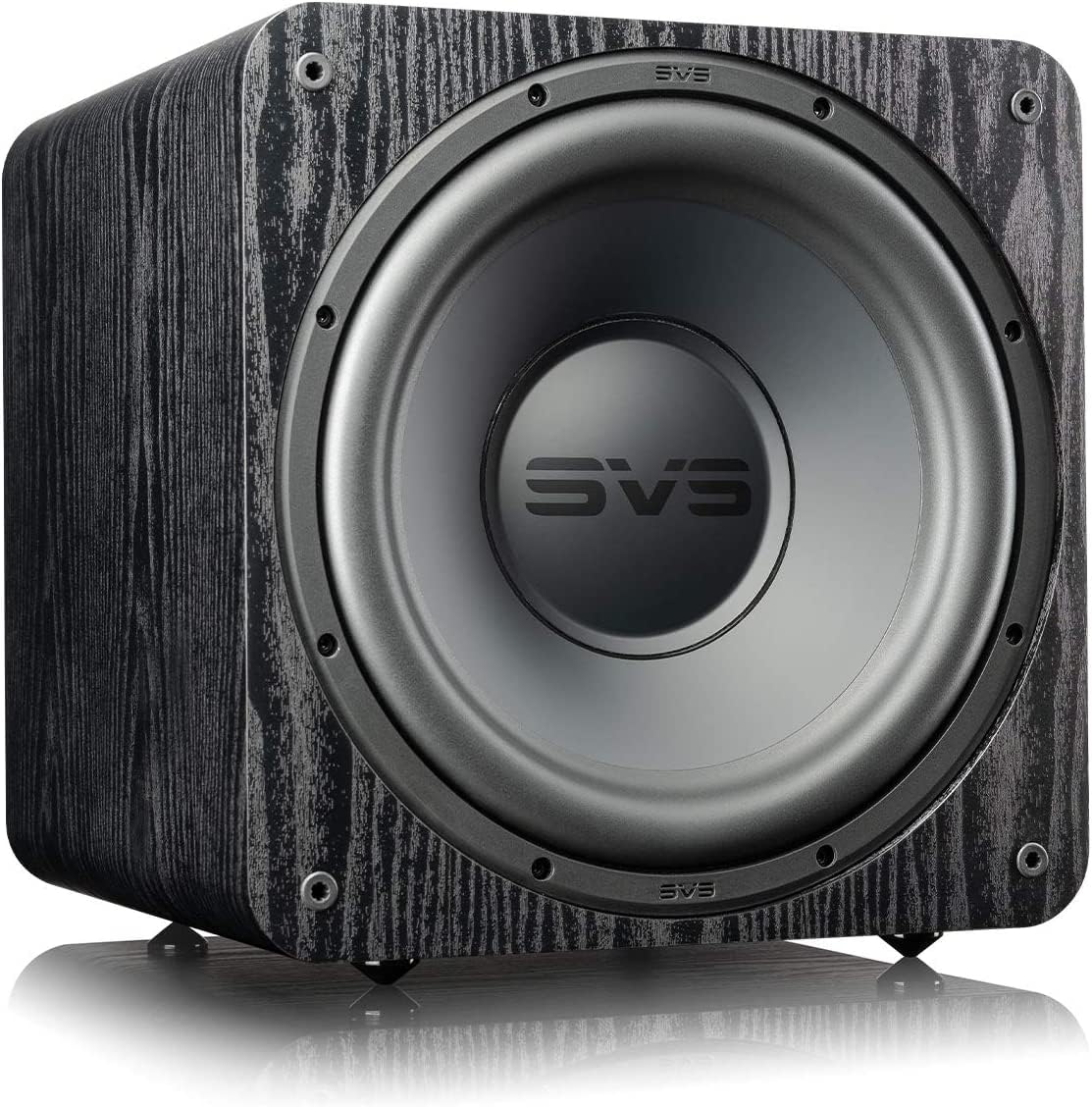
The SVS SB-1000 Pro is a sealed subwoofer that brings the performance and app-based control of the SVS ecosystem into a more accessible price range. Its 12-inch high-excursion driver is powered by a 325-watt RMS Sledge amplifier (820+ watts peak), and the 50 MHz Analog Devices Audio DSP provides room-tuning capabilities that were once reserved for + subwoofers.
In a medium room (250–400 square feet), the SB-1000 Pro delivers flat response down to 20 Hz with the speed and articulation expected from a sealed design. The SVS app allows volume, crossover, parametric EQ, and polarity adjustments from the listening position, which dramatically simplifies the integration process. Users can store multiple presets for music, movies, and gaming and switch between them instantly.
The sealed cabinet is compact—barely larger than a cubic foot—making it easy to position near furniture. While it cannot match the raw output of the larger SB-3000, the SB-1000 Pro is the most capable subwoofer in its price class for buyers who prioritize bass accuracy and tuning flexibility. It pairs exceptionally well with high-quality bookshelf speakers and mid-range floor-standing towers.
Why it’s great
- App-controlled DSP with parametric EQ for room-specific tuning
- Compact sealed cabinet with genuine 20 Hz extension
- Excellent transient response for music reproduction
Good to know
- Sealed design trades maximum SPL for accuracy and speed
- Dual subwoofers recommended for larger rooms to smooth bass response
7. Edifier T5s
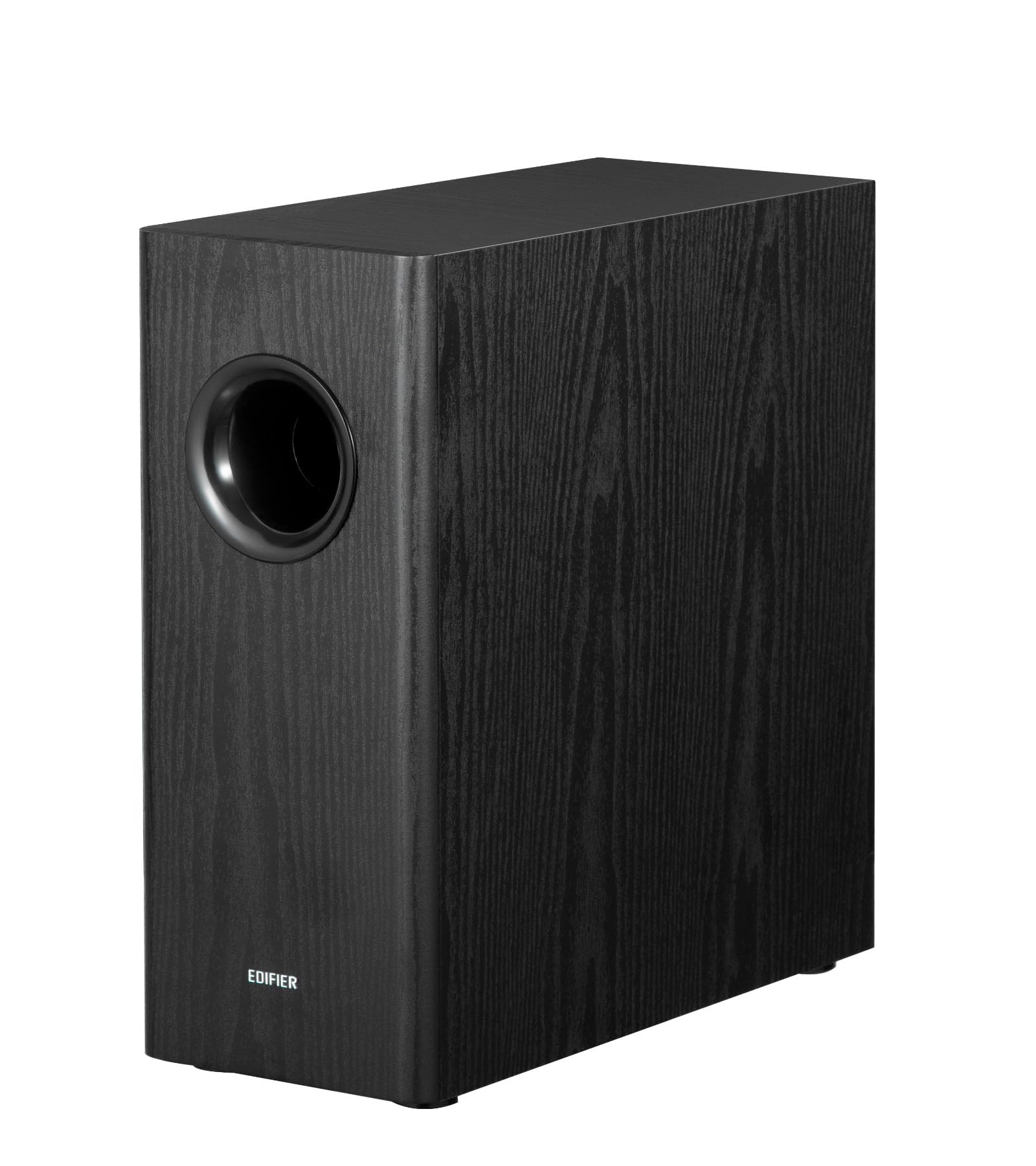
The Edifier T5s is a powered subwoofer designed specifically for pairing with Edifier active speakers and other desktop audio systems. Its 8-inch long-throw woofer and 70-watt RMS Class-D amplifier produce a frequency response reaching 35 Hz, which is notably deep for an 8-inch driver and sufficient for adding weight to desktop near-field listening.
The subwoofer’s slim, vertical cabinet (roughly 6.7 inches wide) occupies minimal desk or floor space, and the front-firing driver with a right-firing acoustic port allows placement against a wall without port obstruction. The adjustable low-pass filter (30–160 Hz) and 0°/180° phase switch enable precise integration with the main speakers, and Edifier provides multiple connection methods, including pass-through for systems without a dedicated subwoofer output.
In real-world use, the T5s adds a solid low-end foundation to the Edifier R1280Ts, R1700BTs, and similar models without overwhelming the room. The auto-standby feature activates after 15 minutes of inactivity, saving power automatically. The T5s is not designed for high-SPL home theater applications—its 70-watt amplifier runs out of headroom quickly in open spaces—but for desktop music listening and gaming, it delivers clean, articulate bass at a reasonable price.
Why it’s great
- 35 Hz extension from a compact 8-inch driver
- Pass-through connection works with systems lacking a sub output
- Auto-standby and slim design suit desktop use
Good to know
- Limited power for large rooms or home theater applications
- Designed primarily for Edifier speakers; integration with other brands requires careful setup
8. Polk Audio PSW10

The Polk Audio PSW10 is one of the longest-running budget-friendly subwoofers on the market, and for good reason: its 10-inch Dynamic Balance woofer and 50-watt RMS (100-watt peak) amplifier deliver smooth, musical bass that integrates well with a wide range of bookshelf and floor-standing speakers. The ported cabinet uses Polk’s Power Port technology, which flares the port opening to reduce turbulence and port noise at higher output levels.
In small to medium rooms (up to 250 square feet), the PSW10 provides enough low-end weight to make movies and music feel more substantial. The continuously variable crossover (80–160 Hz) allows reasonable blending with main speakers, and the phase toggle switch simplifies setup when using multiple subwoofers. The front-mounted, detachable grille gives the subwoofer a clean appearance that matches most Polk Monitor and T-Series speakers.
The primary limitation is output power: 50 watts RMS is modest by modern standards, and the PSW10 will run out of headroom in larger spaces or with demanding content. Keeping the gain below 50% is recommended to avoid distortion. Some users report a buzzing from the front grille at high volumes. For a budget-friendly subwoofer that focuses on musical accuracy rather than sheer volume, the PSW10 remains a reliable choice.
Why it’s great
- Smooth, musical bass that avoids boominess
- Power Port design reduces port noise for cleaner output
- Widely compatible with Polk and other speaker brands
Good to know
- Limited dynamic headroom; distortion increases at higher volumes
- Front grille may buzz during loud passages
9. Klipsch R-101SW

The Klipsch Reference R-101SW is a front-firing, ported subwoofer that brings the brand’s new spun-copper thermoformed crystalline polymer (TCP) woofer technology into a 10-inch form factor. The TCP material minimizes cone breakup and provides a clean frequency response from 28 Hz to 120 Hz, while the built-in all-digital amplifier delivers high efficiency and low distortion.
In real-world listening, the R-101SW produces deep, forceful bass that can “rattle your teeth loose,” as one owner described it, with enough output to pressurize a 300–400 square foot room. The front-firing driver allows flexible placement—against a wall or inside a cabinet—and the low-pass crossover and phase control enable seamless integration with Klipsch Reference and Reference Premiere speakers. The line/LFE inputs ensure compatibility with virtually any A/V receiver.
Compared to the smaller R-8SW, the R-101SW demonstrates significantly more authority in the sub-40 Hz region, making it a strong option for home theater use. The trade-off is size: the R-101SW is noticeably larger and heavier than its 8-inch sibling. For Klipsch system builders who want a subwoofer that balances output, clarity, and value without stepping up to the flagship RP series, the R-101SW is a compelling middle ground.
Why it’s great
- Powerful, clean output down to 28 Hz for a 10-inch ported design
- New TCP woofer material reduces cone breakup
- Low-pass crossover and phase control simplify system integration
Good to know
- Larger than the R-8SW; requires more floor space
- Wired connectivity only; no Bluetooth or wireless options
FAQ
Is a 12-inch subwoofer always better than an 8-inch subwoofer for deep bass?
Should I buy one expensive subwoofer or two budget-friendly subwoofers?
Does a sealed subwoofer really sound tighter than a ported subwoofer?
How do I know if my room is too small for a deep bass subwoofer?
Final Thoughts: The Verdict
For most users, the best deep bass subwoofer winner is the Rockville Rock Shaker 12 because it delivers genuine 12-inch output, adjustable crossover flexibility, and room-filling bass at a price that undercuts virtually every competitor with similar driver size. If you want the speed and DSP tuning of a premium sealed subwoofer, grab the SVS SB-1000 Pro. And for desktop near-field listening where accuracy matters more than sheer volume, nothing beats the Audioengine S8.

Mo Maruf
I created WellFizz to bridge the gap between vague wellness advice and actionable solutions. My mission is simple: to decode the research and give you practical tools you can actually use.
Beyond the data, I am a passionate traveler. I believe that stepping away from the screen to explore new environments is essential for mental clarity and physical vitality.