Our readers keep the lights on and my smoothie glass nicely filled. As an Amazon Associate, I earn from qualifying purchases.
Most decaf green tea tastes like disappointment in a mug — a watery, flat echo of the real thing that leaves you wondering why you bothered. But the chemistry of decaffeination doesn’t have to strip away the grassy notes, the subtle sweetness, or the clean finish. A properly produced decaf green tea retains the same polyphenol profile and aromatic complexity as its caffeinated counterpart, provided the manufacturer uses the right method and starting leaf quality.
I’m Mohammad Maruf — the founder and writer behind WellFizz. For this guide, I analyzed five leading decaf green tea products on the market, cross-referencing customer reviews against processing methods and ingredient lists to identify which brands deliver a genuinely satisfying cup.
What follows is a curated selection of the best decaf green tea options you can buy today, ranked by flavor retention, bag count value, and overall brewing consistency.
How To Choose The Best Decaf Green Tea
The decaf green tea aisle is crowded with boxes, but a closer look at three factors — decaffeination method, leaf grade, and natural flavoring — separates an enjoyable daily brew from a cardboard-tasting disappointment. Understanding these elements helps you avoid costly trial-and-error.
Decaffeination Method: CO2 vs. Ethyl Acetate vs. Water
The method used to remove caffeine is the single biggest predictor of final flavor quality. CO2 decaffeination uses pressurized carbon dioxide to selectively extract caffeine molecules while leaving the majority of polyphenols and essential oils intact, resulting in a cup that tastes nearly identical to the original. Ethyl acetate (sometimes called “natural solvent” because it occurs in fruit) strips caffeine with a chemical bath, often leaching flavor along with it. Water-based decaffeination (the Swiss Water Process) produces a clean cup but can drain more of the tea’s soluble solids.
Leaf Grade and Bag Construction
Even the best decaffeination process cannot resurrect low-quality fannings or tea dust — the broken leaf remnants that brew quickly but lack depth. Look for brands that use whole-leaf or large-broken-leaf green tea inside their teabags. Individually foil-wrapped bags also make a significant difference in freshness, preventing the tea from absorbing pantry odors and staling over weeks of use.
Natural vs. Artificial Flavor Profile
Many flavored decaf green teas rely on natural oils and extracts — ginger, peach, jasmine — which can mask the inherent weakness of a poorly decaffeinated base leaf. The best flavored decaf green teas use these additions to complement the green tea, not to hide it. If you prefer a pure, unflavored cup, prioritize brands whose ingredient list contains only green tea leaves and nothing else.
Quick Comparison
On smaller screens, swipe sideways to see the full table.
| Model | Category | Best For | Key Spec | Amazon |
|---|---|---|---|---|
| Stash Decaf Premium Green Tea | Mid-Range | Clean daily drinker | 100 bags; CO2 decaffeinated | Amazon |
| Yogi Green Tea Pure Green Decaf | Premium | Organic purity seekers | 96 bags; USDA Organic; plastic-free bags | Amazon |
| Twinings Decaf Green Tea | Mid-Range | Classic smooth flavor | 100 individual wrapped bags | Amazon |
| The Republic of Tea Decaf Ginger Peach Green Tea | Mid-Range | Flavored iced tea lovers | 50 bags; gluten-free; natural ginger oil | Amazon |
| Salada Decaffeinated Green Tea | Budget | Bulk value iced tea | 240 bags total (6 packs); water decaf | Amazon |
In‑Depth Reviews
1. Stash Decaf Premium Green Tea

Stash uses a CO2-based decaffeination process, and it shows in the taste. The brewed cup delivers a grassy, slightly nutty character with zero astringency — the hallmark of intact polyphenols and essential oils. At 100 individually foil-wrapped bags, this is a high-volume option that doesn’t sacrifice leaf quality for quantity.
Customers consistently note that this decaf green tea tastes nearly indistinguishable from the caffeinated version, a feat only possible when the decaffeination method preserves the leaf’s volatile aromatic compounds. The minimal 4 mg of caffeine per cup makes it suitable for evening drinking without disrupting sleep.
Stash carries a B Corp certification, which adds a layer of social responsibility for buyers who value ethical sourcing alongside flavor. The foil wrappers also protect the tea from moisture and odors, keeping each bag as fresh as the first.
Why it’s great
- CO2 decaf retains grassy flavor profile intact
- 100-count box with foil wrappers for freshness
- Zero astringency even on longer steeps
Good to know
- Some recent price fluctuations reported by buyers
- Not certified organic if that matters to you
2. Yogi Green Tea Pure Green Decaf
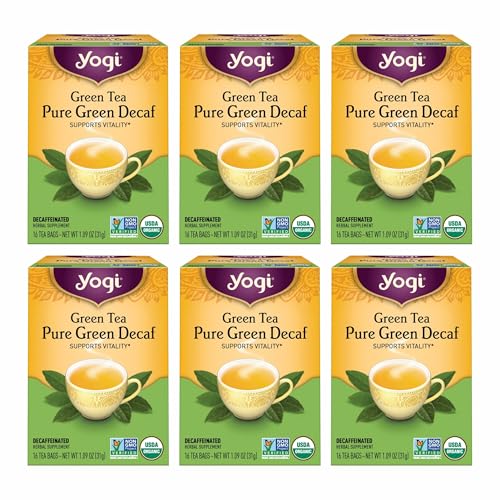
Yogi’s decaf green tea carries USDA Organic certification, Non-GMO Project Verification, and plastic-free compostable tea bags — credentials that matter for health-conscious drinkers who want their daily cup free of synthetic additives and microplastics. The flavor profile is bold and clean, with none of the cardboard notes that plague lower-tier decaf offerings.
The 96-bag count (six 16-bag boxes) accommodates pantry stocking without taking up too much shelf space. Buyers frequently report using this tea for both hot and iced preparations, noting that the bold flavor holds up well when diluted over ice.
One caveat: each tea bag uses a small metal staple to secure the string, a detail that some customers find inconvenient for composting. If you are zero-waste oriented, you may want to remove the staple before tossing the bag into your compost bin.
Why it’s great
- USDA Organic and Non-GMO Verified
- Plastic-free, compostable tea bags
- Bold flavor survives iced brewing well
Good to know
- Small metal staple on each bag string
- Bags are not individually wrapped — use box quickly
3. Twinings Decaffeinated Green Tea
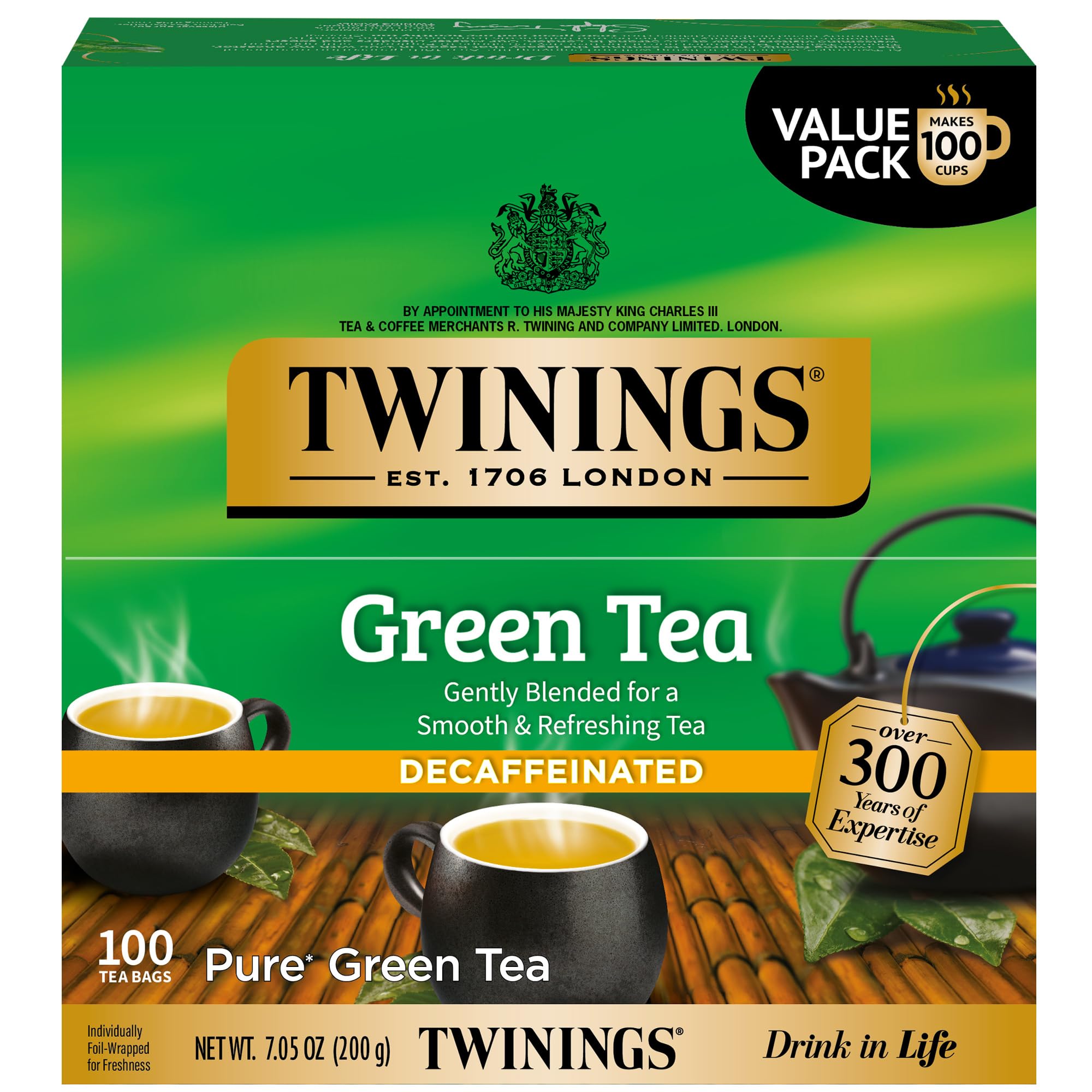
Twinings decaffeinated green tea brews a honey-yellow cup with a smooth, non-grassy flavor that appeals to drinkers who find traditional green tea too vegetal. The 100 individually sealed bags maintain freshness for months, making this a reliable pantry staple for daily sipping.
Customers who dislike the “grassy” or “seaweed” taste common in Japanese green teas consistently gravitate toward this blend — the flavor is mellow with a subtle sweetness and no bitterness, even when steeped slightly longer than the recommended time.
The packaging arrives in a sturdy box, though some buyers have reported damaged outer cartons during shipping. As long as the inner foil wrappers remain intact, the tea quality stays unaffected.
Why it’s great
- Non-grassy flavor profile for sensitive palates
- Individually sealed bags keep tea fresh for months
- Kosher certified and shelf-stable
Good to know
- Box can arrive with cosmetic damage in transit
- Less bold than organic competitors
4. The Republic of Tea Decaf Ginger Peach Green Tea
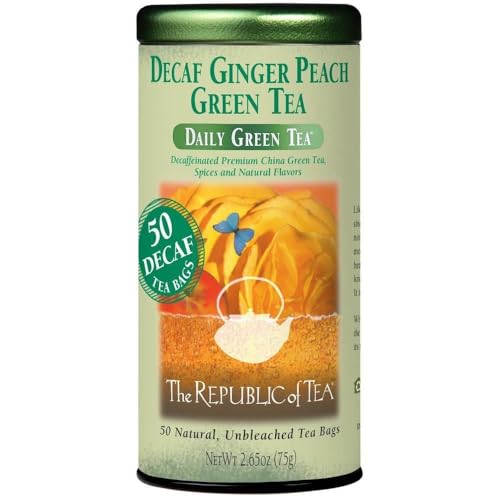
The Republic of Tea combines decaffeinated China green tea with natural peach flavor and ginger oil, creating a cup that tastes like a light dessert without any added sugar or sweeteners. The ginger provides a mild warmth that plays well against the fruity peach notes — a combination that works exceptionally well as iced tea.
At 50 bags in a tin, the count is lower than the bulk options above, but the flavor complexity justifies the difference for buyers who want variety rather than volume. The tin itself is resealable and travel-friendly, keeping the bags from getting crushed in a bag or drawer.
The tea is naturally gluten-free, sugar-free, and carb-free, making it suitable for dietary restrictions. Drinkers should note that the flavor is subtle rather than punchy — this is a gentle, aromatic cup rather than an intense fruit infusion.
Why it’s great
- Natural ginger and peach oils — no artificial taste
- Excellent hot or iced with no sweetener needed
- Resealable tin packaging for freshness
Good to know
- 50 bags per tin — lower count than bulk boxes
- Flavor is subtle, not overpowering fruit punch
5. Salada Decaffeinated Green Tea

Salada’s decaffeinated green tea uses natural spring water and effervescence — essentially a CO2-like physical process — to remove caffeine without chemical solvents. The resulting flavor is delicately smooth with a hint of natural sweetness, making it a reliable entry-level option for heavy tea drinkers.
Six boxes of 40 individually wrapped bags yields a total of 240 servings, the highest count in this roundup. Fans of the brand describe it as “the best flavored decaf green tea I’ve ever tasted” and report using it as a replacement for soda and water throughout the day.
The tea is zero-calorie and unsweetened, so any sweetness comes solely from the leaf itself. Brewed at 3-5 minutes, it produces a strong but smooth cup that transitions seamlessly to iced tea without turning cloudy or bitter.
Why it’s great
- 240 bags — highest volume for the money
- Water/effervescence decaf — no chemical solvents
- Smooth hot or iced without bitterness
Good to know
- Flavor is mild compared to premium single-origin
- Cardboard boxes are not individually sealed
FAQ
How is decaf green tea actually decaffeinated?
Does decaf green tea still have antioxidants?
How much caffeine is left in decaf green tea compared to regular green tea?
Final Thoughts: The Verdict
For most users, the best decaf green tea winner is the Stash Decaf Premium Green Tea because it combines CO2 decaffeination, a classic grassy flavor profile, and 100 individually wrapped bags at a strong value. If you want USDA Organic certification and plastic-free bags, grab the Yogi Green Tea Pure Green Decaf. And for a flavored option that works equally well iced on a hot afternoon, nothing beats The Republic of Tea Decaf Ginger Peach Green Tea.

Mo Maruf
I created WellFizz to bridge the gap between vague wellness advice and actionable solutions. My mission is simple: to decode the research and give you practical tools you can actually use.
Beyond the data, I am a passionate traveler. I believe that stepping away from the screen to explore new environments is essential for mental clarity and physical vitality.