Our readers keep the lights on and my smoothie glass nicely filled. As an Amazon Associate, I earn from qualifying purchases.
A dead auxiliary battery in the middle of a trip isn’t just an inconvenience—it can compromise your entire power system. A proper DC to DC charger ensures your second battery receives the correct voltage profile, whether you’re running a fridge, lights, or a CPAP machine off-grid.
I’m Mohammad Maruf — the founder and writer behind WellFizz. I’ve spent countless hours dissecting the technical specifications, user feedback, and real-world performance data of on-board chargers to identify which models actually deliver on their promises for dual battery setups.
After evaluating amperage ratings, MPPT integration, lithium compatibility, and multi-stage charging algorithms, I’ve narrowed down the field to the most reliable options. This guide covers everything you need to confidently select the best dc to dc charger for your vehicle or marine application.
How To Choose The Best DC To DC Charger
Selecting the right DC to DC charger involves more than just picking the highest amperage. You need to consider your battery chemistry, whether you plan to add solar later, and the physical space available for installation. Here are the key factors to evaluate before buying.
Battery Chemistry Compatibility
Not all chargers support every battery type. Lithium iron phosphate (LiFePO4) batteries require a higher absorption voltage (typically 14.4V to 14.6V) and a different charging profile than AGM or flooded lead-acid. If you run a lithium house battery, ensure the charger explicitly lists LiFePO4 or “Li” in its supported profiles. Units like the REDARC and Renogy allow you to select the chemistry via a DIP switch or app, which is essential for correct charging.
MPPT Solar Input vs. Standalone Alternator Charging
Many modern DC-DC chargers integrate a Maximum Power Point Tracking (MPPT) solar controller, allowing you to charge your auxiliary battery from both the alternator and solar panels using a single device. This reduces wiring complexity and saves space. If you plan to install solar panels later, choosing a unit with built-in MPPT, like the Renogy or Redodo, gives you future flexibility without needing an additional controller.
Amperage and Alternator Load Management
The charging current, measured in amps, determines how quickly your auxiliary battery recharges. A 30A charger will refill a 100Ah battery much faster than a 20A unit. However, higher amperage also places more load on your vehicle’s alternator. Verify that your alternator can handle the added draw, especially at idle. Smart chargers automatically reduce current if the alternator voltage drops, protecting both the alternator and your starter battery.
Quick Comparison
On smaller screens, swipe sideways to see the full table.
| Model | Category | Best For | Key Spec | Amazon |
|---|---|---|---|---|
| REDARC Dual Input 25A | Premium | Overland & Extreme Off-Road | 25A output, MPPT solar, 176°F rated | Amazon |
| Victron Orion-Tr Smart 30A | Premium | Bluetooth Monitoring & Marine | 30A, built-in Bluetooth, 3-stage charging | Amazon |
| BLUETTI Charger 1 560W | Premium | Portable Power Station Charging | 560W, 6X faster than 12V outlet | Amazon |
| Renogy 12V 30A with MPPT | Mid-Range | Solar + Alternator Hybrid Van Builds | 30A, built-in MPPT, dual-input | Amazon |
| Redodo 12V 40A with MPPT | Mid-Range | High Amperage on a Budget | 40A output, MPPT, LiFePO4 activation | Amazon |
| Nilight 140A VSR Kit | Budget | Simple Lead-Acid Dual Battery Isolation | 140A relay, VSR, not for lithium | Amazon |
| LiTime 24V 20A Charger | Budget | 24V Lithium Battery Charging Only | 20A, 29.2V output, 0V wake-up | Amazon |
In‑Depth Reviews
1. REDARC Dual Input 25A In-Vehicle DC to DC Battery Charger

The REDARC BCDC1225D is engineered for the harshest environments, with a fully sealed, potted electronics design that withstands deep water crossings, extreme heat up to 176°F, and relentless vibration. Its dual-input architecture accepts both alternator power and solar panels simultaneously, while the Green Power Priority logic automatically draws from solar first to reduce alternator load and improve fuel efficiency. The unit delivers a stable 25A output at 14.4V for LiFePO4 batteries, with multi-stage charging profiles for AGM, Gel, Lead Acid, and Calcium chemistries.
Users consistently highlight the charger’s over-engineered build quality, noting the massive heatsink and thick cable lugs. The unit includes over-voltage and under-voltage shutoff protection, which prevents damage during extreme alternator spikes or deep discharge conditions. While it lacks built-in Bluetooth monitoring (unlike some competitors), the reliability-focused design means less need for constant tweaking once installed.
The 25A rating is ideal for battery banks sized between 75Ah and 200Ah, making it a perfect match for most overlanding and RV setups. Some users may find the lack of an integrated display limiting, but the straightforward DIP switch configuration and proven track record in Australian outback testing make this a trusted choice for those who prioritize durability above app connectivity.
Why it’s great
- Ruggedized, sealed design survives submersion and extreme temps
- Green Power Priority solar-first logic reduces alternator wear
- Compatible with LiFePO4, AGM, Gel, and Calcium batteries
Good to know
- No built-in Bluetooth or smartphone app monitoring
- 25A output may feel underpowered for larger 300Ah+ battery banks
2. Victron Energy Orion-Tr Smart DC to DC Charger 30A

The Victron Orion-Tr Smart 30A offers unmatched configurability through its integrated Bluetooth and VictronConnect app, allowing you to monitor voltage, current, and temperature in real time, and adjust absorption voltage and float settings directly from your phone. Its three-stage charging (bulk, absorption, float) is optimized for both lead-acid and lithium batteries, automatically selecting the correct profile. This non-isolated unit is ideal for vehicles with a common negative ground, such as most vans, RVs, and boats.
Users praise the easy installation using screw terminals and the compact footprint that fits into tight engine bays. The ability to parallel multiple units for higher output power is a standout feature for those building expandable systems. The Bluetooth range is sufficient for monitoring from inside the cabin, and the data logging helps diagnose charging issues over time.
One common note is that the unit requires adequate airflow to maintain full 30A output under sustained load. Some users recommend adding a small fan for enclosed installations. While the price point is higher than some mid-range competitors, the brand’s proven reliability and extensive global support network justify the investment for serious off-grid and marine applications.
Why it’s great
- Full Bluetooth monitoring and adjustable charging profiles via app
- Can parallel multiple units to increase total output current
- Compact design with convenient screw terminals
Good to know
- Non-isolated design not suitable for all negative-ground systems
- Needs active cooling in enclosed spaces to sustain 30A
3. BLUETTI Charger 1 560W Alternator Charger

The BLUETTI Charger 1 is specifically designed to charge portable power stations, not just standard auxiliary batteries. It delivers up to 560W of DC-DC conversion, claiming six times the speed of a standard 12V cigarette lighter outlet. The intelligent algorithm automatically detects the vehicle’s alternator voltage to prevent draining the starter battery, and it works with 95% of third-party power stations via adjustable voltage output. This unit is a perfect fit for road trippers who rely on generator-style battery packs rather than traditional house batteries.
Users on extended camping trips report charging a 1200Wh power station from near zero in about 1.5 hours of driving. The active cooling fan keeps performance stable during sustained high-output operation, even in warmer climates. The compact and lightweight design (just 2.6 pounds) makes it easy to mount in limited space or even stow when not in use.
The main limitation is its short DC input cable, which may require extension for full-size trucks with tailgate-mounted power stations. Additionally, the unit is not fully weather-sealed, so it should be installed in a dry, ventilated compartment. For those primarily charging power stations from a vehicle alternator, this is one of the fastest and most convenient options available.
Why it’s great
- Extremely fast 560W charging for portable power stations
- Intelligent algorithm prevents starter battery drain
- Wide compatibility with BLUETTI and third-party units
Good to know
- Short input wire harness may need extension for large trucks
- Not weather-sealed; requires dry installation location
4. Renogy DC to DC Charger with MPPT 12V 30A

The Renogy 12V 30A DC to DC Charger with MPPT combines two essential charging sources in one compact unit. It accepts both alternator input and solar panel input, with built-in MPPT technology that maximizes solar harvest by tracking the panel’s maximum power point. The 3-stage charging (bulk, boost, float) ensures your auxiliary battery reaches 100% capacity without overcharging, and the unit supports multiple chemistries including lithium, AGM, Gel, and flooded batteries.
Users who have installed this in van builds and RVs appreciate the ability to prioritize solar energy when both inputs are active, reducing alternator load and saving fuel. The Modbus communication protocol allows integration with the Renogy ecosystem for real-time monitoring via the DC Home app, though a separate Bluetooth module (BT-2) is required for wireless connectivity. The marine-grade construction and protection against reverse polarity, over-voltage, and over-temperature add confidence.
Some users note that the physical size, while compact, still requires adequate clearance for wiring and ventilation. A few reports mention that the unit can feel underpowered compared to dedicated high-amp chargers, but the 30A rating is well-matched to typical 100Ah to 200Ah house battery banks. For those building a solar-ready system from the start, this dual-input design eliminates the need for a separate solar charge controller.
Why it’s great
- Dual-input with built-in MPPT for solar and alternator charging
- Multi-stage smart charging for all major battery chemistries
- Marine-grade construction with extensive protection circuits
Good to know
- Bluetooth monitoring requires separate BT-2 module purchase
- Some users report efficiency is less than dedicated MPPT controllers
5. Redodo 12V 40A DC to DC Charger with MPPT

The Redodo 12V 40A charger delivers the highest continuous current in this list, making it an excellent choice for rapidly recharging large auxiliary battery banks. Like the Renogy, it integrates MPPT solar input alongside alternator charging, and it supports reverse charging to trickle-charge the starter battery if needed. The included Anderson connectors simplify installation and provide a secure, polarized connection that is common in the RV and campervan world.
Users report that the unit reliably charges 100Ah LiFePO4 batteries from near empty to full within a few hours of driving. The compact dimensions (5.8 x 1.9 x 7.4 inches) and 2.4-pound weight are impressive given the 40A rating, allowing installation in tight spaces. The LED indicators clearly show charging status and fault conditions, though some users wish for a more detailed display.
Reliability feedback is mixed, with some users experiencing early failures and citing slow customer support response. While the 40A current is a clear advantage, the unit’s long-term durability is less proven than established brands like Victron or REDARC. For budget-conscious builders who need high current output and MPPT capability, the Redodo offers compelling specs, but consider the risk of potential support issues.
Why it’s great
- Highest amperage output (40A) in this comparison
- Built-in MPPT for solar input and Anderson connectors for easy install
- Supports LiFePO4 BMS activation and reverse starter battery charging
Good to know
- Reliability concerns and mixed customer support experiences reported
- No Bluetooth or app connectivity for remote monitoring
6. Nilight 12V 140AMP Dual Battery Isolator Kit
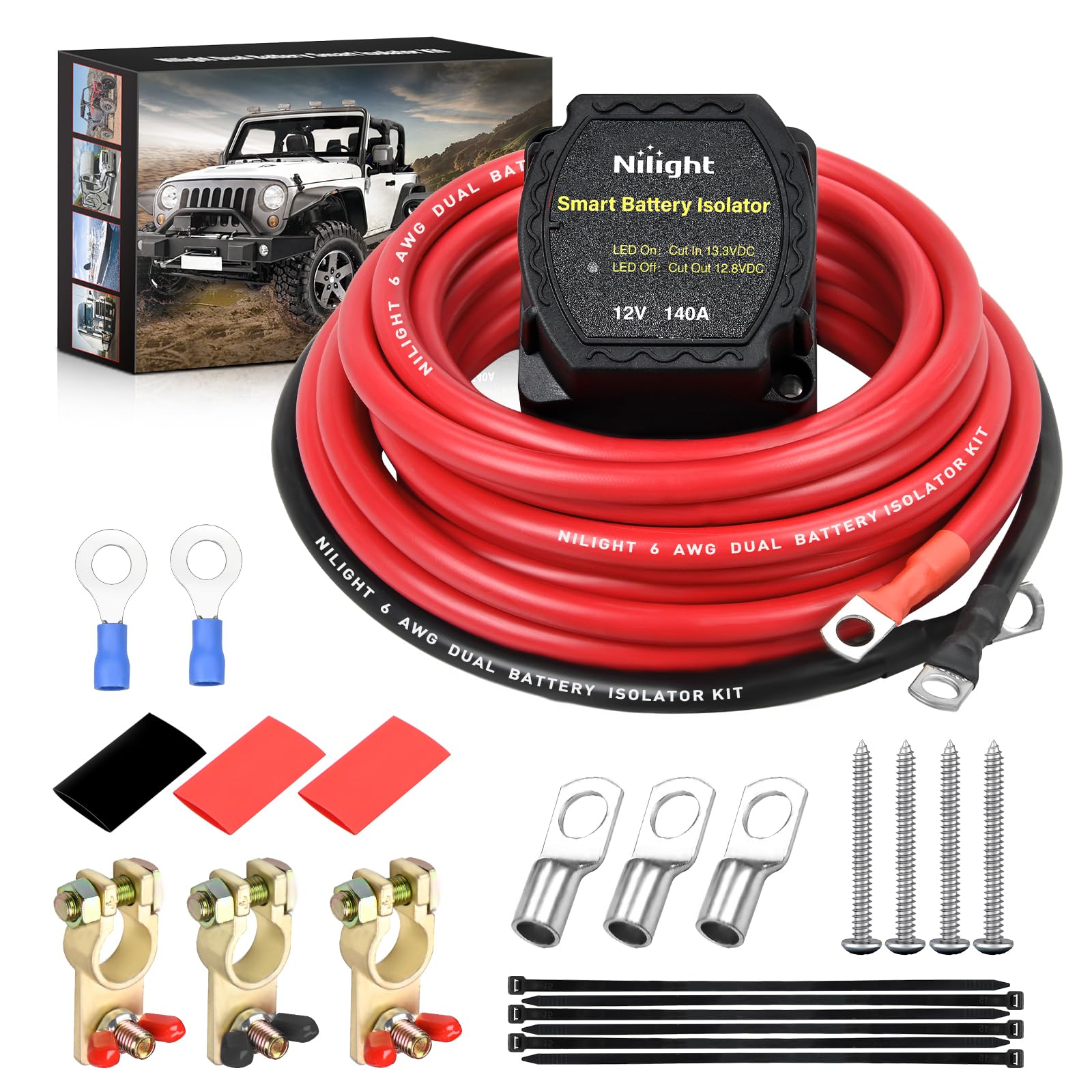
The Nilight 140A kit is a Voltage Sensitive Relay (VSR) isolator, not a multi-stage DC-DC charger. It connects your starter and auxiliary batteries through a high-current relay that closes when the alternator voltage exceeds 13.3V and opens when it drops below 12.8V. This is the simplest method for charging a second lead-acid battery from your alternator, requiring no complex programming. The included 6 AWG power cables, marine-grade terminals, and IP66 waterproof housing make it a practical entry-level solution.
Users appreciate the straightforward installation and the comprehensive hardware package that includes everything needed for a basic dual-battery setup. The 140A continuous rating handles high-draw accessories like inverters without overheating. However, the kit is explicitly incompatible with lithium batteries, which need a specific charging voltage profile that a simple relay cannot provide.
A few users report durability concerns in marine environments, with one review mentioning a display failure after a month on a boat. The reliance on a passive voltage threshold means the auxiliary battery may never reach 100% charge if the alternator output is inconsistent. For those with lead-acid batteries and a limited budget who need a simple shared-charge solution, this VSR kit works, but it lacks the sophistication of a true DC-DC charger.
Why it’s great
- Very affordable with complete install kit included (cables, terminals, accessories)
- High 140A current rating and IP66 waterproof enclosure
- Simple VSR operation, no programming needed
Good to know
- Not compatible with lithium batteries—leads to undercharging
- Lacks multi-stage charging; battery may not reach full charge
- Some durability concerns reported in wet or high-vibration environments
7. LiTime 24V 20A LiFePO4 Battery Charger
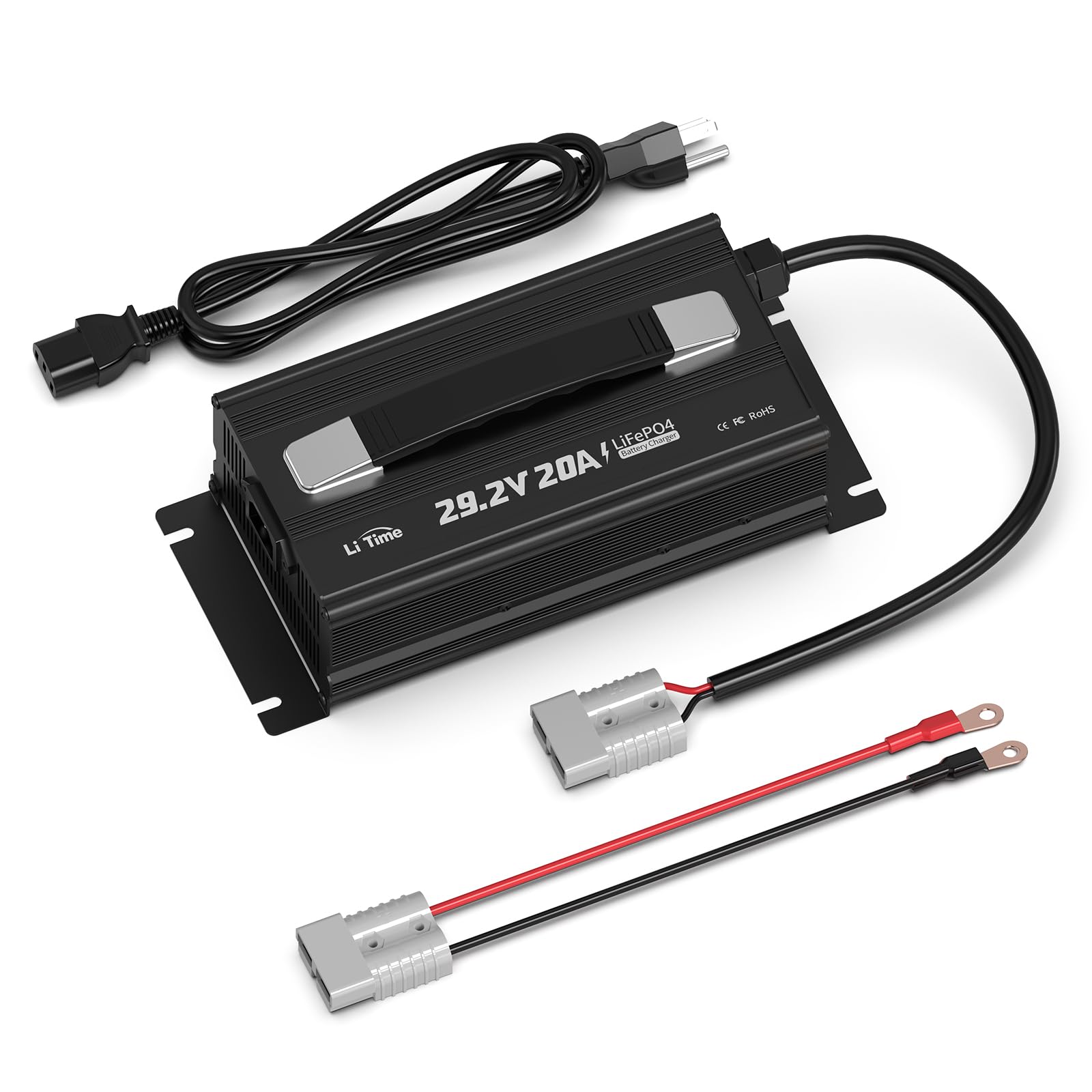
The LiTime 29.2V 20A charger is designed exclusively for 24V (25.6V nominal) LiFePO4 battery banks. It uses advanced LLC half-bridge resonant soft-switching technology to deliver efficient, low-ripple DC power. The 0V activation feature is critical for reviving deeply discharged lithium batteries whose BMS has shut down the output—a common frustration that this charger solves seamlessly. The aluminum alloy shell and built-in fan provide active thermal management during sustained charging cycles.
Users report that this charger quickly brings 50Ah 24V batteries from 45% to 95% in about an hour, making it a practical tool for maintaining off-grid solar systems, RVs, and home backup setups. The CE and RoHS certifications add confidence regarding safety and build quality. The Anderson connector output is standard for many lithium battery terminals, simplifying the connection.
This unit is an AC-DC charger, not a DC-DC alternator charger. It requires a 240V AC input, making it suitable for stationary charging at home, at a campsite with shore power, or in a garage. It is not designed for in-vehicle alternator charging and is explicitly not waterproof, so it is not suitable for marine or exposed outdoor installations. For those who need a dedicated AC-powered charger for a 24V lithium bank, the LiTime performs very well with minimal fuss.
Why it’s great
- 0V activation feature revives deeply discharged lithium batteries
- Fast charging—reports of 45% to 95% in roughly one hour
- Compact, lightweight design with efficient thermal management
Good to know
- AC-DC only, not suitable for in-vehicle alternator charging
- Not waterproof; avoid use in boats or outdoor exposed locations
FAQ
Can I use a DC to DC charger with a lithium battery that has a built-in BMS?
What is the difference between an isolated and a non-isolated DC to DC charger?
Final Thoughts: The Verdict
For most users, the best dc to dc charger winner is the REDARC Dual Input 25A because its ruggedized build, Green Power Priority logic, and proven outback reliability make it the most dependable choice for off-grid and overlanding applications. If you want Bluetooth monitoring and app-based configurability, grab the Victron Orion-Tr Smart 30A. And for fast alternator charging of portable power stations, nothing beats the BLUETTI Charger 1.

Mo Maruf
I created WellFizz to bridge the gap between vague wellness advice and actionable solutions. My mission is simple: to decode the research and give you practical tools you can actually use.
Beyond the data, I am a passionate traveler. I believe that stepping away from the screen to explore new environments is essential for mental clarity and physical vitality.