Our readers keep the lights on and my smoothie glass nicely filled. As an Amazon Associate, I earn from qualifying purchases.
Selecting a data acquisition system means choosing between simple USB adapters for CAN bus logging and multi-channel benchtop analyzers for precision thermal profiling. The wrong pick leaves you with incomplete data, compatibility headaches, or a tool that chokes on your fastest transients.
I’m Mohammad Maruf — the founder and writer behind WellFizz. This guide compresses hundreds of hours reading datasheets, cross-referencing customer failure modes, and benchmarking the real-world throughput of the seven most compelling DAQ systems available today.
Whether you need isolated CAN interfaces for automotive work or a full-stack lab instrument that fits in a pocket, the best data acquisition system depends on matching channel count, sampling rate, and software ecosystem to your specific measurement goal.
How To Choose The Best Data Acquisition System
Every DAQ purchase starts with three questions: what signal type are you measuring, at what speed, and with how many channels. The answers dictate whether a USB dongle, a dedicated logger, or a hybrid oscilloscope-logger is the right fit.
Sampling Rate and Resolution
Slow-changing signals like temperature or power consumption are well served by loggers sampling once per second with 12–16 bit resolution. High-speed diagnostics require rates above 1 MS/s—the Analog Discovery 3’s 125 MS/s per channel covers audio, power supply ripple, and most digital protocols. A mismatch here means aliased data or an empty buffer.
Isolation and Input Protection
Galvanic isolation prevents ground loops from corrupting measurements and protects your PC port. The GRIDCONNECT CAN adapter uses isolation for safe automotive CAN bus work, while the HUATO S220-T8 isolates each thermocouple channel. If you are measuring transients or powered circuits, isolation is not optional.
Software and Connectivity
The hardware is only half the equation. WaveForms (Digilent), HOBOware (Onset), and LogPro (HUATO) each have distinct learning curves and export capabilities. For lab work, an SDK (C, Python, MATLAB) matters more than a pretty UI. For field logging, stand-alone operation with USB download is critical—check whether the logger can run on battery without a live connection.
Quick Comparison
On smaller screens, swipe sideways to see the full table.
| Model | Category | Best For | Key Spec | Amazon |
|---|---|---|---|---|
| Analog Discovery 3 | Benchtop Lab | Multi-instrument prototyping | 125 MS/s, 14-bit, 2-ch scope | Amazon |
| Diesel Laptops Nexiq USB Link 3 | Vehicle Diagnostic | Heavy-duty truck ECM access | 9-pin + OBDII + 6-pin connectors | Amazon |
| Asustor Lockerstor 10 AS6510T | Network Storage | Enterprise data aggregation | Dual 10GbE + Dual 2.5GbE ports | Amazon |
| HUATO S220-T8 | Thermocouple Logger | Multi-point temperature profiling | 8 channels, -200 to 1800°C range | Amazon |
| HOBO UX120-018 | Plug Load Logger | Energy/power consumption logging | 0.5% accuracy, 1/sec logging | Amazon |
| GRIDCONNECT CAN USB Adapter | CAN Bus Interface | Automotive/industrial CAN logging | Isolated, baud rates up to 1M | Amazon |
| MINISFORUM MS-01 | Mini Workstation | High-performance data server/host | 2x 10G SFP+, i9-13900H | Amazon |
In‑Depth Reviews
1. Analog Discovery 3
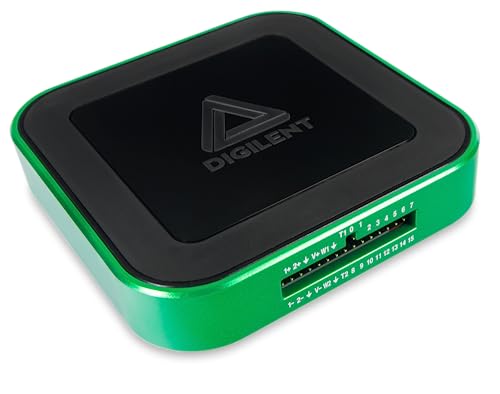
The Analog Discovery 3 collapses an oscilloscope, waveform generator, logic analyzer, spectrum analyzer, network analyzer, and two programmable power supplies into a pocket-sized USB device. Its 125 MS/s per channel with 14-bit resolution captures clean FFTs and eye diagrams for signals up to about 30 MHz, covering the vast majority of embedded and analog work.
WaveForms software bundles everything from a lock-in amplifier to a protocol analyzer for SPI, I2C, UART, CAN, and JTAG. The SDK opens C, C++, Python, and MATLAB scripting for automated test sequences. Users report the software has a modest learning curve but becomes indispensable for daily bench debugging.
The dual-channel ±25 V input range, coupled with user-configurable input filters, makes it safe for general-purpose lab use. A built-in impedance analyzer and data logging capability round out a package that replaces several thousand dollars of separate instruments for sub-30 MHz work.
Why it’s great
- Replaces 5+ benchtop instruments in a single USB-C device
- 14-bit resolution delivers cleaner FFT and spectrogram data than 8-bit scopes
- SDK support for Python and MATLAB enables automated DAQ scripting
Good to know
- WaveForms UI can feel cluttered for first-time users
- Trigger stability can occasionally miss thresholds on fast edges
- Bandwidth limited to ~30 MHz with BNC adapter
2. Diesel Laptops Nexiq USB Link 3 Wired Edition

The Nexiq USB Link 3 is a professional-grade vehicle communication interface built for accessing ECM data on heavy-duty trucks. It ships with 9-pin (J1939), OBDII, and 6-pin connectors, covering most Class 8 trucks and diesel-powered equipment. The wired version eliminates Bluetooth pairing delays—critical when flashing ECUs or logging live data streams.
Bundled Diesel Explorer software reads and clears fault codes, displays live sensor data, and downloads ECM reports. The 90-day Diesel Repair Professional subscription adds wiring diagrams, fault code troubleshooting trees, and labor time guides. Users report immediate compatibility with Cummins Insite, JPro, and other major diagnostic suites on Windows 10.
Build quality matches genuine Nexiq standards—several reviewers switched from failed Chinese clones to this unit and reported flawless operation with Peterbilt and Kenworth platforms. The J1587 add-on adapter is available for legacy systems, and the single-cable design is rugged enough for daily shop use.
Why it’s great
- Works immediately with OEM software (Cummins Insite, JPro, CAT ET)
- Three included connector types cover most heavy-duty protocols
- Genuine Nexiq hardware avoids clone compatibility issues
Good to know
- Price reflects professional-grade tooling—overkill for personal OBDII scanning
- Wired-only design limits mobility compared to Bluetooth variants
- Diesel Repair subscription is time-limited (90 days)
3. Asustor Lockerstor 10 AS6510T

For DAQ setups that generate terabytes of high-speed logs and large file archives, the Lockerstor 10 provides a centralized storage hub with enterprise networking. The Intel Atom C3538 quad-core processor handles RAID calculations, file sharing, and backup operations around the clock. Ten drive bays support massive capacity—reviewers report 130 TB RAID5 arrays.
Dual 10GbE and dual 2.5GbE ports enable link aggregation for sustained bandwidth to multiple DAQ host PCs or workstations. Two M.2 NVMe slots can serve as SSD cache or be configured as a separate high-speed volume. The system runs Asustor’s ADM software with apps for backup, cloud sync, and surveillance, plus Docker and VPN for remote access.
Price and performance fall short of a high-end workstation for real-time DAQ processing—the Atom CPU can bog down during parity calculations and media transcoding. For pure centralized storage with strong data protection (RAID6 hot-swap, auto-rebuild), it is a reliable and quiet addition to a lab network.
Why it’s great
- 10-bay capacity with RAID5/6 for redundant large-scale data storage
- Dual 10GbE ensures no network bottleneck for multiple DAQ hosts
- Hot-swap drive trays and auto-rebuild simplify drive replacements
Good to know
- Atom C3538 is slow for parity-heavy operations and large file transfers
- Initial RAID creation can take several days for high-capacity arrays
- No multi-homing per interface; some advanced network configs limited
4. HUATO S220-T8 Eight Channel Thermocouple Data Logger

The S220-T8 is a dedicated eight-channel thermocouple logger with input isolation between each channel—critical when measuring multiple points with different ground potentials. It supports types K, J, E, T, N, S, R, and B across a wide temperature span, storing up to 86,000 data points per channel. The large LCD displays real-time readings for all eight inputs simultaneously.
LogPro software from Zeolite International is plug-and-play: users report learning the interface within minutes. The AC adapter power option avoids battery changes during extended profiling sessions, though the unit also runs on a 9V battery for field use. Replacements of defective units were handled quickly and professionally by the seller.
Reviewers note that only one thermocouple is included in the box—six of the eight channels will need separate probes. The thermocouple plug spacing is tight and may limit the use of bulky connectors to four channels if not careful. When configured correctly, readings match high-end reference systems.
Why it’s great
- Eight fully isolated thermocouple channels prevent ground-loop errors
- 86,000-point memory per channel supports long-duration profiling
- Intuitive LogPro software with real-time display and data export
Good to know
- Only one thermocouple included; seven additional probes must be purchased
- Plug spacing on the housing can crowd adjacent connections
- NIST traceable certification may not be included despite listing
5. HOBO by Onset UX120-018 Data Logger

The UX120-018 is a plug-load power logger that measures true RMS current, voltage, power factor, and cumulative energy with 0.5% accuracy. Its “Meter Mode” displays real-time variables on the built-in screen without needing a connected computer—ideal for walking through a facility and spot-checking equipment draw. The unit logs time-stamped and totalized data for detailed energy analysis of individual loads.
HOBOware software provides robust graphing with annotations and zoom, data export, and summary reports. Users have validated the logger against other reference meters during thermal qualification of gaming PCs and solar-powered camper setups. The internal battery lasts about six months of continuous logging but requires removing four screws and opening the entire case to replace.
Fastest logging interval is one second, which is sufficient for appliance-level energy audits but too slow for transient capture. A small number of units have developed display failures, and HOBOware has a learning curve when editing logged data. For steady-state power profiling, it is one of the most reliable tools at its level.
Why it’s great
- 0.5% accuracy for credible energy and power quality measurements
- Meter Mode enables on-the-spot readings without a host PC
- Battery backup preserves data during power outages
Good to know
- Battery replacement requires full disassembly of the case
- Maximum logging rate of 1 sample/second misses fast transients
- HOBOware software can struggle with editing out erroneous data points
6. GRIDCONNECT CAN USB Adapter with Isolation

The GRIDCONNECT IPEH-002022 is a compact USB-to-CAN adapter with galvanic isolation, protecting the host PC from ground loops and transients common in automotive and industrial CAN bus environments. It supports baud rates up to 1 Mbit/s and is compatible with USB 1.1, 2.0, and 3.0 ports. The 9-pin male SUB-D connector matches the standard CAN pinout for quick hookup to vehicle or machine networks.
Users report seamless integration with PCAN-View software and MoTeC devices for programming engine control units. The isolated design is the key differentiator here—non-isolated adapters risk damaging a PC when connected to powered vehicle networks, especially during cranking or alternator spikes.
Reviews are consistently positive: the device works out of the box with no driver hassles on Windows, and the small form factor (1.7 x 0.9 x 3.4 inches) fits in any laptop bag. The matte white plastic housing is functional but not ruggedized—care is needed in shop environments with oil or moisture.
Why it’s great
- Galvanic isolation protects host PC from ground loops and spikes
- Plug-and-play with PCAN-View and common diagnostic suites
- Supports up to 1 Mbit/s standard CAN baud rates
Good to know
- Plastic housing is less durable than metal-enclosed alternatives
- Limited to one CAN channel; multi-channel setups need multiple units
- Software ecosystem is PCAN-centric; not universal for all CAN protocols
7. MINISFORUM MS-01 Mini Workstation

The MS-01 is a compact workstation purpose-built to serve as a DAQ host, data server, or home lab node. Its Intel Core i9-13900H (14 cores, 20 threads, up to 5.4 GHz) provides the processing headroom to run multiple acquisition applications simultaneously. Two 10G SFP+ and two 2.5G RJ45 ports eliminate network bottlenecks when streaming high-bandwidth data to storage or visualization tools.
Storage is equally flexible: three M.2 NVMe slots (supporting 2280 and enterprise 22110 form factors), a U.2 adapter for high-capacity enterprise SSDs, and a standard PCIe x16 slot for a graphics card or additional DAQ interface card. The unit runs quietly under load and shipped with Windows 11 Pro pre-installed on the 1TB SSD.
Several users deployed the MS-01 as a Proxmox virtualization host running multiple DAQ and analysis VMs. The Intel X710-based SFP+ ports have exhibited intermittent disconnects on some units, which appears to be a firmware compatibility issue. For most lab and server roles, the performance-per-liter ratio is excellent.
Why it’s great
- Dual 10G SFP+ ports provide high-speed data ingress for multiple DAQ streams
- Three NVMe slots with U.2 adapter support massive local logging capacity
- Compact footprint and quiet operation suit benchtop and rack environments
Good to know
- Intel X710 10G ports have shown intermittent disconnection issues on some units
- No built-in battery backup; needs external UPS for critical logging
- PCIe slot is electrically x8 despite physical x16 connector
FAQ
What sampling rate do I need for logging CAN bus traffic?
Is input isolation necessary for thermocouple data loggers?
Can I use the Analog Discovery 3 as a dedicated data logger?
Final Thoughts: The Verdict
For most users, the best data acquisition system winner is the Analog Discovery 3 because it replaces five separate instruments, offers 14-bit precision at 125 MS/s, and has an SDK for automated testing. If you need heavy-duty vehicle diagnostics, grab the Diesel Laptops Nexiq USB Link 3. And for multi-channel thermocouple profiling with channel isolation, nothing beats the HUATO S220-T8.

Mo Maruf
I created WellFizz to bridge the gap between vague wellness advice and actionable solutions. My mission is simple: to decode the research and give you practical tools you can actually use.
Beyond the data, I am a passionate traveler. I believe that stepping away from the screen to explore new environments is essential for mental clarity and physical vitality.