Our readers keep the lights on and my smoothie glass nicely filled. As an Amazon Associate, I earn from qualifying purchases.
Finding a reliable dash cam for under $50 used to mean accepting grainy footage, flimsy mounts, and constant memory card errors. That compromise is no longer necessary. Today’s budget segment offers real 2.5K resolution, dual-channel recording, GPS logging, and smartphone app control — features that were once reserved for cameras costing three times as much.
I’m Mohammad Maruf — the founder and writer behind WellFizz. I’ve spent hundreds of hours analyzing the sub-$50 dash cam market, cross-referencing sensor specs, bitrate performance, build thermals, and real-world customer patterns to separate cameras that actually work from those that simply check boxes on a spec sheet.
This guide evaluates the five best models available right now, covering single-lens and multi-channel setups, to help you find the most dependable dash cam under $50 for your specific driving needs.
How To Choose The Best Dash Cam Under $50
Sub-$50 dash cams have become surprisingly capable, but the budget ceiling forces trade-offs that you need to understand before buying. Resolution, storage management, and power architecture are the three pillars that separate a useful camera from a frustration.
Resolution vs. Frame Rate: What Actually Matters in an Accident
A 2.5K (2560×1440) sensor captures roughly 70% more detail than standard 1080P — enough to read a license plate from a lane over in good light. Most sub-$50 cams lock to 30 fps, which is fine for daylight driving but can blur motion in fast-changing scenes. Prioritize 2.5K over 4K at this price, because 4K under $50 usually involves heavy compression that destroys the detail it promises.
Power Source: Supercapacitor vs. Lithium Battery
Heat is the number one killer of budget dash cams. A supercapacitor design (used in the Avylet A1 and E-YEEGER V100) handles interior cabin temperatures that can exceed 150°F without swelling or degrading. Lithium-polymer batteries, found in models like the ORSKEY and Galphi 3-channel, are cheaper to manufacture but lose capacity in extreme heat and pose a low risk of expansion over time. If you live in a hot climate or park in direct sun, supercapacitor models are the safer long-term bet.
Parking Mode Realities
Every camera in this guide advertises “24-hour parking mode,” but the fine print matters. True parking mode requires a hardwire kit (sold separately) that draws power from the fuse box rather than the cigarette lighter. Without it, most cams simply shut off when the ignition stops. If overnight surveillance is a must, factor in the extra cost and installation effort of the hardwire kit — and confirm the camera supports time-lapse or low-FPS recording to avoid draining the car battery.
Storage Capacity and Card Format
Loop recording is standard, but the maximum supported SD card size determines how much history you keep before overwriting. A 32GB card (included with many models) holds roughly 3–4 hours of 2.5K footage before it begins recycling. Dropping in a 256GB card extends that window significantly, so pay close attention to the max storage spec — any upgrade beyond 128GB usually requires a U3-rated card to maintain write speeds.
Quick Comparison
On smaller screens, swipe sideways to see the full table.
| Model | Category | Best For | Key Spec | Amazon |
|---|---|---|---|---|
| Galphi M2 3-Channel | 3-Channel | Rideshare, cabin coverage | 2.5K Front + 1080P Rear + 1080P Interior | Amazon |
| Avylet A1 2K | Front Only | Premium single-channel clarity | 2K Quad HD, Supercapacitor, External GPS Ready | Amazon |
| WANLIPO A13 Dual | Dual Channel | 4K front + 2.5K rear combo | 4K Front + 2.5K Rear, 5GHz WiFi, GPS | Amazon |
| E-YEEGER V100 | Mini Front | Compact discreet front cam | 2.5K, Starvis Sensor, 32GB Card Included | Amazon |
| ORSKEY 1080P Dual | Entry Dual | Budget first-time dual cam | 1080P Front + VGA Rear, Max 32GB Card | Amazon |
In‑Depth Reviews
1. Galphi M2 3-Channel Dash Cam
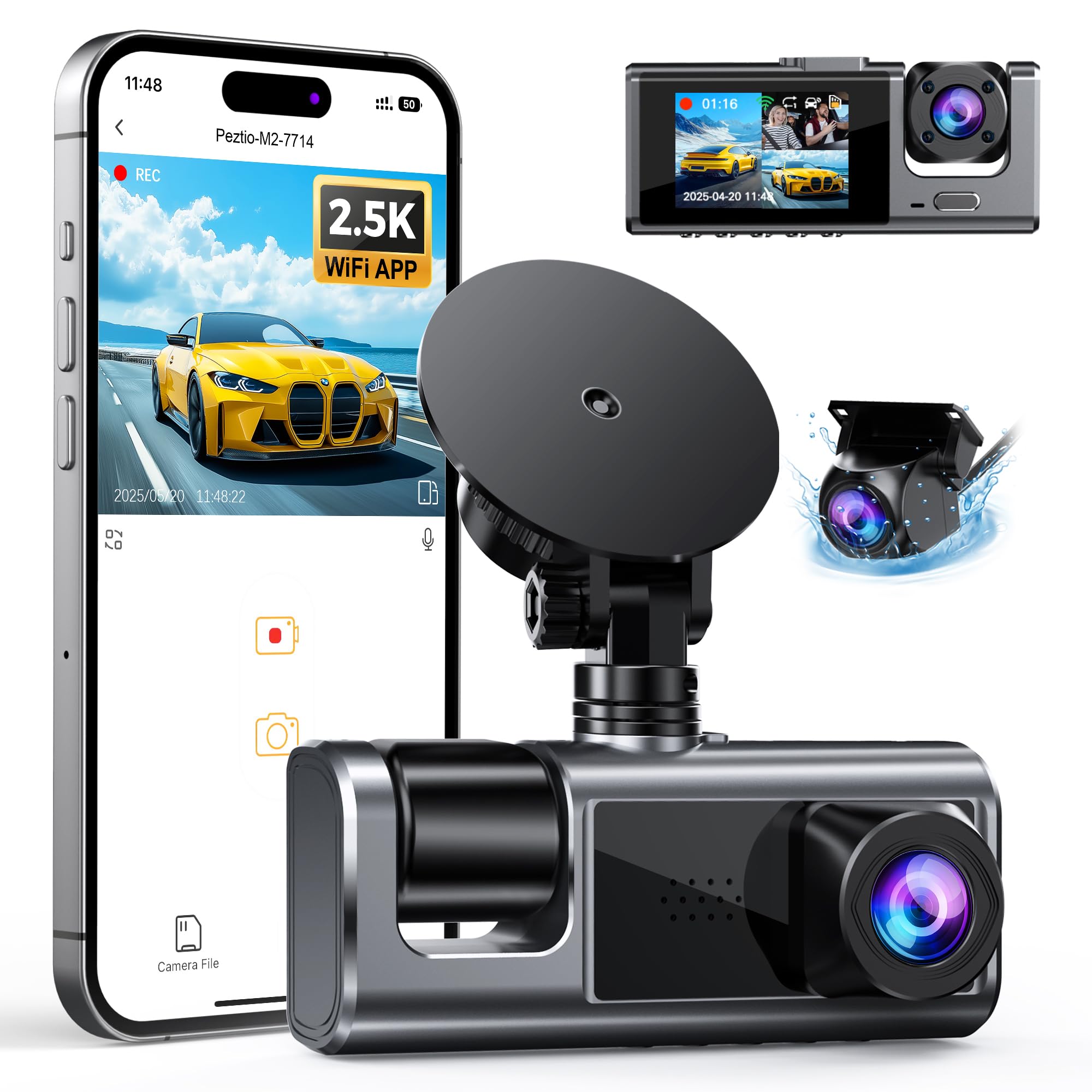
The Galphi M2 delivers the most versatile coverage in the sub-$50 bracket, combining a 2.5K front camera with 1080P interior and rear channels. That three-way view is a serious advantage for rideshare drivers or anyone who wants cabin evidence in case of a dispute. The Sony IMX sensor keeps daytime footage crisp enough to read plates, while the auto-IR cabin camera maintains visibility even in pitch-dark conditions.
WiFi app control is subscription-free, letting you adjust settings and download clips directly to your phone. The compact body attaches with a suction cup mount, and the three adjustable cameras rotate independently to dial in the exact angle. Support for up to 512GB storage via microSDXC means you can record continuously for days before loop recording begins overwriting old material.
The trade-off is that it runs on a lithium-polymer battery rather than supercapacitors, so sustained direct-sun exposure in hot climates may trigger the thermal shutdown protection that some users have reported around 95°F cabin temps. Parking mode requires a separate Type-C hardwire kit. Still, for pure feature density at this price, the Galphi M2 is unmatched.
Why it’s great
- Three simultaneous recording channels (front, cabin, rear) for complete vehicle coverage.
- 2.5K front resolution with Sony IMX sensor delivers sharp plate-level detail.
- Supports massive 512GB microSDXC cards for extremely long recording loops.
Good to know
- Lithium-polymer battery may shut down to protect itself in extreme heat above 95°F.
- Hardwire kit for parking mode is sold separately.
2. Avylet A1 2K Dash Cam
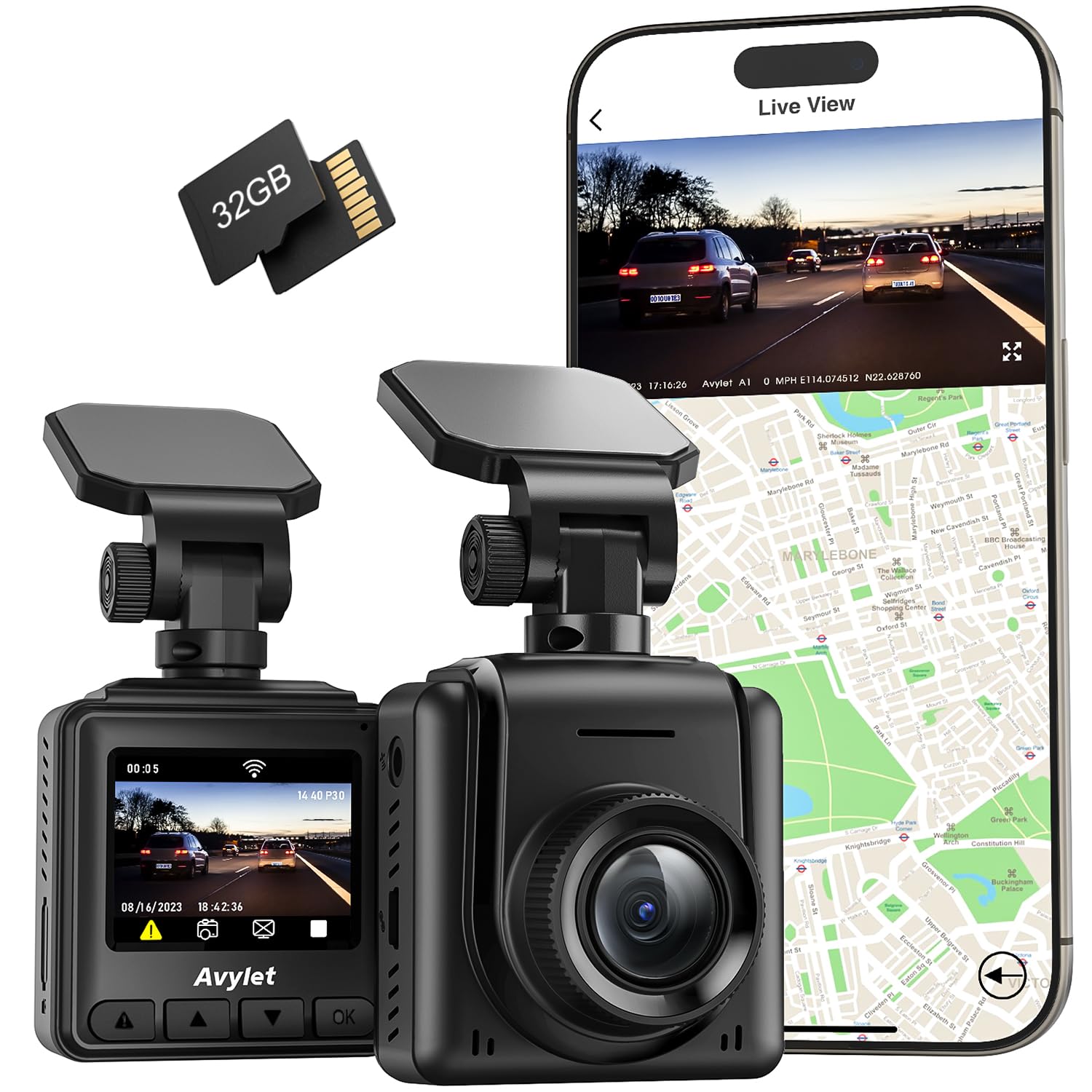
The Avylet A1 is the best front-only camera in this price range, purpose-built for buyers who prioritize image quality and thermal safety over multi-channel coverage. Its 2K Quad HD sensor (2560×1440) captures roughly 1.3x more detail than 1296P cams, and the large F1.6 aperture combined with WDR ensures usable footage in low-light conditions without excessive noise. The 170° ultra-wide lens covers four lanes of traffic with minimal barrel distortion.
Rather than a lithium battery, the A1 uses supercapacitors that handle extreme temperature swings from -4°F to 158°F without swelling or degrading. This makes it a strong candidate for hot climates and long-term reliability. The 1.5-inch IPS screen provides a live view without needing the phone app, though the Avylet app itself is clean and supports OTA firmware updates — a rarity at this price point.
An external GPS module is supported as an optional add-on, enabling speed and route logging for insurance evidence. The adhesive mount feels secure, and the compact body (under two inches per dimension) hides neatly behind the rearview mirror. On the downside, a 32GB card is pre-installed but maxes out at 128GB, and the rear camera is not included — this is strictly a front-facing solution.
Why it’s great
- Supercapacitor design eliminates battery swelling risk in hot cars.
- F1.6 aperture and WDR produce excellent low-light clarity for the price.
- OTA firmware updates and clean app interface with no subscription.
Good to know
- Front-only camera; no rear or interior channel is available.
- GPS module is sold separately and is not included in the box.
3. WANLIPO A13 Dual Channel Dash Cam

The WANLIPO A13 pushes the sub-$50 boundary by offering 4K front recording paired with a 2.5K rear camera — a resolution combo typically found in cams that cost twice as much. The front channel’s 3840×2160 sensor captures license plates and road signage with impressive clarity, and the 170° wide-angle lens reduces blind spots significantly. The 2.0-inch IPS display allows quick menu navigation without needing the phone every time.
One of the biggest practical advantages here is the 5GHz WiFi band, which transfers video files at roughly 8MB/s — about four times faster than the 2.4GHz-only competition. The free Viidure app handles live view, downloads, and settings adjustments, though some playback features require a membership upgrade. Integrated GPS logs speed, route, and coordinates onto the video file, which can be viewed on a computer via GPS Player for precise accident reconstruction.
A 64GB SD card is included, and the camera supports expansion up to 256GB. The G-sensor reliably locks impact footage, and parking monitoring activates with a hardwire kit (sold separately). The main downsides are that the MPH watermark cannot be disabled without cutting the GPS wire on the suction cup mount, and some users find the menu button placement finicky during adjustment.
Why it’s great
- 4K front + 2.5K rear delivers best-in-class dual recording clarity at this price.
- 5GHz WiFi enables fast video downloads without removing the SD card.
- Built-in GPS logs speed, route, and coordinates directly to video files.
Good to know
- MPH watermark cannot be hidden in normal operation without physically cutting the GPS wire.
- Some app playback features (speed adjustment, cloud upload) require a membership.
4. E-YEEGER V100 2.5K Mini Dash Cam

The E-YEEGER V100 strips away the display screen to achieve genuinely tiny dimensions — just 3.2 inches tall and 1.5 inches wide — making it the most discreet option in this roundup. Behind its compact shell, a Starvis sensor and six-glass-lens array capture 2.5K video (2560×1440) at F1.8 aperture, pulling in 30% more light than standard sensors. The 160° field of view comfortably covers four lanes without fisheye distortion.
A 32GB SD card is included out of the box, and the camera supports cards up to 256GB. The supercapacitor power system handles temperature extremes from -40°F to 185°F, which is a critical differentiator for drivers in very hot or cold climates. Loop recording, G-sensor event locking, and 24-hour parking mode (hardwire kit required) are all present, making the feature set surprisingly complete for such a small device.
The biggest drawback is the reliance on WiFi app connectivity, which some users find inconsistent — the E-YEEGER app requires local network permissions, a disabled VPN, and disconnection from CarPlay or Android Auto to maintain a stable connection. Camera controls on the unit itself are minimal, so most settings adjustments must go through the app. If screen-free operation and a tiny footprint match your preference, the V100 is an excellent choice.
Why it’s great
- Exceptionally compact 3.2″ body hides discreetly behind the rearview mirror.
- Supercapacitor power system handles -40°F to 185°F without battery degradation.
- Starvis sensor with F1.8 aperture delivers strong low-light 2.5K footage.
Good to know
- No on-screen display — all settings and playback require the WiFi app.
- App connectivity is finicky and may require disabling CarPlay or VPN.
5. ORSKEY 1080P Front and Rear Dash Cam

The ORSKEY is the most affordable dual-channel option here, combining a 1080P front camera with a VGA waterproof rear cam at a price that undercuts nearly every competitor. The front sensor uses a Sony imaging chip with six glass lenses and six infrared LEDs to support night recording, while the 170° wide-angle lens provides good lane coverage. The 3.0-inch LCD display makes menu navigation straightforward without needing a phone.
Loop recording and G-sensor emergency locking are included, and the rear camera cable runs 18 feet — enough to reach the back window of most sedans and SUVs. The suction cup mount installs quickly, though some users report it losing grip in hot weather and recommend switching to the included adhesive mount instead. The camera goes into screen-saver mode after 30 seconds to reduce heat buildup, showing only the time and date.
The limitations are real: storage tops out at 32GB (microSD card not included), which fills in about 3–4 hours of driving before loop overwriting begins. The rear camera captures VGA resolution only, so it’s useful for showing presence but not for reading plates. There is no WiFi or app connectivity, so reviewing footage requires physically removing the SD card and plugging it into a computer. If you need a basic two-camera setup and can accept manual file management, the ORSKEY is a workable entry point.
Why it’s great
- Very affordable dual-channel setup with long 18-foot rear camera cable.
- 3.0-inch LCD display allows on-device settings without a smartphone app.
- G-sensor and loop recording work reliably for basic accident evidence.
Good to know
- Rear camera is VGA resolution only — sufficient for presence, not plate reading.
- No WiFi or app; footage review requires removing the SD card and using a computer.
FAQ
Will a dash cam under $50 drain my car battery overnight?
Why does my budget dash cam overheat and shut off in summer?
Can I read license plates with a 1080P dash cam at night?
Do I really need a dash cam with WiFi at this price?
Final Thoughts: The Verdict
For most users, the dash cam under $50 winner is the Galphi M2 3-Channel Dash Cam because it delivers the most versatile coverage (front, cabin, and rear) with sharp 2.5K video and a clean app interface, all without a subscription. If you prefer a supercapacitor-powered front camera with excellent night clarity and long-term thermal safety, grab the Avylet A1 2K Dash Cam. And for the best dual-resolution combo at this price ceiling, nothing beats the WANLIPO A13 with its 4K front and 2.5K rear recording plus fast 5GHz WiFi.

Mo Maruf
I created WellFizz to bridge the gap between vague wellness advice and actionable solutions. My mission is simple: to decode the research and give you practical tools you can actually use.
Beyond the data, I am a passionate traveler. I believe that stepping away from the screen to explore new environments is essential for mental clarity and physical vitality.