That fast-spreading, ugly grass taking over your lawn is crabgrass, and if you’re seeing it, the clock is ticking. Unlike dandelions you can pluck, crabgrass thrives on neglect and spreads like a vine, choking out your good turf and leaving bare patches that invite more weeds. A targeted, selective crabgrass treatment is the only way to stop it without nuking your entire lawn.
I’m Mohammad Maruf — the founder and writer behind WellFizz. I’ve spent hundreds of hours analyzing the chemical profiles, application methods, and real-world results of the top weed killers to find which ones actually deliver a weed-free lawn without collateral damage.
After comparing active ingredients, coverage areas, and customer feedback across five leading formulas, this guide will help you choose the right crabgrass treatment for your specific lawn type and infestation level.
How To Choose The Best Crabgrass Treatment
Not all weed killers handle crabgrass the same way. The first decision is timing: pre-emergent formulas stop seeds from germinating in early spring, while post-emergent formulas kill actively growing crabgrass you can already see. Your lawn type also matters — a product safe for St. Augustine grass can kill Bermuda grass, and vice versa. The active ingredient (Mesotrione, Dithiopyr, or 2,4-D variants) determines speed, selectivity, and residual control. Always check the label for the specific turf species, not just “safe for lawns.”
Know Your Lawn Grass Type
The most common mistake is buying a treatment that doesn’t match your grass species. Cool-season grasses like Kentucky Bluegrass, Fescue, and Perennial Ryegrass tolerate different chemicals than warm-season varieties like Bermuda, Zoysia, or St. Augustine. Treatments containing Mesotrione are generally safe on cool-season turf and some warm-season types (like Centipede), but can severely damage Bermuda and St. Augustine. If you have mixed turf, a product labeled “selective” and proven on multiple grass types is your safest bet.
Quick Comparison
On smaller screens, swipe sideways to see the full table.
| Model | Category | Best For | Key Spec | Amazon |
|---|---|---|---|---|
| Liquid Harvest Mesotrione | Selective Post-Emergent | Multi-weed control on cool-season lawns | 8 oz concentrate treats 46 species | Amazon |
| Fertilome Weed-Out with Crabgrass Killer | Selective Concentrate | Targeting 200+ weeds on established turf | 32 oz concentrate treats 5,000 sq ft | Amazon |
| Preen Lawn Crabgrass Control | Pre-Emergent Granule | Season-long prevention | 15 lbs covers 5,000 sq ft | Amazon |
| Ortho WeedClear Comfort Wand | Spot Treatment RTU | Quick, targeted dandelion & crabgrass kill | 1 gal covers 20,480 sq ft | Amazon |
| Hi-Yield Postemergence Herbicide | Selective Post-Emergent | Killing grass weeds in gardens & beds | 8 oz concentrate makes 8 gallons | Amazon |
In‑Depth Reviews
1. Liquid Harvest Mesotrione Concentrate

Mesotrione is the same active ingredient as the popular Tenacity, and this 8 oz concentrate gives you a full season’s worth of both pre- and post-emergent control. Users report visible whitening of crabgrass leaves within days, with full death in 2-3 weeks. It targets 46 different broadleaf and grassy weeds, making it a true multi-purpose weapon.
The key to success with Mesotrione is activation water: you need rain or irrigation within 10 days of application. It’s safe on cool-season turf like Kentucky Bluegrass, Tall Fescue, and Perennial Ryegrass, and on certain warm-season grasses like Centipede. However, avoid using it on Bermuda, Zoysia, or St. Augustine unless you’re certain the grass is dormant.
Because it’s highly concentrated, you’ll need a backpack or pump sprayer — a wand sprayer won’t dilute it properly. Consider adding a spray dye to avoid double-coating and potentially damaging your lawn. This is a pro-grade chemical that rewards careful measurement with exceptional results.
Why it’s great
- Works pre- and post-emergent on 46 weed species
- Fast-acting with visible bleaching in days
- Safe on many cool-season and Centipede lawns
Good to know
- Requires activation water within 10 days
- Can damage Bermuda and St. Augustine if used incorrectly
- Needs a pump sprayer for even coverage
2. Fertilome Weed-Out with Crabgrass Killer
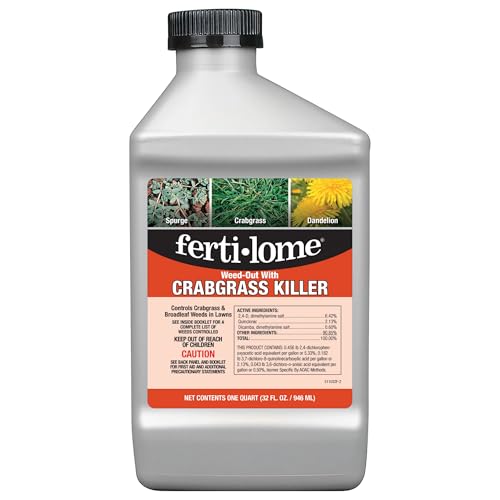
This 32 oz concentrate treats up to 5,000 square feet and lists over 200 grassy and broadleaf weeds on its label — crabgrass and foxtail are specifically called out. The selective formula is designed for established lawns including Bermuda, Buffalo, Kentucky Bluegrass, Fescue, and Ryegrass, which makes it one of the more versatile options.
Customer reports confirm it kills crabgrass on contact, though a second application is often needed for tougher, mature weeds. It also handles ground ivy and spurge effectively. On Bermuda grass, temporary yellowing can occur, but full recovery is expected. Apply in spring or early summer when weeds are young for the best kill rate.
The concentrate format makes it economical for medium to large lawns. Mix it in a hose-end sprayer and treat the whole yard at once. A few users noted that it didn’t work on the most stubborn crabgrass in its first pass, but a follow-up spray a week later solved the problem.
Why it’s great
- Controls 200+ weeds including crabgrass and foxtail
- Safe on many warm- and cool-season turf types
- Large 32 oz bottle covers 5,000 sq ft
Good to know
- May need retreating for mature crabgrass
- Can cause temporary yellowing on Bermuda
- Not a pre-emergent — must be applied post-emergence
3. Preen Lawn Crabgrass Control Granules

Preen Lawn Crabgrass Control is a pre-emergent granule that stops crabgrass before it breaks the surface. The active ingredient Dithiopyr works by preventing root development in germinating seeds. It can be applied up to 4 weeks after crabgrass emerges, giving you a small window to correct late spring applications.
The 15 lb bag covers 5,000 square feet, and one application lasts all season. It’s labeled for nearly every common lawn grass — from cool-season Bentgrass and Kentucky Bluegrass to warm-season Bermuda, Zoysia, St. Augustine, and Centipede. That broad compatibility makes it an easy choice if you don’t know exactly what grass you have.
Apply with a standard broadcast spreader in early spring before soil temperatures hit 55°F. Water it in within 24 hours to activate the barrier. While it’s primarily a prevention tool, a few customers found it slowed existing crabgrass growth. For an already-established invasion, you’ll need a post-emergent spray to finish the job.
Why it’s great
- Season-long prevention with one application
- Safe on the widest range of grass types
- Can be applied up to 4 weeks after emergence
Good to know
- Post-emergent effect is weak — needs a spray partner
- Must be watered in within 24 hours
- Not a treatment for active, mature crabgrass
4. Ortho WeedClear Comfort Wand
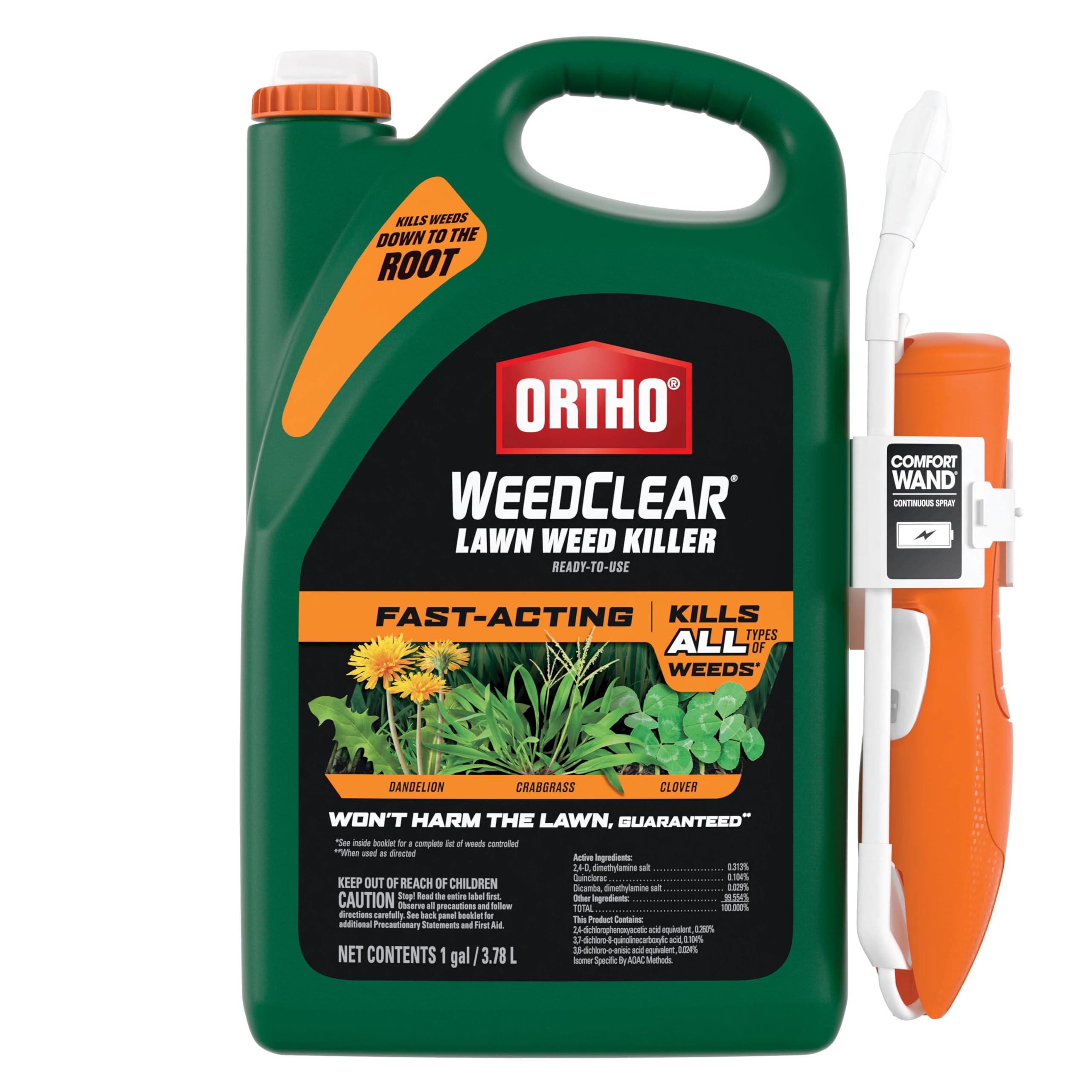
The Ortho WeedClear Comfort Wand is the most beginner-friendly option here. It comes ready to use — no mixing, no measuring. The battery-powered wand lets you spot-spray individual weeds without bending over. The 1 gallon container covers 20,480 square feet of spot treatments, making it a huge value for targeted use.
Users consistently report dandelions and clover wilting within hours and dying completely in about two weeks. It’s labeled as safe on many common lawn grasses including Bermuda, Fescue, Kentucky Bluegrass, Ryegrass, and Zoysia when applied at the correct rate. The wand design delivers a precise spray pattern, reducing drift onto desirable plants.
The downside is that it’s a post-emergent spot treatment — it won’t prevent new crabgrass from sprouting. A few customers found it ineffective on tougher, well-established crabgrass and had to reapply. For light to moderate spot infestations, though, it’s fast and mess-free.
Why it’s great
- Zero setup: ready-to-use with built-in wand
- Huge 1 gal covers 20,480 sq ft of spots
- Safe on many common turf grasses
Good to know
- No pre-emergent action — only kills existing weeds
- May need multiple applications on stubborn crabgrass
- Batteries for wand not included
5. Hi-Yield Postemergence Grass Herbicide
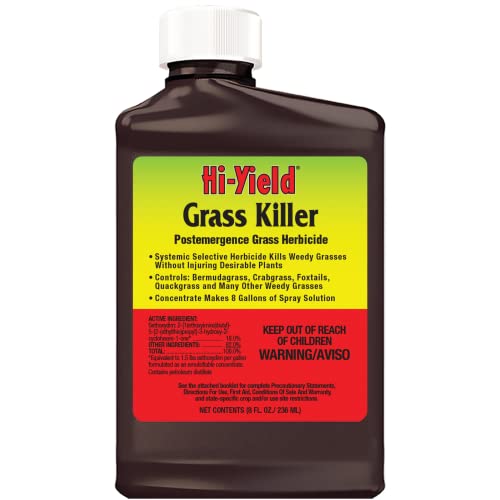
If you need to kill crabgrass and other grassy weeds growing up through your flower beds, garden vegetables, or around shrubs, the Hi-Yield Postemergence Grass Herbicide is your best bet. It’s a selective grass killer that won’t harm most broadleaf ornamental plants and vegetables when applied over the top.
The 8 oz bottle makes 8 gallons of spray solution, covering gardens modestly. Users report Bermuda grass and tall fescue dying within days, with full kill in about a week for most common grasses. It’s also effective on Japanese stilt grass, though that variety can take three to four weeks. The active ingredient Sethoxydim targets grass metabolism, leaving flowers and veggies untouched.
The small bottle size is a limitation — it’s economical for garden beds but won’t cover a full lawn. Some users were disappointed that it didn’t kill broadleaf weeds, but that’s by design: it only targets grasses. For mixed weed pressure, pair it with a broadleaf herbicide. Apply when weeds are young and actively growing for the best results.
Why it’s great
- Safe on flowers and vegetables
- Kills Bermuda, fescue, and crabgrass in garden beds
- Fast acting with visible results in days
Good to know
- Only kills grassy weeds — not broadleaf
- Small 8 oz bottle makes 8 gallons
- Not for full-lawn application
FAQ
Can I use a post-emergent crabgrass killer on a newly seeded lawn?
Does crabgrass treatment also kill dandelions and clover?
Final Thoughts: The Verdict
For most users, the crabgrass treatment winner is the Liquid Harvest Mesotrione because it works as both a pre- and post-emergent, targeting 46 weed species with a single concentrate. If you want a foolproof prevention barrier with the broadest grass-type compatibility, grab the Preen Lawn Crabgrass Control. And for quick spot treatments in flower beds without harming your petunias, nothing beats the Hi-Yield Postemergence Grass Herbicide.

Mo Maruf
I created WellFizz to bridge the gap between vague wellness advice and actionable solutions. My mission is simple: to decode the research and give you practical tools you can actually use.
Beyond the data, I am a passionate traveler. I believe that stepping away from the screen to explore new environments is essential for mental clarity and physical vitality.