Our readers keep the lights on and my smoothie glass nicely filled. As an Amazon Associate, I earn from qualifying purchases.
Crabgrass is the weed that keeps lawn owners up at night — it spreads fast, chokes out turf, and most products designed to kill it often damage or destroy the very grass you’re trying to protect. The problem is finding a formula that targets the invader without harming your lawn’s root system.
I’m Mohammad Maruf — the founder and writer behind WellFizz. I’ve spent hundreds of hours combing through chemical specifications, analyzing mode-of-action data, and cross-referencing user reports to find the selective herbicides that actually deliver on their promise.
After analyzing five of the most trusted options on the market, I assembled this guide to help you find the best crabgrass killer that won’t kill grass for your lawn’s unique needs and seasonal schedule.
How To Choose The Best Crabgrass Killer That Won’t Kill Grass
Not all crabgrass killers are created equal. Many rely on non-selective chemistry that burns everything green. The key is finding a formula with active ingredients designed to disrupt the weed’s growth cycle while leaving your turf’s root system intact. Below are the three most critical factors for a safe, selective kill.
Pre-Emergent vs. Post-Emergent Action
Pre-emergent formulas stop crabgrass seeds from germinating, creating a chemical barrier in the soil that only affects the weed. Post-emergent products target visible, growing crabgrass. Many of the best options for lawn safety combine both modes — a pre-emergent barrier in early spring and a post-emergent spot treatment for stragglers later in the season.
Active Ingredient Selectivity
Ingredients like Mesotrione and quinclorac are engineered to interfere with specific enzyme pathways that exist in crabgrass but not in common turf grasses like Kentucky Bluegrass, Tall Fescue, or Bermuda. Herbicides containing dicamba or 2,4-D must be carefully measured — they can harm sensitive grass types like St. Augustine if over-applied.
Grass-Type Compatibility
Always cross‑reference your lawn’s dominant grass species with the product label. Cool‑season grasses (Fescue, Bluegrass, Rye) tolerate a wider range of selective herbicides, while warm‑season grasses (Bermuda, Zoysia, Centipede) are more sensitive. The wrong formula can yellow or stunt even the healthiest lawn.
Quick Comparison
On smaller screens, swipe sideways to see the full table.
| Model | Category | Best For | Key Spec | Amazon |
|---|---|---|---|---|
| Liquid Harvest Mesotrione | Post-Emergent | Selective spot treatment | 8 oz concentrate; treats up to 5,000 sq ft | Amazon |
| GreenView Crabgrass Control Plus Lawn Food | Pre-Emergent | Fertilizer + prevention | 13.5 lb bag; covers 5,000 sq ft | Amazon |
| Hi-Yield Turf & Ornamental Weed & Grass Stopper | Pre-Emergent | Extended window prevention | 12 lb granules; covers 5,000 sq ft | Amazon |
| Fertilome Weed-Out with Crabgrass Killer | Post-Emergent | Broadleaf + grass weed control | 32 oz liquid concentrate; covers 5,000 sq ft | Amazon |
| Fertilome Weed Free Zone | Post-Emergent | Rapid broadleaf weed kill | 32 oz concentrate; evidence of injury in hours | Amazon |
In‑Depth Reviews
1. Liquid Harvest Mesotrione – 8oz Concentrate

Mesotrione is the gold‑standard active ingredient for selective crabgrass control — it works by inhibiting photosynthesis in the weed while cool‑season turf grasses like Kentucky Bluegrass and Tall Fescue remain unharmed. This 8‑ounce concentrate treats up to 5,000 square feet and works both pre‑ and post‑emergence, making it one of the most versatile tools for any lawn program.
Users report seeing results within 10–14 days, with crabgrass bleaching white before dying. The formula is also effective against clover, dandelion, and wild violet. Activation requires water — if rain doesn’t fall within ten days, you need to irrigate with about 0.15 inches to move the herbicide into the weed’s root zone.
Avoid use on bentgrass, zoysiagrass, St. Augustine (unless sod), and actively growing bermudagrass. For dormant bermudagrass, it works safely. Many reviewers note that a blue spray dye helps prevent overlap damage, especially on stressed turf during hot summer months.
Why it’s great
- Works both as a pre-emergent barrier and post-emergent spot killer
- Highly concentrated — a little goes a long way for large lawns
- Targets 46+ weed species without harming cool-season turf
Good to know
- Can temporarily discolor or stunt stressed turf if over-applied
- Requires water activation within 10 days for best results
- Not safe on St. Augustine seed or plugs — sod only
2. GreenView Crabgrass Control Plus Lawn Food 26-0-4

If you want to simplify your spring lawn routine, this 13.5‑pound bag combines a pre‑emergent crabgrass barrier with a 26‑0‑4 nitrogen‑rich fertilizer. The GreenSmart Enhanced Efficiency technology releases nutrients slowly over eight weeks, feeding your lawn while preventing crabgrass seeds from germinating. Coverage extends to 5,000 square feet.
User experiences are overwhelmingly positive — many report thick, green grass with zero crabgrass breakthrough for the entire season. The dual‑action formula also helps grass retain water during heat and drought, building deeper roots over multiple applications.
One important caveat: this product is a pre‑emergent only and will not kill existing crabgrass. It also has no effect on broadleaf weeds like dandelions or clover. A few reviewers noted an increase in dandelions after use, likely because the nitrogen feed encouraged their growth while the pre‑emergent only targeted grassy weeds.
Why it’s great
- Fertilizer and pre‑emergent in one easy application
- Slow‑release nitrogen feeds lawn for up to 8 weeks
- Improves drought tolerance and root depth
Good to know
- Will not kill existing crabgrass — must be applied early spring
- Does not control broadleaf weeds like dandelions
- Some users report increased broadleaf weed pressure
3. Hi-Yield Turf & Ornamental Weed & Grass Stopper (12 lbs)

Hi‑Yield’s 12‑pound granular formula contains Dimension (dithiopyr), a pre‑emergent that provides a wider application window than many competitors — you can apply it up to four weeks later than other crabgrass preventers. It covers 5,000 square feet and is safe for established lawns, ornamental turf, and landscape beds.
Users who time their spring application correctly (post‑frost, before summer heat) report near‑total crabgrass prevention. The product also controls goosegrass, henbit, and several other annual weeds. Several reviewers emphasize that consistency over two to three seasons dramatically reduces the weed seed bank in the soil.
Because this is a pre‑emergent only, it will not kill actively growing crabgrass. You need to apply it before soil temperatures reach 55°F at a 4‑inch depth. Some buyers received a bag with less product than advertised, so check the weight upon delivery.
Why it’s great
- Flexible application window — up to 4 weeks later than other pre‑emergents
- Contains Dimension for both crabgrass and goosegrass control
- Works well in ornamental beds and on established turf
Good to know
- Pre‑emergent only — won’t kill existing crabgrass
- Timing is critical; missed spring window reduces first‑year benefit
- Some reports of under‑filled bags
4. Fertilome Weed-Out with Crabgrass Killer (32 oz)
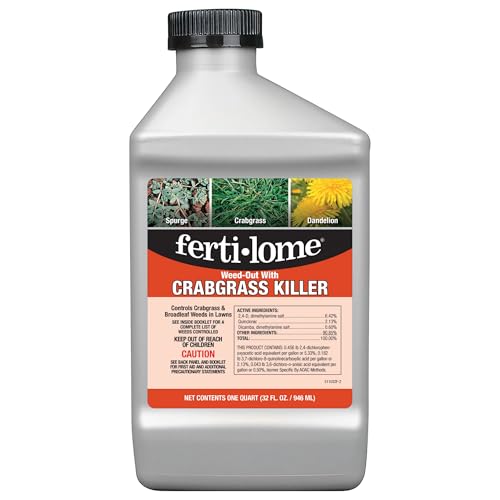
Fertilome’s Weed-Out is a liquid post‑emergent concentrate that targets over 200 grassy and broadleaf weeds, including crabgrass and foxtail, while staying safe on established lawns like Bermuda, Buffalo, and Kentucky Bluegrass. The 32‑ounce bottle makes enough spray to cover up to 5,000 square feet.
Many users report visible results within days on young, actively growing weeds. The formula works best when applied in spring or early summer when temperatures are moderate and weeds are still small. A few customers noted that bermudagrass may show temporary yellowing, though full recovery is expected.
Some reviewers pointed out that the product requires a higher concentration for stubborn weeds like ground ivy, and adding a few drops of dish soap improves leaf adhesion. A small number of users found it ineffective on mature crabgrass, suggesting that early application is critical for success.
Why it’s great
- Controls more than 200 weed species including crabgrass and foxtail
- Safe on multiple turf types including Bermuda and Bluegrass
- Concentrated formula covers up to 5,000 sq ft
Good to know
- May cause temporary yellowing on bermudagrass
- Less effective on large, mature crabgrass
- Some weeds require a second application or higher concentration
5. Fertilome Weed Free Zone (32 oz)
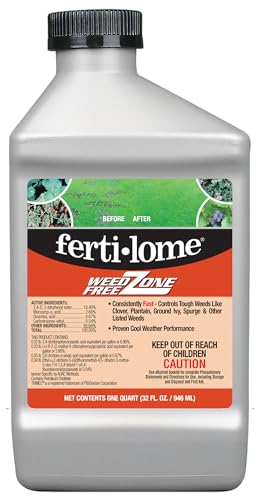
Weed Free Zone is a broadleaf specialist with dicamba as its active ingredient — it shows visible evidence of injury within hours of application, making it one of the fastest post‑emergents on the market. It controls over 80 broadleaf weeds including clover, spurge, chickweed, and thistle, and it’s safe on Kentucky Bluegrass, Bermudagrass, Bahiagrass, and Zoysia.
Customer feedback consistently highlights its effectiveness on creeping Charlie and dandelions, often after a single application. A few users noted that the label’s recommended dose is too weak for clover and needed to double the concentration for full kill. Adding a small amount of dish soap helps droplets stick to waxy leaves.
Because dicamba can drift, it’s important to spray on calm days and avoid overspray onto desirable plants like flowers and shrubs. Some users reported that increasing the mix ratio caused temporary discoloration on certain grass types, so careful measuring is essential.
Why it’s great
- Visible injury to weeds within hours of application
- Controls over 80 broadleaf weed species
- Safe on many common turf grasses
Good to know
- Clover may require a higher concentration than label suggests
- Dicamba can drift and harm nearby plants
- Increasing dose may discolor sensitive turf
FAQ
Will Mesotrione kill my existing grass if I accidentally over-apply?
Can I use a pre-emergent crabgrass killer in the fall?
How long should I wait to reseed after using a selective crabgrass killer?
Final Thoughts: The Verdict
For most users, the crabgrass killer that won’t kill grass winner is the Liquid Harvest Mesotrione because it delivers both pre‑ and post‑emergent action in one concentrated bottle, targeting crabgrass while leaving cool‑season turf unharmed. If you want a simple spring routine that feeds your lawn while preventing crabgrass, grab the GreenView Crabgrass Control Plus Lawn Food. And for a fast‑acting broadleaf solution that shows results within hours, nothing beats the Fertilome Weed Free Zone.

Mo Maruf
I created WellFizz to bridge the gap between vague wellness advice and actionable solutions. My mission is simple: to decode the research and give you practical tools you can actually use.
Beyond the data, I am a passionate traveler. I believe that stepping away from the screen to explore new environments is essential for mental clarity and physical vitality.