Our readers keep the lights on and my smoothie glass nicely filled. As an Amazon Associate, I earn from qualifying purchases.
Crabgrass doesn’t just make a lawn look patchy and neglected—it actively chokes out your desirable turf, creating bare spots that invite more weeds. Once established, its sprawling growth habit is nearly impossible to pull by hand, demanding a selective chemical solution that targets the invader without collateral damage to your grass.
I’m Mohammad Maruf — the founder and writer behind WellFizz. I’ve spent hundreds of hours analyzing active ingredient profiles, customer performance data, and label restrictions for this specific class of post-emergent turf herbicides.
Whether you are fighting a full-blown invasion or catching stray clumps early, the best crabgrass herbicide must balance fast knockdown power with lawn safety and ease of application.
How To Choose The Best Crabgrass Herbicide
Selecting a crabgrass killer goes beyond grabbing the first bottle labeled “weed killer.” You need chemistry that targets grassy weeds specifically, a formulation that matches your lawn type, and an application method that fits the scale of your yard.
Active Ingredient Matching
The three most effective post-emergent crabgrass herbicides use Quinclorac, Mesotrione, or a combination of 2,4-D, dicamba, and MCPP. Quinclorac is the gold standard for crabgrass specifically but can stress Bermuda grass with repeat applications. Mesotrione (the active in Tenacity) is slower but safer on sensitive cool-season grasses like Centipede and St. Augustine (sod only).
Lawn Grass Tolerance
Not all herbicides are safe on all turf. Fescue, Kentucky Bluegrass, and Perennial Ryegrass tolerate most selective formulas. Bermuda grass and Zoysia are more sensitive — Quinclorac can cause yellowing with over-application. St. Augustine requires extra caution; Mesotrione is one of the few safe options when applied strictly per label.
Concentrate vs. Ready-to-Use
Ready-to-use wands and hose-end sprayers are convenient for spot treatment on small lawns (under 5,000 sq. ft.). Concentrates require a pump sprayer but give you precise control over mixing ratios and scale up cost-effectively for larger properties. Trigger spray bottles are best for isolated clumps and flower bed edges.
Quick Comparison
On smaller screens, swipe sideways to see the full table.
| Model | Category | Best For | Key Spec | Amazon |
|---|---|---|---|---|
| Liquid Harvest Mesotrione | Premium | Safe post-emergent on sensitive turf | 8 oz concentrate covers multiple apps | Amazon |
| Primesource Quinclorac 1.5 | Premium | Aggressive crabgrass knockdown | 7.5 oz at 18.92% Quinclorac | Amazon |
| Fertilome Weed-Out with Crabgrass Killer | Mid-Range | Broad-spectrum lawn weed control | 32 oz concentrate treats 5,000 sq. ft. | Amazon |
| Ortho WeedClear Comfort Wand | Mid-Range | Easy spot treatment for small lawns | 1 gal. covers 20,480 sq. ft. | Amazon |
| Ortho Grass B Gon Garden Grass Killer | Budget | Kill grass in flower beds | 24 oz RTU (2-pack) for spot spraying | Amazon |
In‑Depth Reviews
1. Liquid Harvest Mesotrione

Mesotrione is the active ingredient behind the legendary Tenacity, and Liquid Harvest’s 8 oz concentrate brings that same chemistry at a budget-friendly price point. This is the premier choice if you need a selective post-emergent that works without destroying sensitive warm-season grasses like Centipede, St. Augustine (sod only), and Buffalo grass. Users report seeing crabgrass bleach white within 7–10 days and fully die off by the 14-day mark, even after a single application at 1 teaspoon per 2 gallons of water.
Because Mesotrione inhibits photosynthesis in susceptible plants, it spreads through both root and foliar uptake. This dual-action makes it effective as both a post-emergent killer and a pre-emergent germination inhibitor for crabgrass seed. The catch: activation requires rainfall or a 0.15-inch watering within 10 days, and it can temporarily discolor desirable turf if over-applied. A spray tank dye is strongly recommended to track coverage.
Customer feedback highlights its versatility beyond crabgrass — it also eliminates clover, wild violet, and barnyard grass without nuking the lawn. Multiple reviews from Nebraska, Texas, and the Southeast confirm it outperforms generic big-box alternatives on stubborn crabgrass strains. For homeowners with mixed cool-season/warm-season lawns, this is the safest high-performer.
Why it’s great
- Safe on Centipede, St. Augustine, and Buffalo grass when used per label
- Dual pre-and post-emergent action stops crabgrass at two life stages
- Highly concentrated — low cost per application for large yards
Good to know
- Requires rainfall or manual watering within 10 days for activation
- Can temporarily bleach or stunt healthy turf if applied too heavily
- Not safe on Bermuda, Zoysia, or Bentgrass
2. Primesource Quinclorac 1.5 Select

For pure chemical muscle against mature crabgrass, nothing beats Quinclorac. Primesource delivers 18.92% Quinclorac in a 7.5 oz concentrate — effectively the same formulation used by professional lawn services. It provides up to 90 days of residual control, meaning one well-timed application can suppress crabgrass germination for nearly an entire growing season. This is the go-to for cool-season lawns dominated by Fescue, Kentucky Bluegrass, and Perennial Ryegrass.
The aggressive chemistry comes with a tradeoff: multiple reviewers note that a second application stresses Bermuda grass, causing up to 30% yellowing. First treatment kills about 50% of crabgrass with zero damage to Bermuda, but the second round finishes the crabgrass while discoloring the turf. For pure Bermuda lawns, a lower rate or a Mesotrione alternative may be wiser. Mixing with methylated seed oil improves adhesion and translocation.
Beyond crabgrass, this product is highly effective on Dallisgrass and foxtails — two grassy weeds that resist many standard 3-way herbicides. Users with heavy Dallisgrass infestations found it pulled up by hand after two sprays, indicating deep root kill. The primary downside is price per ounce relative to the treatment area, but the residual activity justifies the cost for chronic problem areas.
Why it’s great
- Industry-standard active for professional-grade crabgrass eradication
- 90-day residual control suppresses re-germination
- Superior on Dallisgrass and foxtails, not just crabgrass
Good to know
- Second application can significantly stress Bermuda grass
- Requires surfactant (methylated seed oil) for best results
- Higher upfront cost than RTU alternatives
3. Fertilome Weed-Out with Crabgrass Killer
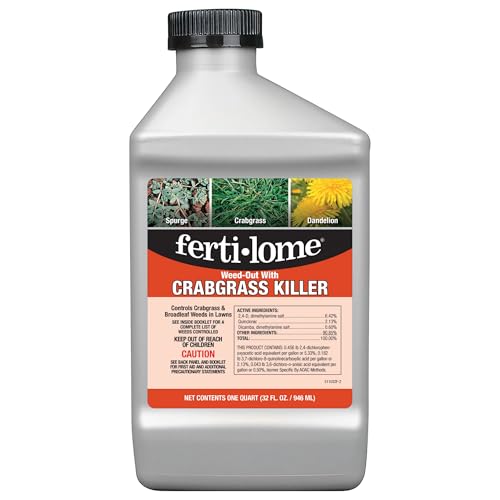
Fertilome’s Weed-Out positions itself as a budget-friendly 3-way selective killer that covers over 200 broadleaf and grassy weeds, including crabgrass and foxtail. At 32 oz of concentrate covering 5,000 square feet, this is the most economical option per treatment area among the mid-range picks. The formula relies on a combination of 2,4-D, dicamba, and MCPP — the classic broadleaf trio — plus crabgrass-specific chemistry.
Crabgrass control here is less dramatic than with Quinclorac or Mesotrione. Customer reviews are split: some report complete death within two weeks, while others found it ineffective on older, established crabgrass. Best results come from spring applications when weeds are small and actively growing. Applying to Bermuda grass may cause temporary yellowing, though full recovery is expected according to the label. For spot-treating isolated patches in Fescue or Bluegrass, this is a solid wallet-friendly choice.
Its real strength is versatility — it kills ground ivy, spurge, clover, and dandelions alongside crabgrass, making it a good one-bottle solution for mixed weed problems. The tradeoff is less targeted power against grassy weeds compared to single-active formulas. If your lawn has a crabgrass monoculture, spend more on a dedicated product; if your issue is a broad weed spectrum with some crabgrass, this hits the sweet spot.
Why it’s great
- Controls over 200 weed species for maximum versatility
- Lowest cost per square foot among selective concentrates
- Effective on spurge, ground ivy, and clover alongside crabgrass
Good to know
- Mixed reviews on killing mature crabgrass in one pass
- May temporarily yellow Bermuda grass
- Requires retreatments for persistent grassy weeds
4. Ortho WeedClear Lawn Weed Killer with Comfort Wand
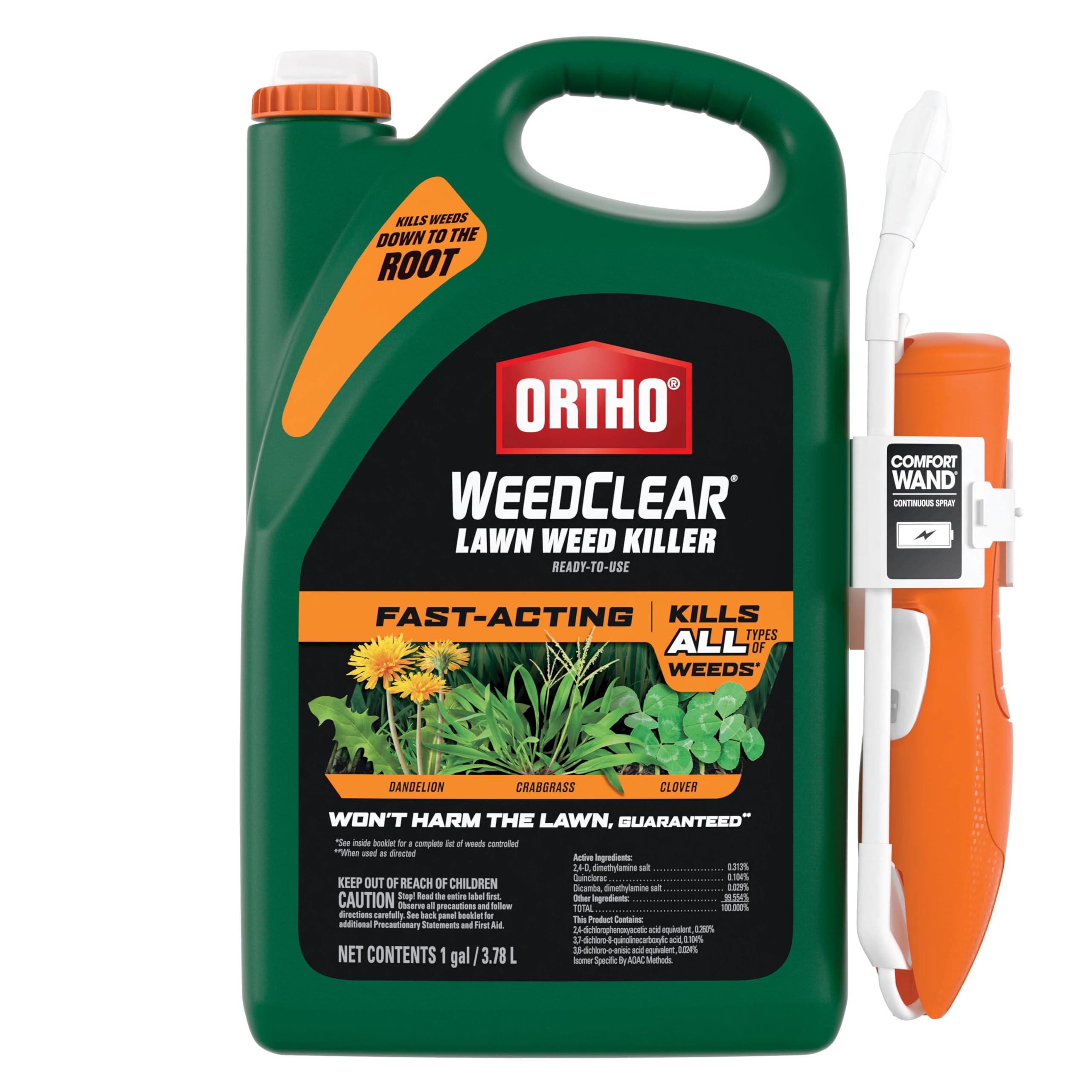
Ortho WeedClear with the Comfort Wand removes every barrier to application. The 1-gallon container comes with an integrated battery-powered wand that delivers a steady, even spray with a trigger pull — no pumping, no mixing, no measuring. It covers an enormous 20,480 square feet per bottle, which is enough for multiple full-yard treatments on a standard suburban lot. The formula kills crabgrass, dandelion, clover, chickweed, and creeping charlie down to the root.
Customer experience is overwhelmingly positive for speed and convenience. Many users saw visible wilting within 24–48 hours and complete weed death in about two weeks with a single application. The selective formula is safe on Bermudagrass, Buffalograss, Fescues, Kentucky Bluegrass, Ryegrass, and Zoysiagrass when used as directed. The main critique is that it does not touch Bermuda grass (the weed, not the turf), and a handful of users reported needing a second spray for fully mature crabgrass clumps.
This is the ideal solution for the homeowner who wants quick, no-fuss weed control without researching surfactant blends or calibration. The wand design also keeps the spray low and directed, reducing drift onto ornamentals and garden beds. For large properties or users with bad knees who don’t want to carry a pump sprayer, this is the most ergonomic pick in the lineup.
Why it’s great
- Battery-powered wand eliminates mixing and pumping
- Massive 20,480 sq. ft. coverage per bottle
- Safe on six common turfgrass types including Bermuda and Zoysia
Good to know
- Some users report weak performance on well-established crabgrass
- Does not control Bermuda grass weeds in lawns
- Wand battery life may not cover continuous heavy spraying
5. Ortho Grass B Gon Garden Grass Killer
Ortho Grass B Gon is not designed for lawn use — it is purpose-built for killing grassy weeds in flower beds, ground covers, landscape beds, and around shrubs and trees. This 2-pack of 24-ounce ready-to-use trigger sprayers targets crabgrass, tall fescue, Bermuda grass (as a weed), annual and Kentucky bluegrass without harming your ornamental plants. If your problem is crabgrass creeping from the lawn into your garden beds, this is the surgical tool.
The formulation is rainfast in one hour, giving you a tight application window even in unpredictable weather. Customer reports emphasize that careful application is critical — overspray onto desirable turf can kill it, so this product should never be used on the lawn itself. Users also note a strong chemical odor during spraying, so a respirator is advisable for extended sessions. Results are visible within a few days on young grassy weeds, though older clumps may need a second spray after 7–10 days.
This is a niche product, but within its niche it excels. Many combination herbicides that kill broadleaf weeds leave grassy weeds untouched. Grass B Gon fills that gap specifically, giving gardeners a selective tool to keep landscape beds clean without resorting to non-selective glyphosate. For the budget-conscious, the 2-pack provides small coverage at the lowest entry price in this guide, though heavy infestations will require multiple bottles.
Why it’s great
- Selectively kills grassy weeds without harming ornamental plants
- Rainfast in just 1 hour after application
- Ideal for flower beds, ground covers, and garden borders
Good to know
- Must avoid drift onto lawn grass — not a lawn herbicide
- Strong chemical odor during application
- May require re-application for mature, deep-rooted clumps
FAQ
Can I spray crabgrass killer on my entire lawn or only spot treat?
How long does crabgrass herbicide take to show results?
Will crabgrass killer damage my lawn if I use too much?
Final Thoughts: The Verdict
For most users, the best crabgrass herbicide winner is the Liquid Harvest Mesotrione because it pairs broad turf safety with dual pre-and post-emergent action, excelling on sensitive warm-season lawns where other products risk damage. If you want aggressive knockdown and residual control for a cool-season lawn, grab the Primesource Quinclorac 1.5. And for pure convenience covering large areas with no mixing hassle, nothing beats the Ortho WeedClear with Comfort Wand.

Mo Maruf
I created WellFizz to bridge the gap between vague wellness advice and actionable solutions. My mission is simple: to decode the research and give you practical tools you can actually use.
Beyond the data, I am a passionate traveler. I believe that stepping away from the screen to explore new environments is essential for mental clarity and physical vitality.