Our readers keep the lights on and my smoothie glass nicely filled. As an Amazon Associate, I earn from qualifying purchases.
Your home’s Wi-Fi dead zones aren’t design flaws—they are physics problems. Building materials, floor layouts, and the location of your modem all conspire to leave your basement, garage, or back bedroom with frustratingly weak signals. A single traditional router leaves entire sections of your home with weak or nonexistent signals, which is why the modern solution focuses on intelligent signal distribution across a wider physical footprint.
I’m Mohammad Maruf — the founder and writer behind WellFizz. I’ve spent countless hours analyzing network topologies, antenna configurations, and real-world user performance data to separate marketing claims from actual wireless reach.
If a weak signal in your home office, an unusable connection in your backyard, or buffering in the guest room is your daily reality, this guide to finding the right best coverage router will help you pinpoint the system that solves your specific layout challenges.
How To Choose The Best Coverage Router
Choosing a router for wide coverage is different from choosing one for raw speed. You need to consider your home’s construction, the number of devices, and whether a single powerful unit can do the job or if you need a mesh system to spread the signal physically across multiple rooms.
Single Router vs. Mesh System: What Fits Your Layout
A single, high-powered router with external antennas and beamforming can cover a large, open floor plan effectively. However, homes with thick concrete walls, multiple floors, or long, narrow layouts benefit from a mesh system where multiple nodes communicate with each other to create a single, seamless network with no dead zones. A mesh system uses a dedicated wireless backhaul, ensuring the signal strength doesn’t drop as it relays from one node to the next.
Frequency Bands and Signal Penetration
The 2.4 GHz band offers the best range and ability to penetrate walls, making it ideal for smart home devices in distant rooms. The 5 GHz band offers faster speeds but shorter range, while the 6 GHz band (found in WiFi 6E and WiFi 7 routers) is the fastest but travels the shortest distance. A tri-band router dedicates one band for the backhaul, preserving performance for your devices. The best coverage router for a large home will intelligently steer your devices to the most efficient band.
Antenna Design and Beamforming
Internal antennas keep a router looking sleek, but external, adjustable antennas often provide better placement flexibility to optimize signal direction. Beamforming technology focuses the Wi-Fi signal directly towards connected devices rather than broadcasting it in every direction equally. This focused approach improves range and reliability, especially for devices on the fringe of the network’s coverage area.
Quick Comparison
On smaller screens, swipe sideways to see the full table.
| Model | Category | Best For | Key Spec | Amazon |
|---|---|---|---|---|
| TP-Link Deco X55 Pro | WiFi 6 Mesh | Whole-home mesh with 2.5G backhaul | 6500 sq ft / 3-pack | Amazon |
| NETGEAR Orbi RBE373 | WiFi 7 Mesh | Largest mesh footprint | 6000 sq ft / 2 satellites | Amazon |
| NETGEAR Orbi RBK752P | WiFi 6 Mesh | Family mesh with security suite | 5000 sq ft / 1 satellite | Amazon |
| TP-Link Archer AX80 | WiFi 6 Router | Single-unit long range | 8 high-gain antennas | Amazon |
| GL.iNet Flint 3e (BE6500) | WiFi 7 Router | Advanced VPN & ad blocking | 2500 sq ft / MLO | Amazon |
| Linksys Velop Pro 6E | WiFi 6E Mesh | Smart mesh with 6 GHz band | 3000 sq ft / single node | Amazon |
| GL.iNet Flint 3 (BE9300) | WiFi 7 Router | Tri-band with VPN & NAS | 2000 sq ft / 5×2.5GbE | Amazon |
In-Depth Reviews
1. TP-Link Deco X55 Pro AX3000

The TP-Link Deco X55 Pro is a three-node mesh system that covers up to 6500 square feet, making it a top-tier solution for eliminating dead zones. Each unit has two 2.5 Gigabit Ethernet ports, which is rare at this level, allowing for a wired backhaul connection that keeps speeds strong between nodes without consuming wireless bandwidth. The system supports up to 150 devices and uses AI-driven mesh technology to learn your network environment and optimize performance.
Setup is handled entirely through the Deco app, which guides you through placing the nodes and configuring the network in minutes. Real-world user reports confirm strong, stable coverage across large homes, with seamless handoff between nodes. The inclusion of TP-Link HomeShield provides free basic network security, parental controls, and QoS management directly from the app.
For homes with gigabit-plus internet plans, the dual 2.5G ports ensure that your router is never the bottleneck, especially when using a wired backhaul. The system performed well in Access Point mode for users who wanted to keep their existing router, offering flexibility in network design. The Deco X55 Pro is a complete package for whole-home coverage without compromise.
Why it’s great
- Massive 6500 sq. ft. coverage eliminates dead zones completely
- Dual 2.5G ports per node for high-speed wired backhaul
- AI-driven mesh learns your home for consistent optimization
Good to know
- Requires careful initial setup when using in Access Point mode
- Some users needed to reconfigure after router mode change
2. NETGEAR Orbi 370 Series (RBE373)

The NETGEAR Orbi 370 Series is a three-node WiFi 7 mesh system that covers up to 6000 square feet at speeds up to 5 Gbps. This system is designed for multi-gig fiber and cable connections, featuring a dedicated 2.5 Gigabit Ethernet port on each node. The Enhanced Backhaul technology ensures that the connection between the router and satellites remains strong, providing smooth 4K streaming and low-latency gaming across every room.
Setup is handled via the Orbi app, which automates the process and allows for remote network management. The system supports up to 70 devices simultaneously, making it a strong fit for larger households with multiple gamers and streamers. Built-in Advanced Router Protection provides automatic firmware updates and safety features to shield the network from online threats.
The move to WiFi 7 brings Multi-Link Operation (MLO), which allows devices to connect across multiple bands simultaneously for higher throughput and lower latency. While satellite reliability has been a noted concern in previous Orbi generations, this model focuses on a more stable backhaul connection. The RBE373 is a premium choice for anyone wanting the latest wireless standard and the widest possible mesh coverage.
Why it’s great
- Massive 6000 sq. ft. coverage with two satellites
- WiFi 7 MLO for ultra-fast, low-latency connections
- Dedicated 2.5G port for true multi-gig internet
Good to know
- WiFi 7 benefits require compatible client devices
- Satellite sync can occasionally be finicky after power loss
3. NETGEAR Orbi RBK752P

The NETGEAR Orbi RBK752P is a proven WiFi 6 mesh system offering coverage up to 5000 square feet with one router and one satellite. It uses a dedicated tri-band backhaul to maintain high speeds between nodes, ensuring that devices at the far end of your home still get strong signals. With capabilities to handle up to 75 devices, it is a robust choice for a busy family home.
Included with the system is a 30-day trial of NETGEAR Armor, which provides advanced cybersecurity protection against hackers, malware, and identity theft across your entire home network. Users consistently report that the system delivers full bandwidth throughout the house, with easy setup through the Orbi app. The design is sleek and unobtrusive, blending into any room’s decor.
While the system is fast and stable, some users have noted that the second satellite can sometimes connect to the main router instead of the intermediate node, which can lead to ‘poor’ reception in certain setups. However, for homes that need reliable, whole-home coverage without jumping to WiFi 7, this remains a top-tier choice. The inclusion of multiple gigabit Ethernet ports allows for wired connections to gaming consoles and PCs.
Why it’s great
- Widespread coverage for large family homes
- Dedicated tri-band backhaul for stable speeds
- NETGEAR Armor suite provides comprehensive security
Good to know
- Satellite channel selection can be suboptimal
- Setup app setup could be more intuitive for advanced settings
4. TP-Link Archer AX80

The TP-Link Archer AX80 is a single-unit WiFi 6 router that uses eight high-gain external antennas and beamforming technology to deliver exceptional range. It is designed to cover three-bedroom houses and larger open-plan spaces without needing a mesh system. The router features a 2.5 Gigabit WAN/LAN port to eliminate bottlenecks on multi-gig internet connections and supports up to 4804 Mbps on the 5 GHz band.
Setup is web-based or through the TP-Link Tether app, and the router supports OneMesh, allowing you to add a range extender later for flexible whole-home Wi-Fi without switching ecosystems. Users consistently report solid signals and incredible range, often replacing older mesh systems with this single unit and achieving better coverage. The advanced features include VPN client support, WPA3 encryption, and TP-Link HomeShield for network security.
The router’s heavy-duty performance makes it an excellent choice for homes where the modem is centrally located and the layout is relatively open. It also functions well as an access point for those who want to keep their existing router. For those who do not need the complexity of a mesh system, the Archer AX80 delivers pure, powerful coverage at a mid-range price point.
Why it’s great
- Eight high-gain antennas provide best-in-class single-unit range
- 2.5G port future-proofs multi-gig internet plans
- OneMesh compatibility allows for future expansion
Good to know
- Not ideal for very large or multi-floor homes
- May not work well with CGNAT-based ISPs like Starlink
5. GL.iNet Flint 3e (BE6500)
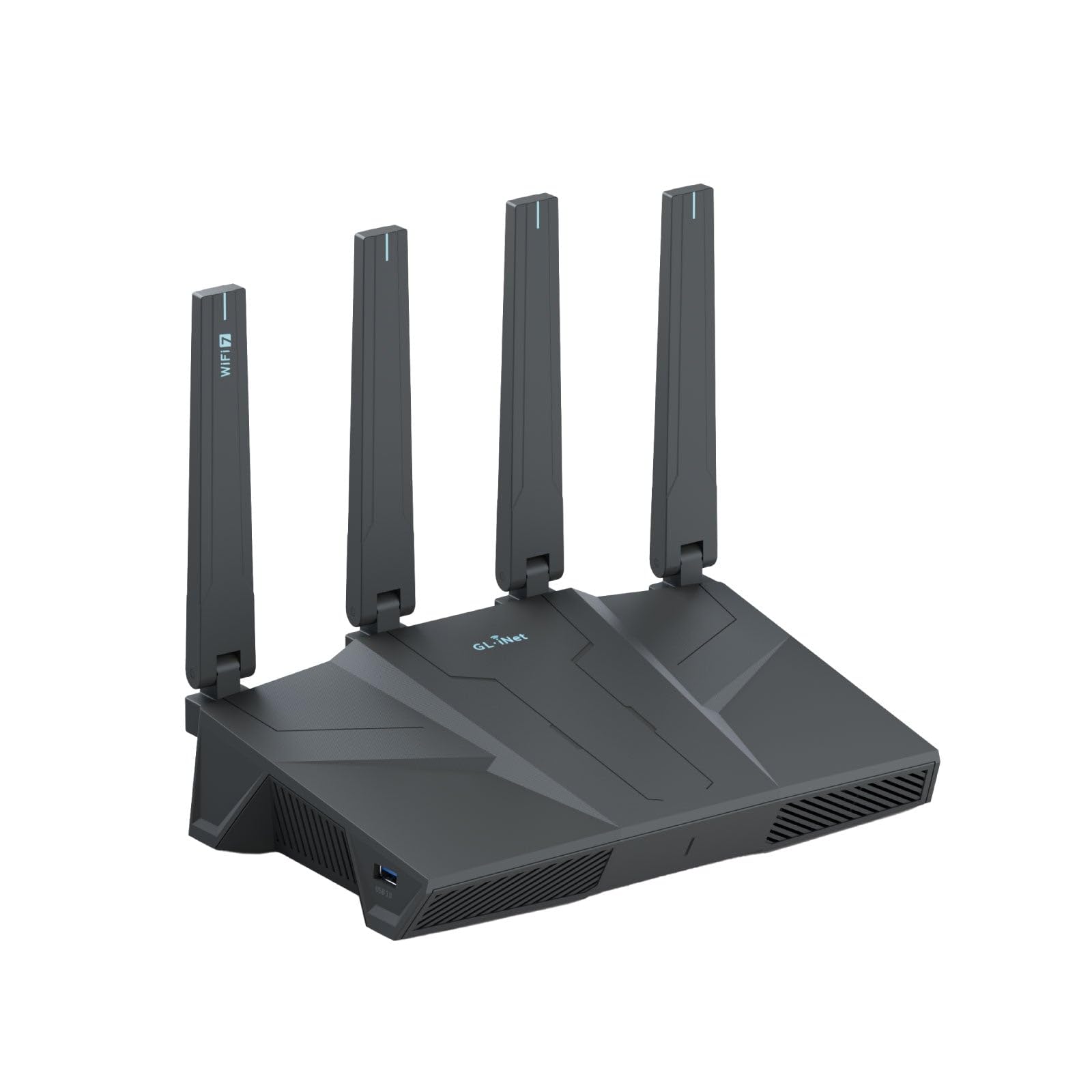
The GL.iNet Flint 3e is a WiFi 7 dual-band router that offers long-range coverage up to 2500 square feet. It is designed with five 2.5 Gigabit Ethernet ports, making it ideal for users with multi-gig fiber internet and a need for high-speed wired connections. The router introduces Multi-Link Operation (MLO) and 4K-QAM for ultra-low latency and high throughput.
One of the standout features is its advanced VPN capabilities, supporting WireGuard and OpenVPN at speeds up to 680 Mbps, which is a significant advantage for users who route all traffic through a VPN. The built-in AdGuard Home integration allows for network-wide ad blocking and DNS filtering, giving users full control over their browsing environment. The router also supports Bark for parental controls, making it a family-friendly option as well.
The Flint 3e has received praise for its open-source approach and feature-rich interface, but some users have noted that the initial setup and customer support can be less intuitive than consumer brands. It cannot be used with Starlink or other CGNAT-based services effectively. However, for those who want strong VPN performance and ad blocking directly at the router level, this is a compelling choice.
Why it’s great
- Excellent VPN throughput at 680 Mbps
- Built-in AdGuard Home for network-wide ad blocking
- Five 2.5G ports for complete wired flexibility
Good to know
- Setup process is less intuitive for non-technical users
- Customer support is appointment-based
6. Linksys Velop Pro 6E (MX6200)

The Linksys Velop Pro 6E introduces Cognitive Mesh Technology, which intelligently optimizes network performance by analyzing real-time data to resolve congestion and manage signal and channel selection automatically. This single node covers 3000 square feet and can be expanded with additional nodes for larger homes. The AXE5400 speeds unlock a dedicated 6 GHz band for the fastest and newest devices, offering true gigabit speeds up to 5.4 Gbps.
Setup is straightforward through the free Linksys app, which allows for remote network management, guest Wi-Fi, and parental controls. The router also features WPA3 encryption and automatic firmware updates to maintain security. A notable advantage is the 3.5-year warranty and 24/7 tech support, showing long-term reliability. The sleek cylindrical design with internal antennas blends well with any room.
While the cognitive mesh technology is a clever selling point, some users have reported quality control issues, with some units appearing refurbished and a few failing after weeks of use. These reports are not the norm, but they suggest that unit consistency can sometimes be a concern. For those who want an intelligent mesh system that requires minimal hands-on tuning, the Velop Pro 6E is a strong contender.
Why it’s great
- Cognitive Mesh auto-optimizes network traffic
- Provides access to the 6 GHz band for fast devices
- Excellent warranty and 24/7 support
Good to know
- Some reports of inconsistent unit quality
- Limited advanced settings for power users
7. GL.iNet Flint 3 (BE9300)

The GL.iNet Flint 3 is a tri-band WiFi 7 router that offers speeds up to 9 Gbps, designed for demanding users who need the absolute fastest wireless performance. It covers up to 2000 square feet, focusing less on sheer footprint and more on delivering high-speed connectivity with ultra-low latency. The router features five 2.5 Gigabit Ethernet ports, allowing for a fully wired office or gaming setup.
The system includes built-in AdGuard Home for network-wide ad blocking and supports both WireGuard and OpenVPN at speeds up to 680 Mbps. It also integrates with Bark for parental controls. The user interface is feature-rich and responsive, allowing for custom configuration without needing to rely on an app. Users have reported excellent performance with speeds reaching 950 Mbps on the 6 GHz band and seamless MLO connectivity.
While the Flint 3 is a powerhouse, its USB 3 NAS transfer speeds have been noted to be inconsistent, which may be a concern for those planning to use it as a media server. Additionally, its strongest feature—high-speed WiFi 7—requires compatible client devices to unlock its full potential. For power users who prioritize raw speed and granular control over coverage area, this is a top-tier choice.
Why it’s great
- Tri-band WiFi 7 with MLO for exceptionally low latency
- Built-in AdGuard for ad blocking without subscriptions
- Five 2.5G Ethernet ports for full wired speed
Good to know
- WiFi range is limited compared to mesh systems
- USB 3 NAS performance is inconsistent
FAQ
How many square feet does a coverage router actually cover in a real home?
What does the dedicated backhaul band do in a mesh system?
Final Thoughts: The Verdict
For most users, the best coverage router winner is the TP-Link Deco X55 Pro because it delivers massive 6500 sq ft coverage with dual 2.5G ports per node for a seamless wired backhaul. If you want the absolute latest WiFi 7 technology and the largest mesh footprint at 6000 sq ft, grab the NETGEAR Orbi RBE373. And for those who prefer a single, powerful unit with incredible range and a 2.5G port, nothing beats the TP-Link Archer AX80.

Mo Maruf
I created WellFizz to bridge the gap between vague wellness advice and actionable solutions. My mission is simple: to decode the research and give you practical tools you can actually use.
Beyond the data, I am a passionate traveler. I believe that stepping away from the screen to explore new environments is essential for mental clarity and physical vitality.