Our readers keep the lights on and my smoothie glass nicely filled. As an Amazon Associate, I earn from qualifying purchases.
Scorching heat doesn’t care about your to-do list. Whether you’re roofing under a midday sun, riding a motorcycle through dry air, or managing a medical condition that makes heat regulation a daily struggle, the right cooling vest can mean the difference between finishing strong and tapping out early. The market is flooded with evaporative fabrics, phase-change gel packs, and old-school ice vests—each claiming to be the one that actually works.
I’m Mohammad Maruf — the founder and writer behind WellFizz. I’ve spent countless hours parsing through customer field reports and manufacturer spec sheets to identify which designs deliver sustained core cooling without the added bulk or sudden failure that cheaper vests often hide.
After comparing seven distinct models across every price tier, I can confidently say the best cooling vest for men is the one that matches its cooling mechanism to your specific work or play environment.
How To Choose The Best Cooling Vest For Men
Not all cooling vests work the same way. The technology that keeps you comfortable in dry desert heat will leave you soaked and miserable in a humid swamp. Understanding three key differentiators will prevent a costly mistake.
Evaporative vs. Ice vs. Phase-Change
Evaporative vests (PVA or HyperKewl fabrics) work brilliantly in low-humidity environments with airflow—a fan or motorcycle wind activates the cooling. In humid conditions, the water won’t evaporate fast enough, leaving you damp and warm. Ice vests (FlexiFreeze, Alphacool) use frozen water packs for intense, reliable cooling regardless of humidity, but they add weight and require freezer access. Phase-change vests (Glacier Tek) use a material that melts at a specific temperature (59°F), offering consistent cooling without the risk of frost nip or the weight of a full ice load. Match the mechanism to your typical conditions.
Fit, Weight, and Mobility
A vest that slides around or weighs you down defeats its purpose. Ice vests can weigh 4-5 pounds once loaded, which is manageable for stationary work but exhausting during constant movement. Evaporative vests are lighter but can stiffen when dry. Look for adjustable shoulder straps and side bungees that cinch the vest snugly against your torso—loose vests let cool air escape and reduce contact efficiency.
Cooling Duration and Recharge Logistics
Evaporative vests need just water to reactivate, making them ideal for long days near a hose. Ice vests typically last 1-2 hours per pack set, requiring multiple frozen packs for a full shift. Phase-change vests offer 2-2.5 hours per charge and recharge quickly in ice water. Consider your access to a freezer, sink, or cooler before choosing a system that demands 12-hour freeze times when you only have a 30-minute lunch break.
Quick Comparison
On smaller screens, swipe sideways to see the full table.
| Model | Category | Best For | Key Spec | Amazon |
|---|---|---|---|---|
| FlexiFreeze Professional Series | Premium Ice | Job site safety compliance | 96 pure-water ice cubes per set | Amazon |
| Glacier Tek Cool Vest | Premium PCM | Consistent 59°F regulation | PureTemp phase-change, 2.5 hrs | Amazon |
| FlexiFreeze Personal Series | Mid-Range Ice | Versatile daily use | 3.5 lbs, <1″ thick | Amazon |
| Alphacool Arctic Ice Vest | Mid-Range Ice | Customizable pack placement | 4 interior pockets, 20 packs | Amazon |
| HyperKewl Sport V-Neck | Evaporative | Dry heat & motorcycle rides | HyperKewl fabric, 5-10 hrs | Amazon |
| TechNiche HyperKewl Sport | Evaporative | Budget evaporative cooling | Quilted nylon outer shell | Amazon |
| Ergodyne Chill-Its 6667 | Evaporative | Lightweight entry-level | PVA material, fast activation | Amazon |
In‑Depth Reviews
1. FlexiFreeze Professional Series Ice Vest

The Professional Series is the clear winner for men who need job-site compliance alongside serious cooling. Its heavy-duty rip-stop shell and 3M reflective fabric meet Hi-Vis Class 1 standards, so you stay visible and cool on road construction or warehouse floors. The vest uses 96 pure-water ice cubes spread across three removable panels, providing roughly 1.5 hours per set of intense core cooling that doesn’t rely on humidity or airflow.
Solid YKK zippers and bungee side adjustments let you cinch the fit from XS to 6X without the fabric pulling or bunching. Customers consistently report that the vest stays dry—no condensation on the outside—making it practical for beekeeping suits, cargo pilot cabins, and welding booths. The ice panels are secured via heavy-duty hook-and-loop strips that hold fast during active work, though the Velcro can occasionally pill a shirt when packs are removed.
For a full 8-hour shift, you will need two or three spare panel sets rotating from a cooler. The upfront investment is higher than any evaporative model, but the combination of high-vis safety, zero-drip ice containment, and professional-grade build quality makes this the most versatile and durable ice vest available. It earns the top spot because it solves two problems at once—heat stress and safety compliance—without compromising on either.
Why it’s great
- Hi-Vis Class 1 compliant with robust 3M reflective trim
- Heavy-duty YKK zipper and rip-stop fabric resist job-site abuse
- Pure water ice panels provide dense, predictable cooling without chemical odor
Good to know
- Each ice set lasts only about 1.5 hours, requiring spare packs for full shifts
- Velcro strips on the vest interior can snag on thin t-shirt fabric
2. Glacier Tek Cool Vest Personal Cooling

The Glacier Tek vest redefines convenience with its phase-change material (PureTemp) that locks at 59°F—cool enough to drop your core temp without the shock of frozen ice against your skin. Each vest ships with eight cooling packs (four large, four small) that slide into interior pockets and provide up to 2.5 hours of consistent cooling in 100°F ambient heat. The real advantage is recharge speed: submerge the packs in ice water for just 20 minutes, or throw them in a freezer for an hour.
One size fits chests from 29 to 52 inches using dual side elastic straps and over-the-shoulder adjustment. At just under 5 pounds fully loaded, it is heavier than an evaporative vest but the weight is distributed evenly across the torso. Users in extreme environments (120-125°F ambient) report that the vest dramatically improves productivity and reduces heat-stroke risk, provided they plan for pack rotation every two hours. The vest stays dry to the touch, making it suitable for wearing over a uniform without creating a soaked mess.
The trade-off is bulk—the vest is thicker and more rigid than an evaporative model, and some users found the side straps at maximum tightness still left a gap for smaller frames. A small percentage of packs have been reported to leak after many cycles, but Glacier Tek’s support reputation is strong. For anyone who needs dependable, repeatable cooling without the hassle of wringing out fabric or handling dripping ice packs, this is the most refined system available.
Why it’s great
- Phase-change material maintains 59°F for consistent, non-freezing comfort
- Ultra-fast recharge: 20 minutes in ice water or 1 hour in freezer
- Dry operation—no condensation or wet clothing
Good to know
- Weighs nearly 5 pounds with all packs inserted
- Vest can feel bulky under tight outer layers like leather jackets
3. FlexiFreeze Personal Series Ice Vest

The Personal Series strips away the high-vis extras to deliver the same 96 pure-water ice cube system in a lighter, more flexible neoprene package. The three removable ice panels attach with Velcro for quick swap, and the neoprene insulates the ice from ambient heat while directing the cold toward your core.
Cooling duration sits at about 1 to 1.5 hours per set, which aligns with the Professional Series. Customers using the vest for MS-related heat sensitivity or outdoor workouts praise how the thin profile fits under a loose shirt without looking like tactical gear. The four-point adjustment (shoulders and side bungees) creates a snug fit for builds from XS to 6X, though the plastic zipper has been flagged as a weak point after repeated daily use—some units show seam pulling around the zipper base after 50 cycles.
If you plan to wear this for full-day shifts, budget for two extra panel sets (sold separately) and a portable freezer or cooler. The vest itself is machine washable once the ice sheets are removed, which is a practical bonus for sweaty work. The Personal Series sacrifices some durability for flexibility, but for non-industrial users who prioritize low profile and low weight, it is the most comfortable ice vest on this list.
Why it’s great
- Only 3.5 lbs and less than 1″ thick for excellent range of motion
- Neoprene construction insulates ice and prevents frost on the shell
- Machine washable after removing ice sheets
Good to know
- Zipper quality is the primary durability concern with heavy daily use
- Extra ice panel sets are required for full-day coverage
4. Alphacool Arctic Cooling Ice Vest

The Alphacool vest takes a different approach with four interior pockets (two chest, two back) that you load with water-based gel packs. It includes 20 packs, enough for six at a time with plenty of spares at home. This design gives you control over where you want the coldest contact—load only the back pockets if you’re seated, or all four for total core coverage. The gel packs feel less rigid than pure ice cubes, conforming slightly to your body shape for better contact.
The lightweight blend fabric shell and adjustable straps provide a decent range of sizes, but the vest runs about 5 pounds fully loaded, making it one of the heavier options here. The straps need to be tight for the ice packs to make solid contact, which can be difficult to manage alone. Users working in Florida humidity and beekeeping suits report the vest performs well, though the gel packs can cause a cold sensation close to frost nip if worn against bare skin—a thin base layer solves this.
The gel packs freeze in standard freezer time and reactivate quickly. The trade-off is a less refined experience—the vest feels bulkier than the FlexiFreeze, and the gel packs won’t stay frozen as long as solid ice in extreme heat. It’s a solid mid-range option for anyone who wants to try the ice-pack method without a large upfront investment.
Why it’s great
- Includes 20 gel packs—generous supply for rotating sets
- Four interior pockets allow targeted placement of cooling packs
- Adjustable side straps and zipper closure for a customized fit
Good to know
- Heavy at over 5 lbs with all packs; weight is not evenly distributed
- Gel packs can feel uncomfortably cold against bare skin without a base layer
5. HyperKewl Light Weight Evaporative Cooling Sport V-Neck Vest

HyperKewl’s patented evaporative fabric is the centerpiece of this vest, designed to absorb water and release it gradually as moisture evaporates, pulling heat away from your core. The V-neck cut and zipper closure give it a sportier silhouette that layers well under a mesh jacket or loose shirt. Soak it for 3-4 minutes, wring lightly, and you get 5-10 hours of claimed cooling—though real-world reports in dry California heat settled around 3-4 hours of noticeable relief.
The lightweight build and breathable fabric make this one of the most comfortable vests for active movement. Motorcycle riders in 90°F+ conditions found that opening jacket vents turned the vest into an effective air conditioner, dropping perceived temperature by about 10°F. The vest stays damp rather than wet, which helps keep a t-shirt underneath reasonably dry compared to cheaper PVA alternatives. It does require airflow to work—stationary use in still air reduces performance significantly.
Sizing runs true, but some users recommend sizing up for a looser fit that promotes better evaporation. The main limitation is dependency on low humidity; in muggy environments, the vest stays wet and loses its cooling edge quickly. It’s also a poor choice if you need to wear it under a non-vented jacket, as trapped moisture won’t evaporate. For dry climate workers and motorcyclists who value low weight and zero freezer prep, this is the most practical pick.
Why it’s great
- Extremely lightweight and flexible for unrestricted movement
- Effective 3-4 hour cooling in dry, ventilated environments
- No freezer or ice packs required—just water to activate
Good to know
- Cooling performance drops sharply in humid or still-air conditions
- Must be worn under airflow (open jacket or breeze) for full effect
6. TechNiche International HyperKewl Cooling Sport Vest
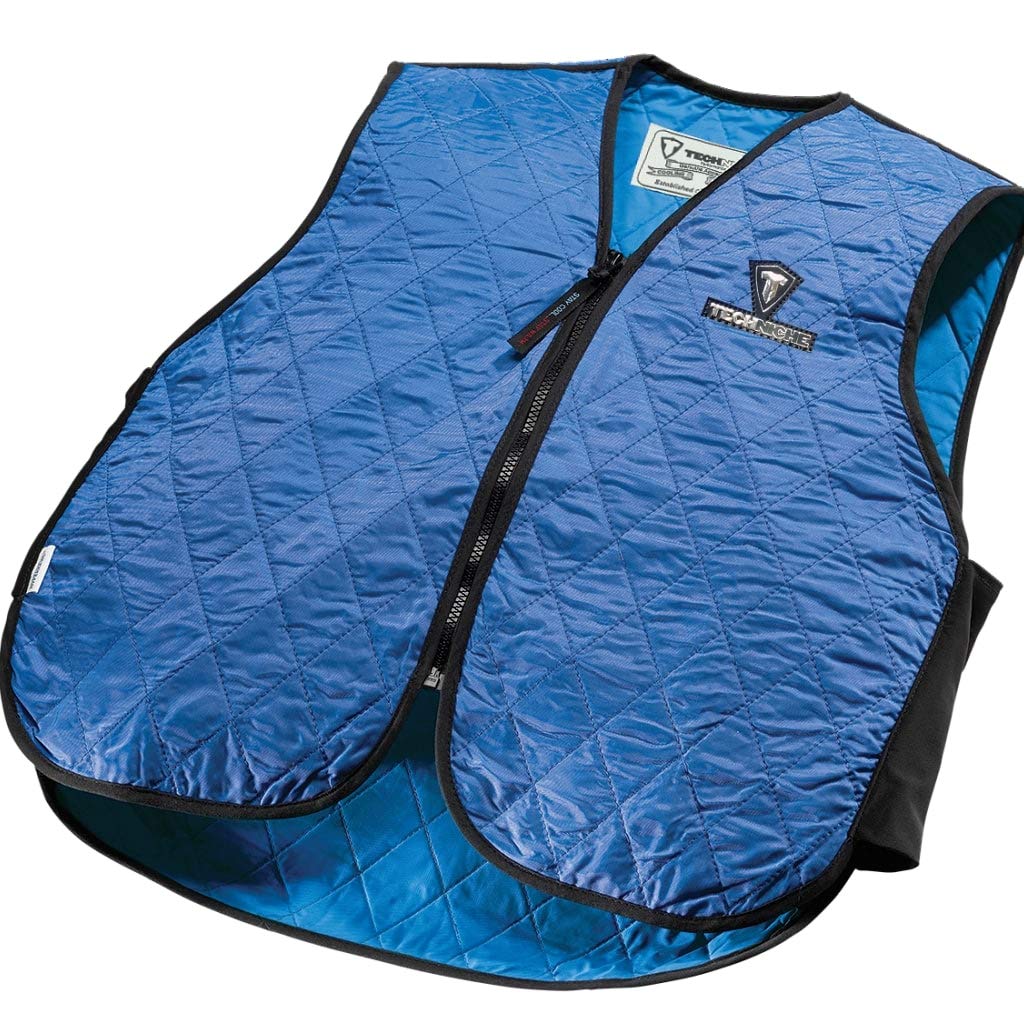
TechNiche uses the same HyperKewl fabric technology as the Sport V-Neck above but wraps it in a quilted nylon outer shell with water-repellent liner. This construction makes the vest more durable for rough environments and prevents moisture from soaking through to outer layers. The blue or silver color options with black polyester trim give it a classic workwear look that doesn’t scream “cooling gear.”
Customers report 4-hour cooling durations on 92°F days with excellent performance on motorcycles and construction sites. The vest activates in 5-10 minutes of soaking and stays damp long enough for a half-day shift without recharging. The water-repellent nylon liner is a standout feature—it keeps the vest’s moisture contained so your shirt stays dry, solving a common complaint with evaporative models. Sizing down is recommended for a snug fit; the vest runs slightly large even by the size chart.
The trade-off for the lower price is a stiffer feel compared to the unlined HyperKewl vest. The quilted nylon doesn’t breathe as well, which can trap some heat against the back during low-wind conditions. It also dries very slowly after use, requiring a fan or hang-dry setup before storage to prevent mildew. For the price, it’s a rugged evaporative option that holds up to daily abuse better than the lighter Sport V-Neck, making it a solid entry-level choice for men who don’t need phase-change precision.
Why it’s great
- Durable quilted nylon shell with water-repellent liner keeps shirts dry
- Long-lasting evaporative cooling with easy re-soak activation
- Budget-friendly entry point for testing evaporative technology
Good to know
- Quilted shell reduces breathability compared to unlined evaporative vests
- Dries slowly after use; requires airflow to prevent mildew
7. Ergodyne Chill-Its 6667 Cooling Vest

The Chill-Its 6667 is the simplest cooling vest on this list: a PVA (polyvinyl alcohol) material that you run under water, wring out, and wear. No ice packs, no phase-change gels, no zippered compartments—just a lightweight, mesh-paneled vest that activates in seconds. It’s the cheapest way to get immediate core cooling, and for many casual users in dry climates, it works surprisingly well. The PVA material feels cooler than ambient air as water evaporates, providing relief for several hours.
The breathable mesh side panels make this vest more comfortable than older PVA models that trap heat. A front zipper allows easy on-off, and the lightweight construction won’t weigh you down during light work. Florida heat sufferers and garage mechanics praise its simplicity: soak, wring, go. The vest is machine washable and hangs to dry. The major quirk of PVA is that it stiffens like cardboard when dry—soak it again to restore flexibility. Customers also note that the vest shrinks roughly two sizes when wet, so ordering up is essential.
There are no reflective elements for safety, no hi-vis rating, and no insulation layer, so the cooling is direct and unfiltered. The vest makes your t-shirt damp (not soaked, but damp), and the upper back tends to dry fastest, creating uneven cooling. It’s not suitable for humid environments, sedentary office use, or situations where you need dry clothing. But for the lowest possible buy-in to test whether evaporative cooling works for your routine, the Chill-Its 6667 is the honest, no-frills starting point.
Why it’s great
- Fastest activation—simply soak, wring, and wear in under a minute
- Extremely lightweight with breathable mesh for airflow
- Machine washable and affordable enough to replace seasonally
Good to know
- PVA material shrinks when wet; order two sizes up for proper fit
- Stiffens when dry and provides no cooling without re-soaking
FAQ
How long does an evaporative cooling vest actually last on a hot day?
Can I wear a cooling vest under a motorcycle jacket or work uniform?
Is a phase-change cooling vest better than an ice pack vest for sensitive skin?
How many ice pack sets do I need for an 8-hour work shift?
Why does my evaporative vest get stiff after it dries?
Final Thoughts: The Verdict
For most users, the best cooling vest for men winner is the FlexiFreeze Professional Series because it delivers heavy-duty ice cooling in a Hi-Vis compliant shell that meets job site requirements while keeping you dry and cool. If you want consistent, non-freezing temperature regulation with the fastest recharge time, grab the Glacier Tek Cool Vest. And for a lightweight, no-prep evaporative option that works great in dry climates, nothing beats the HyperKewl Sport V-Neck.

Mo Maruf
I created WellFizz to bridge the gap between vague wellness advice and actionable solutions. My mission is simple: to decode the research and give you practical tools you can actually use.
Beyond the data, I am a passionate traveler. I believe that stepping away from the screen to explore new environments is essential for mental clarity and physical vitality.