Our readers keep the lights on and my smoothie glass nicely filled. As an Amazon Associate, I earn from qualifying purchases.
Specs are compiled from manufacturer listings and verified buyer reviews and can change over time — please confirm the key details on the product page before buying.
You want to see Saturn’s rings clearly, not a blurry smudge — and the difference between those two outcomes depends on a few specs you need to know before you buy. This guide breaks down six of the best consumer telescopes on the market right now, with real buyer feedback and head-to-head numbers, so you can pick the one that actually fits your backyard or your travel plans.
I’m Mohammad Maruf — the founder and writer behind WellFizz. This guide is built by comparing the manufacturers’ published specifications and the patterns across verified customer reviews, so you get each pick’s real strengths and trade-offs instead of marketing spin.
This roundup of the best consumer telescope options covers beginner-friendly scopes and more serious models for deep-sky objects, so you can find the one that fits your skill level, budget, and viewing goals.
Quick Picks
- Celestron StarSense Explorer 130AZ — Best Overall
- Dianfan 150EQ — Best Value
- SVBONY SV503 70mm — Astrophotography Pick
- Celestron StarSense Explorer LT 80AZ — Easiest to Use
- Gskyer 600x90mm — Budget All-Rounder
- MEEZAA 90mm Telescope — Budget Beginner
How To Choose The Best Consumer Telescope
Picking your first real telescope can feel overwhelming with all the numbers thrown at you — aperture, focal length, mount type, magnification. But a few simple rules will steer you right. Start with the size of the main lens or mirror (the aperture), because that determines how much light your scope collects. More light means you can see fainter objects like nebulae and galaxies. Next, think about the mount: a simple alt-azimuth mount is easiest for beginners, while an equatorial mount gives you smoother tracking of stars as they move across the sky. Finally, do not get hypnotized by huge magnification numbers — a 300x claim on a cheap scope is useless if the image is too dim and shaky to focus.
Aperture Is Everything
The aperture (the diameter of the main lens or mirror) is the heart of any telescope. A larger aperture gathers more light, making images brighter and revealing finer details. For a beginner, a 70mm to 90mm aperture is a solid starting point for seeing the moon’s craters and Jupiter’s moons. If you want to spot galaxies and nebulae, step up to 130mm or larger — but be ready for a bigger, heavier setup.
Refractor vs. Reflector
Refractor telescopes (like the MEEZAA and Gskyer models) use a glass lens at the front and are generally low-maintenance — you rarely need to realign the optics. Reflector telescopes (like the 150EQ and Celestron StarSense Explorer 130AZ) use a mirror and offer more aperture for your money, which is great for deep-sky observing, but they may need occasional collimation (aligning the mirrors).
Mount Stability Matters More Than You Think
A wobbly mount ruins the view no matter how good the optics are. Look for a solid steel or stainless steel tripod (not flimsy aluminum) and a mount with smooth slow-motion controls. Tabletop Dobsonian bases, like on the Celestron StarSense Explorer 130AZ, are inherently very stable for their size.
Quick Comparison
| Model | Best For | Aperture | Focal Length | Mount Type | Amazon |
|---|---|---|---|---|---|
| Celestron StarSense Explorer 130AZ | App-guided viewing | 130mm | 650mm | Tabletop Dobsonian | Amazon |
| Dianfan 150EQ | Large aperture value | 150mm | 650mm | German Equatorial | Amazon |
| SVBONY SV503 70mm | Astrophotography | 70mm | 474mm | OTA (no mount) | Amazon |
| Celestron StarSense Explorer LT 80AZ | Guided start with app | 80mm | 400mm | Alt-azimuth | Amazon |
| Gskyer 600x90mm | Budget all-rounder | 90mm | 600mm | Alt-azimuth | Amazon |
| MEEZAA 90mm | Budget beginner | 90mm | 800mm | Alt-azimuth | Amazon |
In‑Depth Reviews
1. Celestron StarSense Explorer 130AZ

The tabletop Dobsonian that puts a star atlas in your pocket.
This 130mm (5-inch) Newtonian reflector gives you a huge 650mm focal length and a Dawes limit of 0.89 arc seconds, meaning it can resolve finer details than the 80mm refractors on this list. The real magic is the StarSense Explorer app — you dock your smartphone, and the patented sky recognition technology analyzes star patterns to tell you exactly where to point the scope. Buyers report fantastic packaging and build quality, with one calling it “WAY better” than the older DX model thanks to its rock-solid tabletop Dobsonian base and parabolic primary mirror.
Unlike the Gskyer and MEEZAA models that rely on manual finders, this one uses a red-dot finderscope along with the app to guide you. The 650mm focal length paired with the included 25mm and 10mm eyepieces gives you sharp views of Jupiter’s moons, Saturn’s rings, and deep-sky favorites like the Orion Nebula. One reviewer noted the instruction manual is not very helpful, but assembly is still fairly straightforward. The base uses pressboard rather than solid wood, which is a minor trade-off at this price point.
What Stands Out
- 130mm aperture gathers enough light for galaxies and nebulae.
- StarSense app makes finding objects easy for any beginner.
- Parabolic primary mirror delivers sharp, coma-free views.
The Catch
- Tabletop design requires a sturdy table — not ideal for remote field use.
- Base is heavy and uses pressboard, not solid wood.
- Assembly takes a few hours; instructions could be better.
Your best bet if: you want a powerful, app-guided scope that can show you deep-sky objects from day one without any prior astronomy knowledge.
But note: the heavy base and tabletop-only design make it less portable than a tripod-mounted refractor for travel.
2. Dianfan 150EQ
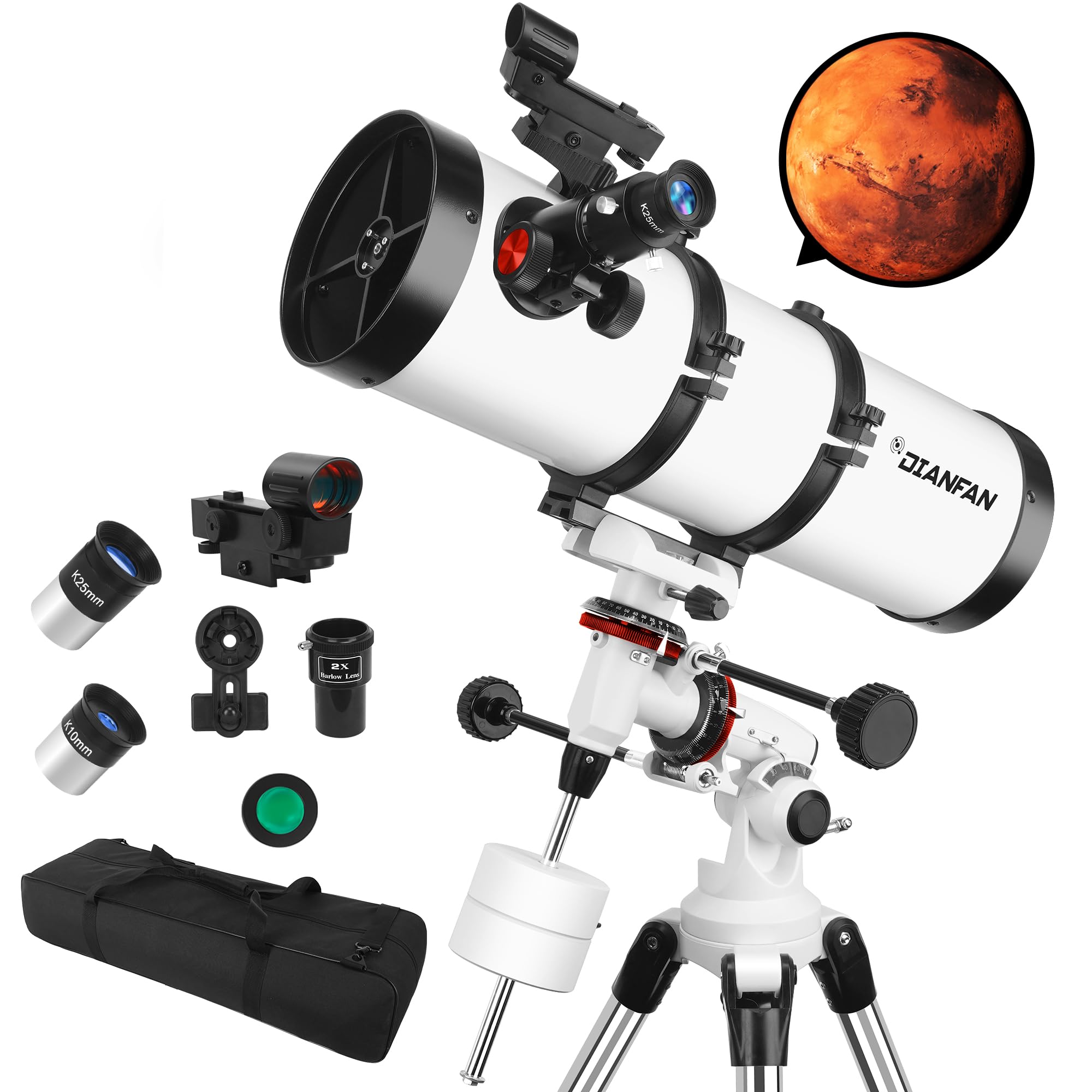
The biggest aperture for your dollar with a proper equatorial mount.
This reflector captures 88% more light than the Celestron StarSense Explorer LT 80AZ because its 150mm aperture (the diameter of the main lens or mirror) is much larger than the Celestron’s 80mm opening. That extra light makes faint deep-sky objects like nebulae and star clusters appear brighter. The 650mm focal length (the distance light travels inside the scope before reaching the eyepiece) works with the German equatorial mount — a mount that uses slow-motion control cables to track objects smoothly as the Earth rotates — unlike the simpler alt-azimuth mounts on the MEEZAA and Gskyer models. Reviewers report excellent value, with one noting it delivers “way beyond what I was expecting” and calling the core scope “near-perfect” for the price.
One buyer mentioned the red-dot finder arrived misaligned (needing about 1-inch offset), and the phone adapter can fall off during use. The included 1.25-inch Kellner eyepieces are acceptable but have a narrow ~40-degree field of view. The stainless steel tripod is sturdy, though buyers suggest it can be slightly unstable at full extension. A major plus is the included carrying bag, which makes transport easier than the separate case needed for the SVBONY SV503.
Why It Wins
- 150mm aperture is the largest in this guide — superb for galaxies and nebulae.
- Equatorial mount with slow-motion controls for smooth tracking.
- Comes with a protective carrying bag for easy transport.
The Downsides
- Red-dot finder often arrives misaligned from the start.
- Plastic focuser and phone adapter feel less durable.
- Setup is more complex than a simple alt-azimuth mount.
Reach for this if: you want maximum light-gathering power for deep-sky observations and are willing to learn how to use a German equatorial mount.
Look elsewhere if: you want a grab-and-go travel scope or prefer the simplicity of an app-guided mount.
3. SVBONY SV503 70mm
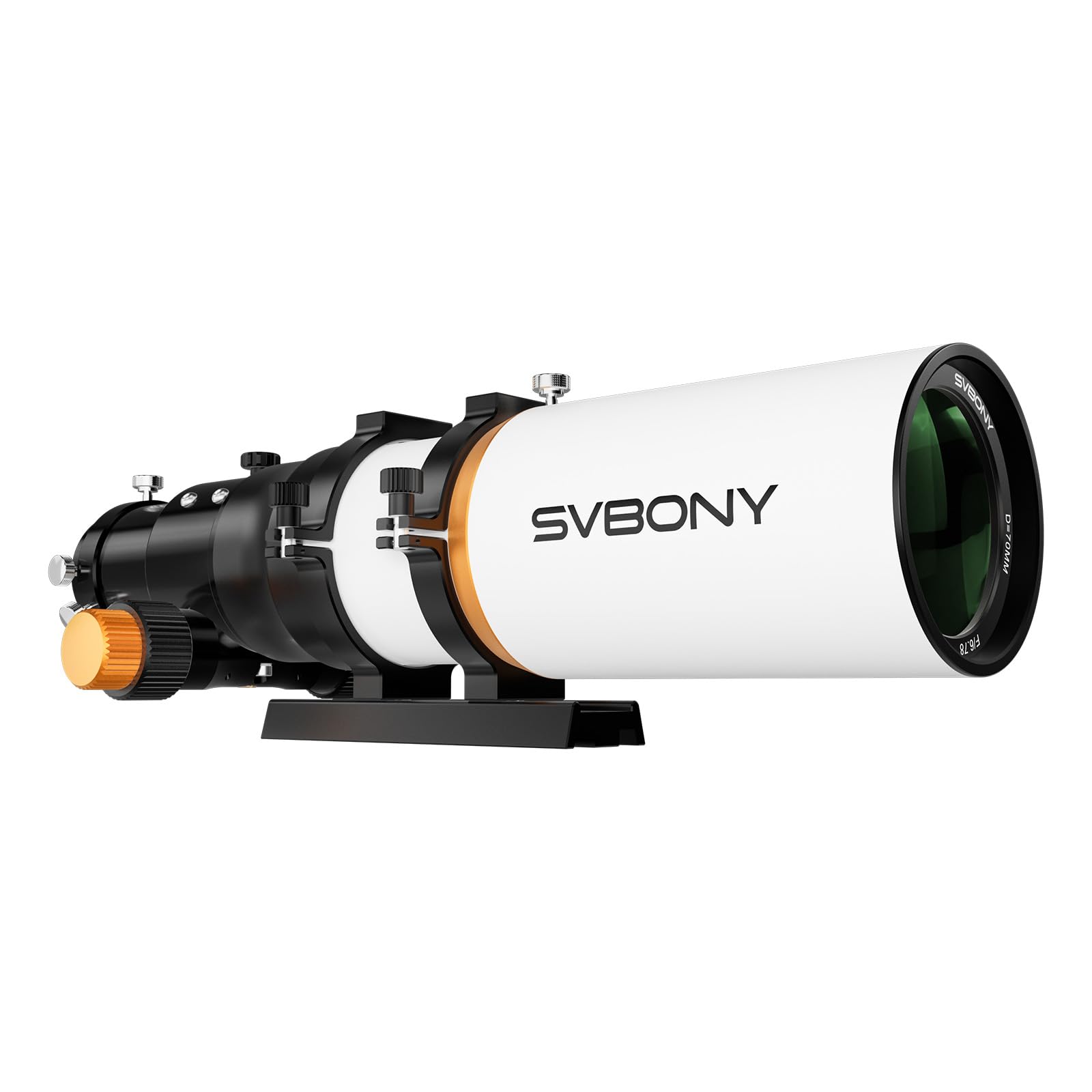
An ED refractor that puts pro-level image clarity within reach.
This is not a complete telescope kit — it is an optical tube assembly (OTA) with no mount or tripod included, designed for serious hobbyists who want to attach it to their own mount for astrophotography. The 70mm aperture with ED extra-low dispersion glass and full broadband anti-reflection coatings significantly reduces chromatic aberration (false color fringing on bright objects), unlike the standard achromatic optics in the Gskyer and MEEZAA models. The built-in field flattener means you do not need to buy a separate accessory to get sharp stars across the entire frame in your photos. Reviewers praise the “exceptional” optics and the smooth dual-speed focuser that handles heavy camera loads without slippage.
Owners mention the scope is lightweight at 2.69 kilograms and delivers sharp, bright images with minimal false color. The 474mm focal length (f/6.78) gives a wide field of view perfect for large nebulae and star fields. However, this model ships without a finderscope, eyepieces, or any mounting hardware — you will need to budget for a mount and accessories separately. One owner reported the focal reducer does not produce a perfectly flat field, so corner stars may appear slightly non-round.
The Strength
- ED glass and built-in field flattener deliver sharp, color-corrected images.
- Dual-speed 2-inch focuser is smooth and precise for fine focusing.
- Lightweight and compact design ideal for portable astrophotography rigs.
The Trade-Offs
- No mount, tripod, or eyepieces included — requires a separate purchase.
- 70mm aperture is smaller than the reflectors for visual-only observing.
- Focal reducer may not give perfectly round stars in corners.
Pick this if: you already own a sturdy mount and want a high-quality refractor for deep-sky astrophotography while staying affordable on an APO triplet.
skip it if: you are a beginner looking for a ready-to-use telescope — you will need to buy extra gear.
4. Celestron StarSense Explorer LT 80AZ

The app-guided refractor that eliminates guesswork for beginners.
The same patented StarSense sky recognition technology found in the pricier 130AZ model is packed into this lighter, more portable 80mm refractor. With a 400mm focal length (half that of the MEEZAA 90mm), this scope offers a wider, lower-magnification field of view ideal for scanning star fields and large objects like the Orion Nebula and Andromeda Galaxy. The app generates a curated list of tonight’s best targets based on your time and location. Customers note excellent moon views showing craters and mountains, and one noted that “Jupiter shows moons but not bands; Saturn’s ring visible” — which is realistic for an 80mm scope.
The manual alt-azimuth mount with altitude slow-motion adjustment is simple and intuitive. The kit includes 25mm and 10mm eyepieces plus a 2x Barlow lens, giving you magnifications up to 80x. At 400mm focal length, it is less demanding on the mount than longer scopes, so the lightweight tripod feels stable enough. One buyer did receive a defective red-dot finderscope, but Celestron’s US-based support replaced it promptly, which speaks to the brand’s 2-year warranty coverage.
What Works
- StarSense app makes locating planets and nebulae easy.
- Lightweight and easy to assemble — great for quick backyard sessions.
- Celestron’s 2-year US warranty and responsive customer support.
The Limits
- 80mm aperture is smaller — Jupiter’s cloud bands are not visible, just its moons.
- 400mm focal length gives lower maximum magnification than longer refractors.
- Red-dot finderscope can arrive non-functional, requiring a replacement.
Ideal for: absolute beginners and families who want the smoothest possible learning curve — the app does the heavy lifting so you spend more time looking up and less time fiddling.
Keep in mind: if you outgrow it for planetary details, you will want a larger aperture scope next.
5. Gskyer 600x90mm

A solid 90mm refractor that punches at its price point.
This 90mm refractor (a telescope that uses a lens at the front to gather light) with a 600mm focal length sits between the compact 80mm and the long 800mm MEEZAA scope. The fully coated optics deliver clear views of the moon, Jupiter, and Saturn for the price. The aluminum tripod adjusts from 31.5 to 49 inches, but reviewers point out it is too short and needs replacement for comfortable viewing — one reviewer specifically said, “Tripod too short; needs replacement.” The kit includes three eyepieces (giving 24x, 60x, and 120x magnifications) plus a 3x Barlow lens that triples each one.
Gskyer claims German technology in the optics, and most buyers agree the glass is good for the price. The finderscope is a reflex style, which is easier to use than the straight-through finders on some cheaper models. However, the mount has some play: one customer observed about stiff, non-functional focus and azimuth adjustments, while another noted the Alt-axis backlash is noticeable and upgraded to a SV225 mount. For terrestrial daytime viewing, the scope works well, but serious stargazers will want to budget for a sturdier tripod.
The Good
- 90mm aperture and 600mm focal length give a nice balance of brightness and magnification.
- Comes with three eyepieces and a 3x Barlow for flexible viewing.
- Good moon, Jupiter, and Saturn views for the price point.
The Bad
- Tripod is too short for comfortable seated or standing viewing.
- Mount can have backlash or stiff focus issues in some units.
- Customer service reportedly unreachable for some buyers.
Budget-conscious move: if you are willing to swap the tripod for a sturdier one, this 90mm refractor gives you the largest aperture among the budget refractors here at a very competitive price.
But be aware: the mount can be finicky, and you may need to do minor adjustments from the start.
6. MEEZAA 90mm Telescope

The long focal-length refractor that makes the moon feel close enough to touch.
With a 800mm focal length (the longest in this group and double the Celestron LT 80AZ), this 90mm refractor gives you high magnifications for detailed planetary and lunar observing. The fully multi-coated glass lenses improve image brightness and clarity. The 3x Barlow lens triples each eyepiece’s power, giving a maximum theoretical magnification of 240x. One user highlighted the setup assembly takes about 20 minutes, and the included paper manual is clear.
The stainless steel tripod adjusts from 28 to 46 inches, which is shorter than the Gskyer but still functional. Buyers generally like the build quality, with one calling it “excellent beginner/novice telescope on a budget.” The honest catch: some users could not find Jupiter or Saturn despite good moon views. The phone adapter works for sharing quick snaps but causes wobble and reduced magnification during use. The straight-through finderscope is a bit tricky for beginners to align with the main scope.
Pros
- 800mm focal length gives you high-magnification views of the moon and planets.
- All accessories fit neatly into the included carry bag for travel.
- Stainless steel tripod is more stable than aluminum alternatives.
Cons
- Longer focal length makes it harder to find objects — not ideal for beginners.
- Phone adapter causes wobble; not designed for serious astrophotography.
- Some buyers could not locate Saturn or Jupiter despite decent moon views.
Who it fits: budget buyers who want a dedicated lunar scope with high magnification potential and do not mind a learning curve to find fainter planets.
Who should pass: total beginners who want a simple, wide-field scope — the 400mm Celestron LT 80AZ is much easier to aim.
Understanding the Specs
Aperture (in mm)
This is the diameter of the main lens or mirror that collects light. Think of it like the size of a bucket collecting rainwater — a bigger bucket gathers more water. With a telescope, a larger aperture means you can see fainter objects like galaxies and nebulae, and resolve finer details on planets. For a consumer telescope, 70mm is a decent starting point, while 130mm and above opens up deep-sky viewing. The 150mm diameter on the Dianfan 150EQ gathers significantly more light than the 80mm on the Celestron LT 80AZ — an 88% larger opening — making a real difference in how much you can see.
Focal Length (in mm)
Focal length determines the magnification power of your telescope when paired with an eyepiece. A longer focal length like 800mm on the MEEZAA gives you higher magnification potential for close-up views of the moon and planets. A shorter focal length like 400mm on the Celestron LT 80AZ gives you a wider field of view, better for scanning large star clusters and the Milky Way. It also affects how “fast” the telescope is for photography — f/6.78 and faster ratios are better for astrophotography.
Mount Type
The mount holds the telescope steady and lets you point it at the sky. Alt-azimuth mounts (simple up-down, left-right) are the easiest for beginners. Equatorial mounts have a tilted axis that aligns with the Earth’s rotation, letting you follow stars by turning just one knob. Dobsonian mounts are a type of alt-azimuth mount that sits on a flat base — they are very stable and great for reflectors. Tabletop designs like the Celestron 130AZ require a sturdy table but are exceptionally stable for their size.
Eyepieces & Magnification
Magnification = telescope focal length / eyepiece focal length. So a 25mm eyepiece on a 600mm telescope gives 24x magnification. A 10mm eyepiece gives 60x. Barlow lenses multiply that — a 3x Barlow turns the 10mm into a 3.3mm effective eyepiece. Do not chase huge magnification numbers: a 300x image on a shaky or dim scope will be a blurry mess. Start with lower magnification for bright, sharp views, then increase as conditions allow.
FAQ
How much aperture do I really need as a beginner?
Will a 90mm telescope show me Saturn’s rings clearly?
Can I take photos through these telescopes?
What is the difference between a refractor and a reflector telescope?
Do I need an equatorial mount for astrophotography?
How do the Celestron StarSense Explorer app models work?
Can I use a telescope during the daytime?
What is the difference between a 90mm f/8.88 telescope and a 90mm f/6.7 telescope?
How long does it take to set up a beginner telescope?
What is the best telescope for under that shows deep-sky objects?
Final Thoughts: The Verdict
Across the board, the best consumer telescope winner is the Celestron StarSense Explorer 130AZ because its 130mm aperture paired with the StarSense app gives you deep-sky capability without the steep learning curve of traditional astronomy. If you want the absolute largest aperture for your money and are willing to learn an equatorial mount, grab the Dianfan 150EQ. And for astrophotography enthusiasts who already own a mount, the SVBONY SV503 70mm delivers ED glass and a built-in field flattener at a price that undercuts most competition.
How We Picked
We do not accept paid placement. Every pick is matched to a real buyer and a real use-case; we do not hands-on test units.
Sources & Methodology
Specifications: manufacturer listings and product documentation. Review insights: verified customer reviews, as of July 2026. Pricing: not shown on this page (it changes often); check the current price via the retailer link.
As an Amazon Associate, WellFizz earns from qualifying purchases. This does not affect which products we feature.

Mo Maruf
I created WellFizz to bridge the gap between vague wellness advice and actionable solutions. My mission is simple: to decode the research and give you practical tools you can actually use.
Beyond the data, I am a passionate traveler. I believe that stepping away from the screen to explore new environments is essential for mental clarity and physical vitality.