Our readers keep the lights on and my smoothie glass nicely filled. As an Amazon Associate, I earn from qualifying purchases.
Specs are compiled from manufacturer listings and verified buyer reviews and can change over time — please confirm the key details on the product page before buying.
A cheap point-and-shoot can out-zoom your phone, but the wrong model delivers blurrier photos than a 5-year-old smartphone. This guide covers four options — from a 96MP hyperzoom to a Kodak optical zoom — highlighting real strengths and marketing fluff.
I’m Mohammad Maruf — the founder and writer behind WellFizz. This guide is built by comparing the manufacturers’ published specifications and the patterns across verified customer reviews, so you get each pick’s real strengths and trade-offs instead of marketing spin.
if you want a tiny travel companion or a high-megapixel vlogging tool, the right cheap point and shoot camera depends on matching your real use — daytime walkaround or indoor content — to the single spec that decides image quality here: optical zoom versus pure digital cropping.
Quick Picks
- AUREAPIX 8K Digital Camera 96MP — Best Overall
- Lmzour 4K Vlogging Camera — Vlogger’s Pick
- Minolta MND20 44MP Digital Camera — Compact Throwback
- KODAK PIXPRO FZ55 16MP — Best Value
How To Choose The Best Cheap Point And Shoot Camera
A budget point-and-shoot lives at the intersection of three things: how close you can zoom before the picture turns to mush, whether your subject stays in focus without fuss, and how long you can shoot before hunting for an outlet. Here is what to check before you click buy.
Optical zoom is the only zoom that counts
Digital zoom simply crops the center of your photo and enlarges the remaining pixels — it is the same as pinching in on your phone screen. Optical zoom physically moves glass inside the lens, preserving every detail. Among these picks, the Kodak FZ55 has a real 5X optical zoom. The other three rely entirely on digital zoom, which means “20X” or “16X” is just heavy cropping — fine for social media thumbnails, useless for a printed 8×10.
Megapixels versus sensor reality
A 96MP or 44MP sensor sounds incredible on paper, but on a tiny budget sensor, those pixels are tiny and noisy in low light. Real resolution is often much lower — one reviewer discovered a “44MP” Minolta actually captures 12MP raw files after checking the image metadata. The Kodak’s 16MP sensor is more honest and, paired with a real optical zoom, often produces cleaner 8×10 prints than the inflated numbers.
Battery and accessories change the real cost
Most budget cameras ship with a proprietary lithium-ion battery that charges inside the camera — you cannot swap in a fresh pack of AA’s on a trip. The AUREAPIX and Lmzour include two batteries and a charger; the Minolta buyers report fast drain; the Kodak ships with no battery at all (you buy one separately). A bundle that includes an SD card, case, and card reader (like the Kodak and Lmzour do) can save you and a second Amazon order.
Quick Comparison
| Model | Best For | Sensor (claimed) | Zoom Type & Power | Max Video | Amazon |
|---|---|---|---|---|---|
| AUREAPIX 8K 96MP | High-megapixel stills & WiFi sharing | 96MP | Digital 20X | 8K | Amazon |
| Lmzour 4K Vlogging | Vlogging with face tracking & remote app | 75MP | Digital (wide-angle 79°) | 4K | Amazon |
| Minolta MND20 | Pocketable beginner novelty | 44MP | Digital 16X | 2.7K | Amazon |
| KODAK PIXPRO FZ55 | True optical zoom & day-to-day snapshots | 16MP | Optical 5X | 1080p Full HD | Amazon |
In‑Depth Reviews
1. AUREAPIX 8K Digital Camera 96MP
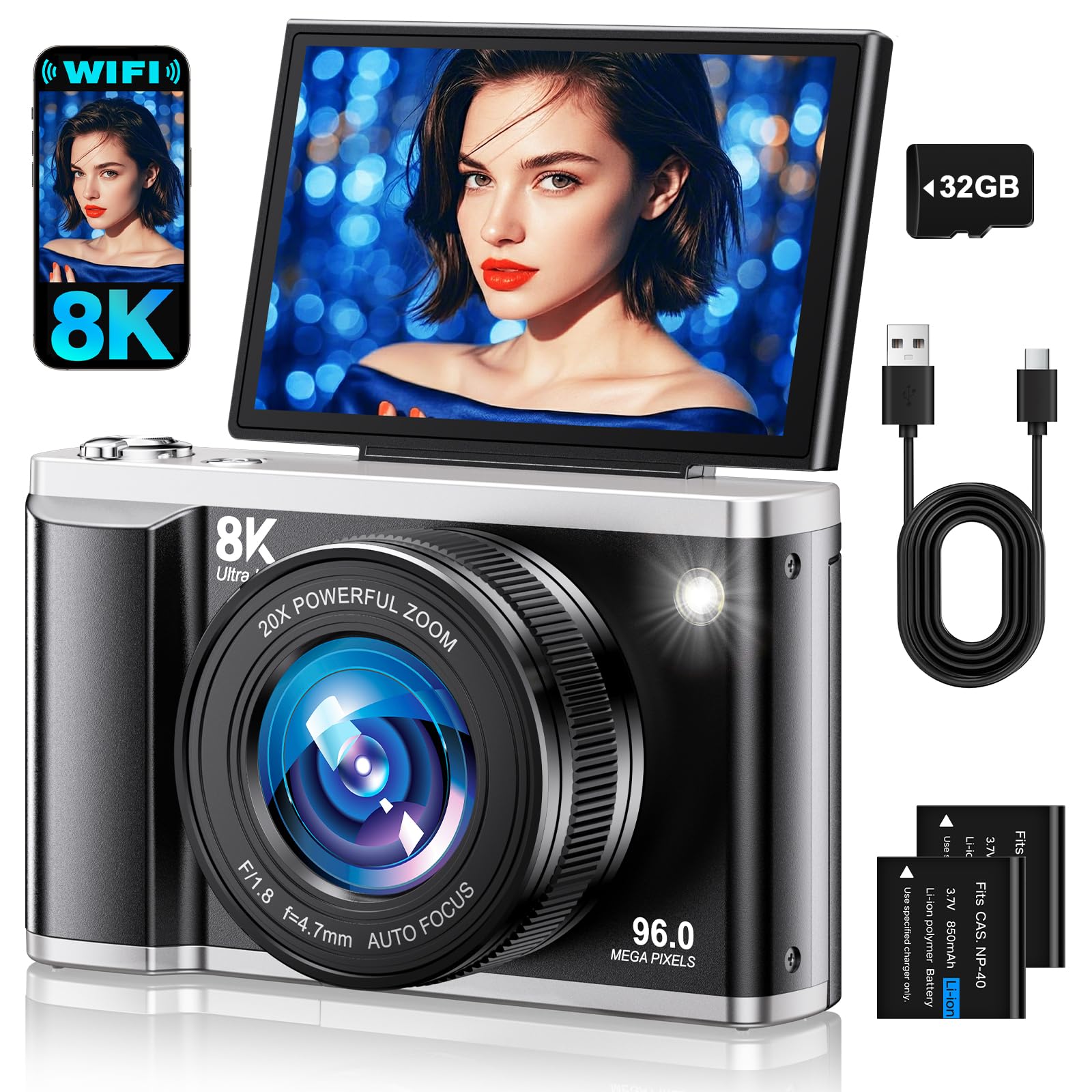
The highest resolution in the group, packing 96MP stills and 8K video into a sub- body.
This is the spec-buster of the bunch — you are getting 96MP photos and 8K video, versus the Minolta’s 44MP and the Kodak’s 16MP sensor. The built-in WiFi transfer (“Viipulse” app for iOS and Android) means you can push photos straight to your phone for social sharing without hunting for a cable. Owners mention “good resolution, includes 2 rechargeable batteries, has internal memory, and allows photo transfer to computer without using phone storage.”
The catch is that all 20X of the zoom is digital — it is cropping, not glass moving. At maximum zoom the 8K resolution drops hard. The 180° flip screen and included 32GB SD card, camera bag, and two batteries make this a complete kit for a beginner creator who wants huge file sizes and WiFi convenience more than optical clarity.
Why it wins for creators
- 96MP photos and 8K video — far more resolution than anything else here
- Includes two rechargeable batteries plus a 32GB SD card in the box
- Built-in WiFi for phone transfer; no computer needed for casual sharing
- 3.5″ 180° flip screen makes selfie framing and vlogging easy
The real trade-off
- 20X zoom is all digital — at full reach the image degrades noticeably
- No optical zoom means you cannot bring distant subjects closer cleanly
- 8K video is interpolated; real sharpness falls short of a true 8K sensor
Reach for this if: you want the highest megapixel count possible under and plan to share mostly on social media — the huge files and WiFi transfer make it a smartphone upgrade for casual creators.
Look elsewhere if: you need clean optical zoom for sharp prints or wildlife shots; the Kodak’s optical 5X will give you far clearer long-range photos despite its lower 16MP count.
2. Lmzour 4K Vlogging Camera
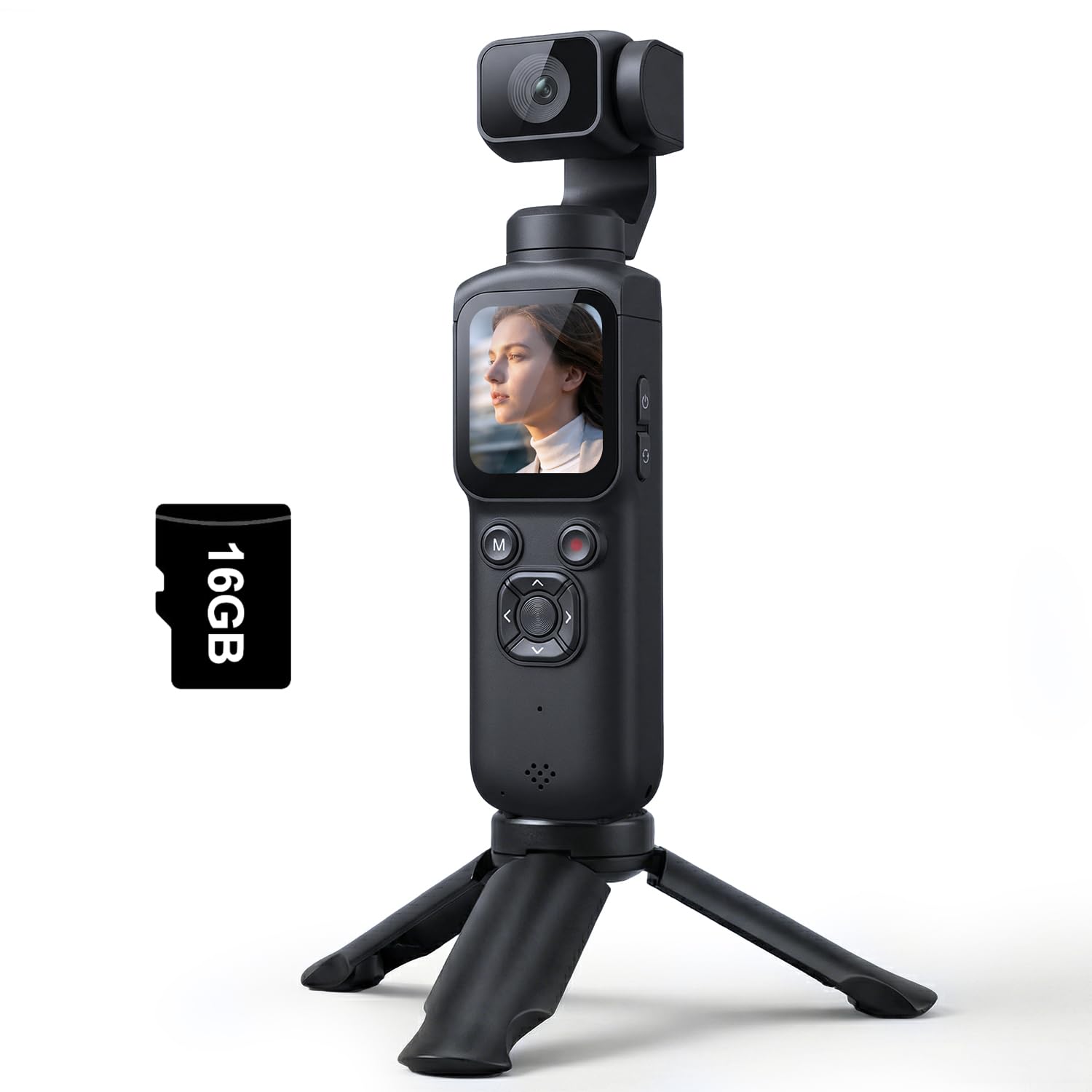
A vlogging-first point-and-shoot with a 330° rotating lens and active face tracking for solo creators.
Unlike the AUREAPIX, this camera is built for video first — 4K footage with a wide-angle 79° field of view and a 330° rotating lens that lets you film yourself without moving the tripod. “4K camera with excellent autofocus, focus lock, and face tracking,” one buyer confirmed, and the face tracking keeps your head centered during live streams or solo vlogs. The included kit — 16GB card, mini tripod, carrying bag — means you can start filming in under five minutes from the start.
The defining difference versus the Minolta above is that the Lmzour records 4K video while the Minolta records 2.7K video. You trade that for no built-in flash and a battery life of about 1.5 hours, so a midday shoot requires the spare battery. Customers note the top “gimbal” section does not lock, so you need to handle it carefully in your bag.
Best for streaming solo: The rotating lens and face tracking mean you do not need a second person behind the camera — set it on the included tripod, twist the lens, and talk.
Ideal for: TikTok, YouTube, or live-streaming beginners who want hands-free framing and cheap 4K video in a pocket-sized body.
skip it if: you primarily shoot photos rather than video — the AUREAPIX delivers much higher still resolution, and the Kodak’s optical zoom beats digital cropping for distant daytime shots.
3. Minolta MND20 44MP Digital Camera
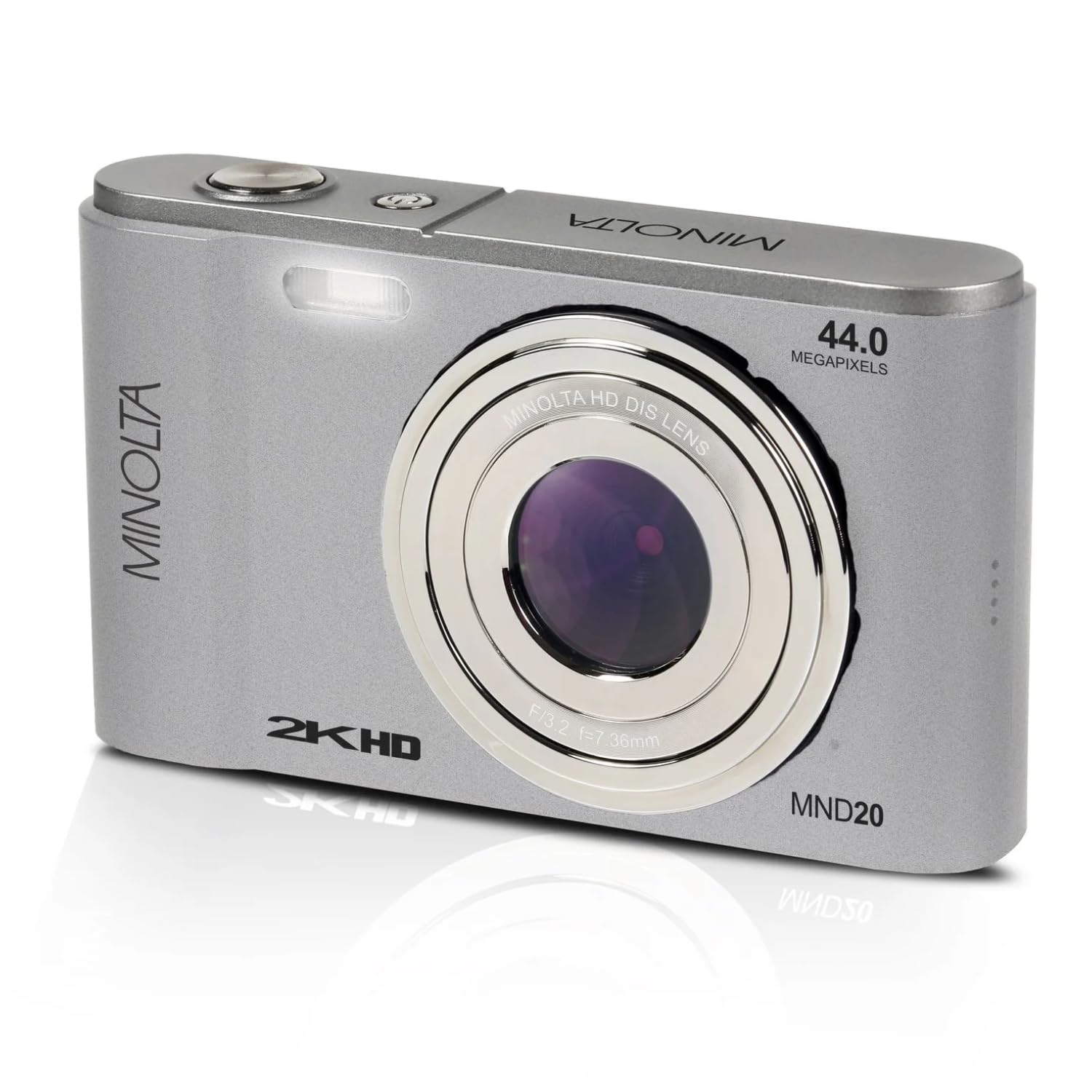
The lightest of the four at 8 ounces, but zoom and image quality reveal budget-limits.
At 8 ounces this is genuinely pocketable — it disappears into a jacket or small purse — and the 44MP stills and 2.7K video (16X digital zoom) look good in bright daylight. One buyer called it “pocketable with 44MP stills, 2.7K video, 16x digital zoom, anti-shake, face detection, time lapse.” The anti-shake feature helps reduce the blur from handheld shooting, and the 2.9″ articulating LCD makes composition flexible.
Multiple reviews confirm the 44MP claim is inflated — one buyer found actual 12MP captures in the metadata — and the digital zoom merely crops the frame center. Unlike the Kodak’s 5X optical zoom where glass physically moves, the Minolta’s 16X digital zoom takes a tiny center slice and enlarges it, so at full reach the image looks soft. Battery life is “dismal” and the proprietary battery charges inside the camera, so you cannot swap mid-day. Best as a novelty camera for a curious teen or as a very cheap entry point, not as a primary shooter.
The lightweight appeal
- Weighs only 8 ounces — the lightest option for carrying all day
- 44MP stills and 2.7K video offer decent daytime results after a learning curve
- Built-in flash and panorama/time-lapse modes add creative options
Where it falls behind
- 44MP is misleading — actual capture is much lower per image metadata
- No autofocus (fixed focus lens); getting a sharp shot requires steady hands and good light
- Battery drains fast and the proprietary cell means no quick swap in the field
- Low-light shots are noisy and grainy; the Kodak handles dim scenes better
Who it fits: A very casual shooter or a first camera for an 8–16 year old who wants something tiny and simple without spending much.
Who should pass: Anyone needing sharp prints or reliable battery — the Kodak FZ55 is more but delivers optical zoom, real autofocus, and 6-8 hour battery life that transforms the experience.
4. KODAK PIXPRO FZ55 16MP
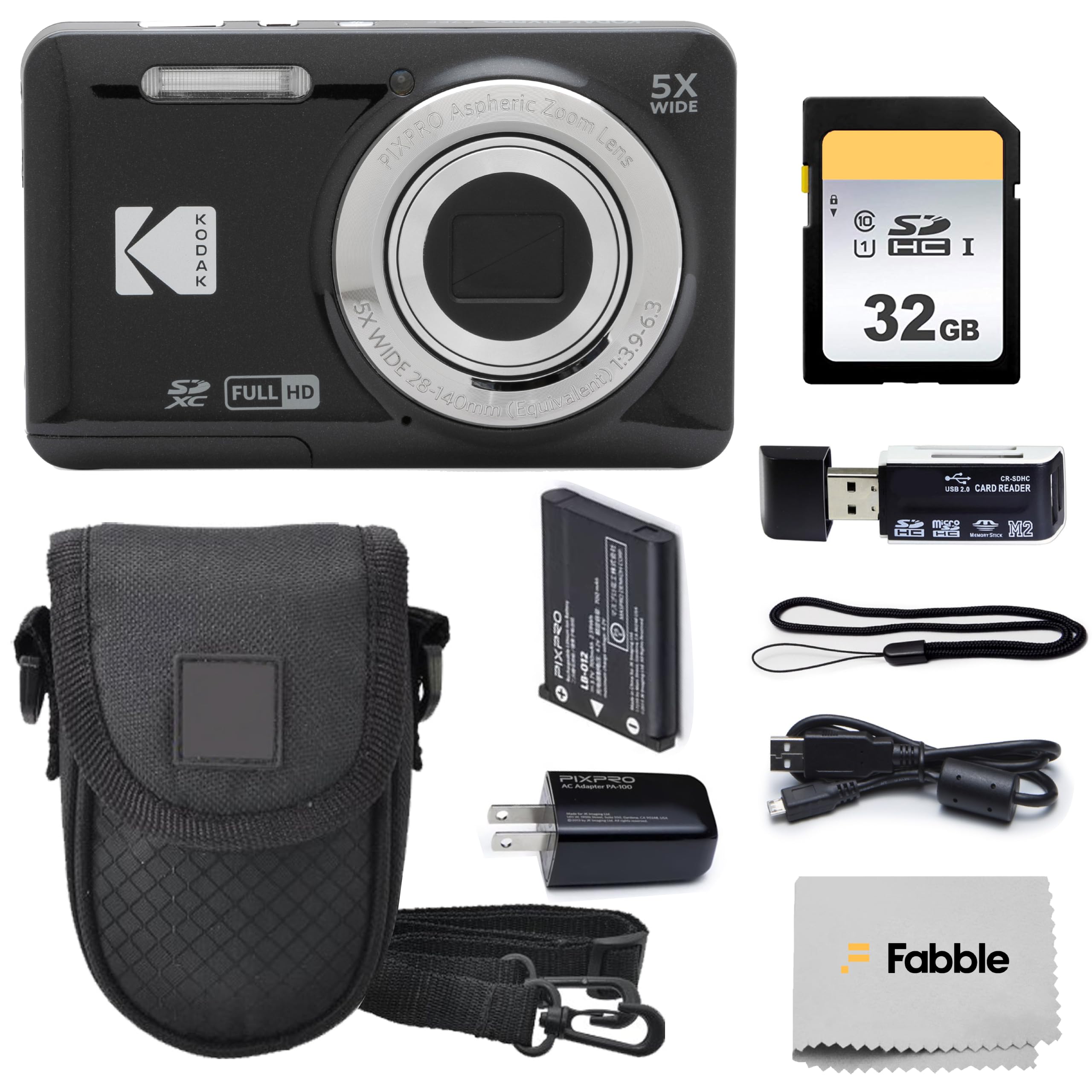
The only camera here with a true 5X optical zoom, beating every digital-only rival on real sharpness at a distance.
This is the honest optical camera in the lineup. While the AUREAPIX boasts 20X digital zoom and the Minolta claims 16X, the Kodak’s 5X optical zoom uses actual moving glass elements — so a subject 100 feet away stays clear, not cropped-and-blown-up. The 16MP sensor is lower on paper but, paired with contrast-detect autofocus (179 autofocus points), produces consistently sharper daytime photos than the 44MP or 96MP digital rivals. Buyers confirm “excellent picture quality for price; vibrant colors,” one noting 6-8 hour battery life — far better than the Minolta’s fast drain.
The bundle includes a 32GB SD card, protective case, and a hi-speed USB card reader — you do not need to buy anything extra. The trade-off: it shoots 1080p Full HD video (not 4K or 8K), so it trails the Lmzour on video resolution, and it does not come with a battery (you buy a lithium-ion separately). But for you get optical zoom that no other cheap point-and-shoot here offers, plus genuine Kodak build quality that reviewers point out holds up over months of use.
The optical advantage
- 5X optical zoom delivers real sharpness at distance — digital rivals cannot match this
- Complete bundle includes 32GB SD card, protective case, and card reader
- 6-8 hour battery life per charge (shoppers say), while Minolta buyers report fast drain
- 179-point autofocus system locks focus reliably; 28mm wide-angle pulls in group shots
What you give up
- Video maxes out at 1080p Full HD — no 4K or 8K for those wanting ultra-high-res clips
- Battery is not included; you must buy a lithium-ion pack separately
- 2.7″ screen is smaller than the AUREAPIX’s 3.5″ flip display
Your move if: you want real zoom that keeps distant details sharp, reliable autofocus, and a camera that lasts a full day on one charge — this is the pick for vacationers, grandparents, and anyone printing 8x10s.
Not the best fit if: 4K/8K video is a must or you need WiFi transfer to your phone without a cable — the AUREAPIX and Lmzour handle those scenarios more directly.
Understanding the Specs
Optical Zoom vs Digital Zoom
Optical zoom (the Kodak’s 5X) moves glass inside the lens so the image stays sharp at full reach. Digital zoom (20X on the AUREAPIX, 16X on the Minolta) just crops the center of the sensor and enlarges the remaining pixels — the “zoom” is a software trick that reduces quality. If you plan to shoot distant subjects (wildlife, stage performances, architecture details), optical zoom is essential. For a budget, absolutely prioritize a real optical zoom number — even 3X is better than 20X digital.
Megapixels and Sensor Honesty
A 96MP or 44MP sensor on a cheap camera packs tiny, noisy pixels that perform poorly in dim light. Several budget cameras claim high megapixel counts but actually capture lower-resolution raw files — one buyer’s metadata check on the Minolta found 12MP reality. A 16MP sensor (like the Kodak) with decent pixel size and contrast-detection autofocus usually produces cleaner, more printable photos. When reading megapixels on an ultra-budget camera, treat anything above 16–20MP as marketing interpolation (software upscaling), not true resolution.
FAQ
Will a cheap point-and-shoot beat my phone’s camera?
What does “digital zoom” actually mean on these cameras?
Can I use these cameras for live streaming or Zoom calls?
How do I transfer photos to my phone without a computer?
Why is the Minolta called 44MP if the photos are actually 12MP?
Which is better for a child or teen — the Minolta or the Kodak?
Do any of these cameras shoot slow motion or time lapse?
What size memory card do these cameras take?
How long does the battery last in these cheap cameras?
Final Thoughts: The Verdict
For the majority of shoppers, the cheap point and shoot camera winner is the KODAK PIXPRO FZ55 because its 5X optical zoom delivers genuinely sharp photos that no digital-only rival here can match, and the 16MP sensor with 179-point autofocus produces reliable daytime shots with 6–8 hour battery life. If you want huge 96MP stills and 8K video with WiFi phone transfer for social sharing, grab the AUREAPIX 8K. And for a pocket-sized 4K vlogging camera with face tracking and a rotating lens that lets you film solo, the Lmzour 4K Vlogging Camera is the best beginner rig under.
How We Picked
We do not accept paid placement. Every pick is matched to a real buyer and a real use-case; we do not hands-on test units.
Sources & Methodology
Specifications: manufacturer listings and product documentation. Review insights: verified customer reviews, as of July 2026. Pricing: not shown on this page (it changes often); check the current price via the retailer link.
As an Amazon Associate, WellFizz earns from qualifying purchases. This does not affect which products we feature.

Mo Maruf
I created WellFizz to bridge the gap between vague wellness advice and actionable solutions. My mission is simple: to decode the research and give you practical tools you can actually use.
Beyond the data, I am a passionate traveler. I believe that stepping away from the screen to explore new environments is essential for mental clarity and physical vitality.