Our readers keep the lights on and my smoothie glass nicely filled. As an Amazon Associate, I earn from qualifying purchases.
A failed concrete-to-concrete bond means your repair, post-base, or step patch cracks loose within a season, wasting hours of labor and bags of mix. The right adhesive locks new concrete to old substrate at a molecular level, turning two separate surfaces into a single monolithic slab that handles foot traffic, freeze-thaw cycles, and heavy loads without delaminating. Choosing the wrong product means you will be chiseling out the failure and starting over.
I’m Mohammad Maruf — the founder and writer behind WellFizz. I’ve spent hundreds of hours analyzing construction adhesive chemistries, reviewing tensile strength data, and cross-referencing field performance reports so you don’t have to guess which formula actually holds.
This guide breaks down the five best performers in five distinct chemistries so you can match the right adhesive to your specific repair, pour, or anchoring job. Read on for the definitive best concrete to concrete adhesive recommendations built from real product specs and verified user outcomes.
How To Choose The Best Concrete To Concrete Adhesive
Selecting the right concrete adhesive involves more than grabbing the cheapest tube. You need to match the chemical formulation to the specific job conditions—moisture exposure, application temperature, required working time, and whether the bond needs to fill gaps or simply glue flat surfaces together.
Chemistry Type: Epoxy, Latex, or Hybrid Polymer
Epoxy paste delivers the highest mechanical strength and is ideal for structural repairs and anchoring on vertical or overhead surfaces where sagging is a problem. Latex admixes like SikaLatex R are added to portland-cement mortar to create a chemical and mechanical bond between old and new concrete, offering the most natural color match and freeze-thaw resistance. Hybrid polymers (urethane-based or advanced polymer formulas) provide excellent gap filling and waterproof bonds with easier cleanup, making them a strong all-around choice for general repairs and non-structural bonding.
Cure Time and Working Window
Fast-curing polyester resin anchors set in minutes, which is ideal for time-sensitive anchoring jobs where you must tension the fastener quickly. However, rapid set means no repositioning—once the adhesive cures, it is permanent. Slower-curing epoxy pastes and latex admixes allow 5 to 30 minutes of working time, which is critical for complex repairs where you need to shape the material or press multiple pieces into place. Always check the full cure time before exposing the bond to moisture or load.
Gap-Filling vs. Surface Bonding
If you are adhering two flat, well-mated concrete surfaces (like a precast step to a slab), a thin-bond adhesive like a latex admix or a low-viscosity hybrid glue works perfectly. For repairs involving cracked, pitted, or irregular concrete where the two faces do not meet perfectly, you need a gap-filling paste or a construction adhesive that bridges gaps without running. Epoxy pastes and thick construction adhesives excel in this scenario because they remain in place on vertical surfaces and fill voids up to 1/4 inch or more.
Quick Comparison
On smaller screens, swipe sideways to see the full table.
| Model | Category | Best For | Key Spec | Amazon |
|---|---|---|---|---|
| PC Products PC-Masonry Epoxy | Epoxy Paste | Structural masonry repairs & overhead anchoring | Non-sag paste, service temp -20°F to +200°F | Amazon |
| SIKA SikaLatex R | Latex Admix | Bonding new concrete overlays & patches | 500 psi bond strength, 1-gal liquid | Amazon |
| Gorilla Max Strength Construction Adhesive | Hybrid Polymer | General repairs & gap-filling on concrete | 2x stronger, waterproof, clear formula | Amazon |
| Titebond TiteGrab Plus | Advanced Polymer | Quick-grab vertical & interior installations | Instant grab, 9 oz cartridge | Amazon |
| Professional Soma Fix Fast-Curing Anchor | Polyester Resin | Anchoring fasteners into concrete & brick | Fast-curing, 10.1 fl oz, extra nozzle | Amazon |
In‑Depth Reviews
1. PC Products PC-Masonry Epoxy Adhesive Paste
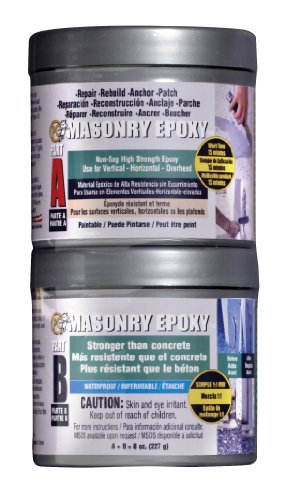
The PC-Masonry Epoxy is a two-part paste designed for the most demanding concrete and masonry repairs. Its non-sag consistency means it stays exactly where you put it—on vertical walls, overhead surfaces, and in deep cracks—without running or slumping. The dough-like texture gives you about five minutes of working time to shape and mold the repair before it starts setting, which is enough for complex patches but requires decisive action.
Once fully cured in 24 to 48 hours, this epoxy delivers compressive and tensile strength comparable to the surrounding concrete. It resists moisture and can be applied to damp surfaces, making it a strong candidate for basement wall cracks, pool coping repairs, and outdoor masonry patches exposed to rain. The gray color blends well with most concrete, and the cured material can be sanded, drilled, painted, or stained.
Users consistently report that it bonds thin slate pavers to concrete slabs and holds up underwater for months without degradation. The main trade-off is that the two cans are small—8 ounces total—and the epoxy must be mixed thoroughly before application. Cleanup with soap and water before cure is straightforward, but once hardened, removal requires mechanical abrasion.
Why it’s great
- Non-sag paste ideal for vertical and overhead bonding
- Can be applied to wet surfaces and resists moisture
- Sandable, paintable, and machinable after cure
Good to know
- Must mix two parts thoroughly before use
- Small container size may not cover large-area repairs
2. SIKA SikaLatex R Concrete Bonding Adhesive

SikaLatex R operates differently from tube adhesives—it is a liquid latex admix that you combine with portland-cement mortar or concrete to create a bonding slurry or grout. When brushed onto a clean, dampened concrete substrate before applying fresh concrete, it forms a chemical and mechanical bond rated at 500 psi tensile strength. This approach is industry-standard for concrete overlays, step repairs, and bonding new concrete to old slabs.
One of the standout advantages of this system is its freeze-thaw resistance. The acrylic-polymer latex fortifies the cement matrix, reducing cracking and delamination caused by winter freeze cycles. It stores easily and comes ready to use straight from the pail—no dilution required. A one-gallon container covers roughly 50 to 100 square feet depending on application, making it the most cost-effective option for large-area bonding jobs.
Users have reported that a single application held bricks in place for years until an exterior redo, and that it successfully reattached heavy ceramic soap dishes with quickset mortar. Note that full cure takes up to 30 days for maximum strength, and the shelf life is limited to one year. For DIYers, it is essential to research proper surface preparation and mixing ratios before starting.
Why it’s great
- 500 psi bond strength for structural overlays
- Resists freeze-thaw cycling for outdoor durability
- Covers large surface areas economically
Good to know
- Requires mixing with cement mortar—not ready-to-use glue
- Full cure takes up to 30 days
3. Gorilla Max Strength Construction Adhesive, Clear
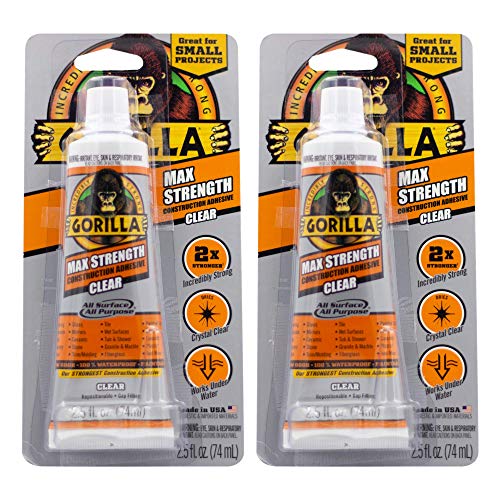
Gorilla’s Max Strength formula is a hybrid polymer construction adhesive that is 2x stronger than their standard heavy-duty construction adhesive. The clear formula leaves a discreet finish, which is a major advantage when bonding concrete elements where the glue line may be visible—such as on exposed edges, stone repairs, or clear glass block assemblies. It is fully waterproof and works for indoor or outdoor applications, even underwater.
The gap-filling capability is notable: the adhesive remains viscous enough to bridge irregularities in rough concrete surfaces while still providing a rigid bond after the 24-hour cure. Users report that it bonds with enough grab to hold magnets inside a hot car interior and seal wood AC covers against rain. Application is straightforward with the squeeze tube, though cleanup requires rubbing alcohol before cure.
One limitation is that the 2.5-ounce tubes are relatively small—you get two in a pack, but large concrete repairs will require multiple packs. The bond, while strong, cures to a hard rubber consistency rather than a rigid epoxy, so it is better suited for non-structural bonding and general repairs than for load-bearing anchoring. The clear appearance can still be slightly glossy on matte stone surfaces.
Why it’s great
- Crystal clear finish leaves no visible glue line
- Gap-filling formula bridges irregular concrete surfaces
- Waterproof and paintable after cure
Good to know
- Small tube size limits large-area coverage
- Cures to a flexible rubber, not rigid epoxy
4. Titebond TiteGrab Plus Construction Adhesive
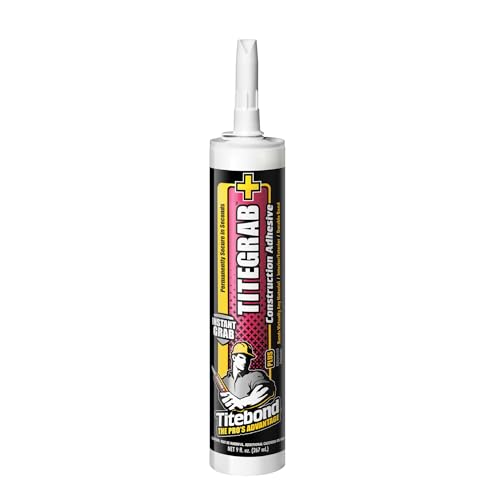
TiteGrab Plus is an advanced polymer adhesive built for instant grip on vertical surfaces. The creamy, high-solids formula extrudes smoothly from a standard caulk gun and grabs immediately, reducing the need for temporary bracing or fasteners. This is especially useful when bonding concrete panels, cement board, or tile to vertical concrete walls where gravity works against you.
The adhesive forms a waterproof, all-weather bond that resists shrinking and embrittlement over time. It bonds to porous and non-porous materials alike, including concrete, wood, metal, foam board, and ceramic tile. The fast strength development means you can move on to the next step of your project within minutes rather than waiting overnight for the bond to hold its own weight.
Some users note that the adhesive struggles on very smooth, non-porous surfaces where mechanical keying is minimal—a common limitation of polymer adhesives. The 9-ounce cartridge is a reasonable size for medium-scale projects, and the price point makes it an accessible choice for interior trim work, backsplash installations, and general concrete bonding tasks where instant grab is the priority.
Why it’s great
- Instant grab reduces need for bracing on vertical surfaces
- Waterproof and weather-resistant for indoor/outdoor use
- Creamy consistency provides precise application control
Good to know
- Less effective on perfectly smooth, non-porous surfaces
- Limited repositioning time due to fast initial grab
5. Professional Soma Fix Fast-Curing Anchoring Adhesive
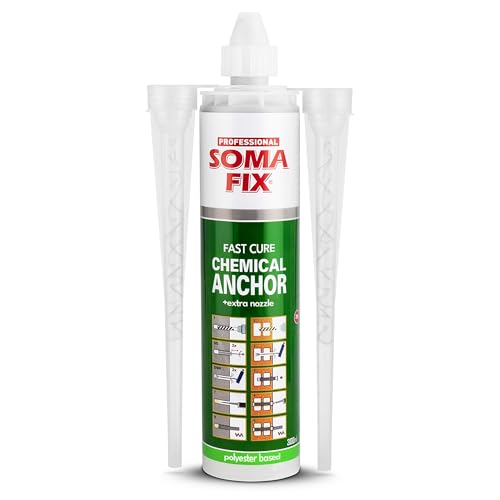
This polyester resin anchoring adhesive from Somafix is engineered for fastening into concrete, brick, stone, and hollow materials. It comes with an extra mixing nozzle for multiple applications, which reduces downtime between shots. The resin sets quickly—within minutes—so you can insert the fastener, tighten it, and move on without waiting for a full 24-hour cure.
The application process is simple: drill the hole, clean it, inject the resin, and insert the threaded rod, rebar, or anchor bolt. No expansion pressure is needed, which makes it suitable for edge distances where mechanical expansion anchors would crack the concrete. For hollow materials like brick or block, a mesh sleeve is recommended to contain the resin and ensure a reliable mechanical interlock.
Users report strong performance for fixing loose outdoor railings and anchoring heavy-duty fasteners. The price point is notably competitive compared to established brands like Sika for the same utility. The main drawback is that the fast set time gives you zero margin for error—once injected, you must seat the fastener immediately and accurately. For structural anchoring where precise positioning is required, a slower-curing epoxy paste might be a safer choice.
Why it’s great
- Fast cure allows immediate fastener tensioning
- Includes additional mixing nozzle for extended work sessions
- No expansion pressure—safe for edge-distance anchoring
Good to know
- Requires mesh sleeve for hollow substrate anchoring
- Very fast set time limits repositioning
FAQ
Can I use any construction adhesive to bond new concrete to old concrete?
How long does concrete adhesive take to cure before it holds weight?
Do I need to roughen the concrete surface before applying adhesive?
Final Thoughts: The Verdict
For most users, the best concrete to concrete adhesive winner is the PC Products PC-Masonry Epoxy because it combines high structural strength with non-sag paste consistency for vertical and overhead repairs. If you need to bond large-area concrete overlays with maximum freeze-thaw resistance, grab the SIKA SikaLatex R. And for quick-grab general repairs where a clear, waterproof finish is a priority, nothing beats the Gorilla Max Strength Construction Adhesive.

Mo Maruf
I created WellFizz to bridge the gap between vague wellness advice and actionable solutions. My mission is simple: to decode the research and give you practical tools you can actually use.
Beyond the data, I am a passionate traveler. I believe that stepping away from the screen to explore new environments is essential for mental clarity and physical vitality.