Our readers keep the lights on and my smoothie glass nicely filled. As an Amazon Associate, I earn from qualifying purchases.
A fresh coat of paint on a concrete floor can fail within months if the underlying surface isn’t properly prepared. The porous, alkaline nature of concrete actively rejects most coatings, leading to peeling, blistering, and dusting that undermines any finish. Selecting the right foundation layer is the singular deciding factor between a durable, long-lasting floor and a costly do-over.
I’m Mohammad Maruf — the founder and writer behind WellFizz. My analysis here is built on hundreds of hours comparing the chemical formulations, coverage rates, and real-world adhesion data for the most popular concrete primers on the market.
This guide delivers the specific, actionable criteria you need to separate effective bonding agents from paint-like products that merely sit on the surface, culminating in a clear verdict for the very best concrete primer for your specific project and conditions.
How To Choose The Best Concrete Primer
Concrete primers do not all function the same way. Some penetrate deep into the substrate to chemically lock loose particles, while others create a physical film on top. Your choice depends entirely on the condition of your concrete and the coating you plan to apply over it.
Penetrating versus Film-Forming Chemistry
A penetrating primer, typically acrylic or silane-siloxane based, soaks into the concrete’s capillaries to bind the surface from within. This is the right approach for dusty, spalling, or unsealed concrete where mechanical adhesion is needed. Film-forming primers, often water-based epoxy or urethane blends, create a distinct layer on the surface to bridge micro-cracks and provide a uniform substrate for topcoats. If your concrete is smooth or previously sealed, a film-forming primer prevents delamination.
Moisture Vapor Transmission and Hydrostatic Pressure
Concrete slabs in basements or garages are subject to moisture vapor rising from the ground. If a primer seals the surface too tightly, hydrostatic pressure can push the coating off from below. For high-moisture environments, you need a primer that is specifically designed as a moisture vapor barrier or one that remains permeable enough to allow the concrete to breathe. Ignoring this spec turns a simple priming job into a peeling disaster within a year.
VOC Content and Application Environment
Solvent-based primers deliver deeper penetration and faster cure times, but their VOCs require respirators and excellent ventilation. Water-based primers are safer for indoor use and easier to clean, though they may require longer recoat intervals. For enclosed spaces like basements or living areas, a low-VOC, water-based primer is the only practical option. For outdoor driveways or patios, the faster cure and tougher film of a solvent-based primer can justify the proper safety gear.
Quick Comparison
On smaller screens, swipe sideways to see the full table.
| Model | Category | Best For | Key Spec | Amazon |
|---|---|---|---|---|
| Polar Dust Proof Concrete Sealer | Acrylic Sealer | Dust-proofing interior floors | 100% acrylic formulation | Amazon |
| Liquid Rubber Multipurpose Primer | Water-Based Bond | Bonding topcoats to wood and concrete | Non-toxic, low VOC | Amazon |
| Rust-Oleum Concrete Moisture Stop | Moisture Barrier | Blocking moisture before epoxy | Prevents radon gas ingress | Amazon |
| MasonryDefender All Purpose Sealer | Silane-Siloxane | Waterproofing exterior masonry | Silane-siloxane penetrating | Amazon |
| Armor AR350 Wet Look Sealer | Solvent Acrylic | Color enhancement on pavers | 700 VOC for deep penetration | Amazon |
| Rust-Oleum Concrete Floor Recoat Primer | Recoat Primer | Overpainting old sealed floors | No sanding or grinding needed | Amazon |
| Tuff Coat UT-80 Adhesion Primer | Water-Based Epoxy | Heavy-use and damp concrete | Two-component epoxy | Amazon |
In‑Depth Reviews
1. Polar Dust Proof Concrete Sealer Clear – 1.32 Gallon

The Polar Dust Proof Sealer uses a 100% acrylic formulation with intentionally low viscosity, which allows the liquid to penetrate deep into the concrete pore structure rather than simply sitting on top. This penetration is the mechanical mechanism that binds loose dust particles to the substrate, resulting in genuinely dust-free surfaces even under foot traffic. Users consistently report that two coats eliminate the powdery residue that plagues new or aging concrete slabs.
Its satin finish provides a subtle sheen without the glossy appearance of film-forming sealers, making it suitable for both interior living spaces and industrial environments like warehouses or garages. The 1.32-gallon container covers up to 25 square meters, and each coat dries within one to two hours, enabling a complete two-coat application in a single afternoon. Reviews highlight its effectiveness on concrete balconies where dust was being tracked indoors, with the sealer stopping the problem entirely.
One important constraint is that this product is designed to be used on its own as a sealer, not as a primer for overpainting. It should not be used underneath floor paints because its bonding characteristics are optimized for direct surface sealing. For projects where the goal is simply to stop dusting and protect the concrete, this is the most efficient and cost-effective solution.
Why it’s great
- Low viscosity penetrates deeply into concrete pores
- Dries to the touch in 1-2 hours per coat
- Eliminates dust tracking from new or aged concrete
Good to know
- Not designed for use under floor paints or topcoats
- Requires two coats for optimal dust-proofing
2. Tuff Coat UT-80 Adhesion Primer – Gallon Kit

The Tuff Coat UT-80 is a two-component, water-based epoxy primer that represents the highest tier of bonding chemistry available for concrete. Its 1:1 mix ratio creates a cross-linked film that can be applied to damp concrete surfaces — a significant advantage in basements or outdoor slabs where complete dryness is impossible to guarantee. The primer is fully compatible with all Tuff Coat rubberized non-skid coatings, making it the go-to choice for boat decks, heavy-use trailers, and industrial floors.
Users report that the primer bonds tenaciously to fiberglass, wood, and previously painted surfaces in addition to concrete. The water-based formulation keeps VOC levels low, though the mixed product must be used quickly as it hardens irreversibly in the can. Multiple reviews on boat decks and pontoon floors confirm that the primer provides a non-slip, durable base that withstands constant exposure to moisture without peeling.
Coverage is rated at 250 square feet per gallon, and the gloss finish indicates a dense, impermeable film. This is not a product for light-duty residential sealing; its epoxy chemistry is engineered for environments where adhesion failure is not an option. If your project involves a rubberized topcoat or sees standing water, the UT-80 is the correct foundation.
Why it’s great
- Can be applied to damp concrete without adhesion loss
- Two-component epoxy provides maximum bond strength
- Works on concrete, wood, fiberglass, and painted surfaces
Good to know
- Must be used immediately after mixing
- Premium price point limits its use to demanding projects
3. Rust-Oleum 301239 Concrete Moisture Stop Fortifying Sealer

The Rust-Oleum Moisture Stop is specifically engineered to address hydrostatic pressure — the upward force of water vapor through a concrete slab. Rather than just coating the surface, this formula penetrates into the concrete matrix and forms a chemical barrier that blocks moisture, water-borne salts, and even radon gas. This makes it the essential prep layer before applying any epoxy or urethane topcoat on basement floors or garage slabs with known moisture issues.
Application requires the sealer to penetrate the surface for 45 minutes before recoating, with one gallon covering roughly 200 square feet. Unlike film-forming primers that can trap moisture and cause delamination, the Moisture Stop fortifies the concrete from the inside out, strengthening the substrate itself. Users who applied it before epoxy coatings on slabs with high hydrostatic pressure reported no cracks or failures even after three years of use.
The clear finish does not alter the surface’s appearance, making it invisible under the final topcoat. Its primary limitation is that it is a dedicated moisture barrier and not a general-purpose primer or dust proofer. For floors where moisture vapor transmission is not the primary concern, a simpler acrylic primer would suffice and cost less.
Why it’s great
- Stops moisture vapor and radon gas from passing through concrete
- Strengthens the concrete structure from within
- Invisible under epoxy or urethane topcoats
Good to know
- Requires 45-minute penetration time before next step
- Overkill for dry, interior slabs with no moisture history
4. Armor AR350 Low Gloss Wet Look Concrete Sealer – 1 Gallon

The Armor AR350 is a solvent-based acrylic sealer formulated for dramatic color enhancement on exterior concrete and pavers. Its low-gloss wet look finish darkens and saturates the surface, mimicking the appearance of wet concrete even after the surface has fully dried. The high-quality US-manufactured resins used in this sealer produce a non-yellowing film that resists UV degradation, road salts, and surface abrasion from foot and vehicle traffic.
Coverage is generous at 175 to 225 square feet per gallon, and the product is ready to use with no thinning required. Application is most effective with a 3/8-inch nap roller, though sprayers work well for large areas. Users report dramatic visual transformation on stamped concrete, pool decks, and patios, with the finish lasting for years before needing a recoat. The solvent base does emit strong VOCs for about an hour after application, requiring a respirator for safe use.
This primer-sealer is self-priming, meaning it bonds directly to clean, unsealed concrete without a separate primer step. However, it is a film-forming product, not a penetrating sealer, so it may require periodic recoat maintenance. For homeowners seeking both protection and aesthetic enhancement on exposed outdoor concrete, the AR350 delivers the most dramatic visual payoff.
Why it’s great
- Creates a deep, wet-look color enhancement on pavers and stamped concrete
- Self-priming — no separate primer needed for unsealed concrete
- Resists UV yellowing and road salt damage
Good to know
- Strong VOC fumes require a respirator during application
- Film-forming sealer needs periodic recoat for long-term protection
5. Rust-Oleum 338806 Concrete & Garage Floor Recoat Primer
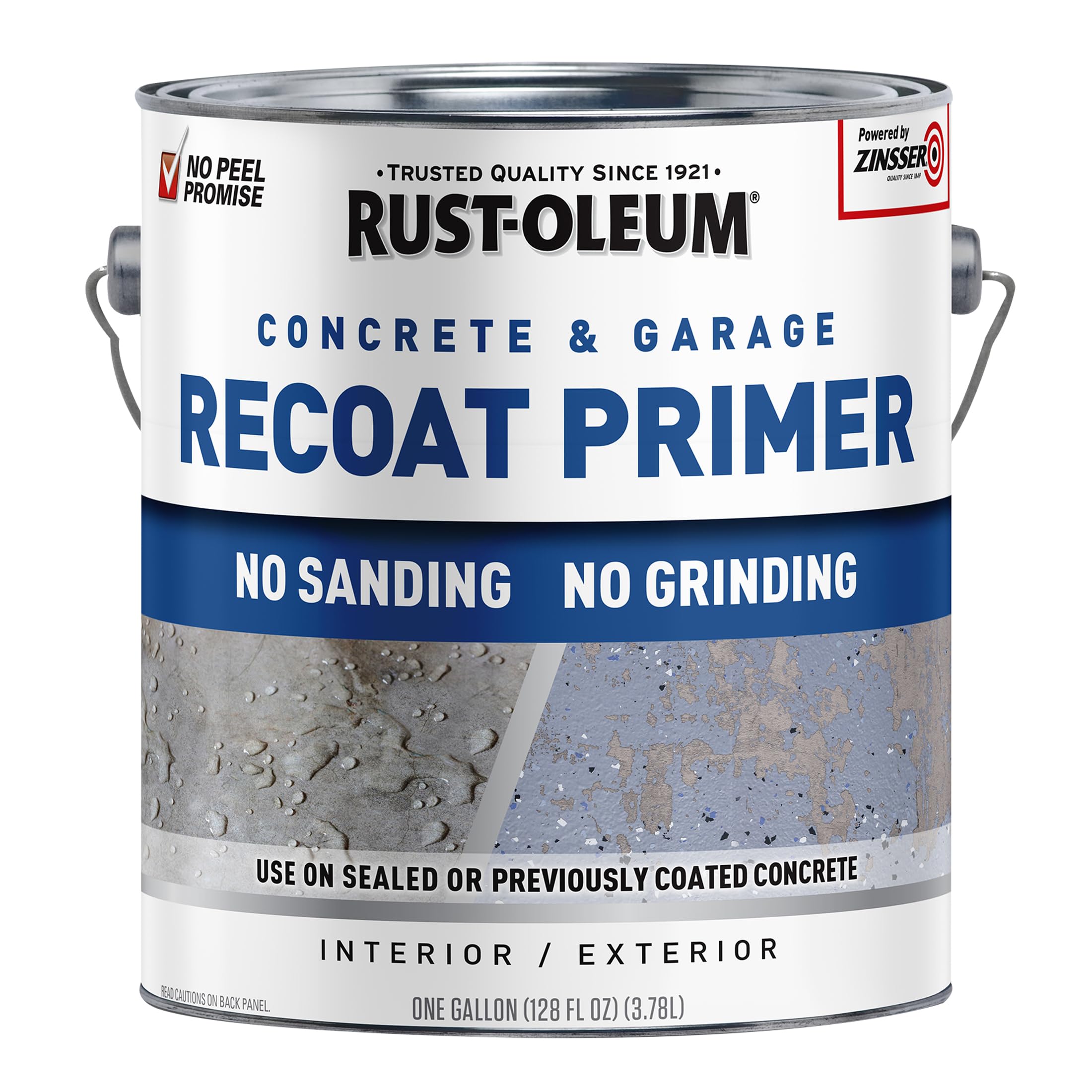
The Rust-Oleum Concrete & Garage Floor Recoat Primer solves a specific and common problem: how to apply a new coating over a concrete floor that has already been painted, sealed, or epoxy-coated. Traditional primers require sanding or grinding to mechanically abrade the old surface, but this water-based formula chemically bridges the old and new layers. The semi-transparent gray finish provides visual feedback during application, ensuring even coverage without leaving streaks.
Coverage is rated at 200 to 400 square feet per gallon depending on surface porosity, and the primer dries to a flat finish that accepts both solvent-based and water-based topcoats after six hours. Users specifically note that it adheres well to 15-year-old epoxy coatings, allowing a fresh topcoat without the labor of mechanical removal. The water-based formulation keeps VOCs low, making it suitable for enclosed garage spaces.
While the product eliminates sanding, careful surface preparation — degreasing and thorough cleaning — remains critical. A small number of users who skipped proper prep reported peeling over time. This primer is not intended for bare, uncoated concrete; its value is specifically in recoat scenarios where the existing coating is still structurally sound but needs renewal.
Why it’s great
- Eliminates sanding and grinding when recoating sealed concrete
- Works over both solvent-based and water-based existing coatings
- Low VOC formula safe for indoor garage use
Good to know
- Thorough degreasing is mandatory for adhesion
- Not intended for bare concrete without an existing coating
6. MasonryDefender All Purpose Brick Stone & Concrete Sealer – 1 Gallon

The MasonryDefender uses a silane-siloxane chemistry that is chemically distinct from acrylic or epoxy primers. Silane molecules are small enough to penetrate deep into the capillary structure of concrete, brick, and stone, where they react with moisture to form a hydrophobic barrier inside the substrate itself. This means the surface remains breathable — water vapor can escape — while liquid water beads up and runs off, preventing freeze-thaw damage and efflorescence.
Coverage is between 90 and 150 square feet per gallon, with best results achieved by applying two coats using a pump-up garden sprayer. Users consistently report that the product solves basement water seepage and stops moss growth on outdoor statuary. The application is straightforward: clean and pressure-wash the surface, spray evenly, and the sealer dries clear without altering the natural appearance of the masonry. One reviewer posted photo evidence of dramatic water beading on a sealed brick walkway after a full season of rain.
Because this is a penetrating sealer rather than a film-former, it does not create a glossy or wet look. If you want color enhancement or a visible shine, the MasonryDefender is not the right choice. But for pure waterproofing that preserves the original texture and allows the concrete to breathe, this is the most effective solution.
Why it’s great
- Chemically bonds inside concrete pores for lasting waterproofing
- Does not alter surface appearance or texture
- Prevents freeze-thaw damage and efflorescence
Good to know
- No visual color enhancement or gloss finish
- Must be shaken thoroughly to prevent nozzle clogging
7. Liquid Rubber Multipurpose Primer – 1 Quart

The Liquid Rubber Multipurpose Primer is a water-based bonding agent with a uniquely thin viscosity, almost like water, which allows it to soak aggressively into porous surfaces. Unlike thick, paint-like primers, this thin formula penetrates wood grain and concrete pores to achieve mechanical interlocking. It is specifically designed to improve adhesion and prevent blistering on concrete, wood, and high-density polyethylene surfaces, with a matte finish that does not alter the substrate’s appearance.
Users describe the application as similar to applying polyurethane — it spreads easily with a brush or roller and dries to the touch in under two hours. The water-based formula is non-toxic and contains no solvents, making it safe for interior use around pets and people. The quart size is convenient for small projects like deck repairs or bonding a topcoat to a wood surface prior to a concrete overlay, but it becomes expensive for large areas compared to gallon-size alternatives.
The primary concern raised by reviews is that the thin consistency can make it feel insubstantial during application, and one user reported failure within a year on a deck despite following instructions. For demanding exterior applications where long-term waterproofing is critical, a thicker, higher-solids primer may provide more reliable results. However, for interior bonding jobs where non-toxicity and ease of cleanup are priorities, this primer performs well.
Why it’s great
- Water-thin viscosity penetrates deeply into wood and concrete pores
- Non-toxic and solvent-free for safe indoor use
- Dries fast — ready for topcoat within 24 hours
Good to know
- Quart size is best suited for small projects
- Thin formula may not provide adequate film build for heavy-use surfaces
FAQ
Can I apply a concrete primer over an existing epoxy coating without sanding?
Will a concrete primer stop moisture from coming up through my basement floor?
How long should I wait between applying a concrete primer and the topcoat?
Final Thoughts: The Verdict
For most users, the best concrete primer winner is the Polar Dust Proof Concrete Sealer because it combines deep penetration with a fast-drying acrylic formulation that stops dusting across interior and exterior surfaces at a very accessible price. If you need a moisture barrier for a basement floor before an epoxy coating, grab the Rust-Oleum Concrete Moisture Stop. And for heavy-duty bonding on damp concrete or as a foundation for rubberized topcoats, nothing beats the Tuff Coat UT-80 Adhesion Primer.

Mo Maruf
I created WellFizz to bridge the gap between vague wellness advice and actionable solutions. My mission is simple: to decode the research and give you practical tools you can actually use.
Beyond the data, I am a passionate traveler. I believe that stepping away from the screen to explore new environments is essential for mental clarity and physical vitality.