Our readers keep the lights on and my smoothie glass nicely filled. As an Amazon Associate, I earn from qualifying purchases.
Buying a circular saw for home use means navigating a sea of amp ratings, bevel stops, and blade sizes to find the tool that actually fits your weekend project — not a professional jobsite demand. The wrong choice leaves you fighting cord lengths, struggling with blade visibility, or paying for capacity you’ll never use on a sheet of plywood.
I’m Mohammad Maruf — the founder and writer behind WellFizz. I’ve spent countless hours analyzing motor performance data, bevel range specifications, and real-user durability feedback to isolate the saws that deliver consistent, accurate cuts without the usual workshop frustrations.
This guide breaks down the seven models that earn a spot in a home garage, ranking them by power delivery, cut precision, and ease of adjustment so you can confidently choose the most reliable circular saw for home use.
How To Choose The Best Circular Saw For Home Use
Home-use saws must balance affordability with enough muscle to rip dimensional lumber and sheet goods without bogging down. Three factors separate a saw that frustrates from one that becomes your go-to tool.
Motor Power: Amps vs. Brushless Efficiency
Corded saws in the 15-amp range deliver consistent torque for cutting pressure-treated lumber and hardwood plywood. Cordless brushless motors provide comparable power with better runtime, but a 4.0Ah battery pack is the minimum for making more than a handful of crosscuts before recharging.
Blade Size and Depth of Cut
A 7-1/4-inch blade is the home-use standard, cutting up to 2-9/16 inches deep at 90 degrees — enough for stacked dimensional lumber. Compact 4-1/2-inch saws offer better maneuverability for trim work but max out around 1-11/16 inches, limiting their use on thicker stock.
Bevel Capacity and Sightline Design
Home saws with a 45-degree bevel stop handle most roofing and deck work. Some models extend to 56 degrees for steeper crown molding cuts. Blade-left designs improve line-of-sight for right-handed users, while blade-right saws typically eject sawdust away from the user.
Quick Comparison
On smaller screens, swipe sideways to see the full table.
| Model | Category | Best For | Key Spec | Amazon |
|---|---|---|---|---|
| BOSCH CS5 | Premium Corded | Precision straight cuts with blade-left sightline | 15 Amp / 7-1/4″ blade-left | Amazon |
| DEWALT DCS590B | Premium Cordless | Maximum cordless power and runtime | 1700 MWO / 5,500 RPM brushless | Amazon |
| SKIL CR5440B-10 | Mid-Range Cordless Kit | All-in-one cordless kit with brake | 20V brushless / electric brake | Amazon |
| CRAFTSMAN CMCS551B | Mid-Range Cordless | Cordless freedom with 56° bevel range | 20V brushless / 56° bevel | Amazon |
| Metabo HPT C7SB3 | Value Corded | Budget-friendly workhorse with dust blower | 15 Amp / 6,000 RPM | Amazon |
| SKILSAW SPT67WL-01 | Value Corded | Lightest pro-class sidewinder | 8.6 lbs / 56° bevel | Amazon |
| WEN 3625 | Entry-Level Compact | Tight spaces and thin materials | 5 Amp / 4-1/2″ blade | Amazon |
In‑Depth Reviews
1. BOSCH CS5 7-1/4-Inch Circular Saw

The Bosch CS5 is the benchmark for sightline-driven design in a home-use saw. Its blade-left configuration places the motor on the right side, letting right-handed users track the cut line without craning their neck — a genuine advantage when ripping long sheets of plywood. The 15-amp motor pushes through hardwood and pressure-treated lumber without bogging, and the built-in spindle lock paired with a stored wrench makes blade swaps tool-free.
Cut accuracy is where this saw earns its premium reputation. The front guide index aligns precisely with the blade kerf, and the cast-metal base resists flexing under load. Adjusting depth and bevel requires no tools, though returning the bevel plate to true 90 degrees after a compound cut demands a square check and patient tweaking. The included 24-tooth blade is functional but produces a wider kerf than desirable — upgrade to a thin-kerf blade for cleaner results.
One design tradeoff: the wrench storage slot between the base plate and motor can, if overtightened, twist the base plate out of square. Owners advise removing the wrench before locking depth. The saw also lacks any dust port, so fine sawdust blows directly toward the user on right-handed cuts — a workshop vacuum is recommended for indoor use.
Why it’s great
- Blade-left design gives unmatched cut-line visibility for right-handed users
- Lightweight 9.3-pound frame reduces arm fatigue on extended rips
- Tool-free depth and bevel adjustments speed job-site changeovers
Good to know
- No dust port or dust chute directs debris into the work area
- Bevel plate requires manual squaring after angle adjustments
- Stock blade is wide-kerf; upgrade recommended for fine cuts
2. DEWALT 20V MAX XR DCS590B Cordless Saw

The DCS590B is DEWALT’s most powerful 20V MAX circular saw, delivering 1,700 maximum watt-out (MWO) from a brushless motor that spins to 5,500 RPM. For home users who already own DEWALT 20V batteries, buying this tool-only version is a logical upgrade path — it cuts through kiln-dried oak and stacked 2x material without the RPM drop that plagues older cordless designs. The electric brake stops the blade within seconds of releasing the trigger, preventing the drifting cuts that happen when a blade coasts.
Depth of cut reaches 2-9/16 inches at 90 degrees and 2 inches at 45 degrees, covering stair stringers and roof rafters. The rubber overmold handle reduces vibration transfer, and the 9.88-pound weight keeps the saw nimble for overhead cuts. Users report that even with third-party 6.0Ah batteries, runtime is sufficient for an afternoon of remodeling work — though a full day of framing will require a second pack.
The included blade is competent for construction lumber but produces scorching on dense hardwoods; upgrading to a fine-finish blade is recommended for visible cuts. The tool ships as a bare unit, so factor a battery and charger into your total investment if you’re not already on the DEWALT platform.
Why it’s great
- Highest power output available in 20V MAX cordless saws
- Electric brake eliminates blade coasting for cleaner stops
- Lightweight frame with long runtime from high-capacity batteries
Good to know
- Bare tool requires existing DEWALT 20V battery system
- Stock blade scorches hardwoods; replacement recommended
- Not enough runtime for a full professional day on one charge
3. SKIL PWR CORE 20 CR5440B-10 Cordless Saw Kit

SKIL’s CR5440B-10 kit delivers cordless convenience out of the box with a 4.0Ah lithium battery and quick charger included — no separate battery investment needed. The digital brushless motor spins the 7-1/4-inch blade to 5,300 RPM and cuts up to 2-5/8 inches deep in one pass, enough for stacked dimensional lumber. The electric brake stops the blade quickly, a meaningful safety upgrade over older SKIL cordless models.
Cut quality is impressive for a kit at this level. Owners report clean, scorch-free cuts through true 2×6 white oak and treated lumber, with the saw tracking straight along a guide. The cast aluminum shoe and upper guard feel durable, and the hex key stores on the tool body — no lost wrenches mid-project. The included 24-tooth carbide blade is serviceable for framing but benefits from an upgrade for furniture-grade work.
Battery life is a strong point: the 4.0Ah pack lasts through hours of intermittent use, and the fast charger replenishes it in under an hour. For professional-level daily use, a second battery is necessary, but for home projects the kit provides ample runtime without the cord drag of a 120V saw.
Why it’s great
Complete kit with battery and charger saves the upfront cost of separate battery purchase
- Included 4.0Ah battery delivers long runtime for home projects
- Electric brake and cast aluminum guards improve safety and durability
- Vacuum adaptor included for dust collection
Good to know
- 12-pound weight is heavier than some cordless competitors
- Stock blade adequate but not optimal for fine-finish cuts
- Professional users will need a second battery for full-day work
4. CRAFTSMAN V20 RP CMCS551B Cordless Saw
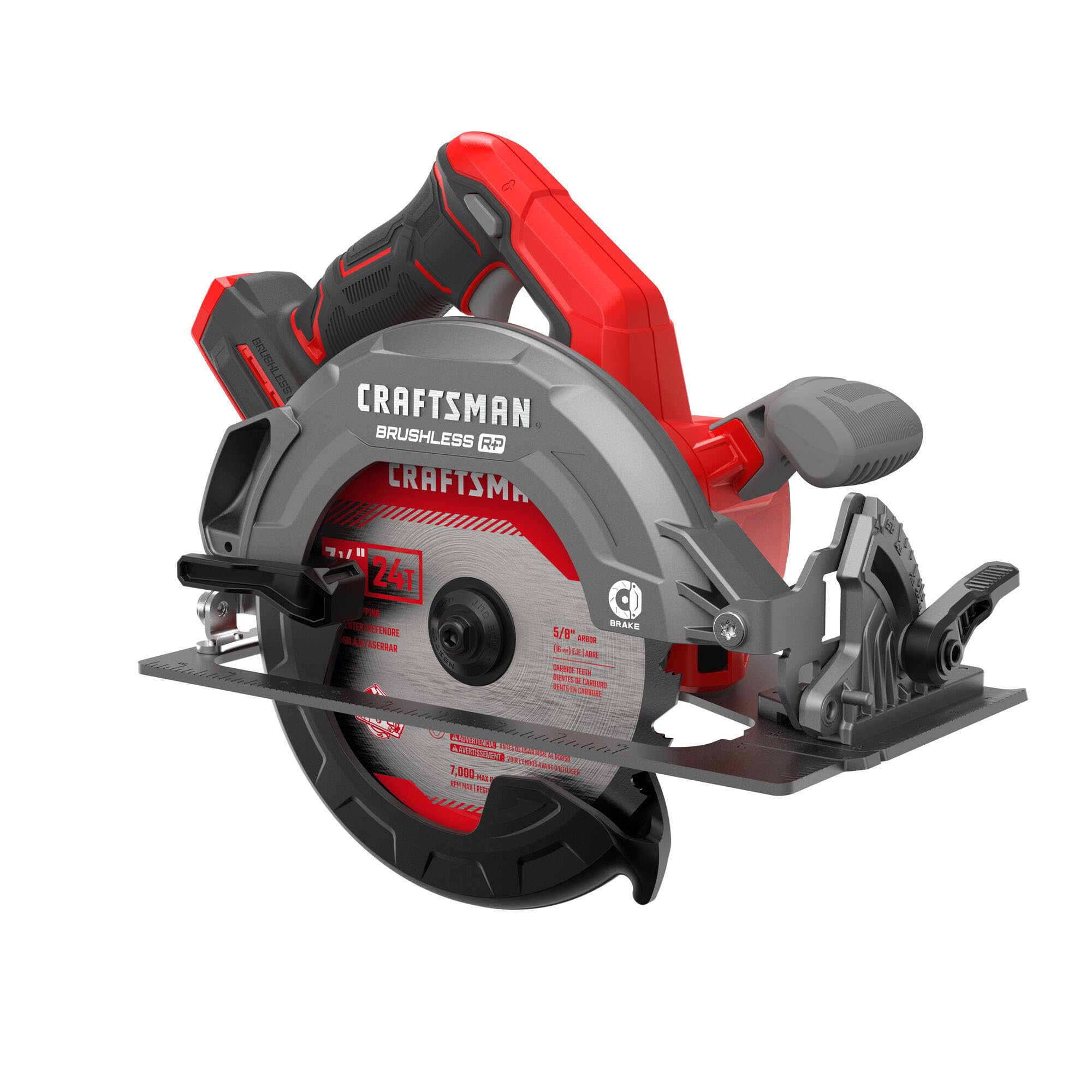
This CRAFTSMAN cordless saw fills a specific niche: home users with an existing V20 battery ecosystem who need occasional cordless cutting without splurging on a premium platform. The brushless motor delivers up to 75 percent more power than brushed predecessors, and the 56-degree bevel capacity (with positive stops at 22.5 and 45 degrees) handles crown molding and steep rake cuts that standard 45-degree saws cannot.
Cut performance is strong in practice. The saw rips through 3/8-inch plywood and 2x lumber with authority, and the rigid aluminum baseplate keeps cuts square when run against a guide. The LED work light illuminates the cut line effectively in dim garage corners. However, the brushless motor exhibits a stall behavior that differs from brushed saws — if the blade pinches, the motor cuts out rather than grinding through, which requires the user to manage workpiece support more carefully.
Battery consumption is the main compromise. A single 4.0Ah pack delivers roughly 10 minutes of continuous cutting time — enough for three 8-foot rips through 1-inch lumber — and the battery becomes noticeably hot after extended use. This saw works best for quick, cord-free tasks around the property rather than all-day framing sessions.
Why it’s great
- 56-degree bevel range with positive stops for crown molding
- Brushless motor delivers power comparable to corded saws
- LED light and rigid baseplate aid accuracy in low light
Good to know
- Bare tool only; requires separate battery purchase
- High battery drain; 6.0Ah pack recommended for extended use
- Stall behavior requires careful workpiece support
5. Metabo HPT C7SB3 7-1/4-Inch Circular Saw

The Metabo HPT C7SB3 is a corded saw that punches above its middle-tier price point, earning recognition from Pro Tool Reviews as a top budget option for professionals. Its 15-amp motor spins at 6,000 RPM — higher than many competitors — producing smooth, burn-free cuts through OSB, LVL, and plywood. The integrated dust blower clears sawdust from the cut line, improving visibility during long rips.
Build quality stands out at this price bracket. The heavy-duty aluminum base is noticeably rigid with square edges that align reliably against a guide. Depth and bevel adjustments are tool-free, and the included 24-tooth framing blade is genuinely excellent — reviewers consistently note that it stays sharp longer than the stock blades found on similarly priced saws. The carrying bag and hex wrench are practical additions for home storage.
Two ergonomic notes: at 9.5 pounds the saw has heft that helps it track straight on rip cuts, but that same weight contributes to fatigue on overhead or prolonged work. The bevel depth stop works accurately, though some users report the depth lever loosens mid-cut if not fully tightened. The saw lacks an edge guide, so users must rely on a separate straightedge for consistent rip widths.
Why it’s great
- 6,000 RPM motor produces cleaner cuts than slower competitors
- High-quality included framing blade reduces immediate upgrade costs
- Heavy-duty aluminum base provides rock-solid stability
Good to know
- 9.5-pound weight causes fatigue on extended overhead cuts
- Depth adjustment lever can loosen during heavy use
- No edge guide included for consistent rip widths
6. SKILSAW SPT67WL-01 15 Amp Sidewinder

At 8.6 pounds, the SKILSAW SPT67WL-01 is the lightest professional-class sidewinder on the market, reducing arm fatigue during extended cutting sessions without sacrificing the 15-amp corded power that home users need for framing lumber and hardwood plywood. The dual-field motor dissipates heat efficiently, keeping the saw cool enough for sustained operation — a real advantage for long rip cuts that bog down cheaper saws.
The 56-degree bevel range with a positive stop at 45 degrees expands the saw’s versatility beyond standard 2x framing. The 10-foot power cord minimizes the need for an extension cord on smaller projects, and the rubber handle grip stays comfortable during sweaty summer work. Owners who have used this saw for eight years report consistent power through 1.5-inch hard maple and pressure-treated dimensional lumber without mechanical issues, a testament to its build longevity.
The biggest omission is the lack of a blade brake — the blade continues spinning for several seconds after trigger release, requiring careful handling during sequential cuts. The cast aluminum base is well-made but the plastic housing scratches more easily than the metal components on pricier saws. For home users who prioritize light weight and corded reliability, this is a strong candidate.
Why it’s great
- Lightest pro-class sidewinder reduces arm fatigue dramatically
- Dual-field motor runs cool for sustained cutting
- 56-degree bevel range with positive stops for complex cuts
Good to know
- No blade brake means blade coasts after trigger release
- Plastic housing scratches more easily than metal frames
- Long-term use shows minor depth scale drift over years
7. WEN 3625 4-1/2-Inch Compact Circular Saw

WEN’s 3625 is a compact 4-1/2-inch saw designed for tight spaces where full-size 7-1/4-inch tools cannot reach — think cutting stair treads, trimming shelving, slicing PVC pipe, and notching drywall. The 5-amp motor spins the blade at 3,500 RPM and cuts up to 1-11/16 inches deep, sufficient for 1-inch pine and hardwood plywood but insufficient for dimensional 2x lumber. The integrated laser projects a line on the workpiece for visual cut guidance.
Maneuverability is the standout feature. The compact body makes accurate cuts on bullnose stair treads and melamine shelves easier than wrestling a full-size saw into position. The included carrying case stores the saw with its 24-tooth carbide blade, dust extraction tube, and wrench — a tidy package for apartment-dwelling DIYers. Owners consistently rate it highly for small-scale carpentry on oak, pine, birch, and melamine.
Limitations become apparent under load. The saw struggles with material thicker than 1 inch, and the aluminum faceplate can bend if dropped. The laser is considered unnecessary by most users; the guide marks on the base plate are actually more helpful. Angle and depth controls require calibration against a square before first use — the factory settings drift. This is a niche tool for trim work, not a primary saw for framing or sheet goods.
Why it’s great
- Compact size excels in tight spaces full-size saws cannot reach
- Great for accurate cuts on trim, stair treads, and thin plywood
- Complete kit with carrying case and dust extraction tube
Good to know
- 5-amp motor struggles with material thicker than 1 inch
- Angle and depth controls require calibration before first use
- Aluminum faceplate bends if dropped; not construction-grade durable
FAQ
Can a cordless circular saw replace a corded saw for home use?
What blade size should a home user choose for a circular saw?
Why does a brushless motor matter for a home circular saw?
How important is the blade brake on a home circular saw?
What is the actual depth-of-cut needed for home projects?
Final Thoughts: The Verdict
For most users, the circular saw for home use winner is the BOSCH CS5 because its blade-left design and 15-amp motor deliver the best balance of cut visibility, power, and precision for weekend projects. If you want cordless convenience with a complete kit included, grab the SKIL CR5440B-10. And for tight-space trim work and thin-material cutting, nothing beats the WEN 3625 compact saw.

Mo Maruf
I created WellFizz to bridge the gap between vague wellness advice and actionable solutions. My mission is simple: to decode the research and give you practical tools you can actually use.
Beyond the data, I am a passionate traveler. I believe that stepping away from the screen to explore new environments is essential for mental clarity and physical vitality.