Our readers keep the lights on and my smoothie glass nicely filled. As an Amazon Associate, I earn from qualifying purchases.
The speakers built into your monitor or laptop are thin, tiny, and tinny — they miss detail, they have no punch, and they make your favorite music sound like it’s coming through a can. A proper set of desktop speakers changes that completely, whether you want to hear footsteps in a game, feel the bass in a movie, or just have clear conference calls without cupping your ear. The right pair for you depends on how much desk space you have, whether you need a separate subwoofer (a speaker that handles only deep bass), and which connection your computer supports.
I’m Mohammad Maruf — the co-founder and writer behind WellFizz. This guide is built by comparing the manufacturers’ published specifications and the patterns across verified customer reviews, so you get each pick’s real strengths and trade-offs instead of marketing spin.
Below you will find seven carefully compared computer speakers under 200 dollars that cover everything from budget-friendly soundbars to premium bookshelf monitors with studio-grade accuracy.
How To Choose The Best Computer Speakers Under 200 Dollars
The range under is surprisingly competitive — you can get anything from a compact soundbar to a serious 2.1 system with a separate subwoofer. The key is knowing which spec actually matters for your setup.
Driver Size and Type
The driver is the round cone that moves air to create sound. A larger driver generally produces deeper bass and can play louder without distorting. For desktop use, a 2.5-inch to 4-inch driver is common in smaller speakers, while a dedicated subwoofer will use a 5.25-inch or larger driver specifically for low frequencies. Look for a silk dome tweeter (a small separate driver for high frequencies) if you want crisp, clear vocals and cymbals without harshness.
2.0 vs 2.1 Systems
A 2.0 system means two speakers (left and right) that handle all frequencies on their own. A 2.1 system adds a third box — a subwoofer — that handles only the deepest bass, which lets the main speakers focus on mids and highs. If you mostly listen to podcasts, conference calls, or acoustic music, a good 2.0 set is plenty. If you watch action movies or play games with explosions and engine sounds, a 2.1 system with a subwoofer will give you that rumble in your chest.
Connectivity Options
The most common connection is a 3.5mm AUX cable that plugs into your computer’s headphone jack. USB and USB-C connections bypass your computer’s internal sound card and use the speaker’s own digital-to-analog converter (DAC — a chip that turns digital audio into the sound you hear), which often gives a cleaner signal. Bluetooth 5.3 or 5.4 lets you play music from your phone or tablet without wires, but for gaming you will want a wired connection to avoid the tiny delay (latency) that Bluetooth adds.
Quick Comparison
On smaller screens, swipe sideways to see the full table.
| Model | Category | Best For | Key Spec | Amazon |
|---|---|---|---|---|
| Creative Pebble X Plus | Premium 2.1 | Compact desk with big sound | USB-C digital input | Amazon |
| Edifier R1280T | Bookshelf 2.0 | Music and near-field listening | 42W RMS, 4″ woofer | Amazon |
| Nylavee 2.1 System | Value 2.1 | Movies and gaming with deep bass | 5.25″ subwoofer, 60W peak | Amazon |
| Ortizan C7 | Studio Monitor | Music production and accurate sound | 3.5″ woofer, TRS balanced input | Amazon |
| OHAYO 60W | Mid-Range 2.0 | Clear soundstage at a fair price | 30W x 2, MDF wood enclosure | Amazon |
| Edifier G1000 II | Budget Gaming | RGB aesthetics on a tight budget | Bluetooth 5.4, 9 RGB modes | Amazon |
| Bluedee Soundbar | Budget Soundbar | Ultra-compact desk and portability | 13-hour battery, rechargeable | Amazon |
In‑Depth Reviews
1. Creative Pebble X Plus 2.1

The Creative Pebble X Plus is the most thoughtfully designed 2.1 system under $200 because it uses a single USB-C cable for both power and audio — that means zero wall-wart clutter and a digital signal that bypasses the often-noisy sound card inside your PC. Reviewers report that the sound quality rivals premium desktop systems, with a wide stereo soundstage and a subwoofer that produces deep, punchy bass without overwhelming the mids and highs. The 2.1 setup (two satellite speakers plus a separate subwoofer) delivers a depth that the Edifier R1280T’s standalone 2.0 system simply cannot match for low-end rumble.
In real use, this system excels at gaming and movies where directional audio matters — the subwoofer uses passive radiators (a cone that moves air without being powered itself) to extend bass response, though buyers report it lacks the very deepest sub-bass you would get from a larger ported sub. The satellite speakers are compact enough to fit on the most cramped desk, and the customizable RGB lighting lets you match your setup without looking like a teenager’s dorm room.
The catch is that the speaker cables are permanently attached and only about 4 feet long, which limits how far apart you can place the left and right satellites. There is also no physical power-off switch or included remote control, so you will need to reach behind the subwoofer or unplug it to turn it off completely. For the buyer who wants premium, clean sound in a tiny footprint with minimal cable mess, this is the top choice.
Why it’s great
- Single USB-C cable for power and audio keeps the desk clutter-free
- Surprisingly deep bass from a compact subwoofer using passive radiators
- Wide soundstage with clear highs and minimal distortion even at high volumes
Good to know
- Speaker cables are permanently attached and only 4 feet long
- No physical power-off switch or remote control included
- Subwoofer cable is short, limiting placement options under a desk
2. Edifier R1280T
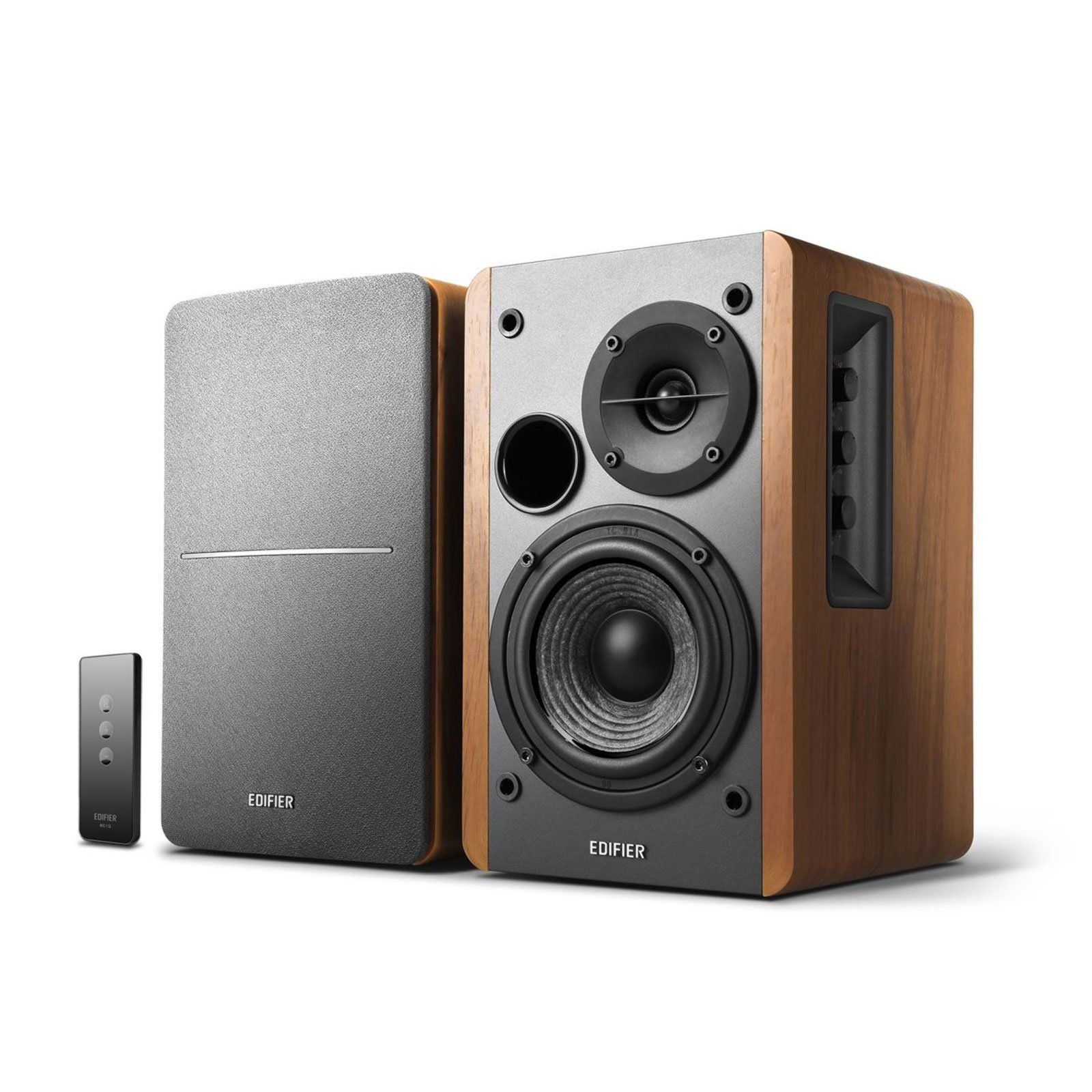
Where the Creative Pebble X Plus wins on compact convenience and a dedicated subwoofer, the Edifier R1280T beats it on sheer audio fidelity for music listening thanks to its 42 watts RMS of clean power, a 4-inch woofer, and a silk dome tweeter in a real MDF wooden cabinet. That wooden enclosure (medium-density fiberboard with a wood-effect vinyl finish) reduces box resonance and vibration more effectively than the plastic shells used on the Bluedee or the Nylavee system, giving you a warmer, more natural sound that reviewers consistently call the best you can buy at this price. The 42W RMS rating (continuous power, not peak) means it can fill a medium-sized room without distortion.
On your desk, you get dual RCA inputs that let you connect two devices at the same time — connect your PC and a turntable or TV, for example, and switch without unplugging cables. The included remote control lets you adjust volume from across the room, and the side-panel knobs for bass and treble give you fine control over the sound signature. Owners mention that after a year of daily use, the speakers still sound as good as day one with no hiss or noise.
The notable limitation is connectivity: there is no Bluetooth and no subwoofer output, so this is a strictly wired 2.0 system. If you need wireless streaming from your phone or deep movie-type bass from a subwoofer, the Creative Pebble X Plus or the Nylavee 2.1 system serve those needs better. Choose the Edifier R1280T if your priority is pure, accurate stereo sound for music and you do not mind staying wired.
Where it shines
- Wooden MDF cabinet delivers warm, resonance-free sound that plastic speakers cannot match
- Dual RCA inputs let you keep two devices connected at once
- Remote control and separate bass/treble knobs give you complete control from your chair
Worth noting
- No Bluetooth or subwoofer output — strictly wired 2.0
- Requires some EQ adjustment to sound its best depending on your room
- Larger than compact soundbars, so measure your desk space first
3. Nylavee 2.1 System
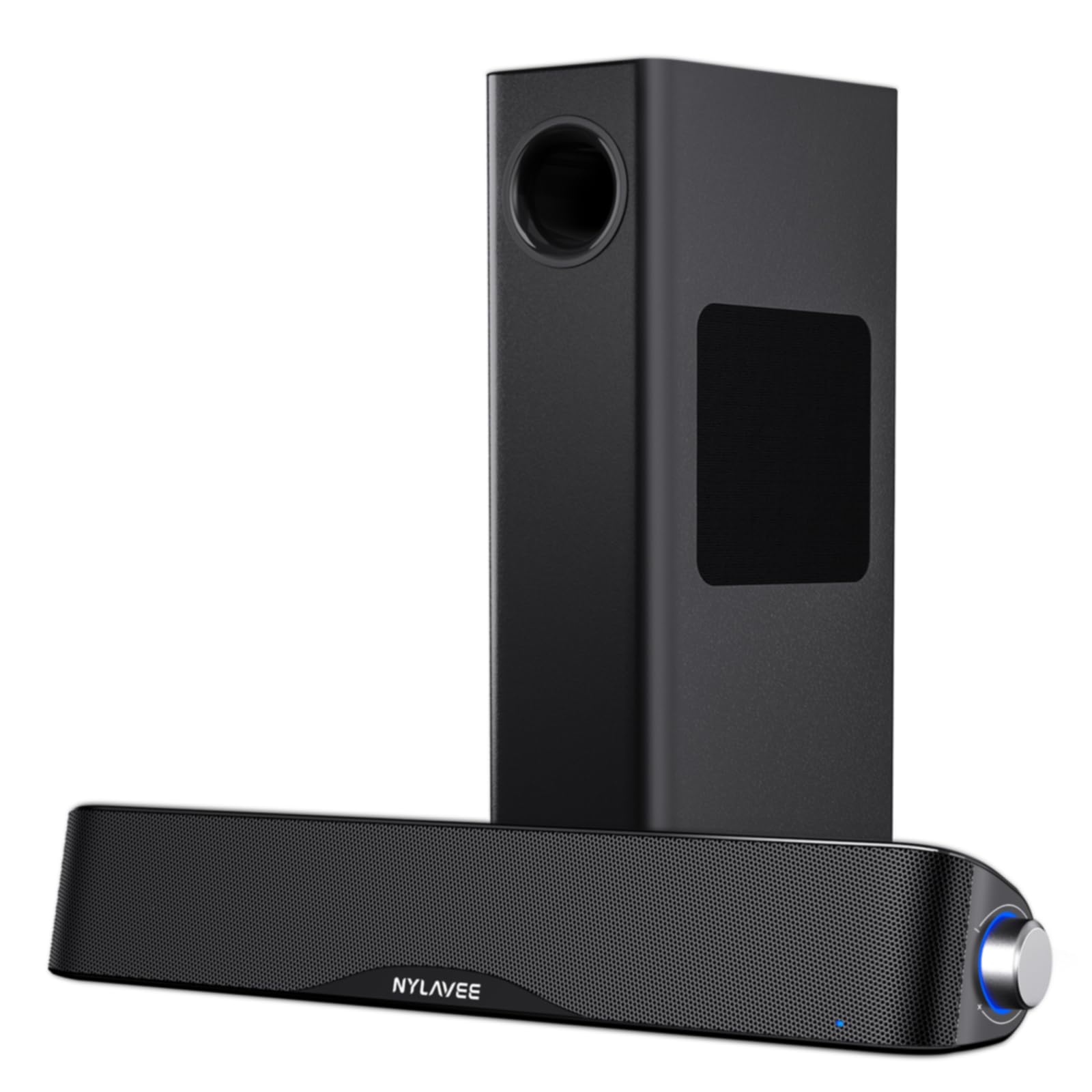
If you watch action movies or play first-person shooters and want that chest-thump bass without spending over , the Nylavee 2.1 system is your answer — its standalone 5.25-inch subwoofer delivers deep, punchy low-end that the Edifier R1280T and the OHAYO 60W simply cannot produce from their smaller drivers alone. The 60W peak power (30W RMS) rating means it gets loud enough to fill a living room, and the two satellite speakers use dual soft-dome silk tweeters (small drivers dedicated to high frequencies) to keep vocals and detail clear even with the subwoofer cranked up.
The soundbar-style satellites are designed to sit under your monitor without blocking the screen, and the setup is genuinely plug-and-play — one plug for power, a 3.5mm cable to your computer, and you are done. Customers note that the components feel heavy and durable, not cheap and hollow, and that the sound is “big and full” for the price. Bluetooth 5.4 gives you a stable wireless connection for streaming from your phone, though for gaming you will want to use the wired AUX connection to avoid any latency (the tiny delay between an action and the sound).
The downside is that the subwoofer is a wired box that needs floor or desk space near an outlet, which might not work for every setup. The enclosure material is ABS plastic (a lightweight, durable plastic), not wood, so it does not have the same resonance-dampening quality as the Edifier R1280T’s MDF cabinet. But for , you are getting a true 2.1 experience that beats every 2.0 speaker in this list for movie and gaming bass impact. This is the right pick for the buyer who wants the thump of a real subwoofer without paying for a premium brand name.
What stands out
- 5.25-inch subwoofer produces deep bass that 2.0 speakers cannot match
- Plug-and-play setup with a single power cable and AUX connection
- Bluetooth 5.4 for convenient wireless streaming from your phone or tablet
The trade-offs
- ABS plastic enclosure does not resonate as cleanly as a wooden cabinet
- Subwoofer requires a nearby power outlet and floor or desk space
- No USB digital input — audio quality depends on your computer’s sound card
4. Ortizan C7 Studio Monitors

The most important spec for accurate music monitoring is a flat frequency response — meaning the speaker does not add extra bass or treble to make the sound “exciting”, but instead plays exactly what is in the recording. The Ortizan C7 achieves this through a 3.5-inch carbon fiber woofer and a 0.75-inch silk dome tweeter paired with an electronic 2-way crossover (a circuit that splits the audio signal so each driver only plays the frequencies it handles best). Reviewers point out the sound is “shockingly close to proper studio monitor tonality” with punchy midbass and spot-on vocals, and the bass extends down to around 45Hz — deeper than the 3-inch drivers on the OHAYO 60W.
Where these monitors shine is connectivity for serious creators: they include a 6.35mm TRS balanced input (a three-conductor jack that rejects electrical interference over long cable runs), letting you connect to a mixing console, audio interface, or an electric guitar. Alongside that, you get RCA, 3.5mm AUX, and USB-C inputs with a built-in 24-bit DAC (digital-to-analog converter) that captures audio directly from your computer for cleaner sound than your motherboard’s headphone jack can deliver. There is also a front-panel headphone output for late-night monitoring without disturbing anyone.
The honest trade-off is that the volume knob has a choppy feel — shoppers say it jumps from silent to audible rather than smoothly ramping up — and the Bluetooth sound effects can feel cheap compared to the wired connection. There is no subwoofer output and no low-bass extension, so these are not for movie explosions. For the price, they are a hidden gem for anyone making music or editing audio on a budget who needs accurate, uncolored sound with professional input options.
The upsides
- Flat frequency response with a 3.5-inch carbon fiber woofer for accurate music monitoring
- TRS balanced input lets you connect professional audio gear like mixers and instruments
- Built-in 24-bit USB DAC delivers cleaner sound than a standard computer headphone jack
Keep in mind
- Volume knob has a noticeable jump from silent to audible
- No subwoofer output and limited low-bass extension
- Bluetooth sound effects are not as refined as the wired audio path
5. OHAYO 60W Computer Speakers

What you actually get at this lower price with the OHAYO 60W is a pair of compact bookshelf speakers with a premium MDF wooden enclosure (medium-density fiberboard) that reduces box resonance — the same build quality you would expect from the Edifier R1280T but at half the price. Each speaker houses a 0.75-inch carbon fiber silk dome tweeter and a 3-inch carbon fiber full-range driver that together deliver 30 watts per channel (60 watts total peak) of clean, distortion-free sound. Buyers report that the frequency response reaches from 20Hz to 22.8kHz — a wider range than most speakers in this price bracket, giving you audible deep bass extension and sparkly treble detail.
You give up the subwoofer rumble of the Nylavee 2.1 system and the professional inputs of the Ortizan C7, but you gain a proper 2.0 stereo setup with a real tweeter (a separate driver for high frequencies) that delivers clear, 3D soundstage for music and gaming. The rear bass port (a tube that lets air move in and out to amplify low frequencies) adds noticeable punch without making the sound muddy. Owners mention the speakers get “surprisingly loud” for their 3-inch size and that the separate bass and treble knobs on the front make tonal adjustment easy without needing software.
The standout feature here is the build quality for the price: the MDF cabinets feel solid, not hollow, and the speakers are very energy efficient, drawing under 1 watt even at full volume. If you want the warmth and clean sound of a wooden speaker cabinet but cannot justify the cost of the Edifier R1280T, the OHAYO 60W is the budget-friendly alternative that does not feel cheap — it is perfect for the budget buyer who prioritizes cabinet quality and clear stereo imaging over subwoofer rumble or extra inputs.
Why we’d pick it
- MDF wooden enclosure reduces vibration for cleaner, warmer sound than plastic speakers
- Wide frequency response (20Hz – 22.8kHz) for deep bass and crisp highs
- Separate treble and bass knobs give you hands-on tonal control
A few caveats
- No subwoofer output — low-bass extension is limited by the 3-inch drivers
- 3.5mm input sounds slightly hollow and quieter than USB or Bluetooth
- Lacks the premium fit and finish of higher-priced bookshelf speakers
6. Edifier G1000 II
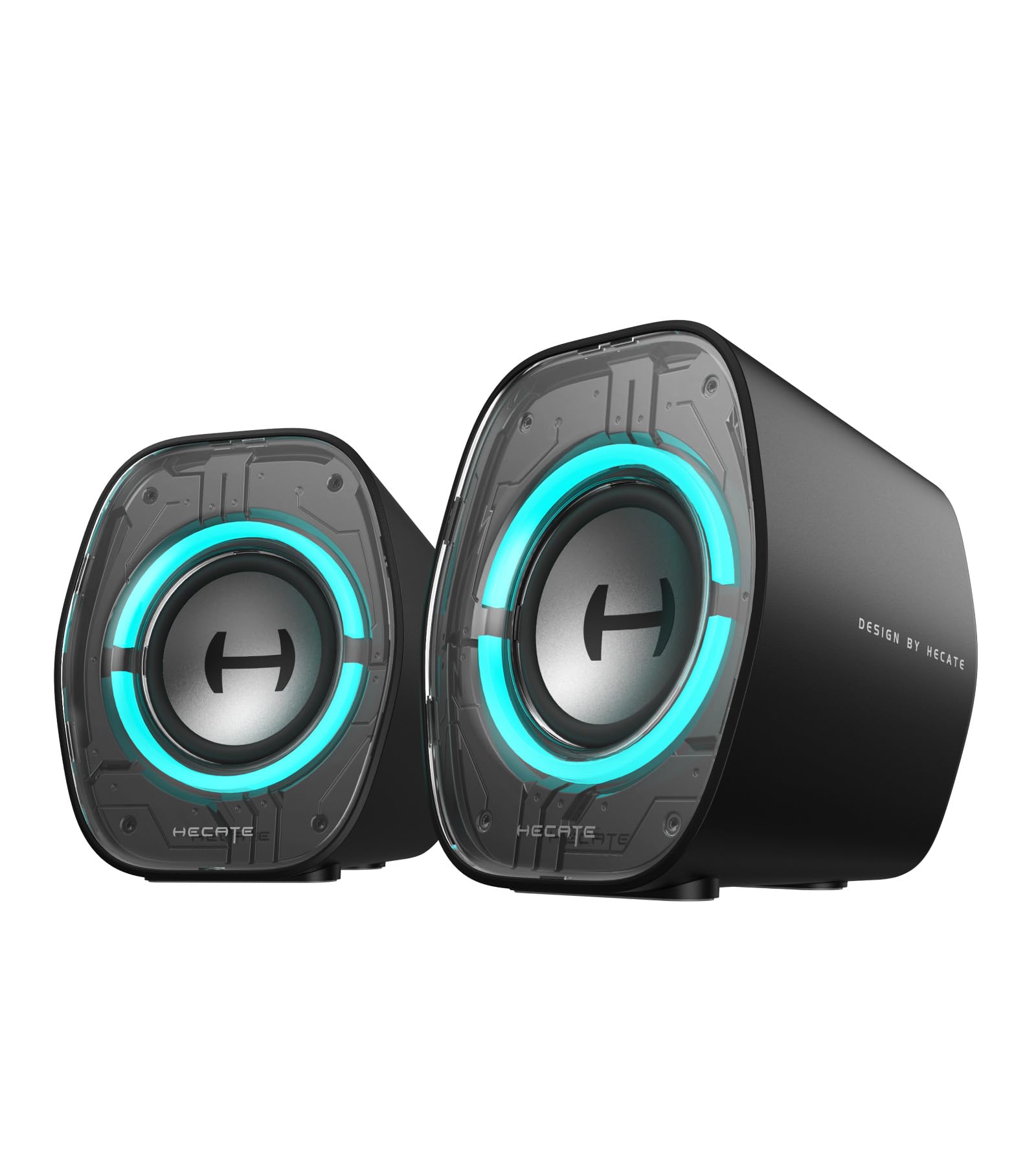
The Edifier G1000 II targets the budget gamer who wants RGB lighting and spatial audio without spending more than , and it delivers exactly that through a 2.5-inch full-range driver with a 16-core high-magnetic system and a racetrack-shaped bass reflex port (a specially shaped tube that boosts low frequencies). The nine dynamic RGB lighting modes — static, breathing, color cycling, and more — let you match your PC’s aesthetic, from subtle white glow to full cyberpunk rainbow, which is something the simpler Bluedee soundbar cannot offer at the same price. Bluetooth 5.4 with a low latency of under 40ms (the delay between your action and the sound) means you can game wirelessly without feeling the lag.
In real use, the G1000 II is a massive upgrade over built-in monitor speakers — buyers call it “a perfect balance between cyber-chic aesthetics and genuine acoustic quality” and note that the app-based EQ (equalizer presets for music, gaming, and movie modes) lets you tailor the sound without fiddling with knobs. The compact 3.6-inch width per speaker fits even the tightest desk setups, and the 10-degree upward tilt (the speakers point slightly upward toward your ears) reduces reflections off your desk surface for cleaner imaging. The top-mounted buttons control volume, EQ modes, and input switching without reaching around the back.
The honest limit is that the total power output is in the single-digit watt range, not the 30W some buyers might expect from the marketing. The bass is better than the previous Edifier G1000 model, but it is still modest — you need to spend more for real low-end thump. Also, the volume adjustment requires holding the button rather than turning a knob, and a reviewer notes that the button jumps by 5+ increments, making precise volume control frustrating. If your top priority is a small, RGB-lit speaker for casual gaming and desk aesthetics at a rock-bottom price, this is a fun pick — just do not expect it to shake the room.
Strong points
- Nine RGB lighting modes let you customize your desk aesthetic without extra cost
- Low-latency Bluetooth 5.4 (under 40ms) lets you game wirelessly with no noticeable delay
- Ultra-compact 3.6-inch width and 10-degree tilt fit snugly on any desk
Before you buy
- Power output is in single-digit watts, not the 30W some buyers expect
- Volume button jumps by 5+ increments and requires holding — no precise knob control
- Bass is improved from the previous model but still modest for a sub- speaker
7. Bluedee Computer Soundbar

The Bluedee Computer Soundbar is the most affordable fully wireless option in this guide, offering a fundamentally different value proposition from the wired Edifier R1280T or the Nylavee 2.1 system: convenience first, raw power second.
For call quality on Zoom and Teams, the Bluedee is excellent — dual full-range drivers and tweeters deliver clear, crisp highs and audible vocals with decent bass for a single-bar design. You can also play music directly from a USB flash drive or TF card (a microSD memory card) without connecting to a computer at all, which is a handy backup if you want to play audio from a phone without pairing over Bluetooth. Customers note that the sound is “exceptionally clear with great bass” for the form factor and that setup via AUX, Bluetooth, or USB is insanely easy — plug and play in seconds.
The trade-off is that a single soundbar cannot produce the stereo separation (the sense of left-right space between instruments) that a pair of separate left and right speakers like the OHAYO 60W or the Edifier R1280T creates. The bass is decent for movies but nowhere near the chest-thump of the Nylavee’s separate subwoofer. If you value a clean, minimalist desk with zero cables and the ability to carry your speaker to different rooms, the Bluedee is the perfect choice — especially for a dorm room, a home office with frequent moves, or anyone who hates cord clutter above all else.
What we like
- 13-hour rechargeable battery lets you use it wirelessly anywhere in your home
- Ultra-compact 16.5-inch soundbar fits under almost any monitor without blocking the screen
- Multiple playback options: Bluetooth, AUX, USB flash drive, or TF card
The downsides
- Single soundbar lacks the stereo separation of separate left/right speakers
- Bass is decent for the size but cannot match a 2.1 system with a dedicated subwoofer
- Wire ports sit on the top surface, which can look messy if you keep them plugged in
Understanding the Specs
RMS Power vs Peak Power
RMS (Root Mean Square) is the continuous power a speaker can handle without distorting — it tells you how loud and clean the speaker will sound during normal use. Peak power is the maximum burst the speaker can handle for a split second before distorting. Always compare RMS numbers between speakers; peak numbers are marketing figures that can be inflated. For a desktop setup, 20W to 42W RMS is plenty for clear, room-filling sound without distortion.
Driver Size and Configuration
The driver size (measured in inches across the cone) directly affects how much air the speaker can move and therefore how much bass it can produce. A 2.5-inch driver produces modest bass, a 3-inch to 4-inch driver gives you solid low-end for music, and a dedicated subwoofer with a 5.25-inch driver or larger delivers the deep rumble you feel in movies and games. A tweeter (a small separate driver for high frequencies) is essential for clear vocals and detail — without one, highs can sound dull or muffled.
Frequency Response
Frequency response, written as a range like 20Hz – 22.8kHz, tells you which pitches the speaker can reproduce. The human ear hears roughly 20Hz (deep bass, like a kick drum) to 20kHz (high treble, like cymbals). A wider range means the speaker can play both deeper bass and higher treble. If a speaker says 80Hz – 20kHz, it cannot reproduce deep bass below 80Hz, so you will miss the lowest notes in electronic music or movie explosions.
Digital-to-Analog Converter (DAC)
A DAC is a chip inside the speaker that converts the digital audio file (1s and 0s from your computer) into an analog electrical signal that drives the speaker cones. A built-in 24-bit DAC, like the one in the Ortizan C7, processes the audio outside your computer’s often-noisy internal sound card, resulting in a cleaner signal with less background hiss and more detail. USB and USB-C connections use the speaker’s internal DAC; AUX cables use your computer’s internal sound card.
FAQ
Do I need a subwoofer for computer speakers under ?
What is the difference between Bluetooth 5.3 and Bluetooth 5.4 for speakers?
Can I connect computer speakers to a TV or gaming console?
Final Thoughts: The Verdict
For most buyers, the computer speakers under 200 dollars winner is the Creative Pebble X Plus because it packs a true 2.1 system with a subwoofer and a single USB-C cable into the smallest footprint of any premium option. If you want the absolute best stereo sound for music and do not need a subwoofer, grab the Edifier R1280T. And for the buyer who wants deep movie and game bass at the lowest possible cost, the standout is the Nylavee 2.1 System.

Mo Maruf
I created WellFizz to bridge the gap between vague wellness advice and actionable solutions. My mission is simple: to decode the research and give you practical tools you can actually use.
Beyond the data, I am a passionate traveler. I believe that stepping away from the screen to explore new environments is essential for mental clarity and physical vitality.