Our readers keep the lights on and my smoothie glass nicely filled. As an Amazon Associate, I earn from qualifying purchases.
Picking a compact sleeping bag that is both light and warm sounds simple, but you face real trade-offs. Down vs synthetic fill, temperature ratings that are often misleading, and packed sizes that range from water-bottle tiny to backpack-busting large. This guide cuts through the confusion. You will learn what each spec means for your actual night’s sleep on the trail, and which bag suits your kind of camping.
I’m Mohammad Maruf — the co-founder and writer behind WellFizz. This guide is built by comparing the manufacturers’ published specifications and the patterns across verified customer reviews, so you get each pick’s real strengths and trade-offs instead of marketing spin.
By the end, you will know which compact sleeping bag fits your next trip and your budget — explained in plain language with the facts that matter for a good night’s rest outdoors.
How To Choose The Best Compact Sleeping Bag
Choosing a compact sleeping bag comes down to three things: warmth, weight, and how small it packs. Here is what matters most.
Down vs Synthetic Fill
Down (goose or duck feathers) gives you the best warmth for the least weight and packs down the smallest. The fill power — a number like 550, 600, or 650 — tells you how fluffy the down is. A higher number means more warmth per ounce (so you need less down to stay warm) and a smaller packed size. Down is useless when wet unless it has a hydrophobic treatment (a water-repellent coating). That means you need a dry tent or a dry bag for it to work. Synthetic fill (like the 7D hollow-fiber in the 1TG Tactical bag) is heavier and packs larger, but it still works when damp and dries fast. For true compact travel, down wins every time.
Temperature Ratings: Comfort vs Extreme
A sleeping bag’s temperature rating has two numbers. The comfort rating is the lowest temperature at which an average sleeper can sleep comfortably — this is the number you should trust for real-world use. The extreme rating is survival only (you will be shivering, not sleeping). For example, a bag rated “20°F” often has a comfort rating closer to 32°F for women or cold sleepers. If you sleep cold, add 10–15°F to the bag’s listed number to find your real comfort point.
Packed Size and Weight
The whole point of a compact sleeping bag is that it fits inside your backpack without eating up all the space. Look for a packed size under 14 inches long and under 8 inches in diameter — anything larger is hard to justify for backpacking. Weight should be under 3 pounds for a true compact bag; ultralight options dip below 2 pounds. The compression sack that comes with the bag matters too — better sacks have separate straps that let you cinch the bag down tight.
Shape: Mummy vs Rectangular
Mummy bags taper at the feet and hug your body, saving weight and space because there is less fabric and insulation. They are warmer for their weight but can feel restrictive, especially for side sleepers. Rectangular or semi-rectangular bags (like the QEZER down bag) give you more room to move and can unzip flat to use as a blanket, but they are heavier and pack less small for the same temperature rating.
Quick Comparison
On smaller screens, swipe sideways to see the full table.
| Model | Category | Best For | Key Spec | Amazon |
|---|---|---|---|---|
| Naturehike Ultralight RDS Down | Down | Ultralight backpackers wanting the smallest pack size | 1.3 lb, 650 FP down, packs to 4.7″ x 10.2″ | Amazon |
| ZOOOBELIVES Alplive T400 | Down | Lightweight backpackers who want a spacious shape | 1.7 lb, 650 FP down, packs to 11″ x 6.7″ | Amazon |
| QEZER Down Sleeping Bag (600 FP) | Down | Roomier semi-rectangular sleep for taller campers | 2.54 lb, 600 FP down, 86.61″ x 30.71″ | Amazon |
| Kelty Cosmic 20 Down | Down | 3-season backpackers wanting a trusted brand at a good price | 2.6 lb, 550 FP down, 20°F rating | Amazon |
| QEZER Mummy Down (0°F/15°F) | Down | Cold-weather campers needing warmth without bulk | 2.34 lb, 600 FP down, 28°F extreme rating | Amazon |
| 1TG Tactical Mummy (25°F) | Synthetic | Budget-conscious campers wanting a tough, washable bag | 3.88 lb, synthetic 7D hollow-fiber, 25°F rating | Amazon |
| OneTigris Bushcrafter | Synthetic | Budget campers needing a roomy, durable bag for car camping | 3.1 lb, polycotton fill, 82.6″ x 33″ | Amazon |
In‑Depth Reviews
1. Naturehike Ultralight Backpacking RDS Down Sleeping Bag

At 1.3 pounds and a packed size of 4.7 by 10.2 inches — the smallest of any bag here — the Naturehike Ultralight is for backpackers who prioritize minimal weight and volume above all else. You do not have to choose between a tiny pack size and real comfort; it gives you both, packing down roughly the size of a large water bottle and weighing 2.4 pounds less than the OneTigris Bushcrafter.
It uses 650 fill power RDS-certified down for ethical sourcing and delivers a 42.8°F comfort rating, warm enough for three-season use. Reviewers consistently say it is “warm enough for freezing temps” and praise how it “packs small.” The YKK two-way zipper lets you zip two bags together for couples, though the 20D 400T nylon shell is durable only for normal use, and one reviewer noted a drawstring design flaw with weak stitching. Tall sleepers should skip it unless you pick the medium CWM400, since the short size (CW295) is only 74.8 inches long.
If you want the absolute smallest, lightest compact sleeping bag that still sleeps warm on three-season trips, this is it.
Why it’s great
- Ultralight 1.3 lb weight is ideal for backpackers
- Packs tiny (4.7″ x 10.2″) — holds up to any compression test
- RDS-certified 650 FP down for responsible warmth
- Opens flat to use as a quilt, adding versatility
Good to know
- Drawstring stitching can be weak — inspect before your first trip
- Short size (CW295) is only 74.8″; tall sleepers need the medium CWM400
- Down loses insulation if it gets wet, even with water-repellent treatment
2. ZOOOBELIVES Ultralight Backpacking 32-50F Down Sleeping Bag

The ZOOOBELIVES Alplive T400 beats the Naturehike on spaciousness while staying impressively light. At 1.7 pounds — that is 0.4 pounds heavier than the Naturehike, but still a full 1.4 pounds lighter than the OneTigris Bushcrafter — it gives you a rectangular shape that feels more like a home quilt than a tight cocoon. The 650-fill duck down (the same fill power as the Naturehike) packs into an 11-inch by 6.7-inch sack, so it fits easily inside a 40-liter pack.
For warm-weather backpackers, this bag is a dream: it is rated for 32°F to 50°F, and one reviewer confirmed it “performed well” when tested at 50°F wearing just shorts and a T-shirt. The dual two-way YKK zippers (zippers that can open from both top and bottom) allow you to vent your feet on warmer nights, and two bags can zip together into a double sleeping bag for couples — a real advantage over the mummy-style Naturehike. The honest limit: this bag uses “tube stitching” (vertical stitched-through channels that don’t have internal baffles), which reduces warmth compared to the more expensive baffled boxes on premium down bags. Also, the 20D nylon shell (a thin fabric that feels a bit “plasticky” and rustles against your skin) is not the quietest or softest.
Choose this over the top pick if you prioritize a roomy rectangular shape and the ability to zip two bags together for couples, and you are willing to accept a slightly heavier pack weight and a less refined shell fabric for a lower price.
Where it shines
- Rectangular shape gives you real room to move — no claustrophobia
- Lightweight 1.7 lb with compact pack size (11″ x 6.7″)
- Dual zippers allow foot venting and couples-zip compatibility
- Zero odor down — a common complaint with cheap down avoided
Worth noting
- Tube stitching reduces warmth vs baffled construction — stick to 50°F+ nights
- Fabric feels plasticky and rustles; use a liner for comfort
- Needs vigorous shaking to re-loft after compression
3. QEZER Down Sleeping Bag for Adults, 600 Fill Power

If you stand 6’2″ and have spent every camping trip with your feet pressed against the bottom of a mummy bag, the QEZER is the compact bag that finally gives your legs room to stretch. At 86.61 inches long and 30.71 inches wide, it offers 7 more inches of length than the Naturehike and a full 9 more inches than the ZOOOBELIVES—comfortably fitting sleepers up to about 6 feet 4 inches, while the ZOOOBELIVES stops at 6 feet 7 inches tall, this one actually has more legroom for most people.
The semi-rectangular shape is wider at the shoulders and feet than a true mummy, giving you space to turn over without feeling trapped, yet it still packs down to a reasonable 13.78 inches by 6.3 inches—just slightly larger than the Naturehike. One buyer mentioned it “kept scout (5’8″, 130 lbs) warm in <30°F,” which suggests the 41°F comfort rating is conservative. The 600 fill power duck down (slightly lower than the 650 FP in the Naturehike and ZOOOBELIVES, but still good) and the 400T nylon shell (a denser fabric that prevents feathers from poking through) make this a durable warm-weather bag. The one catch: at 2.54 pounds, it is nearly twice the weight of the Naturehike.
If you prioritize legroom over ultralight weight and need a bag that handles high-20s temps, this QEZER is your best bet—and at 86.61 inches long, it is the only compact bag in this guide that truly fits a 6’4″ sleeper without compromise.
What stands out
- Generous 86.61″ length fits tall sleepers comfortably
- Semi-rectangular shape gives you room to move without the weight of a full rectangle
- Thick down fill kept a scout warm below 30°F — better than rated
- Foot zipper lets you vent on warmer nights
The trade-offs
- At 2.54 lb, it is noticeably heavier than the Naturehike (1.3 lb)
- Outer fabric is thin — one reviewer got a hole from a splinter
- Stuff sack is small and thin; the larger mesh storage bag is better for long-term storage
4. Kelty Cosmic 20 Down Mummy Sleeping Bag

21°F ISO limit: the Kelty Cosmic 20 Down Mummy Sleeping Bag delivers the most honest temperature rating on this list, with an ISO limit of 21°F and an ISO extreme of -11°F, meaning you can trust the 20°F number for three-season camping. It uses 550 fill power down (slightly less compressible than the 650 FP in the Naturehike and ZOOOBELIVES, but still warm). At 2.6 pounds for the regular size, it is heavier than the top picks but still packable at 13 inches by 7 inches.
The catch you accept is a snugger mummy cut. Buyers report it is “tight at the shoulder” and hard to zip with a bent arm, especially for broader or barrel-chested users. If you have broad shoulders, you may find it more comfortable unzipped as a blanket, which several buyers do. However, the quality is undeniable: the recycled nylon and polyester shell (PFAS-free DWR treatment, meaning it sheds water without the toxic forever chemicals) and the dual-direction zipper with a thick draft tube make this a bag built to last season after season.
At a mid-range price point that undercuts premium brands, the Kelty gives you a legitimate 20°F down bag from a company that has been making camping gear since 1952—making this the most trustworthy cold-weather buy on the list for the price.
The upsides
- ISO-rated 21°F limit rating — the most trustworthy temperature on the list
- PFAS-free DWR treatment and recycled fabrics for eco-conscious buyers
- RDS-certified down is traceable back to the farm batch
- Packs small enough to fit in a motorcycle saddlebag, per reviewers
Keep in mind
- Snug at shoulders and arms — not ideal for broad-chested or barrel-chested sleepers
- Heavier (2.6 lb) than the Naturehike (1.3 lb) for the same warmth
- Mummy shape feels restrictive; some buyers use it as a blanket instead
5. QEZER Mummy Down Sleeping Bag (0°F / 15°F)

At this lower price, you actually get a 600-fill-power duck down mummy bag that weighs just 2.34 pounds and compresses to 13.78 by 6.3 inches — roughly the same packed size as the Kelty Cosmic but 0.26 pounds lighter. The comfort rating is 41°F, with a survival extreme rating of 28°F; one owner reported surviving single-digit temperatures in the Colorado mountains with it, suggesting the rating may be conservative for a warm sleeper in a tent. This gives it a better cold-weather-to-compactness ratio than the Naturehike, which is lighter but not warm enough for freezing temps without layers.
The trapezoidal foot box lets your feet splay naturally, avoiding the cramped feeling common among side sleepers in mummy bags. The 400T tear-resistant nylon outer uses a dense weave that resists rips and prevents feathers from poking out, and the zipper includes a thick draft tube and Velcro closure to block cold air. One customer observed the bag “compresses much smaller than similar-sized bags” and praised the build quality, though another buyer reported the inner mesh storage bag ripped on first use.
For its price point, this is the best cold-weather-to-compactness ratio on the list, delivering legitimate warmth for shoulder-season camping and even mild winter trips in a package that fits easily in a 50-liter pack. It is perfect for the budget buyer who needs a genuinely warm, packable down bag for freezing conditions without spending for premium brands.
Why we’d pick it
- Comfort rated to 41°F but tested in single digits — real cold-weather ability
- Lightweight 2.34 lb yet packs down to a small 13.78″ x 6.3″
- Trapezoidal foot box gives feet natural room — no cramped toes
- Smooth YKK zipper with draft tube keeps warmth locked in
A few caveats
- Inner mesh storage bag ripped on first use for one reviewer
- Mummy shape is snug — not for sleepers who toss and turn a lot
- Down loses insulation power if it gets wet
6. 1TG Tactical Mummy Sleeping Bag (25°F-36°F)
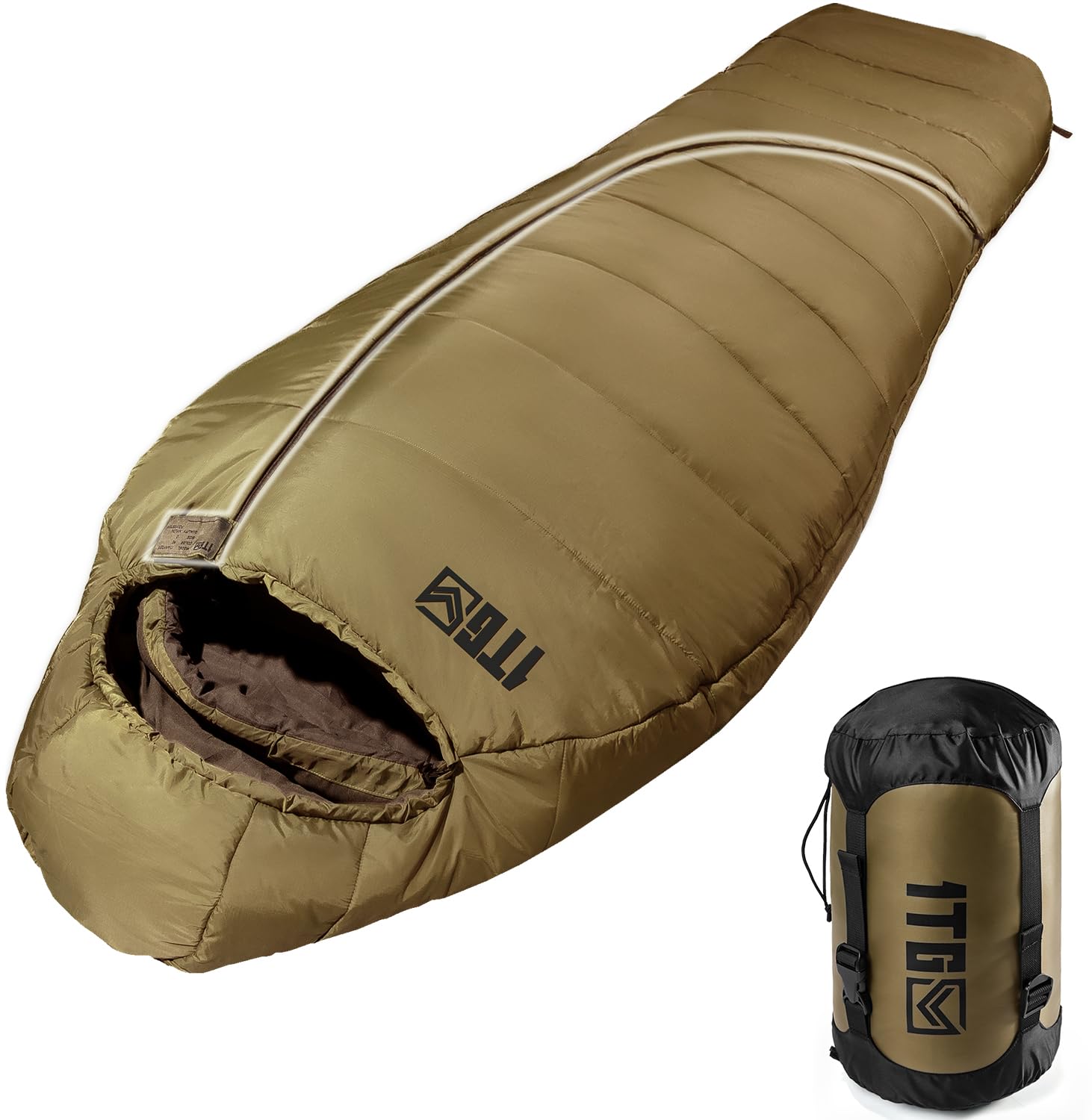
The 1TG Tactical is for the camper who beats up their gear and needs something that can survive an elk hunt or a rough scout trip. The 40D nylon outer shell (a thicker, more abrasion-resistant fabric than the delicate 20D on down bags like the Naturehike) is built to resist damp ground and brush.
The unique diagonal zipper (rather than a traditional side zip) makes it easy to get in and out in the dark without snagging, and the 3D ergonomic foot box (a shaped foot area that gives your feet room to move naturally) means you will not feel trapped. Owners mention it is “great for the price” and praise that it “kept 11yo warm to 30°F without a liner.” Plus, it is fully machine washable — a big advantage over down bags that require special cleaning — and the compression sack packs it to a compact 13 inches.
The honest limit: 3.88 pounds is not a compact sleeping bag for a serious backpacker who counts every ounce. But for car camping, emergency kits, hunting trips, or family use where weight is less critical, this bag gives you durability and damp-weather performance that no down bag can match at this price.
Strong points
- Machine washable and water-resistant synthetic fill — handles damp conditions
- Tough 40D nylon outer shell resists tears and brush
- Unique diagonal zipper is snag-free and easy to use in the dark
- Fits up to 6’1″ with a roomy box foot
Before you buy
- At 3.88 lb, it is too heavy for true backpacking
- Synthetic fill packs larger than down for the same warmth
- Best for 3-season use; not for deep winter but can handle cold nights
7. OneTigris Bushcrafter’s Mummy Sleeping Bag

The OneTigris Bushcrafter is the most affordable entry into this list, and for that price, you get a genuinely roomy bag that measures 82.6 inches by 33 inches — that is wider than any other bag here, making it comfortable for a 6-foot, 245-pound sleeper, as one reviewer confirmed. At 3.1 pounds, it is lighter than the 1TG Tactical by 0.78 pounds but still over a pound heavier than the down options.
What that lower price gets you is a polycotton synthetic fill (a blend of polyester and cotton that is splash-resistant and machine washable but not as compressible as down) and a 300T pongee outer shell (a woven nylon fabric that resists light rain but is not fully waterproof). Customers note the “zipper catches material ~5 times” — the anti-snag design is better than some budget bags but not perfect — and the large hood with a one-sided drawstring feels a bit basic. The bag is rated for 46.4°F to 59°F, making it strictly a warm-weather (spring/summer/fall) option.
For the car camper, backyard camper, or someone building an emergency kit on a strict budget, this OneTigris gives you a ton of space and respectable warmth without the sticker shock of down. Just do not expect it to pack small enough for multi-day backpacking — the stuff sack is a tube shape (7.8 inches by 16.5 inches) that will eat up a lot of pack space. The one clear reason to choose it is its unmatched width and low price for a warm-weather synthetic bag.
What we like
- Generous 33″ width fits broad shoulders and big sleepers comfortably
- Machine washable and splash-resistant for easy care
- Polycotton fill is warm for 3-season use in mild climates
- Great value for occasional or car camping on a budget
The downsides
- Zipper snags material occasionally — not a snag-free design
- 3.1 lb is heavy for backpacking; packed size is large
- Temperature rating is optimistic; best for 50°F+ nights
Understanding the Specs
Fill Power (FP)
Fill power is the number that tells you how fluffy the down is — a higher number means the down takes up more space per ounce, which traps more air and keeps you warmer. A 650 FP bag (like the Naturehike and ZOOOBELIVES) will be warmer and more compressible than a 550 FP bag (like the Kelty) at the same weight. For compact sleeping bags, aim for 600 FP or higher — that is the sweet spot between cost and performance.
Comfort vs Limit vs Extreme Rating
Manufacturers always list a single temperature number, but that is often the limit or extreme rating — not the comfort rating. The comfort rating is the lowest temperature at which you can actually sleep warm. A bag rated “20°F” often has a comfort rating around 32°F for an average sleeper. The ISO (International Organization for Standardization) standard used by Kelty is the most trustworthy. If no ISO rating is given, add 10–15°F to the listed number for your real comfort temperature.
Denier (D) in Shell Fabric
The “20D” or “40D” number on the shell fabric refers to the thickness of the nylon threads. A 20D fabric (used on the Naturehike, ZOOOBELIVES, and Kelty) is very thin and lightweight, saving ounces but being more prone to tears from rocks or branches. A 40D fabric (used on the 1TG Tactical) is thicker and more durable but heavier. For backpacking where every gram counts, 20D is fine as long as you are careful with your tent floor.
Mummy vs Semi-Rectangular Shape
A true mummy bag (like the Kelty Cosmic 20 and the 1TG Tactical) is narrow at the shoulders and tapers sharply at the feet, which saves weight and space. A semi-rectangular shape (like the QEZER 600 FP bag) is wider and boxier, giving you more room to move but adding weight and packed size. If you are a side sleeper or toss and turn, look for a bag with a trapezoidal foot box — a foot area shaped like a wide trapezoid that lets your feet lie naturally without constriction.
FAQ
What is the difference between 550, 600, and 650 fill power down?
Can a compact sleeping bag keep me warm in freezing weather?
How small should a compact sleeping bag pack down to?
Is a synthetic or down compact sleeping bag better for me?
Final Thoughts: The Verdict
If you want one dependable pick, the best compact sleeping bag is the Naturehike Ultralight RDS Down because it delivers the smallest pack size (4.7″ x 10.2″) and lightest weight (1.3 lb) without sacrificing warmth or comfort — perfect for any backpacker who wants to save space and ounces. If you want a spacious rectangular shape that still packs small and costs less, grab the ZOOOBELIVES Alplive T400. And for cold-weather camping where temperature performance matters most, the Kelty Cosmic 20 Down is the most trustworthy 20°F bag on the list, backed by ISO ratings and decades of brand reputation.

Mo Maruf
I created WellFizz to bridge the gap between vague wellness advice and actionable solutions. My mission is simple: to decode the research and give you practical tools you can actually use.
Beyond the data, I am a passionate traveler. I believe that stepping away from the screen to explore new environments is essential for mental clarity and physical vitality.