Our readers keep the lights on and my smoothie glass nicely filled. As an Amazon Associate, I earn from qualifying purchases.
A keyboard that doesn’t keep up with your coding flow is a bottleneck. Slow actuation, missed keystrokes, wrist fatigue from a poor layout — these aren’t just annoyances, they’re productivity killers that compound over a full workday. The right mechanical board becomes an extension of your logic, not a distraction from it.
I’m Mohammad Maruf — the founder and writer behind WellFizz. I’ve spent hundreds of hours analyzing switch types, actuation forces, latency reports, layout ergonomics, and build materials for keyboards purpose-built for programming.
Your choice determines whether you’re fighting the machine or thinking through the problem. This guide looks at the key specs that separate a good typing deck from a great one, and identifies the best computer keyboard for programmers across different priorities and budgets.
How To Choose The Best Computer Keyboard For Programmers
A programming keyboard is a tool you interface with for hours daily. The wrong switch or a cramped layout doesn’t just feel bad—it can slow your typing rhythm and cause repetitive strain. Focus on these three criteria to narrow the field.
Switch Type and Feel
The switch determines every tactile sensation. Linear switches (like Cherry MX Red or HyperX Red) offer a smooth, uninterrupted keystroke ideal for rapid key presses with no bump. Tactile switches (Cherry MX Brown, NX Snow) provide a gentle bump at the actuation point, giving confirmation without the audible click. Clicky switches (Cherry MX Blue, Logitech Clicky) add sound to the bump. Programmers who type for hours generally prefer tactile or smooth linear switches to avoid fatigue from bottoming out or the noise of clicky variants. Hall Effect magnetic switches introduce adjustable actuation points—you can set the registration depth from 0.2mm to 3.8mm, tailoring response to your typing force.
Layout and Ergonomics
Full-size keyboards include a numpad, which can be useful for data entry but pushes the mouse hand further to the right, potentially straining the shoulder. Tenkeyless (TKL) models drop the numpad for a narrower stance, centering the typing area in front of the monitor. Seventy-five percent and smaller layouts save even more space. For programmers with wrist or hand pain, contoured ergonomic designs with split keywells and thumb clusters (like the Kinesis Advantage2) reposition hands into a neutral, handshake-like posture that can eliminate strain entirely.
Build Quality and Connectivity
A keyboard that shifts on the desk or has excessive key wobble degrades confidence with every stroke. Look for aluminum or metal-reinforced frames that provide a stable, rigid base. Keycaps made from PBT resist shine and wear over time better than ABS. Wireless connectivity (Bluetooth or 2.4 GHz) reduces cable clutter, but latency and battery life vary. For programmers who also game, polling rate and N-key rollover matter for rapid passages of code and macro sequences.
Quick Comparison
On smaller screens, swipe sideways to see the full table.
| Model | Category | Best For | Key Spec | Amazon |
|---|---|---|---|---|
| Kinesis Advantage2 | Ergonomic | Eliminating wrist pain | Contoured split keywells | Amazon |
| ASUS ROG Azoth | Premium | Customization enthusiasts | 75% gasket mount, OLED | Amazon |
| Logitech MX Mechanical | Wireless | Multi-device productivity | Low-profile clicky switches | Amazon |
| Corsair K70 PRO TKL | Hall Effect | Adjustable actuation | 0.4mm-3.6mm per-key actuation | Amazon |
| Keychron K10 HE | Hall Effect | Full-size magnetic board | Tri-mode wireless, wood frame | Amazon |
| HyperX Alloy Origins Core | TKL | Compact durability | Aircraft-grade aluminum body | Amazon |
| Cherry KC 200 MX | Entry-Level | Budget mechanical feel | MX2A Silent Red switches | Amazon |
In‑Depth Reviews
1. Kinesis Advantage2 (KB600)

The Kinesis Advantage2 is not a keyboard you buy casually—it is a serious ergonomic intervention. Its patented contoured keywells drop your fingers into a natural, relaxed curve, while the thumb clusters offload modifier keys (Backspace, Enter, Control, Delete) from your weakest fingers. This repositioning can eliminate wrist and hand pain for programmers who spend entire days at the keyboard, as confirmed by multiple long-term users who reported complete pain relief within weeks.
The board uses genuine Cherry MX Brown switches—tactile with a low activation force and rated for 50 million presses. Every key is fully programmable on the fly using the onboard Smart Set engine, without needing drivers. You can remap any key, record macros, and switch between QWERTY, Dvorak, and custom layouts instantly. The 4MB flash memory stores everything onboard, so it works across different computers without software.
Be aware of the adaptation period. Most users report needing two to four weeks to rebuild muscle memory for the thumb-based modifiers and ortholinear layout. The build uses a lot of plastic at this price point, which some describe as feeling less premium than aluminum boards. There is no backlighting, and the keycap legends can fade over time. For anyone with existing RSI or a desire to prevent it, the Advantage2 is unmatched.
Why it’s great
- Proven ergonomic design that eliminates wrist strain for many users
- Fully programmable onboard with macro recording, no software required
- Cherry MX Brown switches with tactile feel and 50 million keystroke rating
Good to know
- Takes two to four weeks to build new muscle memory for thumb keys
- Plastic chassis feels less premium at this price point
- No backlighting and keycap legends can fade over time
2. ASUS ROG Azoth

The ASUS ROG Azoth brings enthusiast-grade customization straight out of the box. Its 75% layout saves significant desk space while retaining the F-row and arrow keys that programmers rely on for IDE shortcuts. The pre-lubed ROG NX Snow linear switches are buttery smooth and remarkably quiet, with no audible ping thanks to three layers of dampening foam inside a silicone gasket-mounted frame. The typing feel is consistent, flex-free, and deeply satisfying for long sessions.
Hot-swappable sockets let you replace switches without soldering, and the included DIY kit (Krytox lubricant, switch opener, pullers, lube station, brush) invites you to experiment with feel and sound. The integrated 2-inch OLED screen displays system stats, media info, or custom animations, though it requires a wired connection for PC monitoring. Wireless connectivity via 2.4 GHz offers sub-2ms latency with over 2000 hours of battery life when OLED and RGB are off, making it a true dual-use board for coding and gaming.
The Armoury Crate software is widely described as buggy and resource-heavy, which can frustrate daily use. The OLED screen is less useful on wireless, and the board lacks Hall Effect switches for adjustable actuation. At this price, the included accessories and build quality justify the cost for programmers who value a premium typing experience and the ability to mod their board over time.
Why it’s great
- Outstanding out-of-box typing feel with gasket mount and three-layer foam dampening
- Hot-swappable with included professional modding kit for customization
- Battery life exceeds 2000 hours in wireless mode with RGB and OLED off
Good to know
- Armoury Crate software is buggy and resource-heavy
- OLED display functionality is limited in wireless mode
- Expensive compared to non-enthusiast boards with similar layout
3. Logitech MX Mechanical

The Logitech MX Mechanical redefines a productivity keyboard with low-profile mechanical switches that require less finger travel than standard mechanical boards. The clicky variant provides a satisfying, audible tactile feedback that many programmers find addictive—each keystroke is confirmed by sound and feel. The full-size layout includes a numpad, which some developers find valuable for data entry and navigation, though it does push the mouse hand further right.
Smart illumination is a standout feature: backlit keys activate when your hands approach and adjust brightness to ambient light. Pairing with up to three devices via Bluetooth or the included Logi Bolt receiver is seamless, and you can switch between them instantly. Battery life reaches 15 days with backlighting on or up to 10 months with it turned off. Logi Options+ software allows deep customization of Fn keys and backlighting effects, and the keyboard is compatible with macOS, Windows, Linux, iOS, and Android.
The switches are not hot-swappable, so you are locked into your initial choice of clicky, linear, or tactile. Some users note slight key wobble and a plastic feel that doesn’t fully match the premium price. The low-profile design also limits keycap compatibility for those who want to customize later. For programmers juggling a desktop, laptop, and tablet simultaneously, the MX Mechanical is a polished, low-friction option.
Why it’s great
- Low-profile mechanical switches reduce finger travel for faster typing
- Seamless multi-device switching between up to three devices
- Exceptional battery life with smart, hand-aware backlighting
Good to know
- Switches are not hot-swappable and cannot be replaced easily
- Some key wobble reported with low-profile stems
- Numpad on full-size version may feel cramped for some desk setups
4. Corsair K70 PRO TKL

The Corsair K70 PRO TKL represents the next generation of keyboard technology with its pre-lubed Hall Effect MGX Hyperdrive magnetic switches. Unlike traditional mechanical contacts, these switches use magnets to detect keystrokes with zero physical contact, theoretically lasting for 150 million actuations. The killer feature is per-key adjustable actuation: you can set each key’s registration point between 0.4mm and 3.6mm in 0.1mm increments, allowing you to make modifier keys require a deeper press to prevent accidental activation while keeping letter keys hyper-responsive.
The tenkeyless layout saves desk space and centers the typing area, reducing shoulder reach to the mouse. Rapid Trigger dynamically changes the reset point mid-stroke, enabling super-fast repeated key presses for gaming or rapid code navigation. The chassis is a heavy, rigid aluminum frame that does not flex. A programmable volume roller, dedicated media keys, and a comfortable wrist rest round out the package. The RGB lighting is exceptionally bright and accurate.
The iCue software is powerful but complex, with a steep learning curve and occasional bugginess that can corrupt profiles. The volume roller sits very close to the PgUp and Home keys, causing occasional mis-presses. There is no numpad, which may be a dealbreaker for programmers who enter lots of numeric data. For developers who want cutting-edge switch technology and per-key tuning, the K70 PRO TKL is the most adaptable board in this lineup.
Why it’s great
- Per-key adjustable actuation from 0.4mm to 3.6mm for customized response
- Hall Effect switches rated for 150 million keystrokes with no contact wear
- Rock-solid aluminum chassis with smooth pre-lubed switches
Good to know
- iCue software has a steep learning curve and can be buggy
- Volume roller placement too close to PgUp/Home keys
- No standard numpad on TKL layout
5. Keychron K10 HE

The Keychron K10 HE brings Hall Effect magnetic switches to a full-size layout, a rarity in the mid-range market. The Gateron Double-Rail Nebula magnetic switches offer 0.1mm sensitivity with adjustable actuation ranging from 0.2mm to 3.8mm, giving you fine control over how deep each key must travel to register. The full 100% layout includes a dedicated numpad, which is essential for programmers who frequently input numeric values or use number-heavy IDEs.
The build quality is exceptional for the price range: an aluminum frame with genuine rosewood side accents gives the board a refined, organic look that stands out on any desk. The OSA-profile double-shot PBT keycaps resist shine and wear far better than ABS. Tri-mode connectivity (Bluetooth 5.2, 2.4 GHz, USB-C) lets you pair with three devices and switch between them, while the Keychron Launcher web configurator enables full key remapping, macro creation, and rapid trigger adjustments without installing software.
Battery life is a notable weakness—some users report needing to charge daily with 8 hours of use and RGB on. There is no storage slot for the 2.4 GHz dongle, making it easy to misplace during travel. The RGB brightness is described as dull even at maximum settings. Despite these drawbacks, the K10 HE offers Hall Effect technology in a full-size format that wireless and numpad enthusiasts will find hard to beat at this tier.
Why it’s great
- Full-size layout with numpad, rare for Hall Effect keyboards
- Premium aluminum and genuine wood construction for an upscale look
- Web-based configurator for customization without software install
Good to know
- Battery life is short, requiring daily charging with heavy use
- No built-in dongle storage slot
- RGB brightness is underwhelming even at the highest setting
6. HyperX Alloy Origins Core

The HyperX Alloy Origins Core is a tenkeyless mechanical board built around a single piece of aircraft-grade aluminum that gives it substantial weight and zero flex. The HyperX Red linear switches are rated for 80 million keystrokes and offer a smooth, quiet keypress that programmers who bottom out aggressively will appreciate. The compact form factor leaves maximum room for mouse movement, which benefits multi-monitor coding setups.
RGB lighting is a highlight here—the LEDs are exceptionally bright with true-color rendering, and the aluminum deck acts as a light diffuser for even coverage. The detachable USB-C cable makes it easy to pack for travel or LAN sessions. The standard MX-style stems allow keycap replacement with any aftermarket set. The PBT keycaps feel dense and durable, though some users note that the legends on symbol keys can appear slightly blurry.
The HyperX Ngenuity software is a recurring complaint: it crashes frequently, requires the Windows Store, and loses customizations if not left running. There are no dedicated media keys—they are handled through a function layer. The stabilizers on larger keys (spacebar, shift) have noticeable lateral play and rattle out of the box. A simple band-aid mod can significantly improve this. For a clean, durable TKL that prioritizes build quality over frills, the Origins Core is a solid mid-range option.
Why it’s great
- Full aircraft-grade aluminum body provides exceptional rigidity and weight
- Ultra-bright RGB with true color accuracy and even diffusion
- Detachable USB-C cable with standard MX stems for keycap swapping
Good to know
- Ngenuity software is buggy, crashes frequently, and loses customizations
- Stabilizers have excessive rattle and lateral play out of the box
- No dedicated media keys; all media controls are on the function layer
7. Cherry KC 200 MX
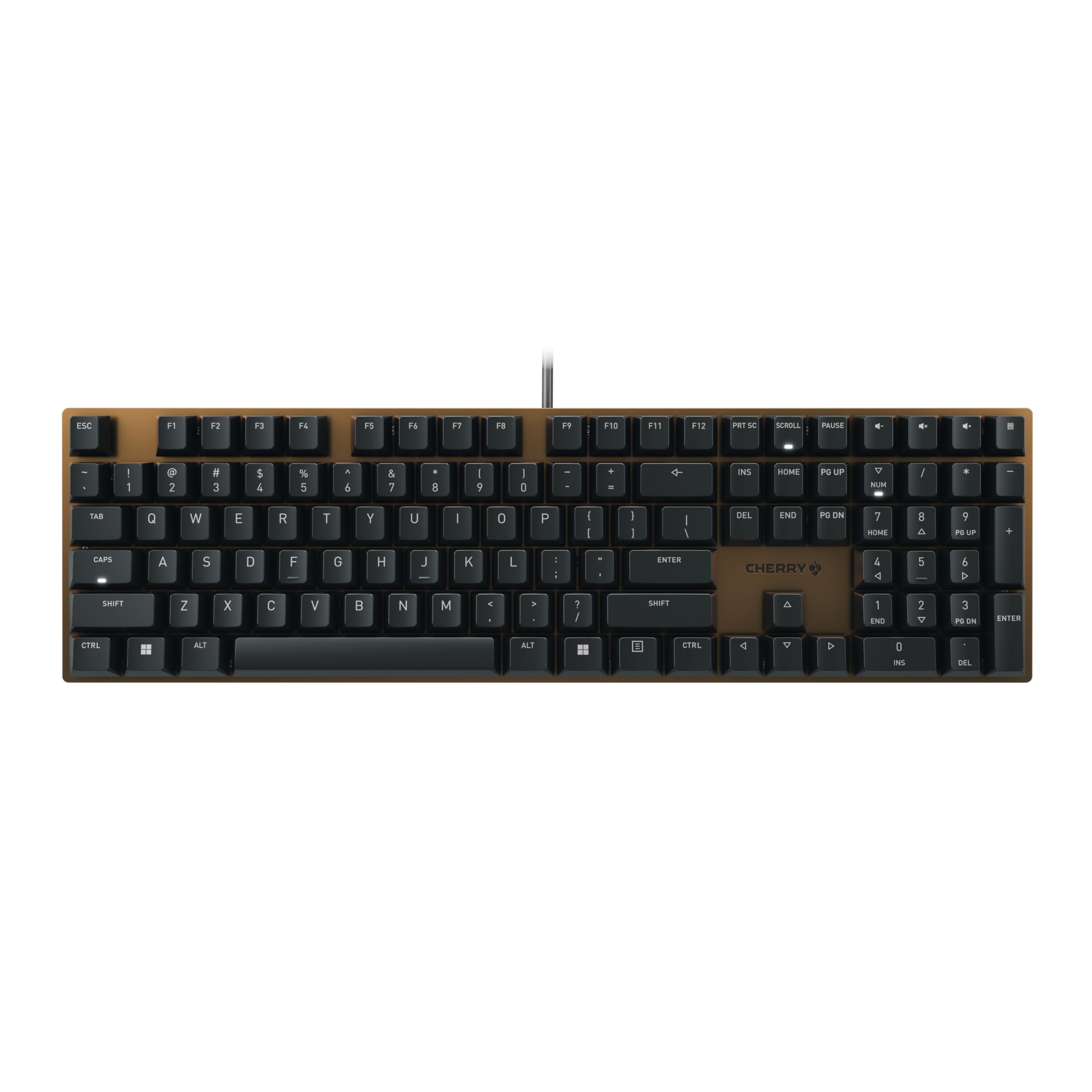
The Cherry KC 200 MX is a no-frills wired mechanical that brings genuine Cherry MX2A switches to a budget-conscious price point. The Silent Red linear variant offers a smooth, quiet keystroke with zero audible click, making it an excellent choice for open-plan offices or shared workspaces where noise is a concern. The anodized aluminum plate gives the board a surprising amount of heft and stability for a budget-tier product, and the full-size layout includes a numpad for numeric-heavy workflows.
Build quality is a mixed bag positively. The laser-etched, abrasion-resistant keycaps hold up well to years of heavy use without fading. Full N-key rollover and anti-ghosting are included, ensuring no missed keystrokes even during rapid typing. Practical features include four dedicated hotkeys (calculator, volume control, and media shortcuts) and white status LEDs for CAPS LOCK, SCROLL LOCK, and NUM LOCK. The compact full-size footprint saves some desk depth compared to traditional boards.
The rubber feet on the bottom are undersized and cause the board to slide on smooth desks—only one of the three front feet makes proper contact. The tilt feet are clunky and lack rubber grips. The USB cable is not detachable and cannot be replaced. The overall plastic case feels less premium than competing boards from more gamer-focused brands. For first-time mechanical buyers or programmers on a strict budget who want genuine Cherry switches, the KC 200 MX delivers core value with minimal compromises.
Why it’s great
- Genuine Cherry MX2A Silent Red switches with smooth linear feel
- Anodized aluminum plate provides surprising stability at this price
- Full N-key rollover and anti-ghosting for error-free typing
Good to know
- Rubber feet are undersized and do not grip the desk well
- Non-detachable USB cable limits cable management options
- Plastic case material feels less premium than aluminum rivals
FAQ
Are linear or tactile switches better for programming?
What is the advantage of a Hall Effect keyboard for coding?
Should I choose a full-size or tenkeyless keyboard for coding?
How important are PBT keycaps for a programming keyboard?
Final Thoughts: The Verdict
For most users, the best computer keyboard for programmers winner is the Corsair K70 PRO TKL because it combines per-key adjustable Hall Effect actuation with a rock-solid aluminum build and failsafe software features—giving you complete control over every keystroke without sacrificing durability. If you need to eliminate wrist pain and don’t mind a learning curve, grab the Kinesis Advantage2. And for a premium wireless experience with multi-device switching, nothing beats the Logitech MX Mechanical.

Mo Maruf
I created WellFizz to bridge the gap between vague wellness advice and actionable solutions. My mission is simple: to decode the research and give you practical tools you can actually use.
Beyond the data, I am a passionate traveler. I believe that stepping away from the screen to explore new environments is essential for mental clarity and physical vitality.