Our readers keep the lights on and my smoothie glass nicely filled. As an Amazon Associate, I earn from qualifying purchases.
The gap between a smartphone and a dedicated camera has never been narrower, but for video creators who need a gimbal-stabilized 4K/120fps rig that fits in a jacket pocket, a phone simply can’t deliver the heat management, lens control, or mechanical stabilization of a purpose-built compact video camera. Whether you’re chasing run-and-gun vlogs, family travel diaries, or pro B-roll, the decision comes down to sensor size, stabilization type, and battery workflow.
I’m Mohammad Maruf — the founder and writer behind WellFizz. I’ve spent hundreds of hours cross-referencing 1-inch CMOS performance, 3-axis gimbal reliability, codec support, and real-world battery drain across this category to separate the truly pocketable workhorses from the spec-sheet illusions.
This guide covers nine models spanning entry-level convenience to premium sensor performance, so you can confidently choose the best compact video camera for your specific shooting style and budget.
How To Choose The Best Compact Video Camera
Buying a compact video camera means balancing portability against sensor performance and stabilization hardware. The wrong choice leaves you with shaky low-light footage and a battery that dies mid-shoot. Here are the three critical specs that define this category.
The Sensor Size Trade-Off: 1-Inch vs Smaller
Pocketable cameras typically house either a 1/2.3-inch, 1/1.3-inch, or full 1-inch CMOS sensor. A 1-inch sensor (roughly four times the surface area of a 1/2.3-inch chip) captures significantly more light, delivering cleaner shadows, less noise at higher ISOs, and a more natural background blur. If you plan to shoot indoors, at golden hour, or in any mixed-lighting environment, prioritize a 1-inch sensor — the difference is immediately visible in the final footage.
Stabilization: Mechanical Gimbal vs Digital vs OIS
Digital stabilization crops the frame and can introduce a gelatinous wobble during fast pans. Optical Image Stabilization (OIS) built into a lens reduces minor hand shake but struggles with walking motion. The gold standard for run-and-gun filming is a built-in 3-axis mechanical gimbal, which physically counter-rotates the sensor to keep the horizon level even while running or climbing stairs. It also leaves the full field of view uncropped, preserving your shot composition.
Audio Input Matters More Than You Think
Onboard microphones in pocket cameras are tiny and prone to wind rumble and handling noise. A 3.5mm external mic jack or wireless microphone support (such as DJI’s OsmoAudio protocol) transforms the usable audio quality of your vlogs and interviews. Cameras without mic input force you to record audio separately and sync in post — a workflow that quickly becomes tedious.
Quick Comparison
On smaller screens, swipe sideways to see the full table.
| Model | Category | Best For | Key Spec | Amazon |
|---|---|---|---|---|
| DJI Osmo Pocket 3 | Gimbal Camera | Professional vlogging & B-roll | 1-inch CMOS, 3-axis gimbal, 4K/120fps | Amazon |
| Sony ZV-1F | Vlog Camera | Solo vloggers who need wide selfie angles | 1-inch sensor, 20mm ultra-wide, eye AF | Amazon |
| Canon PowerShot V10 | Ultra-Compact | Pocket-first lifestyle vlogging | 1-inch CMOS, built-in stand, 19mm lens | Amazon |
| Sony RX100 VII | Pro Compact | High-end travel & hybrid stills/video | 24-200mm zoom, 357-point phase-detect AF | Amazon |
| Canon EOS R100 | Mirrorless Entry | Interchangeable-lens beginners | 24.1MP APS-C sensor, 4K/24p | Amazon |
| Panasonic LUMIX ZS99 | Long Zoom | Concert & wildlife shooting | 30x optical zoom, 24-720mm Leica lens | Amazon |
| DJI Osmo Nano | Action/POV | Hands-free magnetic POV shots | 1/1.3-inch sensor, 143° FOV, 4K/60fps | Amazon |
| Xtra Muse | Budget Gimbal | Beginner vloggers on a budget | 1-inch CMOS, 3-axis gimbal, 4K/120fps | Amazon |
| OM SYSTEM TG-7 | Rugged Adventure | Underwater & extreme-environment shooting | Waterproof to 15m, shockproof, macro modes | Amazon |
In‑Depth Reviews
1. DJI Osmo Pocket 3

The Osmo Pocket 3 remains the benchmark for pocketable video. Its 1-inch CMOS sensor captures 4K footage at up to 120fps with genuine 10-bit color depth and D-Log M flat profile, giving editors significant grading latitude in post. The 3-axis mechanical gimbal delivers rock-steady shots without any crop, even during fast walking or light running — a critical advantage over any purely digital stabilization system.
The Creator Combo adds a DJI Mic 2 transmitter, battery handle, wide-angle lens, and mini tripod, effectively turning the Pocket 3 into a one-bag video studio. ActiveTrack 6.0 reliably locks onto a subject and keeps them center-frame while you move, making it the best option for solo vloggers and one-person interview crews. The 2-inch rotating touchscreen flips between horizontal and vertical shooting without menu diving.
Battery life sits around 166 minutes per charge, and the included battery handle extends that considerably. The only real compromise is the fixed wide-angle lens — there’s no optical zoom, so you must physically move closer or use the included wide-angle adapter. For pure video-first creators who want out-of-box cinematic smoothness, this is the consistent recommendation.
Why it’s great
- True mechanical 3-axis gimbal with zero crop on stabilization
- 10-bit D-Log M color for professional grading
- Creator Combo includes wireless mic and battery handle
Good to know
- No optical zoom — requires physical proximity to subjects
- Wide-angle adapter can introduce slight corner softness
2. Sony ZV-1F

The ZV-1F is purpose-built for solo vloggers who need a wide angle that fits two people or a scenic backdrop at arm’s length. The fixed 20mm equivalent f/2.0 lens (f/2.8 at wide, f/3.5 at tele digital zoom) combined with the 1-inch sensor creates pleasing background defocus and excellent low-light performance. The side-articulating 3-inch touchscreen makes framing selfie shots natural.
Sony’s Eye AF and Real-Time Tracking are class-leading, keeping human subjects razor-sharp even when they move unpredictably. The directional 3-capsule mic with included windscreen captures clean audio outdoors, although serious creators will want to use the 3.5mm mic jack for a lavalier. The Product Showcase mode automatically pulls focus to an object held near the lens — a genuinely useful feature for unboxings and tutorials.
The main limitation is battery life, which reviewers consistently peg around 45 minutes of continuous recording. Buying at least one spare NP-BX1 battery is mandatory for any day-long shoot. There is also no built-in ND filter, so in bright sunlight you’ll need a third-party adapter. For creators who prioritize autofocus and wide-angle selfie framing over zoom range, this is a strong mid-range contender.
Why it’s great
- Reliable Eye AF and Real-Time Tracking for sharp vlogs
- 20mm ultra-wide lens captures wide backgrounds at arm’s length
- Built-in directional mic with windscreen reduces wind noise
Good to know
- Battery lasts roughly 45 minutes continuous recording
- No optical zoom beyond fixed 20mm wide angle
3. Canon PowerShot V10

The PowerShot V10 is arguably the most pocketable 1-inch sensor camera in this list — roughly the size of a stack of business cards, it slides into a small crossbody bag or even a large pocket. Its unique built-in stand folds forward or backward, letting you prop it on a table for hands-free filming without any extra rig. The fixed 19mm wide-angle lens (35mm equivalent) is purposefully wide for vlogging, and the retractable front-facing LCD makes solo framing intuitive.
Video quality from the 15.2-megapixel back-illuminated CMOS sensor is solid at 4K/30p and Full HD at 60p, with decent color science straight out of camera. Three image stabilization modes (IS Off, IS On, IS Enhanced) give you flexibility based on your movement. The stereo mic array with a center channel for noise cancellation picks up clear dialog in quiet environments, though wind protection is minimal without an external mic.
The biggest compromise is the lack of any zoom. You are locked to the fixed 19mm focal length, and digital zoom during 4K recording introduces visible artifacts. The USB-C port supports charging while recording, which partially offsets the moderate battery life. For ultra-portability and tabletop vlogging, the V10 is a clever niche pick that trades features for sheer compactness.
Why it’s great
- Smallest body — fits in a pants pocket or small bag
- Built-in foldable stand for hands-free tabletop recording
- Solid 1-inch sensor with good color science
Good to know
- No zoom of any kind — fixed 19mm lens only
- Battery life requires USB-C bank for extended shoots
4. Sony RX100 VII
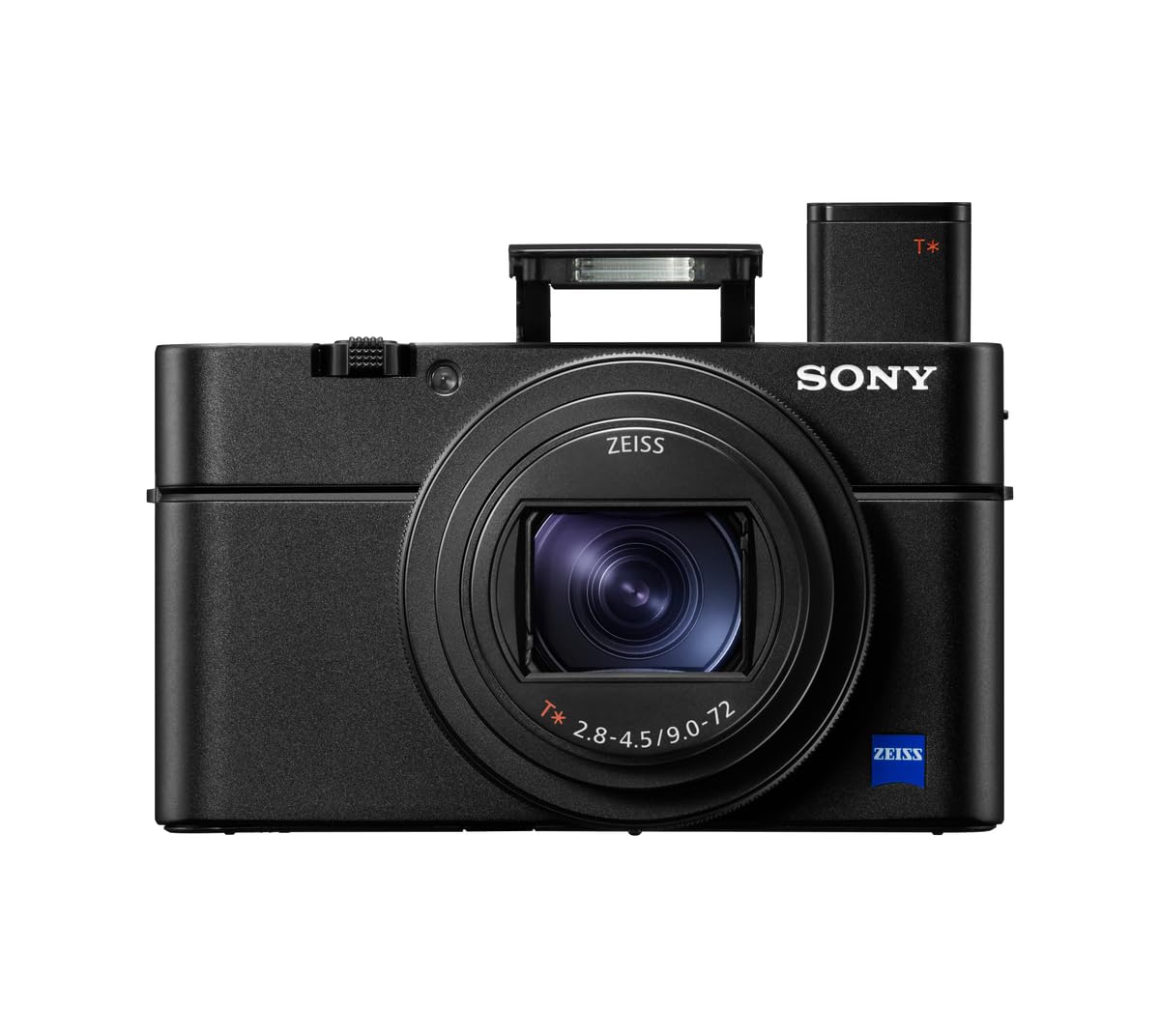
The RX100 VII is the compact that can do it all: a 24-200mm equivalent f/2.8-4.5 Zeiss Vario-Sonnar zoom lens stowed inside a body barely larger than a deck of cards. The 20.1MP stacked 1-inch CMOS sensor delivers phase-detection autofocus with 357 points covering approximately 68% of the sensor, achieving focus in 0.02 seconds. The buffer-less 20fps blackout-free burst shooting with continuous AF is unmatched in this size class.
For video, the RX100 VII offers oversampled 4K/30p from the full sensor width, S-Log3 for color grading, a built-in microphone jack, and Active Mode stabilization that smooths walking shots better than previous generations. The pop-up electronic viewfinder (EVF) is a rarity among compact cameras, giving you an eye-level option that helps in bright outdoor light. The 315-point contrast-detection system works in tandem with the PDAF for reliable tracking across the frame.
The price is the highest in this comparison, and the smaller 1-inch sensor cannot match the low-light performance of an APS-C or full-frame body. The menu system is dense, and the touchscreen is less responsive than modern competitors. For hybrid shooters who need a single compact travel companion for both stills and video up to 200mm, the RX100 VII remains the undisputed premium standard.
Why it’s great
- 24-200mm optical zoom in a truly pocketable body
- Industry-leading 0.02s phase-detect autofocus with eye AF
- 4K with S-Log3 and microphone jack for pro capture
Good to know
- Premium price point reflects the zoom/portability combination
- No mechanical gimbal — relies on digital + OIS hybrid stabilization
5. Canon EOS R100

The EOS R100 brings the larger APS-C sensor size (24.1MP) to an entry-level price point, giving you a much larger light-gathering surface than any 1-inch or smaller chip in this list. Paired with the RF-S18-45mm kit lens, it provides a versatile zoom range equivalent to 29-72mm in full-frame terms. The DIGIC 8 processor handles 4K/24p video, which is capped at a 1.56x crop but still delivers pleasing sharpness and Canon’s natural skin tones.
The Dual Pixel CMOS AF system gives you 143 zones with human face and eye detection, working reliably for both stills and video. The compact body is the smallest in the EOS R series, weighing only 356g with the kit lens, making it easy to carry for a day of hybrid shooting. The 6.5fps continuous shooting with One-Shot AF is adequate for family action shots and slow-moving subjects.
The 4K/24p crop is noticeable, and the lack of in-body image stabilization (IBIS) means you’ll rely on the lens-based IS for handheld footage. The fixed LCD screen cannot flip forward for selfies, which limits its vlogging usability. For aspiring filmmakers who want the depth-of-field control and lens ecosystem of a mirrorless system, the R100 is a capable entry point, but you will need to invest in additional lenses and a stabilizer.
Why it’s great
- APS-C sensor provides superior dynamic range and shallow depth of field
- Interchangeable RF lens system for future growth
- Dual Pixel CMOS AF with face/eye detection
Good to know
- 4K/24p uses a 1.56x crop factor
- No flip-forward screen for selfie vlogging
6. Panasonic LUMIX ZS99

The ZS99 (known as the TZ99 outside the US) packs a Leica 24-720mm equivalent f/3.3-6.4 lens into a true pocket form factor. This 30x optical zoom range is the defining spec — capturing subjects from sweeping landscapes to distant stage performers without changing lenses. The 20.3-megapixel 1/2.3-inch sensor is smaller than the 1-inch chips above, meaning low-light noise is higher, but the zoom reach opens up shooting scenarios no other compact here can touch.
Video recording tops out at 4K/30p with a high-bitrate mode that preserves detail in good light. The 1,840k-dot tiltable touchscreen helps with low-angle and overhead shots, and USB Type-C charging means you can top up from a power bank. Bluetooth v5.0 with a dedicated Send Image button makes wireless file transfer to a phone nearly instant — a practical feature for social-media deployment.
The autofocus uses a 19-point contrast-detection system, which is noticeably slower and less reliable in video than phase-detect systems on Sony or DJI cameras. Low-light handheld 4K at the telephoto end is nearly unusable without a tripod. The ZS99 is a specialist tool: if you need to film from the back of a concert venue or track wildlife at a distance, the zoom reach is unmatched; if you shoot indoors or in motion, look elsewhere.
Why it’s great
- Immense 24-720mm optical zoom fits in a pocket
- High-resolution tiltable touchscreen for creative angles
- Fast Bluetooth transfer and USB-C charging
Good to know
- Small 1/2.3-inch sensor limits low-light performance
- Contrast-detect autofocus is slower than phase-detect systems
7. DJI Osmo Nano
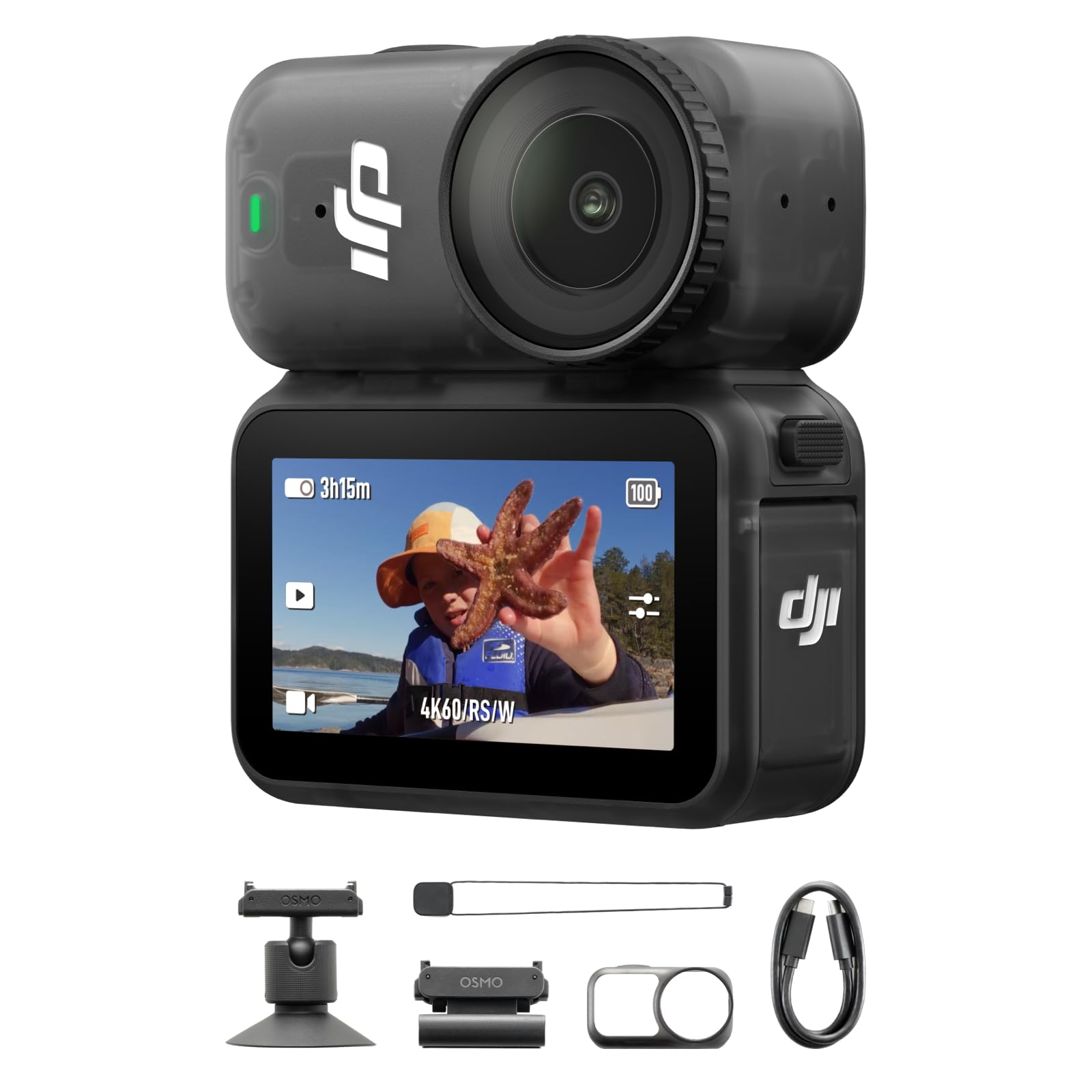
The Osmo Nano is DJI’s magnetic action camera that bridges the gap between a pocket vlog camera and a POV body cam. The 1/1.3-inch sensor records 4K/60fps with a 143° ultra-wide field of view, and the magnetic mounting system lets you attach the camera to a hat clip, lanyard, or metal surface in seconds — no screw mounts or cage required. The 128GB built-in storage means you start recording immediately out of the box without buying a memory card.
Color performance is surprisingly rich for the sensor size, with 10-bit and D-Log M color science inherited from DJI’s larger cameras. The camera is waterproof to 10 meters without a housing, making it suitable for snorkeling and rain shoots. The magnetic Vision Dock provides connectivity and extends battery life to roughly 200 minutes when attached, though reviewers note the dock drains itself even when idle.
The lack of a screen means you’ll rely on your smartphone or the DJI Mimo app for framing, which adds an extra step. The 4x digital zoom is usable only in good light. For POV-first creators, runners, or someone who wants a body cam for first-person vlogging, the Osmo Nano is a clever and portable solution, but it’s not a replacement for a screen-equipped gimbal camera.
Why it’s great
- Magnetic mounting system for instant POV setup
- 128GB built-in storage and 10m waterproof rating
- 10-bit D-Log M color straight from a tiny sensor
Good to know
- No on-camera display — requires app for framing
- Vision Dock drains battery even when powered off
8. Xtra Muse

The Xtra Muse directly targets the DJI Pocket 3 formula — a 1-inch CMOS sensor, 4K/120fps recording, and a built-in 3-axis gimbal — at a significantly lower entry point. The result is genuinely impressive for the money: footage is sharp in good light, the gimbal eliminates walking shake effectively, and face/object tracking keeps moving subjects in frame reliably. The 2-inch touchscreen rotates for horizontal or vertical shooting, and the included carrying bag, handle, and wrist strap add immediate utility.
Battery life averages 161 minutes per charge, which is competitive with higher-priced competitors. The 10-bit X-Log color mode gives you room to grade sunset and high-contrast scenes, though noise in shadows is more apparent than on DJI’s Pocket 3. Users report that DJI Pocket 3 accessories (like third-party cages and filters) work with the Xtra Muse, which is a huge bonus for upgraders.
Build quality is slightly lighter than the DJI, and the plastic construction doesn’t inspire the same confidence as a metal chassis. The autofocus, while fast, occasionally hunts in low-contrast scenes. For budget-conscious creators who want the gimbal-stabilized look without spending premium money, the Xtra Muse is a compelling value proposition that punches well above its class.
Why it’s great
- True 3-axis gimbal with 1-inch sensor at an accessible price
- Compatible with many DJI Pocket 3 accessories
- Long 161-minute battery life for all-day clips
Good to know
- Plastic build feels less robust than premium gimbal cameras
- Autofocus can hunt in low-contrast lighting conditions
9. OM SYSTEM Olympus Tough TG-7

The TG-7 is the only camera in this guide built from the ground up for abuse. It is waterproof to 15 meters (50 feet), shockproof from a 2.1-meter drop, crushproof to 100 kgf, and freezeproof down to -10°C. The 12-megapixel back-illuminated CMOS sensor is paired with an f/2.0 4x optical zoom lens (25-100mm equivalent) and TruePic VIII processor for 4K/30p video and 120fps high-speed movie recording.
What sets the TG-7 apart is its Variable Macro System — four dedicated macro modes, including a microscope mode that captures subjects from 1 cm away. Five underwater scene modes (including Underwater Microscope and Underwater HDR) give snorkelers and divers professional-quality results without an external housing. The 1,040k-dot LCD is bright enough for sunny conditions, and the GPS/compass/temperature sensor suite logs location data automatically.
The 1/2.33-inch sensor is the smallest in this list, which means noticeable noise starts creeping in above ISO 800. The contrast-detect autofocus is adequate for daylight landscapes and macro work but struggles with fast action or dim interiors. For outdoor adventurers, divers, and anyone who needs a camera that survives drops and dunks, the TG-7 is the only real choice in this category.
Why it’s great
- Waterproof to 15m without any housing
- Shockproof, crushproof, and freezeproof for extreme conditions
- Superb macro and underwater scene modes
Good to know
- Small sensor produces noticeable noise above ISO 800
- Contrast-detect AF is slower than modern phase-detect systems
FAQ
Is a 4K/120fps compact camera worth it if I only post to social media?
Can I use an external microphone with a compact video camera?
How does optical zoom affect video quality in pocket cameras?
Final Thoughts: The Verdict
For most users, the best compact video camera winner is the DJI Osmo Pocket 3 because it combines a 1-inch sensor, true mechanical 3-axis gimbal, 4K/120fps recording, and a professional 10-bit color profile in a genuinely pocketable body — no other current model balances these crucial specs without compromise. If you need a wider selfie angle for solo vlogging with Sony’s best autofocus, grab the Sony ZV-1F. And for extreme environments or underwater shooting, the OM SYSTEM TG-7 is the only option built to survive the elements.

Mo Maruf
I created WellFizz to bridge the gap between vague wellness advice and actionable solutions. My mission is simple: to decode the research and give you practical tools you can actually use.
Beyond the data, I am a passionate traveler. I believe that stepping away from the screen to explore new environments is essential for mental clarity and physical vitality.