Our readers keep the lights on and my smoothie glass nicely filled. As an Amazon Associate, I earn from qualifying purchases.
Dark patches, sun spots, and post-acne marks that refuse to fade are the exact reason the at-home chemical peel category exists — and the right acid concentration can rewrite your skin’s surface in weeks. The challenge is separating a gentle, building formula from one that damages skin barrier in a single sitting.
I’m Mohammad Maruf — the founder and writer behind WellFizz. I’ve spent hundreds of hours cross-referencing dermatology journals with real user data to isolate which acid blends actually treat hyperpigmentation without causing rebound irritation.
This guide breaks down seven top-tier treatments to help you choose the best chemical peel for hyperpigmentation at-home based on your skin type, tolerance, and desired intensity level.
How To Choose The Best Chemical Peel For Hyperpigmentation At-Home
Pigmentation treatments demand a precise balance: enough acid strength to break down melanin clusters deep in the epidermis, yet a pH high enough that you don’t chemically burn living skin cells. At-home peels occupy a narrower window than professional-grade solutions, so matching the acid type to your pigmentation pattern is non-negotiable.
Identify Your Pigmentation Type First
Post-inflammatory hyperpigmentation from acne responds best to salicylic acid blends that reach into pores. Melasma, with its larger subsurface patches, usually needs glycolic or lactic acid at higher concentrations. Sun spots and age spots often fade fastest with mandelic acid because its larger molecular structure stays more superficial, reducing irritation on thinner facial skin.
Check the pH, Not Just the Percentage
A 25% glycolic acid peel at pH 3.1 is far gentler than a 10% glycolic lotion at pH 2.0. The lower the pH, the more free acid is available to penetrate. Any peel with a pH under 3.0 requires precise timing and thorough neutralization. Look for formulations that buffer strong acids with soothing ingredients like aloe or allantoin to keep inflammation low.
Frequency and Downtime Expectations
Stronger peels used once every two to four weeks produce visible pigment fading but require 24 to 48 hours of peeling downtime. Lighter lactic or mandelic acid peels can be used twice a week with zero visible peeling, working gradually. Your schedule and social tolerance for flaking should determine which tier you start with.
Quick Comparison
On smaller screens, swipe sideways to see the full table.
| Model | Category | Best For | Key Spec | Amazon |
|---|---|---|---|---|
| Paula’s Choice 25% AHA + 2% BHA | Maximum Strength | Weekly resurfacing with fast pigment fading | 25% AHA blend + 2% BHA | Amazon |
| iS CLINICAL Active Peel System | Two-Step System | Aesthetician-grade glow with minimal peeling | Two-step pad system | Amazon |
| EXUVIANCE Performance Peel AP25 | Gentle Anti-Aging | Fine lines and mild sun spots | Mandelic + Polyhydroxy Acids | Amazon |
| Juice Beauty Green Apple Peel | Organic AHA | Eco-conscious users wanting light exfoliation | Glycolic + Lactic + Malic Acids | Amazon |
| Paula’s Choice 6% Mandelic + 2% Lactic | Daily Gentle | Sensitive skin and daily maintenance | 6% Mandelic + 2% Lactic | Amazon |
| Isispharma Glyco-A Intense Peeling | High Potency Cream | Deep pigment correction at moderate strength | 25% Glycolic Acid, pH 3.1 | Amazon |
| Pineapple Pumpkin Enzyme Skin Peel | Enzyme + Acid | Texture and pigmentation with natural ingredients | Pineapple + Papaya Enzymes + AHAs | Amazon |
In‑Depth Reviews
1. Paula’s Choice 25% AHA + 2% BHA Face Exfoliant Peel
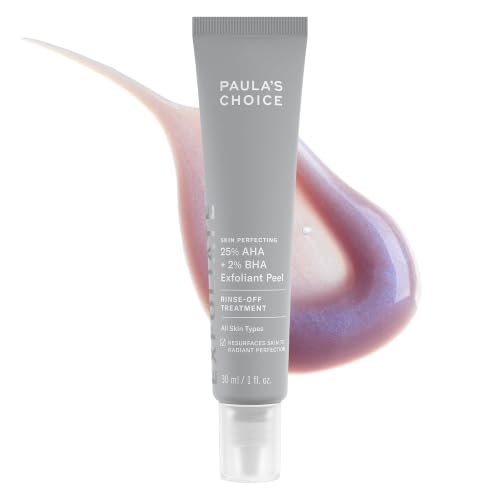
This is the gold standard for anyone wanting office-quality resurfacing at home. The five-acid AHA blend (glycolic, lactic, mandelic, tartaric, malic) targets multiple layers of pigmentation simultaneously, while the 2% salicylic acid dives into pores to clear the inflammation that triggers post-acne marks. User self-assessment studies show 91% saw brighter complexions after a single session.
At a pH suitable for a 10-minute rinse-off mask, this peel delivers visible pigment fading and texture refinement with proper spacing — most users apply it every one to two weeks. The liquid-gel consistency spreads thinly, so a 1-ounce bottle lasts several months even with regular use. Mild tingling is normal; those with sensitized barriers should patch test first.
Clinical data backs its speed: softer, smoother skin after one use and accumulated improvement in dark spots after four to six sessions. The only sacrifice is olfactory — the acid blend has a functional, no-fragrance odor that dissipates once neutralized.
Why it’s great
- Clinically validated rapid results in brightness and tone
- Combination AHA/BHA addresses both surface and pore-level pigmentation
- Fragrance-free and formulated for all skin types
Good to know
- Requires strict sun protection for days after use
- Unpleasant functional smell during application
2. iS CLINICAL Active Peel System
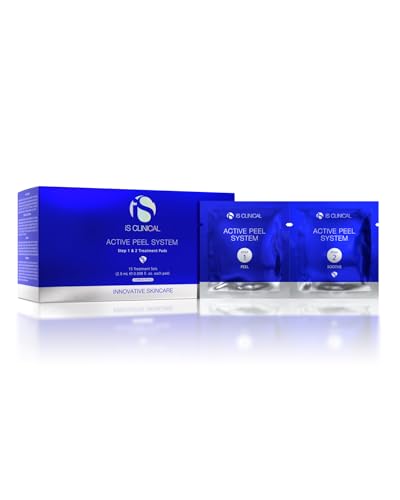
Developed for aesthetician use, this two-step system starts with an activating pad that delivers a controlled tingle, followed by a neutralizing leave-on pad that hydrates and calms. The result is a transformation in skin texture and glow without the visible peeling associated with stronger acids. Users report smoothness and clarity after the first session.
Hyperpigmentation fading typically becomes noticeable between week four and six when used twice weekly. The formula is especially effective for those who cannot tolerate retinoids or high-concentration glycolic peels. The included neutralizer pad allows you to adjust intensity by holding the activator on for longer or shorter intervals, giving you precise control.
The price point sits at the top of this category, but each towelette can be cut in half to extend the supply. The system is favored by licensed aestheticians for maintaining an intact skin barrier while still delivering professional-grade results.
Why it’s great
- Two-step design allows customizable intensity
- Visible sun spot fading without aggressive peeling
- Respected by professionals; Allure award winner
Good to know
- Premium cost per use compared to single-bottle peels
- Package print is difficult to read due to shiny surface
3. EXUVIANCE Performance Peel AP25
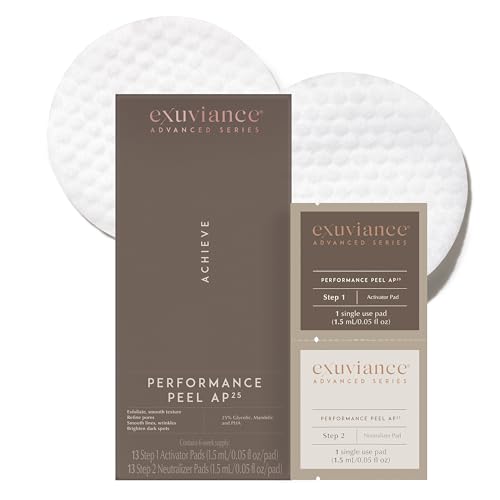
EXUVIANCE uses a mandelic acid base paired with polyhydroxy acids to deliver a gentle peel that still shrinks pores and fades mild sun damage. Mandelic acid’s larger molecular weight means it penetrates slowly, reducing the stinging risk that glycolic acid causes on sensitive or darker skin tones prone to reactive hyperpigmentation.
Users note visible improvements in skin texture and a more even tone after three weeks of twice-weekly application. The included neutralizer pad adds convenience, though the peel sensation itself is very mild — some users describe it as barely detectable. This makes it an excellent starting point for first-time peel users or those with light pigmentation that doesn’t require heavy acid concentrations.
The formula also contains arginine and glycerin to buffer irritation, so downtime is virtually zero. For melasma or stubborn dark patches, the AP25 works best as a maintenance step between stronger treatments.
Why it’s great
- Extremely gentle; no visible peeling or redness
- Mandelic acid is ideal for melanin-rich skin
- Comes with neutralizing pads for controlled application
Good to know
- Too gentle for deep hyperpigmentation or severe sun spots
- Results take longer compared to glycolic-based peels
4. Juice Beauty Green Apple Peel Full Strength
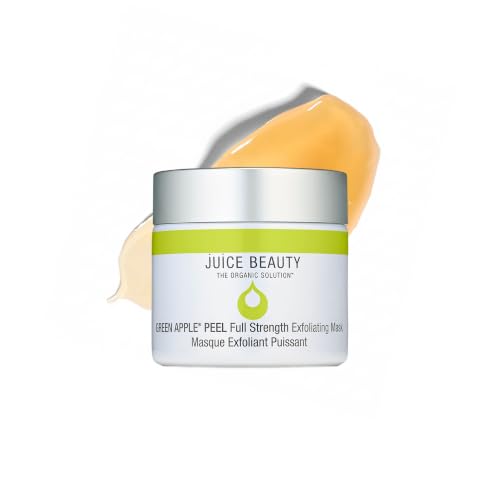
Juice Beauty combines glycolic, lactic, and malic acids (from organic green apples) with vitamin C and alpha-lipoic acid in a peel-off mask format that delivers visible brightening after ten minutes. The mask approach means you can feel exactly where the product is active, reducing the risk of missed spots compared to liquid swipes.
Most users see results in two weeks when used once or twice weekly, though the formula is slightly weaker than previous versions, requiring more applications for deep dark spots. The tingling sensation is expected and subsides quickly. Those with eczema or combination skin have reported good tolerance, experiencing reduced pore size and improved hydration without stripping.
The vegan, cruelty-free formulation skips parabens, sulfates, and synthetic fragrances, making it a strong pick for the clean-beauty shopper. Note that hypersensitive or rosacea-prone skin should avoid this product, as the acid blend can cause prolonged redness.
Why it’s great
- Organic acids with added vitamin C for brightening synergy
- Peel-off mask format ensures full coverage
- Cruelty-free and free from synthetic fragrances
Good to know
- Recent formula is milder than earlier versions
- Not suitable for rosacea or hypersensitive skin
5. Paula’s Choice 6% Mandelic + 2% Lactic Acid Exfoliant
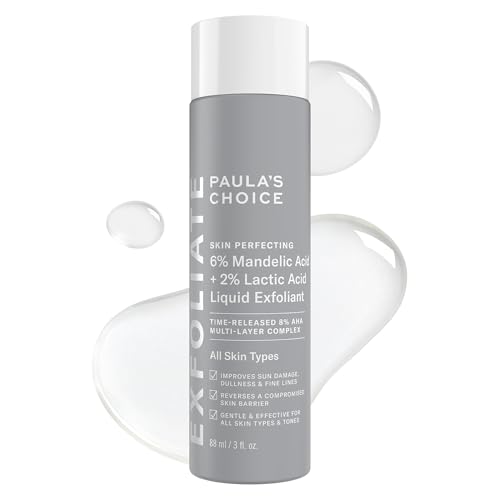
Not all peels need to be rins-off events. This daily liquid exfoliant uses time-released lactic acid at a concentration tested to be as gentle as water while delivering the potency of conventional 10% formulas. The 6% mandelic acid portion provides the pigmentation-fading power, while yarrow extract and fermented antioxidant blend support the skin microbiome.
Users with sensitive skin report immediate improvement in surface texture, pore appearance, and overall radiance with zero irritation. The watery consistency absorbs instantly with no sticky residue, making it suitable for morning or evening use under moisturizer. For mild hyperpigmentation and maintenance between stronger peels, this is the safest daily option in the lineup.
The formula is fragrance-free and tested to be gentle enough for rosacea-prone skin. It won’t produce dramatic peeling, but consistent use over four to six weeks will lift superficial discoloration and create a more even canvas.
Why it’s great
- Daily-use formulation with zero downtime
- Time-released lactic acid prevents irritation spikes
- Leaves no greasy or sticky finish
Good to know
- Too mild for stubborn or deep hyperpigmentation
- Requires consistent daily use for visible results
6. Isispharma Glyco-A Intense Peeling 30ml

This French pharmacy staple delivers a 25% glycolic acid concentration in a cream vehicle designed for overnight application. The pH of 3.1 strikes a balance between efficacy and tolerance — low enough to exfoliate effectively but buffered well above the irritation threshold of many high-concentration peels. The cream format slows absorption slightly, reducing the sharp sting of a liquid peel.
Users report significant improvement in skin roughness and brightness, with the treatment working best as a leave-on night cream applied after cleansing. Because it stays on the skin, the exfoliation continues throughout the night, so users should start with shorter wear times to gauge reaction. The 30ml tube is compact but lasts longer than expected due to the small pea-sized amount needed per session.
Customer feedback is overwhelmingly positive, though most reviews are in Spanish, indicating strong popularity in the Latin American market. The glycolic acid concentration makes this unsuitable for beginners or those with active breakouts — it shines for maintenance users looking for an affordable high-potency cream.
Why it’s great
- High 25% glycolic acid in a buffered, cream vehicle
- Budget-friendly compared to similar concentrations
- Dermatologist-backed French pharmacy brand
Good to know
- Not beginner-friendly; requires careful timing
- Limited English-language reviews and instructions
7. Pineapple Pumpkin Enzyme Skin Peel

This formula takes a botanical approach by using pineapple and papaya fruit enzymes as natural exfoliants, then backing them with glycolic and lactic acids for deeper AHA penetration. The result is a peel that feels gentler than its percentage suggests, making it a popular entry point for first-time home peelers. Users report immediate smoothness and a porcelain-like hue after the first application with minimal redness.
The pineapple enzymes break down dead surface cells while pumpkin extract increases cell turnover rate, targeting fine lines and uneven tone simultaneously. For hyperpigmentation caused by folliculitis scars or mild sun damage, users saw dark spots begin to lighten after three weekly sessions. The natural ingredient profile is attractive for those avoiding synthetic-heavy formulations.
It is strong enough that sensitive-skinned users should start with one-minute contact times and build up. Post-peel sun protection is critical — the fresh layer of skin is highly UV-reactive, and skipping SPF can reverse gains within days.
Why it’s great
- Natural enzyme exfoliation reduces irritation risk
- FDA registered and cruelty-free
- Noticeable glow and pore refinement after single use
Good to know
- Strong tingling sensation; must start with short timing
- Requires diligent post-peel sun protection
FAQ
How many weeks until I see hyperpigmentation fading?
Can I use a chemical peel if I have melasma?
Should I stop retinol before using a chemical peel?
Final Thoughts: The Verdict
For most users, the best chemical peel for hyperpigmentation at-home winner is the Paula’s Choice 25% AHA + 2% BHA Face Exfoliant Peel because it combines clinical-strength acid percentages with a safety-tested rinse-off format that delivers visible pigment fading in weeks. If you want a daily gentler option that won’t interrupt your routine, grab the Paula’s Choice 6% Mandelic + 2% Lactic Acid Exfoliant. And for a professional-grade two-step system that minimizes irritation while still transforming texture, nothing beats the iS CLINICAL Active Peel System.

Mo Maruf
I created WellFizz to bridge the gap between vague wellness advice and actionable solutions. My mission is simple: to decode the research and give you practical tools you can actually use.
Beyond the data, I am a passionate traveler. I believe that stepping away from the screen to explore new environments is essential for mental clarity and physical vitality.