Our readers keep the lights on and my smoothie glass nicely filled. As an Amazon Associate, I earn from qualifying purchases.
Most people pack a smartphone as their only camera for travel and everyday life, then miss the shot because the zoom is digital, the sensor can’t handle a dim restaurant, or the battery dies by noon. A dedicated compact camera closes that gap with a real lens, a larger sensor, and physical controls that let you frame and capture without fighting a touchscreen interface.
I’m Mohammad Maruf — the founder and writer behind WellFizz. I’ve spent years analyzing the lens specs, sensor sizes, stabilization systems, and real-world output of point-and-shoot cameras across every major brand, separating genuine performance from marketing fluff.
Whether you need a rugged underwater companion or a stylish everyday shooter with a large sensor, this guide distills the field to find the right best compact camera for your specific use and budget.
How To Choose The Best Compact Camera
A compact camera can be a careful investment, and the wrong choice often leaves you reaching for your phone anyway. The buying decision comes down to three core areas: sensor and lens quality, zoom reach, and the physical features that match your real-world shooting style.
Sensor Size and Lens Brightness
The sensor is the heart of the camera. A larger 1-inch or APS-C sensor collects more light, producing cleaner images with pleasing background blur compared to the tiny sensors in budget compacts and most phones. Pair that with a bright lens (f/1.8 or f/2.8), and you get usable photos in low light without a flash. Compact cameras with smaller 1/2.3-inch sensors can still produce good results in bright daylight, but expect more noise and grain as the sun goes down.
Optical Zoom Range
Zoom is where a compact camera leaves every smartphone behind. A 3x to 5x optical zoom covers typical street and travel needs, while 25x to 83x zoom ranges let you capture wildlife, moon shots, and distant subjects your phone could never resolve. Beware of “digital zoom” — it’s just cropping inside the camera. The number that matters is the optical zoom multiplier and the equivalent focal length in 35mm terms.
Stabilization, Autofocus, and Build
Image stabilization (either in-body or lens-based) is critical for sharp photos at long zoom lengths and for smooth handheld video. Autofocus technology ranges from basic contrast detection (slower, fine for still subjects) to phase-detect and hybrid systems that lock onto moving faces, animals, or vehicles. Finally, consider the physical envelope: weather sealing, a tilting or flip screen, and a built-in flash or hot shoe can determine whether a camera is a joy to carry or a frustration to use.
Quick Comparison
On smaller screens, swipe sideways to see the full table.
| Model | Category | Best For | Key Spec | Amazon |
|---|---|---|---|---|
| Fujifilm X100VI | Premium | Walkaround street photography | 40MP APS-C sensor, fixed 23mm f/2.0 lens | Amazon |
| Ricoh GR IIIx | Premium | Everyday pocket carry | 24MP APS-C sensor, fixed 40mm equivalent f/2.8 | Amazon |
| Sony RX100 II | Mid-range | Low-light versatility | 20MP 1-inch Exmor R sensor, f/1.8-4.9 lens | Amazon |
| Nikon COOLPIX P950 | Mid-range | Extreme telephoto / wildlife | 16MP sensor, 83x optical zoom (24-2000mm) | Amazon |
| Panasonic LUMIX ZS99 | Mid-range | Travel / concerts | 20MP sensor, 30x Leica zoom (24-720mm) | Amazon |
| OM System TG-7 | Mid-range | Underwater / adventure | 12MP sensor, 4x optical zoom, waterproof to 50ft | Amazon |
| Canon PowerShot V10 | Mid-range | Vlogging / self-recording | 15MP 1-inch sensor, fixed 19mm wide-angle lens | Amazon |
| Canon ELPH 360 HS | Budget | Simple point-and-shoot | 20MP CMOS sensor, 12x optical zoom | Amazon |
| Kodak PIXPRO AZ255 | Budget | Budget zoom / beginners | 16MP sensor, 25x optical zoom, 24mm wide-angle | Amazon |
In-Depth Reviews
1. Fujifilm X100VI (Silver)

The Fujifilm X100VI packs a 40MP APS-C X-Trans CMOS 5 HR sensor into a body that fits in a jacket pocket, delivering image quality that rivals much larger interchangeable-lens cameras. The fixed 23mm f/2.0 lens provides a classic 35mm equivalent field of view that feels natural for street, travel, and documentary work, while the built-in 6-stop in-body image stabilization (IBIS) keeps handheld shots sharp even in fading light.
Its hybrid viewfinder lets you switch between optical and electronic preview, and the 425-point hybrid autofocus system with intelligent subject recognition locks onto faces, animals, and moving vehicles with speed and precision. The camera also records 6.2K 30p 10-bit 4:2:2 video, making it a capable hybrid shooter for both stills and film.
Battery life is average for a compact of this class, so carrying a spare is sensible for day-long shoots. The lack of a zoom lens is a deliberate trade-off that rewards owners with uncompromised optics and a minimalist shooting discipline.
Why it’s great
- Class-leading 40MP APS-C sensor delivers exceptional resolution and dynamic range
- 6-stop IBIS and hybrid AF with subject detection provide steady, accurate focus
- Beautiful design with a hybrid OVF/EVF and acclaimed Fujifilm film simulations
Good to know
- Fixed 23mm lens may feel restrictive if you need zoom versatility
- Battery life is modest; a spare battery is recommended for all-day shooting
2. Ricoh GR IIIx (Black)

The Ricoh GR IIIx is the ultimate everyday carry for photographers who demand APS-C image quality in a body small enough to slide into a jeans pocket. Its 24.2MP sensor and the sharp 26.1mm GR lens (40mm equivalent in 35mm format) produce images with a natural perspective and excellent edge-to-edge sharpness, while the in-body image stabilization adds versatility in lower light.
Startup time is about 0.8 seconds, and the hybrid autofocus system with 101 points makes it responsive for street shooting. The camera’s control layout has been refined over generations, offering quick access to aperture, shutter speed, and exposure compensation without diving into menus.
The fixed 40mm equivalent lens is a deliberate choice that offers a slightly tighter field of view than the standard GR III’s 28mm, making it ideal for portraiture, food, and detail shots. Battery life is the main compromise — owners should budget for two or three spare batteries for a full day of shooting.
Why it’s great
- APS-C sensor in an incredibly pocketable body with outstanding lens sharpness
- Fast startup and responsive controls designed for instinctive street photography
- IBIS extends handheld shooting into dim environments
Good to know
- Battery life is short; carrying multiple spares is a must
- No built-in flash and average video performance; it’s a pure stills camera
3. Sony RX100 II

The Sony RX100 II remains a compelling choice for anyone seeking a pocketable camera with a 1-inch sensor and a bright f/1.8 lens for low-light work. The 20.2MP Exmor R CMOS sensor delivers clean images up to ISO 3200, and the 3.6x optical zoom (28-100mm equivalent) covers a useful range from group shots to portraits.
The tilting 3-inch LCD with 1,229,000 dots helps compose shots from high and low angles, while the Multi-Interface shoe lets you attach an external microphone or viewfinder to expand the camera’s capabilities. Built-in Wi-Fi and NFC make image transfer to a phone quick and painless.
On the downside, the autofocus system uses contrast detection and can hunt in low light, and the internal microphone picks up handling noise. For its age, however, the RX100 II holds up remarkably well and offers an excellent entry point into premium compacts without breaking the bank.
Why it’s great
- 1-inch sensor with fast f/1.8 lens produces excellent low-light images
- Pocketable body with a tilting screen and accessory shoe for expansion
- Wi-Fi and NFC for easy smartphone sharing
Good to know
- Contrast-detect autofocus can be slow in dim conditions
- Built-in microphone quality is average; external mic recommended for video
4. Nikon COOLPIX P950 (Black)

The Nikon COOLPIX P950 rewrites the rules of reach with an 83x optical zoom lens spanning 24mm to 2000mm, letting you photograph the moon’s craters, a distant bird in flight, or a performer on a faraway stage. The 16-megapixel sensor and Dual Detect Optical Vibration Reduction work together to keep the frame steady at full telephoto, and the 399-point contrast-detect autofocus system has a manual focus ring for fine-tuning.
Dedicated Bird and Moon scene modes simplify shooting challenging subjects, and 4K UHD video at 30p captures detailed footage from extreme distances. The rotating 3.2-inch LCD and built-in electronic viewfinder support both waist-level and eye-level shooting, while built-in Wi-Fi and Bluetooth make image sharing straightforward.
Image quality is good in good light but shows noise as ISO rises, and the autofocus can struggle with fast-moving subjects at maximum zoom. The P950 is not a pocket camera — its size is the trade-off for its unparalleled optical reach.
Why it’s great
- 83x optical zoom (24-2000mm) captures subjects impossible for smaller cameras
- Dedicated Bird and Moon modes simplify advanced telephoto shooting
- 4K video, rotating LCD, and built-in EVF for versatile composition
Good to know
- Large body is not pocketable; designed as a dedicated superzoom bridge camera
- Low-light performance and autofocus speed at full zoom have limitations
5. Panasonic LUMIX ZS99 (Silver)

The Panasonic LUMIX ZS99 packs a 30x LEICA DC Vario-Elmar zoom lens covering 24-720mm into a body that easily slips into a pocket, making it one of the most travel-friendly superzoom compacts available. The 20.3-megapixel sensor and hybrid autofocus with 171 points provide reliable focusing in most conditions, while the 1,840k-dot tiltable touchscreen adds flexibility for self-portraits or overhead shots.
4K video recording at 30p and 4K PHOTO burst mode let you extract high-resolution stills from video clips, and the dedicated Send Image button paired with Bluetooth 5.0 transfers photos to your phone quickly. USB Type-C charging is a welcome modern addition that simplifies travel power management.
Image quality is very good in daylight and at moderate zoom lengths, but low-light performance is limited by the f/3.3-6.4 aperture, and the LCD can be difficult to see in bright sunlight. The menu system is deep and takes time to learn, though the camera’s auto mode works well for casual users.
Why it’s great
- 30x Leica optical zoom in a genuinely pocketable body
- Tiltable touchscreen and USB-C charging for modern travel
- 4K video and 4K PHOTO burst for capturing fast moments
Good to know
- Slow aperture limits performance in low light
- LCD can be hard to read in direct sunlight
6. OM System OLYMPUS Tough TG-7 (Red)

The OM System Tough TG-7 is the go-to compact camera for adventurers who shoot in wet, dusty, or freezing environments. It’s waterproof to 15 meters, shockproof from 2.1 meters, crushproof to 100kgf, and freezeproof down to -10°C, meaning it handles conditions that would destroy any other compact. The 12-megapixel back-illuminated CMOS sensor and f/2.0 lens capture bright images underwater and in shaded forests.
What sets the TG-7 apart is its variable macro system with four dedicated modes, allowing magnified shooting up to 1 centimeter from the lens — ideal for documenting insect details, jewelry, or small objects. Five underwater modes, including underwater HDR and underwater microscope, produce excellent results at depths where typical cameras fail.
4K video at 30p and 120 fps high-speed recording add creative flexibility, and raw shooting capability satisfies users who want to edit their underwater or macro images. Low-light performance is typical for a rugged compact, and the 4x optical zoom is modest compared to superzoom options, but for durability and macro capability, the TG-7 is unmatched.
Why it’s great
- Waterproof, shockproof, crushproof, and freezeproof for extreme conditions
- Variable macro system captures details from 1cm away
- Five underwater modes and raw shooting for versatile outdoor work
Good to know
- Low-light performance lags behind larger-sensor compacts
- 4x optical zoom is limited for distant subjects
7. Canon PowerShot V10 (Black)

The Canon PowerShot V10 is purpose-built for vloggers, featuring a 15.2-megapixel 1-inch back-illuminated CMOS sensor that excels in low light and a fixed 19mm wide-angle lens (35mm equivalent) perfect for self-recording. The built-in stand folds to the front or back, providing hands-free tabletop shooting for streaming, interviews, or travel diaries.
Its retractable front-facing flip screen makes framing yourself easy, and the three stereo microphones (with a third center mic for noise cancellation) capture clean audio without an external mic. Three image stabilization modes keep handheld walk-and-talk footage smooth, and 14 movie color filters let you set the mood without post-processing.
The main limitation is the lack of optical zoom — framing changes come from moving the camera or digitally cropping. Battery life is about average for its size, though some users report it drains more quickly in cold weather. For a dedicated vlogging tool that fits in a small handbag, the V10 delivers excellent video and audio quality with minimal setup.
Why it’s great
- 1-inch sensor and 19mm wide-angle lens produce high-quality 4K vlog footage
- Built-in stand and front-facing flip screen streamline self-recording
- Three stereo mics with noise cancellation capture clean audio
Good to know
- No optical zoom limits compositional flexibility
- Battery life may not last a full heavy shooting day
8. Canon PowerShot ELPH 360 HS (Silver)
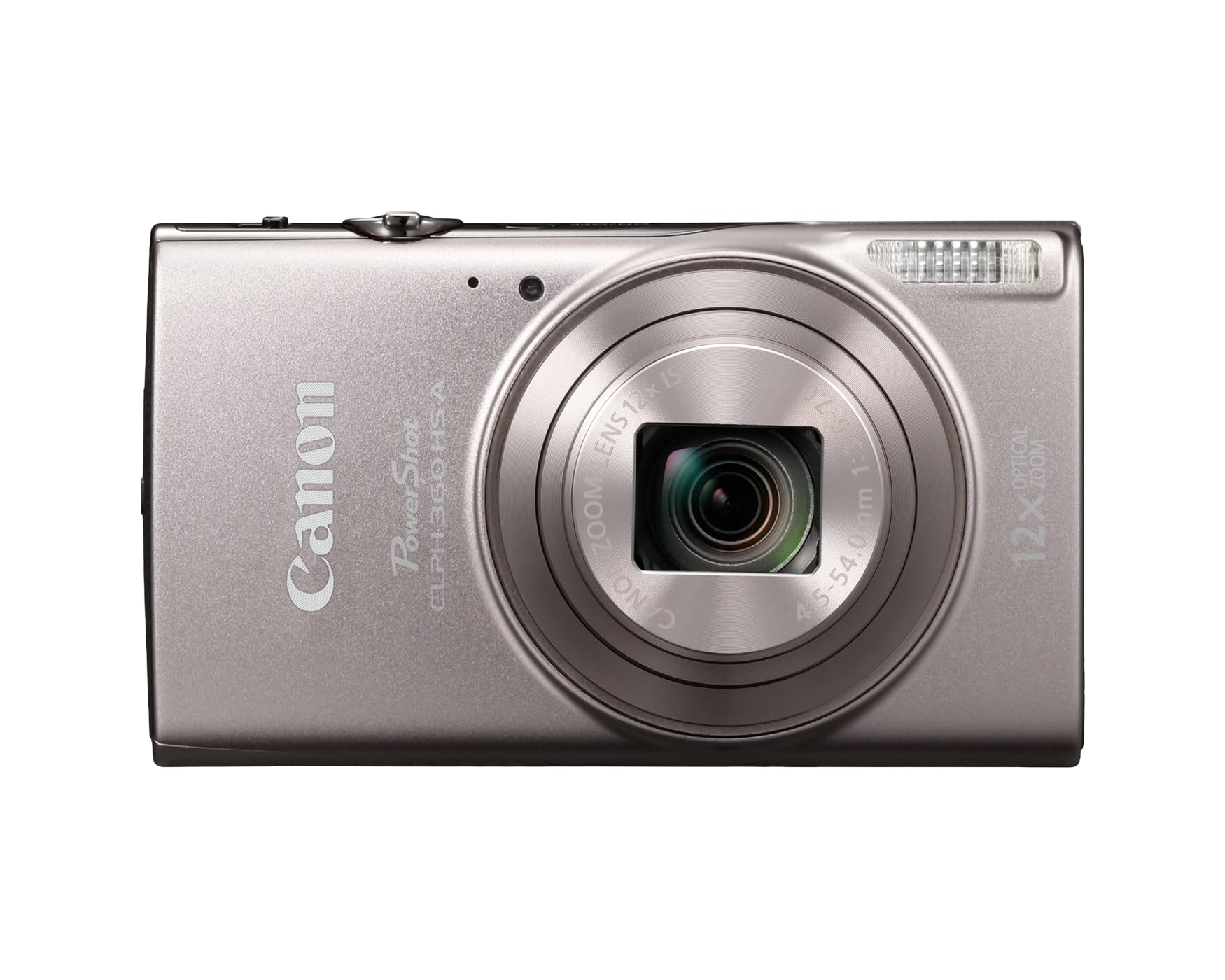
The Canon PowerShot ELPH 360 HS is a straightforward point-and-shoot that prioritizes simplicity and reliable image quality. Its 20.2-megapixel CMOS sensor and DIGIC 4+ image processor produce pleasant photos in good light, and the 12x optical zoom with optical image stabilization gives you reach that no smartphone can match for casual wildlife or concert snapshots.
Built-in Wi-Fi and NFC make transferring images to a smartphone effortless, and the large 3.0-inch LCD provides a clear view for framing. The Hybrid Auto mode captures a short video clip before each still photo and combines them at the end of the day into a highlight reel — a fun feature for documenting events.
The camera has no built-in flash and its battery life is rated at about one hour of continuous use, which is fine for a day of occasional shooting. It’s an excellent entry-level compact for beginners, families, or anyone who wants better zoom than a phone but doesn’t want to learn manual controls.
Why it’s great
- 12x optical zoom with stabilization offers clear telephoto shots
- Wi-Fi and NFC enable fast, wireless image transfer
- Hybrid Auto mode creates fun daily recap videos automatically
Good to know
- No built-in flash limits shooting in very low light
- Battery life is modest; carry a spare for full-day outings
9. Kodak PIXPRO AZ255-BK (Black)

The Kodak PIXPRO AZ255 is a budget-friendly entry point for anyone who wants a long zoom range without spending much. Its 16-megapixel CMOS sensor and 25x optical zoom (24mm wide-angle to 600mm telephoto) deliver surprising clarity for the price, and the optical image stabilization helps keep handheld shots at full zoom usable.
1080p Full HD video recording, a 3-inch LCD, and support for AA batteries make it an accessible camera for beginners, families, or anyone who doesn’t want to deal with proprietary chargers. The included lens cover, strap, and cables mean you can start shooting right out of the box (though you’ll need to supply an SD card).
Image quality in low light is limited by the small sensor, and the camera is bulkier than true pocket compacts. Autofocus is contrast-detect and can be slow in dim conditions. For daytime outdoor shooting, nature hikes, or as a first camera for a child, the PIXPRO AZ255 offers tremendous zoom for a very accessible price point.
Why it’s great
- 25x optical zoom provides DSLR-like reach at a budget-friendly price
- Runs on AA batteries — easy to source and replace anywhere
- Includes lens, strap, and cables for immediate use
Good to know
- Low-light image quality is poor; best used in bright outdoor conditions
- Larger than most pocket compacts; not truly pocketable
FAQ
Are compact cameras still worth buying if I have a flagship smartphone?
What does the “35mm equivalent” focal length mean on a compact camera?
How important is image stabilization in a compact camera?
Can I use a compact camera for professional or semi-professional work?
Final Thoughts: The Verdict
For most users, the best compact camera winner is the Fujifilm X100VI because it offers a massive 40MP APS-C sensor, beautiful fixed-lens optics, and a timeless design that makes you want to carry and shoot every day. If you want extreme zoom reach for wildlife and sports, grab the Nikon COOLPIX P950 with its incredible 83x optical zoom. And for underwater adventures and rugged outdoor use, nothing beats the OM System Tough TG-7 with its waterproof, shockproof build and specialist macro modes.

Mo Maruf
I created WellFizz to bridge the gap between vague wellness advice and actionable solutions. My mission is simple: to decode the research and give you practical tools you can actually use.
Beyond the data, I am a passionate traveler. I believe that stepping away from the screen to explore new environments is essential for mental clarity and physical vitality.