Our readers keep the lights on and my smoothie glass nicely filled. As an Amazon Associate, I earn from qualifying purchases.
For a commercial kitchen, a juice bar, or a busy cafe, the bottleneck is often prep time. Washing, peeling, chopping, and waiting for a slow home juicer to process a single glass simply doesn’t cut it when there is a line of customers. A real workhorse must handle volume without breaking down, delivering consistent yield and minimal waste shift after shift.
I’m Mohammad Maruf — the founder and writer behind WellFizz. I’ve spent hundreds of hours analyzing the specifications, user-reported durability, and real-world yield data across dozens of heavy-duty juicing machines to separate the lasting performers from the countertop casualties.
Whether you are opening a new juice bar or upgrading an existing setup, picking the right equipment is critical. This guide details the market’s most reliable options for the best commercial juice extractor based on build quality, throughput, and cleanability.
How To Choose The Best Commercial Juice Extractor
Forgiving the wrong machine can cost you dozens of pounds of produce before you realize the yield is too low or the motor overheats after an hour. Focusing on the right specs from the start prevents both financial loss and operational downtime.
Motor Type and Continuous Duty Rating
Home juicers usually run on a duty cycle of 10–15 minutes. Commercial extractors must run much longer. A heavy-duty induction motor with a continuous duty rating (like those found in the Waring WJX80 or Nutrifaster N450) will handle back-to-back batches without thermal shutdown. Look for at least 800 watts and a thermal overload protector.
Pulp Ejection System
Batch-style machines with a pulp bin require you to stop and empty the container, which kills productivity during a rush. Machines with continuous pulp ejection—like the Waring WJX80 or the Nutrifaster N450—push waste directly into a separate bucket or bag, allowing non-stop operation. For high-volume bars and cafes, this is a non-negotiable feature.
Feed Chute Dimensions and Prep Reduction
Every second you spend chopping apples or carrots into small pieces adds up to lost revenue. A wide feed chute—ideally 3 inches or larger, like the 3.5-inch chute on the Breville Juice Fountain Cold Plus or the 88mm flip gate on the Kuvings CS600—accepts whole or halved produce, dramatically speeding up your workflow.
Build Materials and Sanitation
Stainless steel (SUS304 or better) is the standard for food-contact surfaces due to its corrosion resistance and ease of sanitization. Polycarbonate or aluminum housings can crack or dent under commercial abuse. The Nutrifaster N450 uses a polished aluminum body, while the Waring units rely on stainless steel and reinforced polycarbonate. Always ensure all contact parts are dishwasher safe or easily removable for scrubbing.
Quick Comparison
On smaller screens, swipe sideways to see the full table.
| Model | Category | Best For | Key Spec | Amazon |
|---|---|---|---|---|
| Nutrifaster N450 | Premium Centrifugal | High-volume juice bars | 1.25 HP Induction Motor | Amazon |
| Kuvings CS600 | Commercial Slow Juicer | Whole fruit, 24/7 operation | 88mm Flip Gate Feed Chute | Amazon |
| Waring WJX80 | Heavy-Duty Centrifugal | Continuous pulp ejection | 1.2 HP / 1000W Motor | Amazon |
| Sunkist J-1 | Citrus Press | High-volume citrus only | 20 Gallons Per Hour | Amazon |
| VEVOR Orange Juicer | Automatic Citrus | Self-feeding orange juicing | 20 Oranges Per Minute | Amazon |
| Kuvings AUTO10 | Self-Feeding Masticating | Hands-free, low pulp | 100 oz Capacity / 240W | Amazon |
| Hurom H400 | Easy Clean Masticating | Low-scrub cleaning routine | Strainer-Free Design | Amazon |
| Hurom H-AA | Slow Masticating | High-yield, cool operation | 150W Quiet Motor | Amazon |
| Breville BJE530BSS | Consumer Centrifugal | Large batch home juicing | 3.5″ Wide Feed Chute | Amazon |
| Waring 6001C | Medium-Duty Centrifugal | Bars and light restaurants | 3600 RPM Induction Motor | Amazon |
| PYY Sugar Cane Juicer | Specialty Cane Press | Sugar cane only, high volume | 3-Roller / 800W Motor | Amazon |
In‑Depth Reviews
1. Nutrifaster N450 Multi Purpose Juicer

The Nutrifaster N450 is built for non-stop production. Its 1.25 HP induction motor spins at 3450 RPM, producing a glass of juice in seconds while immediately ejecting pulp into an external container. Users consistently report extremely dry pulp, indicating maximum yield extraction—critical for keeping produce costs down in a high-volume juice bar.
The all-metal construction—polished aluminum body and stainless steel motor shaft—eliminates the cracking issues seen on polycarbonate housings after repeated assembly and disassembly. Weighing 64 pounds, it stays planted on the counter even when processing hard ingredients like beets or whole apples. Cleaning takes roughly 10–15 minutes, and no plastic parts to worry about cracking under heat or impact.
While the price reflects a serious commercial investment, operators who have used Santos and Zumex units often switch to the N450 for its reliability and quieter operation. The warranty and support are reasonable, though some users report limited responsiveness from the manufacturer. For a juice bar processing over a hundred pounds of produce daily, this machine pays for itself in reduced waste and faster throughput.
Why it’s great
- Industry-standard durability with all-metal housing
- Instant pulp ejection enables non-stop operation
- Produces very dry pulp, maximizing yield
Good to know
- Heavy footprint requires dedicated counter space
- Some users experienced issues with customer service response times
2. Kuvings CS600 Whole Slow Juicer

The Kuvings CS600 is a commercial-grade masticating juicer designed for continuous, round-the-clock use. Its most distinctive feature is the 88mm flip gate, which accepts whole apples, pears, and large carrots without pre-cutting—a huge time saver in a commercial setting. The low-speed (roughly 50 RPM) masticating technology preserves nutrients and produces very dry pulp, meaning more juice from every pound of produce.
A built-in cooling system prevents the motor from overheating during extended operation, a common failure point in lesser masticating units. The stainless steel body and Ultem/Tritan components are BPA-free and designed for easy disassembly. A rotating cleaning brush simplifies strainer maintenance. The Smart Cap feature allows you to mix different juices without cross-contamination between runs.
Users who upgraded from high-speed centrifugal models report a dramatic improvement in juice quality—less separation, richer flavor, and longer shelf life in the refrigerator. Some users had issues with assembly tightness leading to leakage, but those who mastered the fitting routine find it performs flawlessly. This is a specialist’s tool for serious juice bars that prioritize quality over pure speed.
Why it’s great
- Accepts whole fruit, reducing prep labor significantly
- Continuous 24-hour operation with no overheating
- Nutrient preservation and very dry pulp output
Good to know
- Heavier and larger than typical slow juicers
- Assembly learning curve for first-time users
3. Waring Commercial WJX80 Heavy-Duty Pulp Eject Juice Extractor
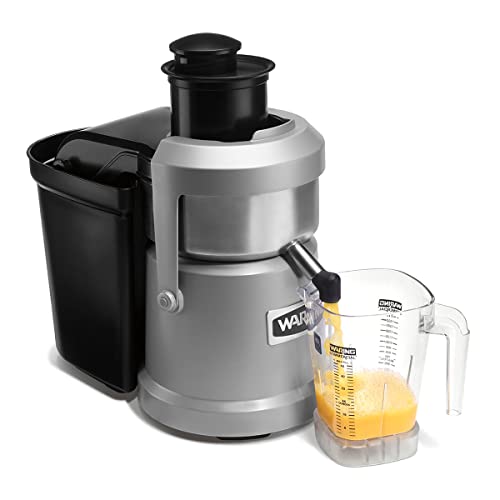
The Waring WJX80 is a heavy-duty centrifugal machine purpose-built for all-day use in smoothie shops, restaurants, and cafeterias. Its 1000-watt motor drives a stainless steel shredder disc and filter basket that produce impressive yields while continuously ejecting pulp into an external container. The design allows for non-stop operation during back-to-back orders.
All parts that contact food are dishwasher-safe, and the included cleaning brush simplifies daily maintenance. The stainless steel housing withstands the abuse of a busy kitchen environment. The switch controls are straightforward, making it easy to train new staff quickly. Users in high-volume settings note that it handles carrots and beets with ease, though some report that the pulp moisture content is higher than on a slow masticating machine.
The WJX80 has attracted some criticism regarding cost versus performance—some users felt the pulp stuck to the shredder and the machine struggled with leafy greens like spinach. The lack of variable speed means it’s optimized for harder produce. For a cafe that focuses primarily on carrot, beet, and apple blends, this unit offers a strong balance of throughput and reliability.
Why it’s great
- Continuous pulp ejection allows high-speed workflow
- Dishwasher-safe components for easy sanitation
- Sturdy stainless steel construction
Good to know
- Single speed limits versatility for soft produce
- Some users experienced leakage from the basket area
4. Sunkist Growers J-1 Commercial Juicer

When your operation revolves around citrus—oranges, grapefruits, lemons, and limes—the Sunkist J-1 is the gold standard. This electric press has been a fixture in bars and restaurants for decades, and the current chrome-plated model continues that legacy. With a throughput of 20 gallons per hour, it can handle even the busiest brunch rush without breaking a sweat.
The J-1 comes with three interchangeable extracting bulbs to accommodate different fruit sizes, ensuring maximum juice extraction from each piece. The corrosion-proof white plastic and chrome-plated steel construction are easy to wipe down, and the entire unit is dishwasher safe. Users consistently report decades of reliable service from these machines, with some running daily in high-volume bars for over ten years with zero mechanical failures.
The main limitation is obvious: this machine does citrus and only citrus. If you need to juice carrots, ginger, or leafy greens, you’ll need a separate machine. But for its intended purpose, the J-1 is nearly faultless. It’s quiet, fast, and the motor shows no signs of fatigue even under continuous use. The price is justified by build quality alone.
Why it’s great
- Proven durability often exceeding a decade of daily use
- High throughput ideal for busy bars and restaurants
- Easy to clean and dishwasher safe
Good to know
- Designed exclusively for citrus fruits
- Relatively heavy at 31 pounds
5. VEVOR Commercial Orange Juicer Machine

The VEVOR orange juicer automates the feeding process with a top storage basket and an automatic feed chute that accepts oranges sized 55-80mm. A 120W motor drives a concave-convex squeezing mechanism to extract juice at a rate of 20 oranges per minute. The transparent PC protective cover includes a pressure sensor that stops the machine if the cover is removed, prioritizing operator safety.
Construction uses food-grade SUS304 stainless steel and high-quality polycarbonate, ensuring hygiene and resistance to citrus acids. The pull-out filter box makes cleaning straightforward, though the machine does require some disassembly for a thorough rinse. The included replacement parts and two peel collecting buckets add convenience for continuous use in grocery stores, fruit shops, or restaurants.
Some users noted that the machine is optimized specifically for medium-to-large oranges—smaller fruits like lemons may not trigger the mechanism properly. The 88-pound weight makes it a permanent fixture rather than a mobile unit. When used within its intended spec range, it delivers consistent, high-volume citrus juice with minimal operator intervention.
Why it’s great
- Self-feeding design reduces labor during rush periods
- Safety sensor stops operation when cover is removed
- Stainless steel and PC construction for durability
Good to know
- Best suited for standard-size oranges only
- Very heavy; not intended for frequent relocation
6. Kuvings AUTO10 Cold Press Juicer Machine
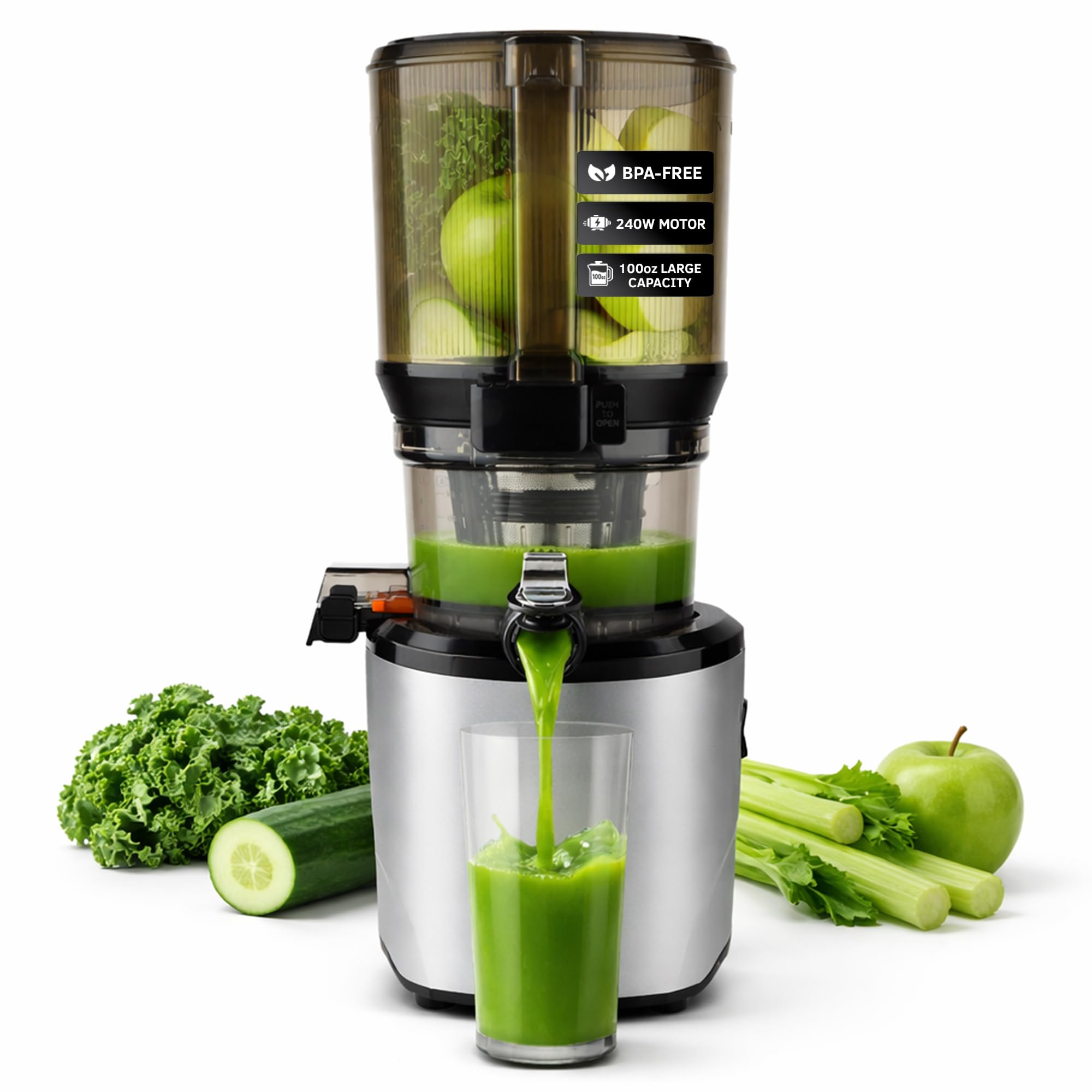
The Kuvings AUTO10 is a self-feeding masticating juicer that accepts whole fruits through its Auto-Cut double-crushing blade system. The 240W motor drives the auger at 50 RPM, a slow press that preserves nutrients and produces a very low-pulp juice with a silky texture. The 3-liter (approximately 100 oz) capacity is among the largest for a cold press model, suitable for entire family batches or multi-day production.
Hands-free operation is the main selling point: load the hopper, and the machine cuts and feeds ingredients automatically. The sound level is notably low for a commercial-grade machine—users often comment that it doesn’t disrupt conversation. The included cleaning tools are designed to make maintenance quick, which is critical for maintaining healthy juicing habits. A 15-year assurance from Kuvings backs the build quality.
Some early buyers reported receiving units that appeared used or had damaged parts, which suggests quality control in shipping needs attention. Once running, however, the performance is strong: dry pulp extraction (particularly with turmeric and ginger) and smooth operation. For a cafe that wants cold-press quality without the constant labor of manual feeding, the AUTO10 is a strong mid-range option.
Why it’s great
- Self-feeding reduces operator labor during juicing
- 100 oz large capacity for batch production
- Quiet operation allows use during service hours
Good to know
- Mixed packaging quality reports from some buyers
- Not all parts are dishwasher safe
7. Hurom H400 Cold Press Juicer Machine

The Hurom H400 represents a significant evolution in masticating juicer design by removing the strainer entirely. The two-part auger meshes together to strain pulp within the chamber, which dramatically reduces scrubbing time—the number one complaint among slow juicer owners. This Easy Clean approach, combined with a large self-feeding hopper, allows for high-volume production without constant disassembly.
Matte black finish and a gauge window on the front of the body let you monitor juice levels at a glance. The 550ml capacity is modest compared to commercial batch machines, but the self-feeding hopper compensates by allowing continuous addition of ingredients. The quiet motor is a consistent highlight in user feedback—several owners noted it doesn’t disturb sleeping children or ongoing conversations in a cafe environment.
The trade-off for strainer-free operation is that thick pulp can build up and require soaking if the machine isn’t cleaned promptly after use. Some users found that processing very large quantities of leafy greens was less efficient than with a blade-style centrifugal. For a juice bar that prioritizes cleaning speed and quiet operation over raw throughput, the H400 is a smart, user-friendly choice.
Why it’s great
- No strainer to scrub dramatically reduces cleaning time
- Self-feeding hopper accepts whole halved produce
- Quiet motor is well-suited for customer-facing spaces
Good to know
- Leafy greens extraction not as efficient as blade-style
- Requires prompt cleaning to prevent dried fiber buildup
8. Hurom H-AA Slow Juicer

The Hurom H-AA uses the brand’s patented Slow Squeeze technology—a low-speed auger that minimizes oxidation and thermal buildup, preserving nutrients for juice that can be stored for up to 72 hours. The 150-watt motor is exceptionally quiet, a major advantage for a commercial setting where noise can impact the customer atmosphere. The machine’s lightweight 10.8-pound body makes it one of the more portable options in the mid-range masticating space.
Adjustable pulp control via a lever, plus fine and coarse strainers, gives you precise control over juice texture—from silky-smooth to pulp-rich. The Ultem strainer is noted as 8x stronger than standard plastics, addressing longevity concerns. The H-AA also has the versatility to process nuts for milk, soybeans for tofu, and even create ice cream straight from the chamber, adding menu flexibility for specialty cafes.
While the H-AA is excellent for yield and taste, it has a smaller 500ml chamber that requires more frequent emptying during high-volume production. Some users had negative experiences with customer service for mechanical issues. However, for a boutique juice bar or a health-focused cafe that values juice quality and operational quietness, the H-AA delivers standout performance within its throughput limits.
Why it’s great
- Exceptional juice yield with very dry pulp output
- Quiet motor creates a better customer environment
- Versatile: can make nut milk, sorbet, and soy milk
Good to know
- 500ml capacity requires frequent emptying for high volume
- Some users reported issues with customer support responsiveness
9. Breville BJE530BSS Juice Fountain Cold Plus
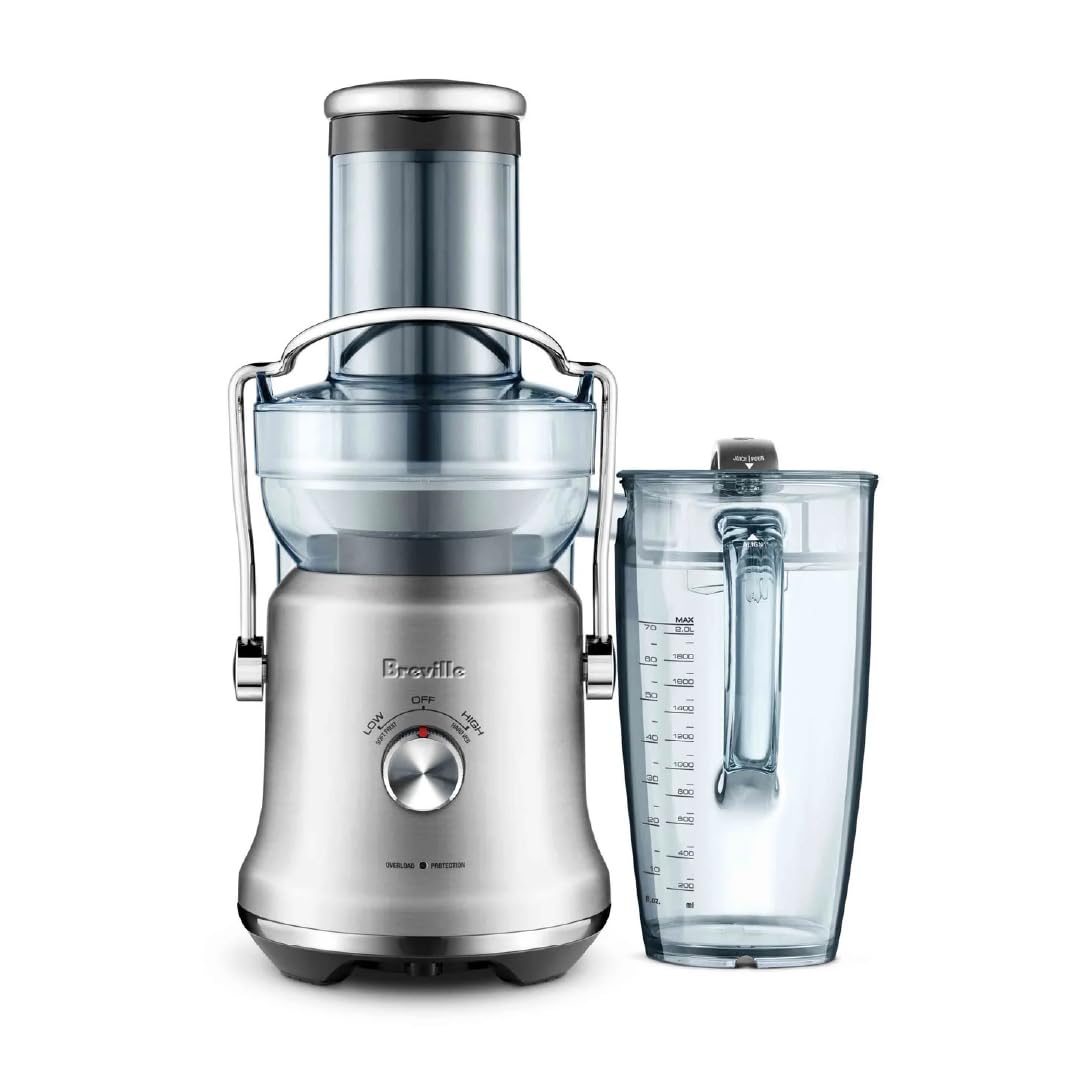
The Breville Juice Fountain Cold Plus is a heavy-duty consumer centrifugal juicer that can ably serve a light commercial operation—think a breakfast cafe or a small juice bar that doesn’t process hundreds of pounds daily. Its 3.5-inch extra-wide chute accepts whole fruits, dramatically cutting prep time. The Cold Spin Technology, combined with an Italian-made precision mesh filter, keeps heat generation low to preserve nutrients better than older centrifugal models.
The 70 fl oz Seal & Store jug is one of the largest included containers at this tier, allowing you to batch-prepare juice for up to three days of refrigerator storage. The 1000-watt motor delivers consistent performance on hard vegetables like carrots and beets. The space-saving design places the pulp bin behind the base, reducing the machine’s countertop footprint. Two speed settings allow optimization for soft berries versus hard root vegetables.
User feedback on the long-term durability is mixed—some report years of flawless service, while others note the pulp waste isn’t as dry as a masticating machine. The pitcher lid design can be difficult to remove due to its rubber seal. For a budget-conscious start-up that needs a high-volume unit without the premium price tag, the Breville offers excellent value per ounce of juice produced.
Why it’s great
- Very wide chute reduces produce prep time significantly
- Large 70 oz jug with froth separator for batch storage
- Cold Spin Technology helps preserve nutrients
Good to know
- Pulp not as dry as masticating alternatives
- Pitcher lid seal can be difficult to remove for cleaning
10. Waring Commercial Medium-Duty Juice Extractor 6001C

The Waring 6001C is a classic bar and restaurant juice extractor with a 3600 RPM induction motor designed for quick, pulp-free juice production. Its stainless steel cutting disc and precision-balanced extraction basket speed up juice flow and separate pulp efficiently. The polycarbonate motor housing is break- and scratch-resistant, making it suitable for environments where equipment gets bumped and moved frequently.
This unit is lightweight at just over 11 pounds, which can be an advantage for portability but also means it can vibrate and move on the counter during rigorous juicing of hard ingredients. It’s dishwasher safe for easy cleaning, and the flip switch operation is intuitive for any staff member. The 12.5-inch height allows it to fit under standard cabinets, saving valuable counter space.
Despite being labeled as commercial-duty, recent user reviews suggest the current production version may not handle heavy continuous use as well as older models. Several users reported the motor struggling with ginger and pineapple, and some found the machine “walks” across the counter during operation. For lighter duty bars that juice primarily soft fruits and occasional carrots, the 6001C offers a familiar, space-efficient solution.
Why it’s great
- Compact, lightweight design ideal for tight bar spaces
- Dishwasher-safe parts for quick turnaround
- Proven heritage in commercial food service
Good to know
- Motor may struggle with very hard produce like ginger
- Lightweight design allows machine to vibrate during use
11. PYY Commercial Sugar Cane Juicer Machine
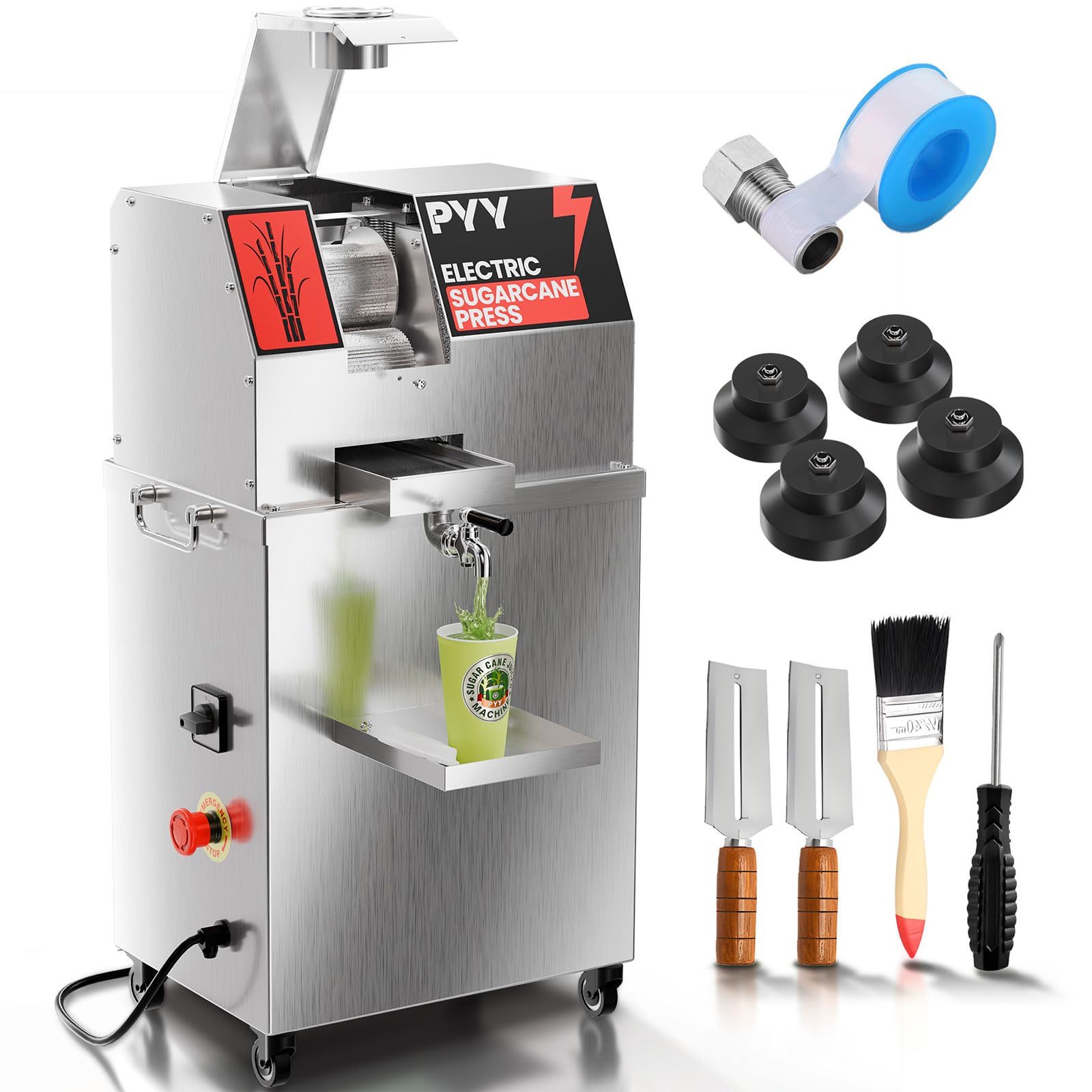
The PYY sugar cane juicer is a purpose-built machine for extracting juice from sugar cane stalks, a staple in many ethnic and specialty drink menus. Its three-roller design achieves up to 75% juice extraction rate at a maximum throughput of 300 kilograms per hour. The 800W motor provides the torque needed to crush fibrous cane without stalling, and a reverse knob clears any jams quickly.
Construction uses thickened stainless steel with food-grade 304 components, and the inclined feed inlet design helps prevent blockages. The screw-cap cleaning mechanism on the rollers simplifies what is normally a difficult cleanup task. Four flexible casters and two handles make this 115-pound machine portable enough to move between market stalls or storage areas, despite its size.
Some units have arrived with shipping damage (dents, broken buttons), so inspecting the packaging thoroughly upon delivery is advisable. The press is designed specifically for sugar cane and will not process other types of produce. For food trucks, juice bars, or farmers’ market stands that serve fresh sugar cane juice, the PYY press delivers industrial-grade output at a mid-range price point.
Why it’s great
- Very high throughput for sugar cane processing
- 3-roller design provides effective juice extraction
- Included caster wheels enable easy repositioning
Good to know
- Designed exclusively for sugar cane stalks
- Some units arrive with shipping damage
FAQ
What is the difference between a centrifugal and a masticating commercial juicer?
How often should I replace the filter basket or strainer on a commercial juice extractor?
Can I juice leafy greens in a commercial centrifugal juice extractor?
How do I clean a commercial juice extractor quickly between shifts?
What voltage do commercial juice extractors typically require in the US?
Final Thoughts: The Verdict
For most users, the best commercial juice extractor winner is the Nutrifaster N450 because it offers the most balanced combination of all-day throughput, maximum yield (very dry pulp), and all-metal build quality that stands up to years of heavy use. If you prioritize nutrient preservation and whole-fruit convenience for a premium juice bar, grab the Kuvings CS600. And for high-speed, continuous pulp ejection at a lower cost point, nothing beats the Waring Commercial WJX80.

Mo Maruf
I created WellFizz to bridge the gap between vague wellness advice and actionable solutions. My mission is simple: to decode the research and give you practical tools you can actually use.
Beyond the data, I am a passionate traveler. I believe that stepping away from the screen to explore new environments is essential for mental clarity and physical vitality.