Our readers keep the lights on and my smoothie glass nicely filled. As an Amazon Associate, I earn from qualifying purchases.
Choosing the wrong cleaning cloth turns a quick wipe-down into a frustrating battle against lint, streaks, and scratched surfaces. The difference between a satisfying clean and a smeary mess often comes down to the microfiber blend, weave density, and edge construction of the cloth you’re holding.
I’m Mohammad Maruf — the founder and writer behind WellFizz. I’ve spent hundreds of hours analyzing microfiber weights, split-filament ratios, and wash-cycle durability to separate the cloths that genuinely clean from those that just push dirt around.
After comparing absorbency rates, lint-shedding tests, and edge-stitching quality across dozens of models, I’ve narrowed the field to the five cloths that consistently outperform. This guide delivers the best cleaning cloths for every surface and budget.
How To Choose The Best Cleaning Cloths
Not all cloths labeled “microfiber” perform the same. The split-filament construction — where each fiber is split into tiny wedges that trap dirt — is what separates a true cleaning cloth from a glorified rag. Pay attention to the blend ratio, weave pattern, and edge finish before adding any pack to your cart.
Blend Ratio: Polyester vs. Polyamide
Standard microfiber uses an 80/20 or 70/30 split between polyester and polyamide (nylon). Polyester provides the scrubbing structure and mechanical cleaning action, while polyamide adds water absorbency and softness. A cloth with 12 to 20 percent polyamide typically strikes the best balance — too little polyamide makes the cloth feel scratchy, too much turns it into a lint magnet.
Weave Geometry and Density
A tight zig-zag weave works best for picking up fine dust and polishing glass without streaks. A looser, open weave is better for absorbing liquid spills and trapping larger particles like crumbs or hair. Some premium cloths use a compressed weave on one side for scrubbing and a looped weave on the reverse for buffing.
Edge Stitching and Durability
Cloths with reinforced edge stitching — either double-stitched or laser-sealed — resist fraying after repeated machine washing. Untreated raw edges will unravel within ten wash cycles, turning a once-useful cloth into a source of loose threads. Check the product care instructions: if it says “machine washable” without mention of edge reinforcement, expect a shorter lifespan.
Quick Comparison
On smaller screens, swipe sideways to see the full table.
| Model | Category | Best For | Key Spec | Amazon |
|---|---|---|---|---|
| MR.SIGA Microfiber Cloth | Premium | Streak-free windows & mirrors | 12.6 x 12.6 in / reinforced edges | Amazon |
| Bona Microfiber Multipack | Mid-Range | Room-specific cleaning (bath, kitchen, wood, glass) | 4 cloths with labeled weaves | Amazon |
| Amazon Basics Microfiber | Mid-Range | High-volume general cleaning & car detailing | 60% biconstituent fiber / 36-pack | Amazon |
| CloroxPro Handi Wipes | Budget | Commercial or heavy-duty reusable wiping | Synthetic blend / 72 count | Amazon |
| HONOVA Tear-Away Roll | Budget | Paper towel replacement for daily kitchen spills | Perforated roll / 45 pieces per roll | Amazon |
In‑Depth Reviews
1. MR.SIGA Microfiber Cleaning Cloth

The MR.SIGA cloths stand out immediately for their density and hand feel — noticeably thicker than the loose-woven budget packs. The high-quality stitching along the edges prevents fraying even after repeated machine washes, which is the single biggest failure point for cheaper microfiber towels. Owners consistently describe them as “soft to the touch” and “pleasant to handle,” a rare trait for a utility cleaning cloth.
In real-world use, these cloths excel at streak-free window and mirror cleaning. The tight microfiber weave traps fine dust particles without leaving lint behind, and the material holds enough moisture to wipe a full window without needing to re-wet. The 12.6-inch square size offers good coverage for countertops and glass surfaces, though some users wish they were slightly larger for drying tasks.
One trade-off: the cloths are better at picking up dirt and grime than at drying wet surfaces. For absorbing large spills or drying dishes, a more open weave or dedicated drying towel would perform faster. Still, for the person who wants the highest-quality feel and streak-free results on delicate surfaces, this 12-pack is the benchmark.
Why it’s great
- Thick, premium microfiber with reinforced edges
- Zero lint shedding on glass and mirrors
- Color-coded pack for separating tasks
Good to know
- Not ideal for heavy liquid absorption compared to open-weave cloths
- Moderate pack size (12) for the price tier
2. Bona Microfiber Cleaning Cloths Multipack
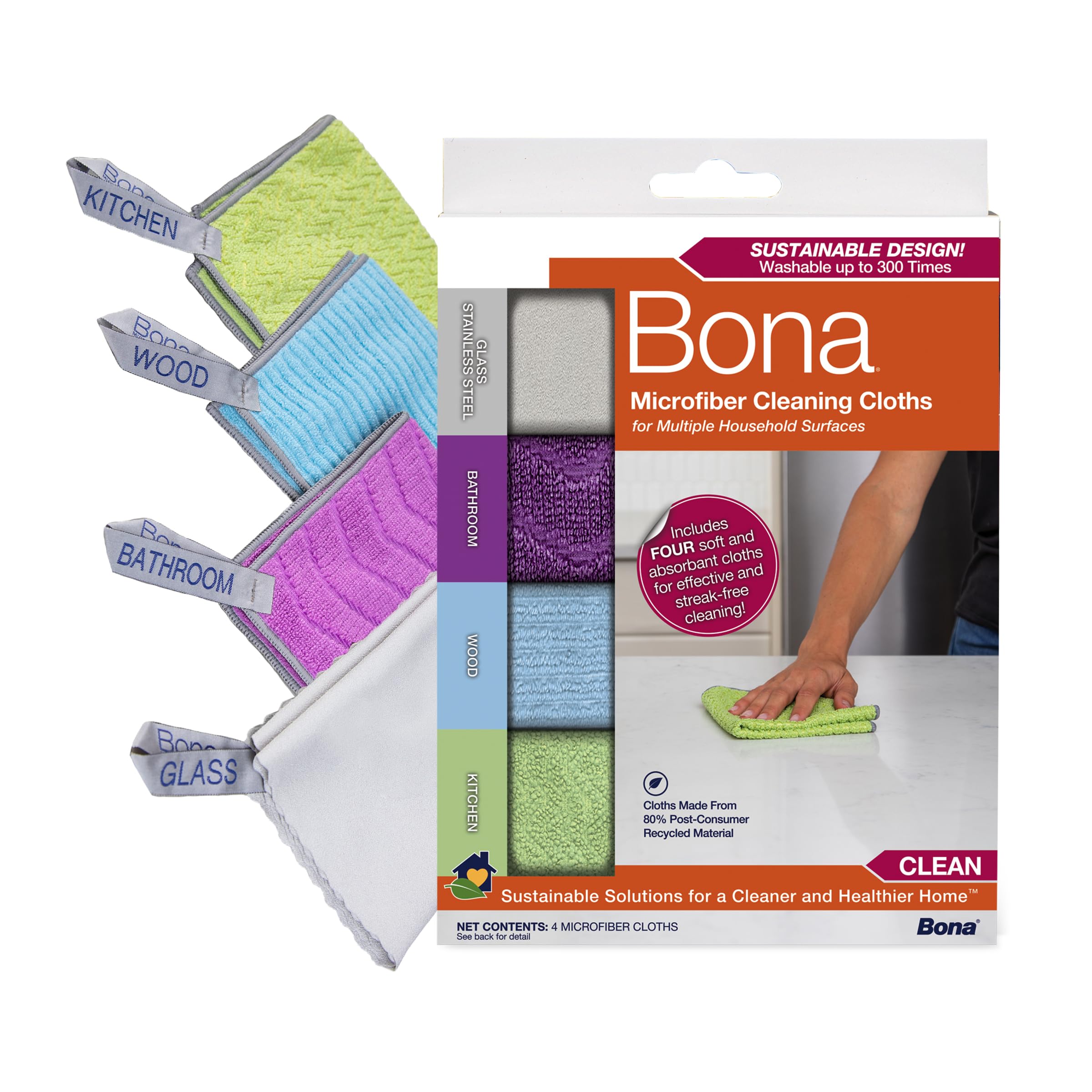
Bona’s approach is unique: instead of a stack of identical cloths, you get four specialized weaves designed for specific rooms. The bathroom cloth uses a looser zig-zag weave to trap hair and soap scum, while the kitchen cloth uses a tight zig-zag to capture crumbs and grease. The glass/stainless steel cloth features a compressed weave for fingerprint-free mirrors, and the wood cloth uses a straight weave for gentle dusting.
Each cloth has a hang loop with a printed surface callout, solving the “which cloth did I use for the bathroom?” problem. Owners report that the glass cloth performs noticeably better on mirrors and stainless steel than generic microfiber — the weave density grabs smudges rather than spreading them. The kitchen cloth also holds up well against greasy countertops without absorbing odors after washing.
The main consideration is quantity: you get four cloths total. For a single person or small apartment, that’s plenty. For a larger household running through multiple cloths per cleaning session, you’ll either need to wash frequently or buy multiple sets. Durability is strong — several users report cloths still looking like new after two years of regular use when following the recommended laundry instructions.
Why it’s great
- Room-specific weaves genuinely outperform one-size-fits-all cloths
- Labeled hang loops prevent cross-contamination between rooms
- Made from 80% post-consumer recycled material
Good to know
- Small pack size (4 cloths) limits bulk usage
- Higher per-cloth cost than multi-pack alternatives
3. Amazon Basics Microfiber Cleaning Cloths
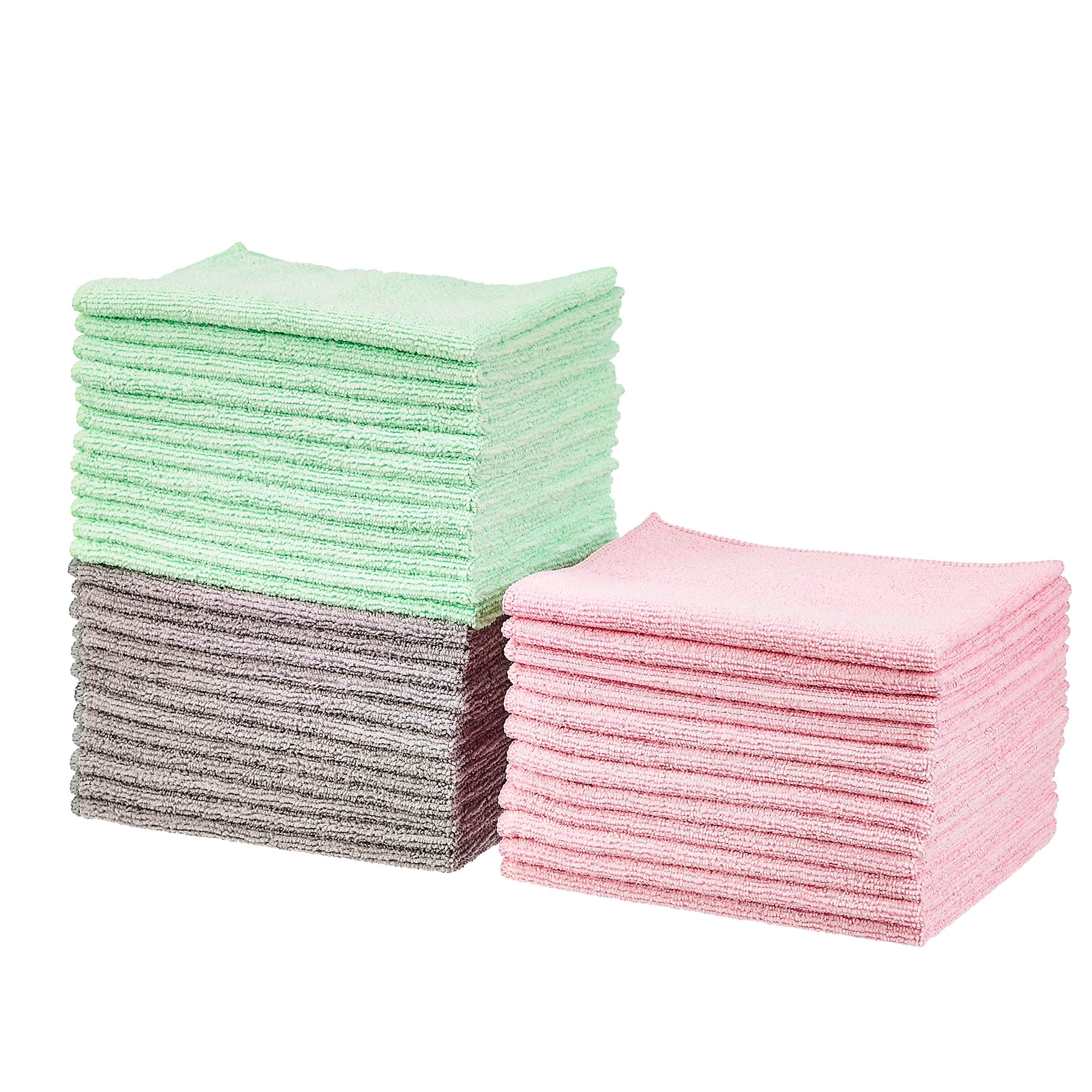
The Amazon Basics 36-pack is the volume king for a reason. With three colors (green, gray, pink) in the pack, you can assign each color to a different room or task — kitchen, bathroom, car — without having to remember which cloth is which. The 16 x 12-inch size is slightly longer than standard square cloths, giving you more surface area for wiping down large countertops or car panels.
The blend uses 60% biconstituent fiber (81% polyester / 19% polyamide split) and 40% polyester, which delivers strong absorbency — the cloths can soak up about eight times their weight in liquid. Owners confirm that they produce no lint or streaks on glass and mirrors, and hold up well through dozens of machine washes. Several users mention using them for car detailing (wax removal and glass cleaning) with no scratching on clear coat or vinyl.
The trade-off is that these cloths are not the thickest or most plush microfiber available. Compared to premium options like MR.SIGA, the Amazon Basics cloths feel thinner and less dense. They work perfectly for daily cleaning, but if you’re looking for a cloth that feels luxurious in hand, this pack prioritizes quantity over hand feel. For the price per cloth, it’s hard to beat as a bulk staple.
Why it’s great
- 36 cloths for high-volume cleaning without frequent laundry
- Three colors enable easy task separation
- Scratch-free on auto paint and delicate surfaces
Good to know
- Thinner fabric compared to premium microfiber cloths
- Wash separately before first use to activate fibers
4. HONOVA Microfiber Cleaning Cloth Roll

The HONOVA roll format targets a specific pain point: paper towel dependency. Each roll contains 45 perforated 12 x 12-inch microfiber sheets that fit on a standard paper towel holder. You tear off a sheet, use it for a spill or wipe-down, and either toss it for severe messes or toss it in the laundry for reuse. This hybrid approach bridges the gap between disposable paper towels and full-commitment reusable cloths.
The absorbency is strong — the 88% polyester / 12% nylon blend soaks up roughly eight times its weight, which is on par with mid-range microfiber cloths. Owners report using them on glass, counters, electronics, and car interiors with no scratching or lint shedding after the first wash. The perforated design means you never have to pull a whole cloth from a stack, which feels more natural for quick counter wipes.
One minor caveat: a few users noted slight lint on the first use before washing. This is typical for new microfiber and resolves after the first machine wash. Also, at 12 inches square, each sheet is smaller than a standard paper towel, so you may reach for multiple sheets for larger spills. For anyone trying to cut paper towel waste, this roll format is a practical and cost-effective starting point.
Why it’s great
- Perforated roll fits standard paper towel holders
- Reusable and washable, reducing paper towel waste
- Streak-free on mirrors and stainless steel
Good to know
- Sheets (12 x 12 in) are smaller than full-size cloths
- May release light lint on the very first use
5. CloroxPro Clorox Handi Wipes Multi Use Reusable Cloths

CloroxPro Handi Wipes take a different material approach: instead of traditional microfiber, they use a synthetic blend that feels more like a reinforced non-woven cloth. The key advantage is durability — each wipe can be rinsed and reused up to 20 times, and the 72-count pack is rated to replace 26 rolls of standard paper towels. For high-traffic environments like restaurants, offices, or busy family kitchens, this translates to significant waste reduction.
The texture is slightly more abrasive than standard microfiber, making it effective for scrubbing dried-on food, grease, and grime. Owners report strong absorbency for spills and the ability to rinse out the cloth under running water without it falling apart. The cloths work well with or without cleaning sprays, and they dry quickly without developing odors between uses.
The trade-off is that these cloths are not the softest choice for delicate surfaces like polished glass or fine wood. Users doing streak-free window cleaning or gentle dusting should stick with dedicated microfiber. But for someone who wants a tough, reusable cloth that can handle kitchen grease, bathroom scum, and shop spills without being babied, the CloroxPro pack delivers outstanding value and longevity.
Why it’s great
- Extremely durable — one pack replaces 26 rolls of paper towels
- Rinses clean and can be reused up to 20 times per cloth
- Textured surface lifts grime without scratching most surfaces
Good to know
- Not ideal for streak-free glass or mirror polishing
- Synthetic blend feels less plush than standard microfiber
FAQ
Can I wash microfiber cloths with regular laundry detergent?
How many times can I reuse a microfiber cleaning cloth?
What’s the difference between a general-purpose cloth and a glass polishing cloth?
Final Thoughts: The Verdict
For most users, the best cleaning cloths winner is the Amazon Basics Microfiber 36-Pack because it delivers consistent, lint-free performance across kitchen, bathroom, and auto tasks at a per-cloth cost that makes bulk cleaning practical. If you want a premium feel and streak-free window results, grab the MR.SIGA 12-Pack. And for heavy-duty reusable wiping in a commercial or busy home setting, nothing beats the CloroxPro Handi Wipes 72-Count.

Mo Maruf
I created WellFizz to bridge the gap between vague wellness advice and actionable solutions. My mission is simple: to decode the research and give you practical tools you can actually use.
Beyond the data, I am a passionate traveler. I believe that stepping away from the screen to explore new environments is essential for mental clarity and physical vitality.