Our readers keep the lights on and my smoothie glass nicely filled. As an Amazon Associate, I earn from qualifying purchases.
Getting a crisp, professional-grade edge on a commercial property or large residential lot is a different game than trimming a small suburban lawn. The tools that deliver that straight, deep cut through compacted soil and thick sod demand real engine power and a rigid frame — not a lightweight trimmer tilted at an angle. Whether you maintain a fleet of rental houses, manage a municipal property, or run a full-time landscaping business, the difference between a tool that finishes a curb line in one smooth pass and one that bogs down on the first root is a matter of hours saved every week.
I’m Mohammad Maruf — the founder and writer behind WellFizz. For this guide, I spent weeks combing through engine displacements, blade diameters, deck construction materials, and real-world owner reports to isolate the specific commercial edger models that can handle daily abuse without quitting.
A proper commercial edger is defined by its ability to maintain consistent cut depth under load, survive repeated starts and stops throughout a workday, and keep the operator moving at a pace that justifies the investment.
How To Choose The Best Commercial Edger
The commercial edger market splits cleanly into handheld and walk-behind categories, and picking the wrong format for your property will cost you time every single day. Handheld units offer portability and a lower price, but they demand upper-body strength and a steady hand to hold the cut line straight. Walk-behind models, with their large wheels and pivoting blades, deliver professional-grade straight lines with far less fatigue — but they are heavier, more expensive, and harder to transport. The right decision hinges on how many linear feet of edging you need to cover and how much your crew can carry.
Engine Power and Displacement
Commercial-grade edging tools need enough torque to maintain a constant blade speed when the steel hits a root or a patch of compacted clay. In handheld units, look for a displacement of at least 25cc — anything smaller will bog down when you try to run the blade at the full depth. Walk-behind models typically start at 79cc and can climb past 160cc for the heavy-duty string trimmers that double as brush cutters. The higher the displacement, the less likely the engine will stall when you push into undisturbed soil. A 79cc 4-cycle engine in a walk-behind frame, like the EarthQuake 41273, provides the low-end torque that 2-cycle equivalents struggle to match without mixing fuel.
Blade Design and Cutting Depth
The blade geometry dictates how cleanly the tool severs grass roots and slices through dirt. Tri-tip blades, made from high-strength steel, produce a more defined edge and last longer than standard bar-style blades. The ability to adjust cutting depth is equally critical — a premium model should offer at least five depth settings, with a maximum cut depth of 2.5 inches. A pivot that allows the blade to tilt up to 20 degrees in either direction lets you create beveled edges around flower beds and curved walkways, adding versatility beyond straight sidewalk lines.
Wheel Configuration and Stability
A four-wheel design provides dramatically more stability than a three-wheel setup, especially when you are pushing the blade through thick roots at full depth. Handheld edgers that rely on a single guide wheel require constant downward pressure from the operator to keep the blade engaged. Walk-behind models with large diameter rubber wheels (14 inches or bigger) roll over uneven ground without digging into the turf, and they distribute the weight of the engine and steel deck across a broader footprint. If you are edging along concrete curbs every day, the curb wheel featured on some electric models (like the Greenworks 80V) can save you from scraping the metal blade against the hard surface repeatedly.
Quick Comparison
On smaller screens, swipe sideways to see the full table.
| Model | Category | Best For | Key Spec | Amazon |
|---|---|---|---|---|
| EarthQuake 41273 Walk-Behind Edger | Walk-Behind | Deep trenching & professional curb lines | 79cc 4-cycle Viper engine, 2.5″ depth, tri-tip blade | Amazon |
| SENIX STMG-L Walk-Behind Trimmer | Walk-Behind | Large lot brush clearing & edging | 160cc 4-cycle engine, 22″ swath, 14″ wheels | Amazon |
| EarthQuake 40314 Walk-Behind Mower | Walk-Behind | Overgrown slopes & heavy weeds | 160cc Viper engine, airless wheels, 22″ cut | Amazon |
| ECHO SRM-3020T String Trimmer | Handheld | Professional handheld edging & trimming | 30.5cc 2-stroke, 1.8 HP, high-torque gear ratio | Amazon |
| ECHO PE-225 Curved Shaft Edger | Handheld | Residential commercial edging, precise curves | 21.2cc 2-stroke, i-30 starter, 5,000 RPM | Amazon |
| Greenworks 80V Brushless Edger | Battery Handheld | Noise-sensitive areas & flat properties | 80V brushless, 8″ steel blade, 2.25″ depth | Amazon |
| Husqvarna 122LKE Multi-Purpose Edger | Handheld | Multi-tool versatility, light commercial use | 26cc 2-stroke, 2.5″ depth, 6″ adjustable wheel | Amazon |
| Wild Badger Power 26cc 4-in-1 | Handheld Multi | Budget multi-tool for mixed tasks | 26cc 2-cycle, 4 attachments, 17″ cutting width | Amazon |
| SENIX STMG-L-001A-002 Walk-Behind | Walk-Behind | Farm & large property brush maintenance | 160cc engine, 22″ swath, 5 height settings | Amazon |
In‑Depth Reviews
1. EarthQuake 41273 79cc Walk-Behind Edger
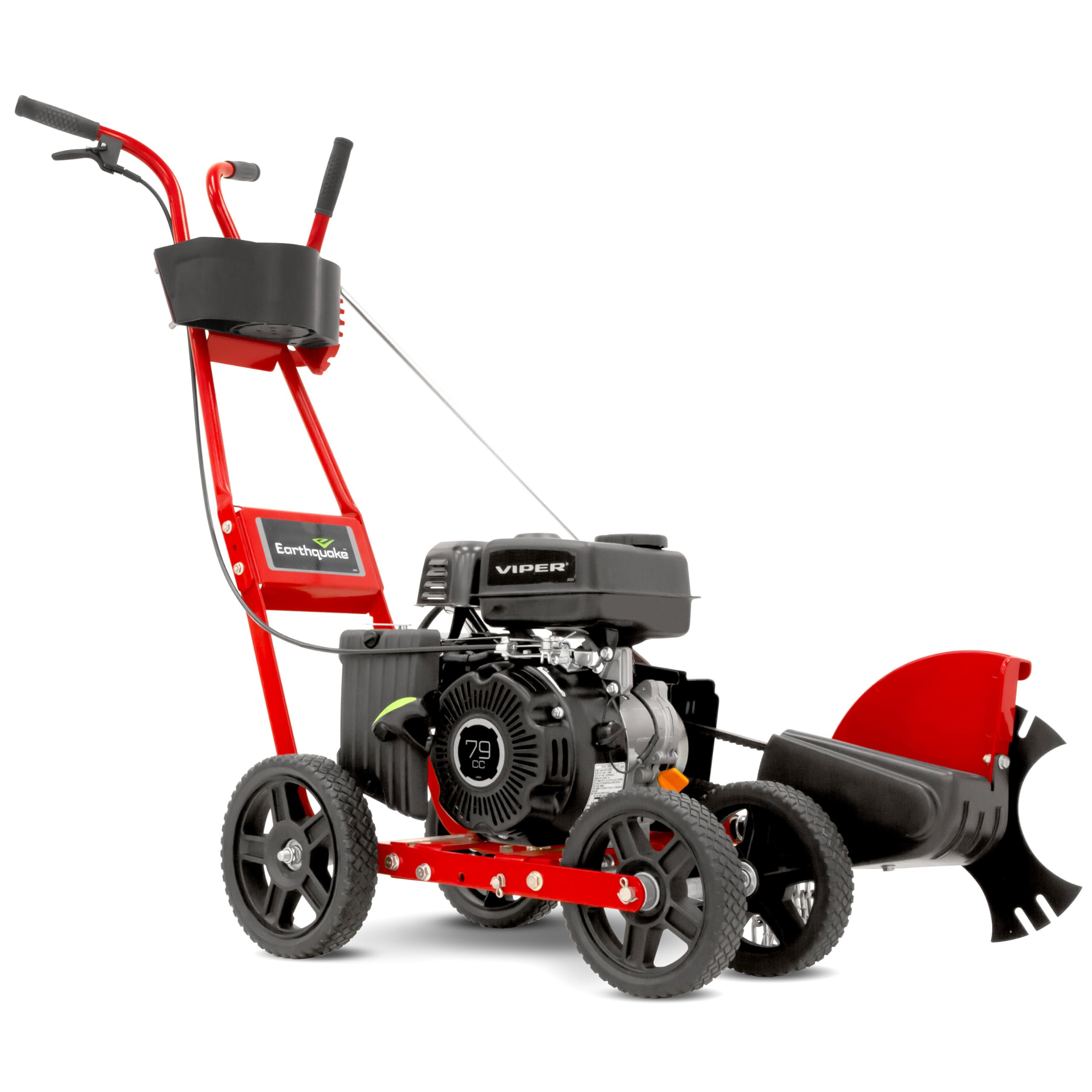
Its 79cc 4-cycle Viper engine eliminates the 2-cycle fuel mixing step while delivering enough low-end torque to push a tri-tip blade through roots and compacted clay at the full 2.5-inch depth. The engine starts reliably on the first or second pull based on owner feedback, and the automatic compression release reduces the effort required during a busy morning.
The four-wheel chassis provides the stability that three-wheel designs lack, especially when you pivot the blade up to 20 degrees for beveled edges around flower beds. Ten depth settings give you the precise control needed to avoid scalping the turf on a shallow pass while still having the range to cut a deep trench for electric fence or cable runs. The built-in cup and tool holder is a small touch that keeps shears or a trowel accessible during the day.
Assembly takes about an hour according to most reports, and the hardware is robust enough that nothing loosens during the first season. Some users noted that the painted rod required a mallet to fit during assembly, but once put together, the unit stays tight. The 5-year limited warranty suggests the manufacturer expects this frame to hold up under repeated commercial use.
Why it’s great
- Plenty of torque from the 79cc 4-cycle engine to cut through roots without stalling.
- Ten depth settings and a pivoting blade for straight or beveled cuts.
- Four-wheel stability eliminates wobble on hard ground.
- 5-year warranty from a U.S.-based support team.
Good to know
- Assembly requires about an hour and some users report tight fitment on certain parts.
- At 57 pounds, it is heavy to lift into a truck bed without a ramp.
- The included instructions lack a full-size parts diagram, making identification slow.
2. SENIX STMG-L 22-Inch Walk-Behind Brush Cutter

The SENIX STMG-L is a walk-behind string trimmer that doubles as an edging tool for properties where brush and tall weeds are the main obstacle. Its 160cc 4-cycle engine provides the grunt to spin a 0.155-inch trimmer line through a 22-inch swath, and the steel deck with five height adjustments allows you to drop the cutting head low enough to create a clean edge along a driveway or sidewalk. The 14-inch rubber wheels roll over rough terrain without digging in, which matters when you are working a field transition or a ditch line.
Owners consistently praise the machine for cutting heavy briars and brush that would bog down a standard handheld trimmer. The fold-down handle makes storage in a pickup bed or garage corner simple, and the included oil and trimmer line means you can start edging right after assembly. Several reports note that the primer bubble can be finicky, but the engine starts on the first pull after the initial oil priming is done correctly.
Noise levels are noticeably lower than a 2-cycle equivalent, which reduces crew fatigue on multi-hour jobs. The machine weighs 48.5 pounds, so it is lighter than the EarthQuake walk-behind models while still offering significant cutting power. The 3-year limited warranty covers the main components, though the engine retains a separate coverage term.
Why it’s great
- 160cc 4-cycle engine provides reliable power without mixing fuel.
- 22-inch cutting swath covers large areas quickly.
- Large rubber wheels and steel deck handle uneven ground well.
- Fold-down handle for easy storage and transport.
Good to know
- Some units arrive with a primer bubble that does not move fuel properly.
- The string head does not auto-feed; you must replace line manually when it runs out.
- Reports of a squealing belt on a small number of units out of the box.
3. EarthQuake 40314 Walk-Behind String Mower

The EarthQuake 40314 is built for the most punishing terrain you will encounter on commercial properties — steep slopes, overgrown ditches, and fields with woody weeds up to an inch thick. The 160cc Viper 4-cycle engine uses an automatic compression release that makes starting predictable even after the machine has been sitting for weeks. The 2.5-inch by 14.5-inch airless wheels eliminate the risk of a flat in the middle of a job, and the one-piece steel deck extends far enough to reach under low-hanging branches and fence lines.
The engagement bail design is a standout feature for commercial efficiency — you can release the bail to stop the cutting head while you clear a path, then re-engage without restarting the engine. Owners report that the machine cuts through three-foot weeds and half-inch saplings with the same smooth motion, and the adjustable handlebar accommodates operators of different heights without requiring tools. The 22-inch cutting diameter means fewer passes along a long curb line.
Assembly is straightforward, though the air filter location requires removing a wheel for access during maintenance. Some plastic debris deflector pieces have snapped off on units that see heavy abuse, but the steel frame itself holds up well. The 5-year limited warranty is one of the strongest in this category, reflecting the durability of the drivetrain and chassis.
Why it’s great
- Airless wheels eliminate flat tires on rough terrain.
- 160cc Viper engine starts easily with automatic compression release.
- Engagement bail stops the head without killing the engine.
- Cuts weeds up to an inch thick without bogging down.
Good to know
- Air filter access requires removing a wheel for maintenance.
- Handle bolts tend to loosen during use and need periodic tightening.
- No auto-feed string head; you must stop to replace the line.
4. ECHO SRM-3020T Professional String Trimmer
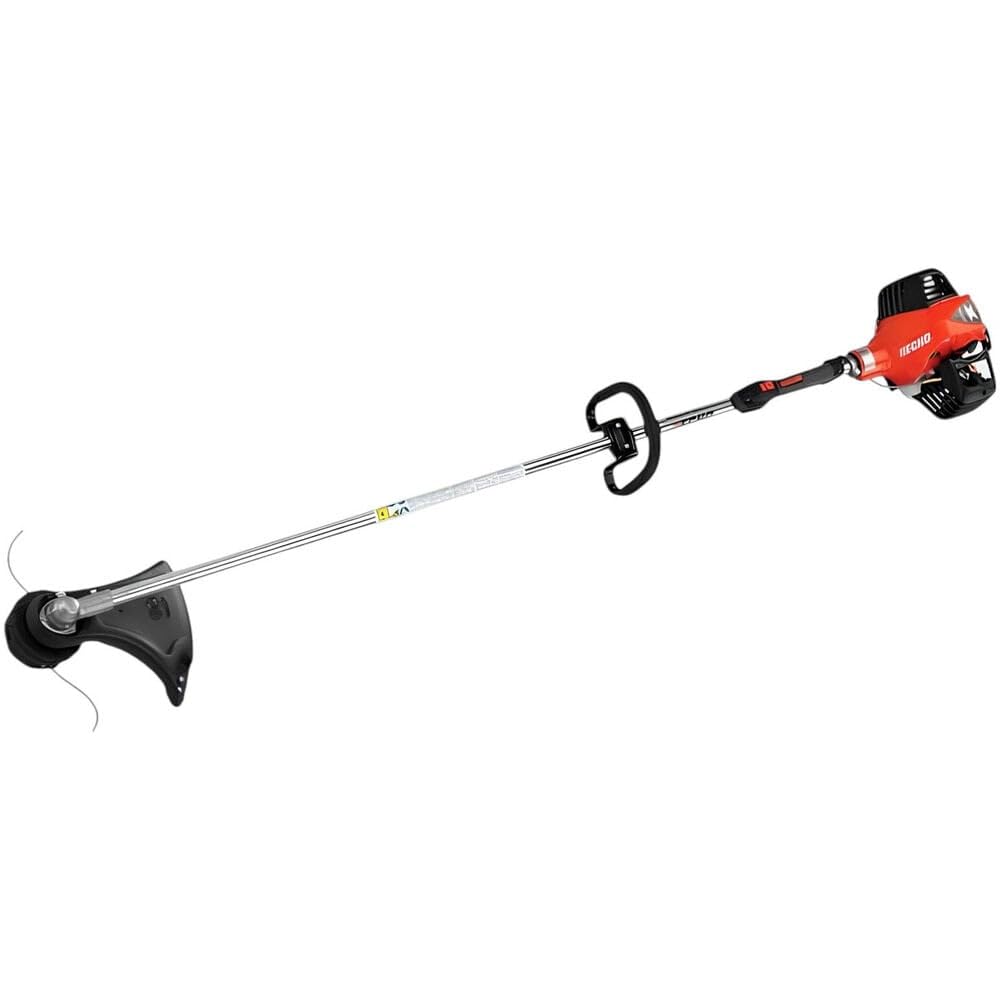
The ECHO SRM-3020T is the handheld powerhouse that professional landscapers reach for when they need to edge along miles of curb and still have power left for heavy trimming. The 30.5cc 2-stroke engine delivers 1.8 horsepower through a 2:1 high-torque gear ratio that keeps the line spinning at full speed even when you are cutting into dense brush or half-inch woody saplings. The tool-less air filtration system allows you to clean the filter in the field without carrying a screwdriver, which reduces downtime on long shifts.
Commercial users report that this unit can load 0.155-inch trimmer line without modification and that the rubber grips on both the front and rear handles reduce vibration during extended edging sessions. The two-stage air filtration system is a genuine commercial feature — it dramatically extends the intervals between filter cleaning, which matters when you are working in dusty conditions around construction sites or dry fields. The SRM-3020T is sold as a straight shaft trimmer, but the high torque makes it effective with an edger attachment as well.
Some owners experienced starting issues after years of heavy use, which is common with pro-level 2-stroke engines that accumulate carbon deposits. Regular maintenance — including spark plug replacement and carburetor adjustment — keeps this unit running strong. The 5-year consumer and 2-year commercial warranty reflects the expected duty cycle, but the initial investment positions it as a tool for crews, not occasional homeowners.
Why it’s great
- 30.5cc engine with a 2:1 high-torque gear ratio for heavy brush and roots.
- Tool-less air filter access for fast field servicing.
- Two-stage filtration extends maintenance intervals in dusty conditions.
- Rubber grips reduce vibration during multi-hour edging sessions.
Good to know
- Premium price may be overkill for residential-only use.
- Some units develop starting issues after years of heavy use if not maintained.
- Commercial warranty is only 2 years, requiring careful upkeep.
5. ECHO PE-225 Curved Shaft Edger

The ECHO PE-225 is a dedicated curved-shaft edger designed specifically for the task — not a trimmer with an edging attachment bolted on. The 21.2cc professional-grade 2-stroke engine is sized for operators who want a lightweight unit that can still handle daily commercial edging without the bulk of a walk-behind machine. The i-30 starter reduces pull effort by 30 percent, which adds up significantly when you are starting and stopping the engine dozens of times per shift.
The captive wheel mount hardware makes height adjustments simple and secure, so you can switch between shallow touch-up passes and deeper cuts without tools. The curved shaft shifts the center of gravity closer to the operator, reducing the strain on your arms during long curb runs. Owners consistently note that the unit requires no assembly out of the box — a real time-saver when you need to get a new machine into rotation immediately.
This model is best suited for residential commercial work rather than heavy trenching. The 21.2cc displacement will not outmuscle a 79cc walk-behind on thick roots, but for maintaining crisp edges on established lawns, it is fast and maneuverable. The 2-year commercial and 5-year consumer warranty is a strong safety net, and the replacement parts network for ECHO is among the best in the industry.
Why it’s great
- Dedicated edger design with a curved shaft for reduced arm fatigue.
- i-30 starter reduces pull effort by 30 percent.
- Captive wheel mount for tool-free height adjustments.
- No assembly required — ready to run out of the box.
Good to know
- Not powerful enough for deep roots or hard-packed clay soil.
- Classified as a residential-use tool, not suitable for heavy commercial trenching.
- More expensive than equivalent trimmer-plus-attachment combos.
6. Greenworks 80V Brushless Edger

The Greenworks 80V Brushless Edger brings the convenience of battery power to commercial-grade edging without sacrificing the cut quality that professionals expect. The 8-inch military-grade steel blade cuts 34 percent wider than standard 6-inch edgers, and the tool-free depth adjustment allows you to drop the blade to a full 2.25 inches for deep, clean edges. The brushless motor delivers torque equivalent to a 27cc gas engine, which means it can handle compacted soil and concrete curbs with the same precision as a gas unit, but at 68 percent lower noise.
The curb wheel is a practical feature that keeps the metal blade off the concrete, extending the blade life and preventing sparks. Owners report that the edger produces ruler-straight lines that are 0.25 inches wide and 2.5 inches deep, and that it can edge an entire front yard in under 10 minutes. The tri-grip balance system keeps the weight manageable at 13.8 pounds with a 2Ah battery installed, making this the lightest true commercial-grade edger in the roundup.
The main limitation is battery compatibility. The tool uses the Greenworks 80V platform, and batteries are sold separately. Kobalt 80V batteries are incompatible due to different rail geometry, although some users have modified the tool compartment to make them fit. If you already own Greenworks 80V equipment, this edger extends your platform economically. If not, the battery investment adds to the upfront cost. The 4-year warranty on the motor and gearbox is reassuring.
Why it’s great
- 8-inch steel blade cuts wider and deeper than standard 6-inch models.
- Brushless motor provides gas-equivalent torque with less noise and vibration.
- Tool-free depth adjustment with 5 positions for precise cutting.
- Curb wheel protects the blade from concrete contact.
Good to know
- Batteries and charger are not included, adding to the initial cost.
- Not compatible with Kobalt 80V batteries without modification.
- The metal blade wears faster when cutting against concrete curbs.
7. Husqvarna 122LKE Multi-Purpose Edger
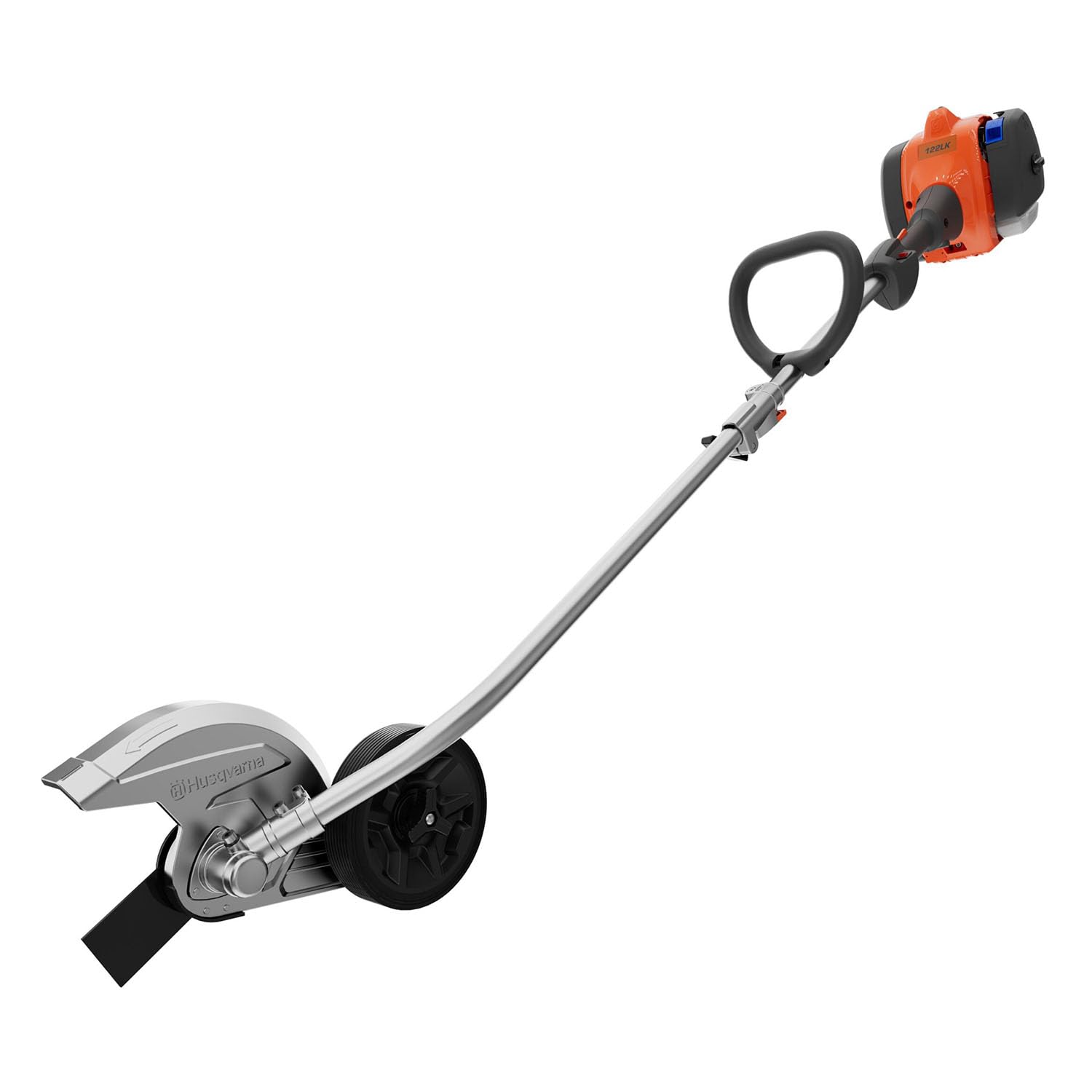
The Husqvarna 122LKE is a multi-purpose tool that ships with a dedicated edging attachment, making it a practical choice for landscapers who want one power head to handle edging, trimming, and pole saw tasks. The 122LKE features Smart Start technology that reduces the pull force required to start the 2-stroke engine, along with an air purge that clears the carburetor and fuel system for quicker starts. The 6-inch adjustable wheel provides smooth tracking along the curb edge.
The curved shaft design enhances balance when the edger attachment is installed, reducing the fatigue that comes from holding the tool at an awkward angle for long stretches. Owners who received a properly functioning unit report that it starts easily and cuts clean lines at the advertised 2.5-inch depth. The detachable shaft means that switching to hedge trimmer or pole saw attachments (sold separately) is a fast, click-on process — a real benefit for crews that prefer to carry one power head instead of three separate machines.
There is a notable quality-control concern: several buyers received units with faulty carburetors that never started, and Amazon classified these as non-returnable items, forcing owners to seek warranty service through Husqvarna dealers. This makes the purchase risky if you do not have a local Husqvarna service center. The units that run correctly are strong performers, but the inconsistency in initial quality means this model requires careful vetting before purchase.
Why it’s great
- Dedicated edging attachment with a 6-inch adjustable wheel for stable tracking.
- Smart Start and air purge reduce starting effort.
- Multi-purpose design with detachable shaft for hedge trimmer and pole saw attachments.
- Curved shaft balances the tool well for edging tasks.
Good to know
- Some units arrive with faulty carburetors and are non-returnable on Amazon.
- Not powerful enough to cut into hard-packed soil on the first pass.
- Throws small rocks and pebbles at the operator’s legs if run at high speed.
8. Wild Badger Power 26cc 4-in-1 Trimmer
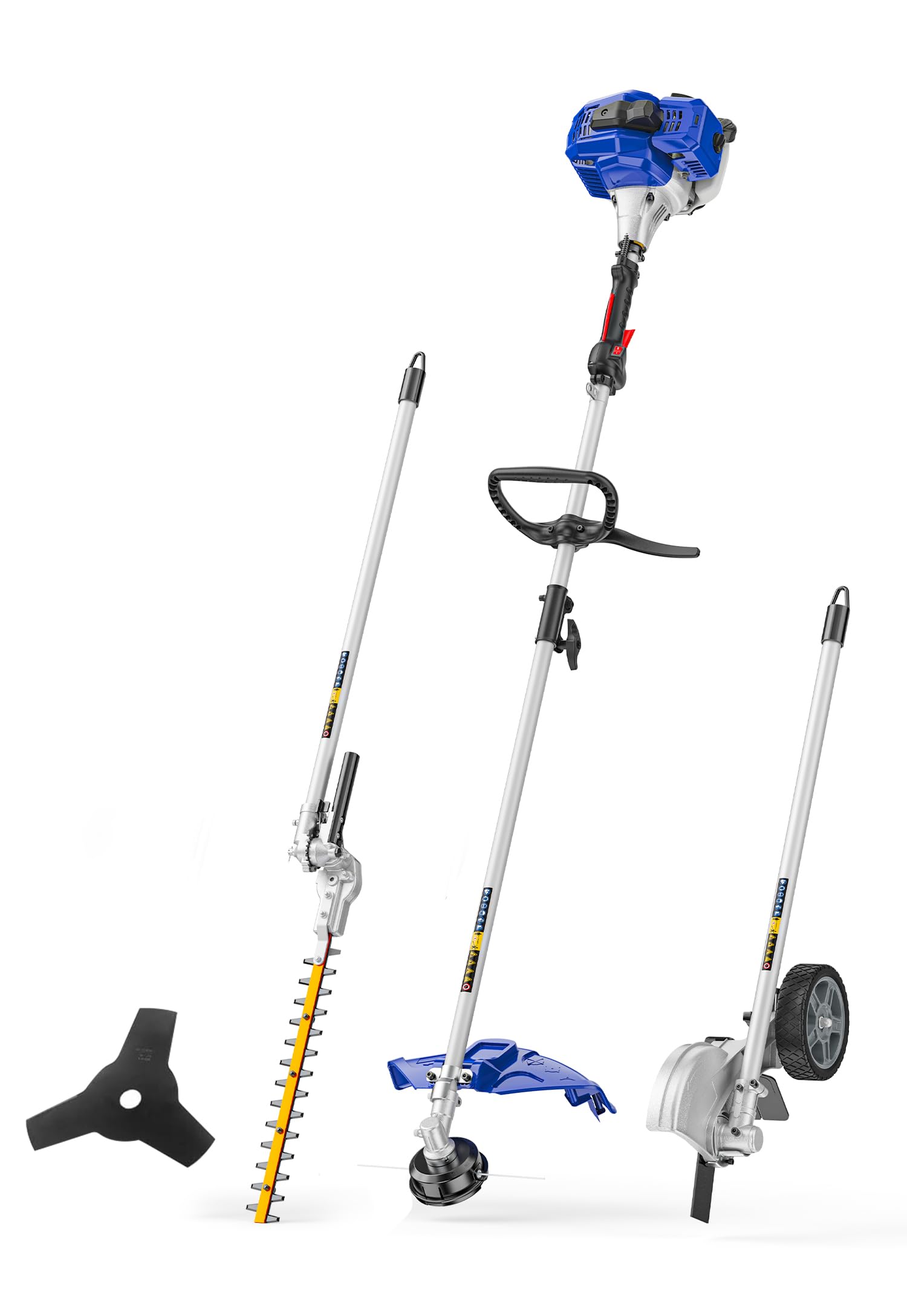
The Wild Badger Power 26cc 4-in-1 is the most affordable way to get an edging-capable machine into your commercial rotation, but the compromises are real. The 26cc 2-cycle engine provides enough power to run the 9-inch wheeled edger attachment through normal turf, but multiple owner reports indicate that the blade stops rotating when it hits significant resistance in hard soil or thick roots. The engine itself is powerful enough to trim heavy brush with the string head, but the edging attachment reveals the limits of the power head’s torque.
The kit includes a 17-inch string trimmer, a 9-inch wheeled edger, a 16-inch hedge trimmer, and a 10-inch brush cutter blade, which makes it a versatile starter package for a small crew. The attachments lock into place with a simple mechanism, and the aluminum support reduces vibration through the transmission. The 3-year homeowner and commercial warranty is generous for the price tier, though the commercial coverage may be tested by daily use.
The pull start mechanism is reported to be awkward and the handle feels heavy during extended use. Some owners found that the hedge trimmer head cannot rotate, requiring the user to tilt the entire machine, which causes fuel to drip from the carburetor. For light commercial edging on well-maintained lawns, the Wild Badger works. For anything approaching real commercial trenching, the torque deficit is noticeable.
Why it’s great
- Four tools (trimmer, edger, hedge trimmer, brush cutter) in one kit.
- Aluminum support reduces vibration in the transmission.
- Attachments lock in and out quickly for fast task switching.
- Competitive price point with a 3-year warranty.
Good to know
- The edger blade stops on resistance in hard soil or thick roots.
- Pull start mechanism feels awkward and the handle is heavy.
- Hedge trimmer head does not rotate; tilting the machine causes fuel leaks.
9. SENIX STMG-L-001A-002 Walk-Behind Trimmer
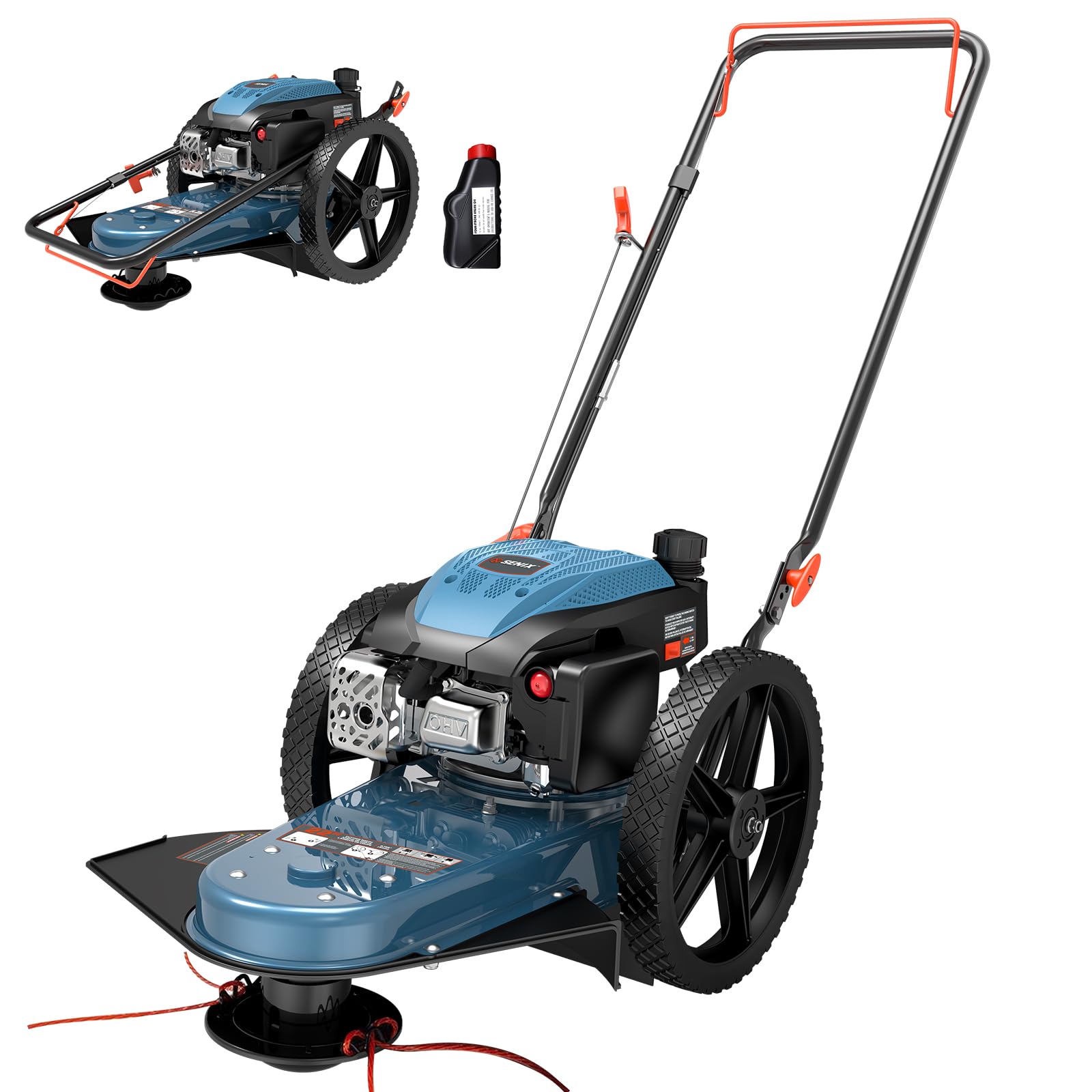
The SENIX STMG-L-001A-002 is the walk-behind trimmer that fills the gap between a dedicated edger and a brush mower for large properties. Its 160cc 4-cycle engine delivers the same platform as the STMG-L but is packaged specifically for operators who need a trimmer that can also cut a clean edge along fence lines and buildings. The 22-inch cutting swath with a 0.155-inch trimmer line makes quick work of overgrown grass and weeds, and the five height settings let you drop the cutting head low enough to edge against concrete or asphalt.
The 14-inch rubber wheels provide good floatation over uneven terrain, and the fold-down handle makes storage compact enough for a truck bed or shed corner. Many owners reported that the unit arrived pre-assembled, requiring only unfolding the handle and adding oil and gas before starting. The engine starts on the first pull according to most reports, and the lightweight feel (48.5 pounds) makes it easy to maneuver around obstacles compared to heavier steel-deck machines.
The primary weakness is the primer pump, which some users found inoperative, requiring the engine to be started without priming. The belt-driven system has also drawn complaints of insufficient power from a small number of owners, and the non-returnable policy on Amazon means that a defective unit requires a warranty claim rather than a simple refund. For operators who want a lightweight walk-behind for mixed edging and trimming on large residential or farm properties, this SENIX delivers solid value, but the belt and primer issues warrant caution.
Why it’s great
- Lightweight walk-behind design at 48.5 pounds for easy maneuverability.
- 160cc 4-cycle engine starts on the first pull for most users.
- 22-inch cutting swath covers large areas efficiently.
- Cuts half an acre on a single tank of gas.
Good to know
- Some units have a faulty primer pump that does not move fuel.
- Belt-driven system lacks power for thick, woody brush.
- Non-returnable on Amazon; defective units require a warranty claim.
FAQ
Should I get a handheld edger or a walk-behind model for commercial use?
Why do some commercial edgers require fuel mixing and others do not?
What trimmer line diameter should I use for commercial edging?
How often should I replace the blade on a commercial edger?
Can I use a battery-powered edger for commercial work?
Final Thoughts: The Verdict
For most commercial operators, the commercial edger winner is the EarthQuake 41273 Walk-Behind Edger because the 79cc 4-cycle engine, tri-tip blade, and 10-depth pivoting system deliver the perfect balance of torque, stability, and edge quality for daily professional use. If you need a quiet, low-maintenance solution for noise-sensitive neighborhoods, grab the Greenworks 80V Brushless Edger — its 8-inch steel blade and tool-free depth control produce gas-quality edges at a fraction of the noise. And for a lightweight walk-behind that handles both edging and heavy brush clearing on large properties, the SENIX STMG-L delivers the most cutting width per dollar with its 22-inch swath and 160cc engine.

Mo Maruf
I created WellFizz to bridge the gap between vague wellness advice and actionable solutions. My mission is simple: to decode the research and give you practical tools you can actually use.
Beyond the data, I am a passionate traveler. I believe that stepping away from the screen to explore new environments is essential for mental clarity and physical vitality.